Three knocks.
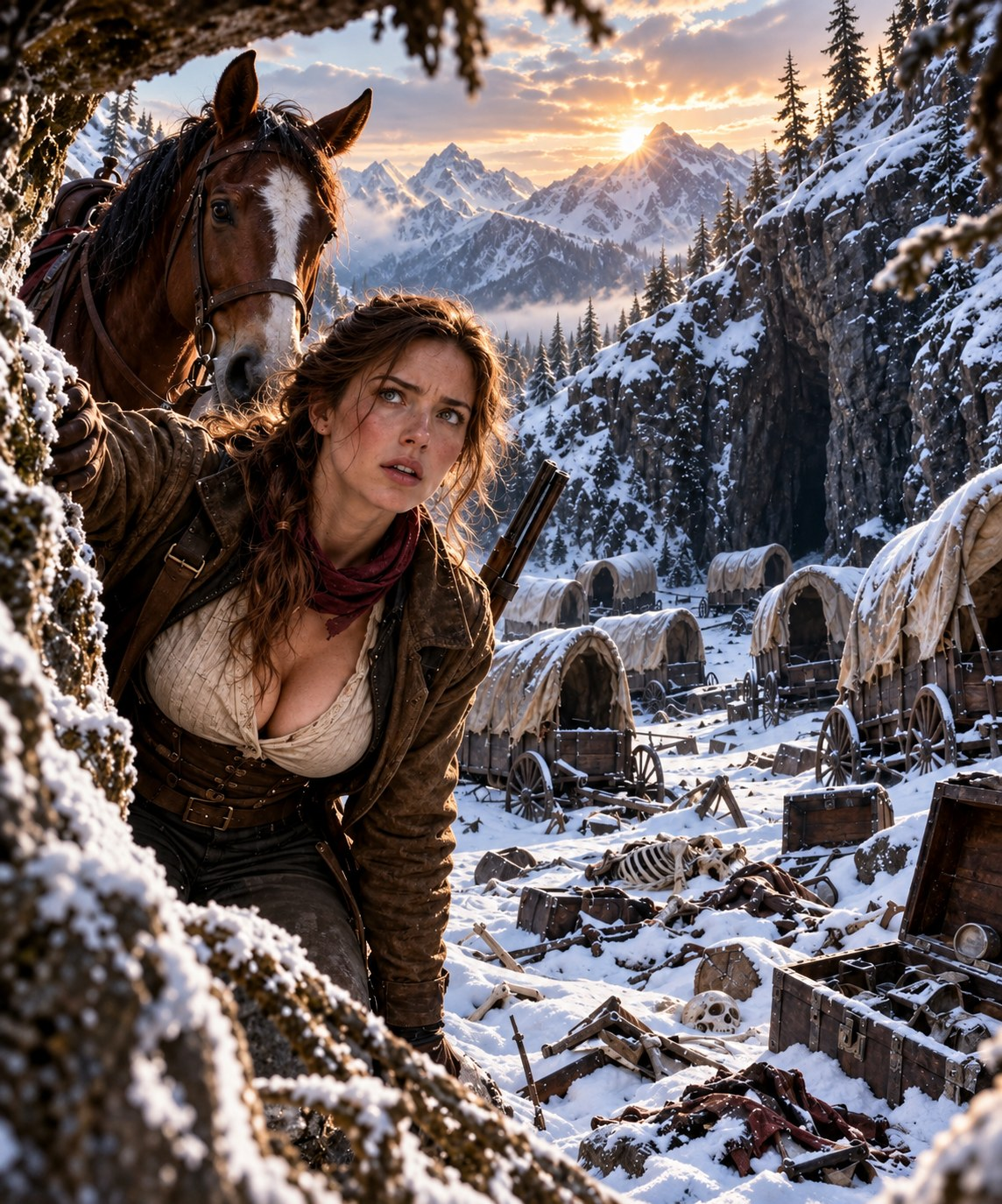
I stood frozen beside the nearest wagon, my father's name still visible beneath my fingertips.
The sound had come from somewhere beyond the last covered wagon.
Three deliberate knocks.
Not the random cracking of frozen wood.
Not the movement of branches in the wind.
Someone had struck something.
I turned toward Juniper.
The mare stood several yards behind me, her ears pointed toward the far end of the clearing. Her nostrils widened as she released a nervous breath into the cold air.
I reached for the Winchester.
My fingers were stiff inside my gloves.
"Easy, girl," I whispered.
Juniper shifted her weight but didn't move.
I looked toward the trees.
Nothing.
The six wagons stood exactly where I had first seen them. Their canvas coverings were torn, their wheels half buried beneath decades of snow and debris.
I counted them again.
One.
Two.
Three.
Four.
Five.
Six.
There was no seventh wagon.
There was no visible person.
Yet the knocking had been real.
I had heard it clearly.
I slowly moved away from the wagon bearing my father's name.
My eyes remained fixed on the final wagon, the one closest to the dark line of pine trees.
Its canvas covering was almost completely gone.
One side had collapsed inward, exposing the wooden frame.
The wagon appeared older than the others.
Its front axle was broken, and one wheel rested at an unnatural angle beneath the body.
I raised the rifle slightly.
"Hello?"
My voice sounded strangely small against the mountains.
Nothing answered.
I waited.
Then I heard it again.
Knock.
Knock.
Knock.
This time, the sound came from inside the wagon.
My heart began beating harder.
I looked toward Juniper.
The mare had taken two steps backward.
That frightened me more than the knocking.
Juniper was not easily startled. My father had trusted her in thunderstorms, rock slides, and narrow mountain trails where one frightened movement could send a horse tumbling into a ravine.
If she wanted to leave, she usually had a reason.
I considered mounting her and riding back toward the lower trail.
It would have been the sensible thing to do.
But my father's name was carved into the first wagon.
He had written that the wagons were still there.
He had drawn the symbol on the granite boulder.
And he had specifically warned me not to trust the man who owned the water.
I had already traveled too far to turn around because of three knocks.
I moved toward the final wagon.
The snow reached almost to my knees in several places.
Every step made a soft crunch.
The wind had weakened, leaving the clearing strangely still.
As I approached, I noticed a section of canvas hanging from the side of the wagon.
It moved slightly.
I stopped.
Something dark was visible behind it.
I raised the rifle.
"Come out where I can see you."
No answer.
I moved closer and used the barrel to lift the loose canvas.
A small wooden compartment was attached beneath the wagon's rear platform.
It was not part of the original construction.
Someone had installed it later.
The wood was darker than the surrounding boards, and a narrow iron latch held it shut.
I lowered the rifle.
There was a small brass plate fixed to the compartment.
I brushed away the snow.
The plate contained three letters.
T.W.
My father's initials.
I felt the blood drain from my face.
For several seconds, I couldn't understand what I was seeing.
The wagon had disappeared in 1834.
My father had been born decades later.
Yet his initials were attached to a hidden compartment beneath it.
I crouched.
The iron latch was old, but not nearly as old as the wagon.
There were fresh scratches around the lock.
Someone had opened it recently.
I pulled a small folding knife from my pocket and worked the blade beneath the latch.
It resisted.
I tried again.
The metal shifted.
Then the compartment opened with a dry wooden creak.
Inside was a small oilskin packet.
I removed it carefully.
The packet was wrapped in several layers of cloth, protected from the snow and moisture.
My hands trembled as I opened it.
There was a brass key.
A narrow strip of paper.
And a photograph.
I picked up the photograph first.
It showed six covered wagons arranged in a clearing.
The image was old and faded.
But the landscape was unmistakable.
The same mountain ridge.
The same granite boulder.
The same six wagons.
I turned it over.
A date had been written on the back.
OCTOBER 17, 1879.
Beneath it was a sentence.
THEY WERE NOT EMPTY WHEN I FOUND THEM.
I stared at the handwriting.
I knew it.
I had seen those letters on grocery lists, account books, birthday cards, and the notes my father left beside the kitchen stove.
It was his handwriting.
The photograph had been taken only a few years before I was born.
I looked at the brass key.
It was heavy and unusually long, with a narrow rectangular head.
There was a number stamped into it.
SIX.
I unfolded the strip of paper.
Only one sentence appeared.
THE FIRST WAGON IS NOT THE ONE YOU NEED.
I read it twice.
Then I looked toward the first wagon.
The one bearing my father's name.
Why would he leave me a photograph of the six wagons but tell me not to investigate the first?
And why had he hidden the key beneath the sixth?
I slipped the photograph and paper into my coat.
The key went into my pocket.
I was about to close the compartment when something caught my attention.
A small metal object had been wedged beneath the wooden floor.
I reached inside and pulled it free.
It was a pocket watch.
The glass was cracked.
The hands had stopped at eleven minutes past four.
The back was engraved with a name.
CAROLINE WHITFIELD.
My mother's name.
I forgot about the cold.
I forgot about the rifle.
For a moment, I could barely breathe.
My mother had died when I was nine.
She had never traveled to Harrow Pass, at least not according to anything my father had told me.
She had spent most of her life in Coldwater.
She had worked as a seamstress before marrying my father, and after I was born, she rarely left the valley.
I had never seen this watch.
Not once.
I turned it over again.
There was another inscription beneath her name.
NOVEMBER 1834.
I stared at the date.
The six wagons had disappeared forty-five years before the photograph was taken.
My mother had been born decades after that.
The watch should not have existed.
I opened its back.
Inside, beneath the mechanism, was a tiny folded piece of paper.
It was so small that I almost missed it.
I removed it with the tip of my knife.
The paper contained four words.
ASK THOMAS ABOUT THE CHILD.
My knees nearly gave way.
What child?
I read the message again.
Then I looked toward the wagons.
The clearing seemed different now.
It no longer felt like an abandoned settlement.
It felt like a place where something had happened that everyone in Coldwater had agreed to forget.
I placed the watch inside my satchel.
Then I heard Juniper whinny.
I turned sharply.
The mare had pulled against her reins.
Her head was raised, and she was staring toward the trees behind the granite boulder.
I followed her gaze.
A narrow trail descended between two pine trees.
I had not noticed it when I first entered the clearing.
It was nearly concealed beneath fallen branches.
Something had disturbed the snow.
There were footprints.
Human footprints.
They were partially covered by fresh powder, but they were unmistakable.
Someone had walked through the clearing recently.
I crouched beside them.
The prints were deep and widely spaced.
A man, judging by their size.
They led from the trees toward the wagons.
Then they stopped.
I followed them with my eyes.
There was no return trail.
I checked the snow beside the footprints.
Nothing.
Whoever had come here had either climbed onto a wagon or entered the trees by another route.
I stood slowly.
The rifle was still in my hands.
"Who's there?"
The wind moved through the pines.
A small amount of snow fell from an overhead branch.
Then I noticed something else.
A cigarette butt.
It was lying beside one of the footprints.
I picked it up.
The paper was yellowed, but the tobacco had not completely decomposed.
It was not from any brand I recognized.
There was a red mark printed along the edge.
I placed it in my pocket.
My father had never smoked cigarettes.
He preferred a pipe.
But Silas Crowell's foreman, a man named Everett Pike, always carried cigarettes with a red stripe along the paper.
I had seen him smoking outside the freight depot.
Twice.
The last time had been the morning Silas came to our house with the mortgage.
My stomach tightened.
Silas had said there was nothing in the mountains worth finding.
Yet someone connected to him had apparently been here.
I turned toward the first wagon.
My father's name was still visible on its side.
I approached it again.
This time, I examined the carving more carefully.
The letters had been cut into the wood with a sharp blade.
They were not ancient.
The edges were relatively clean.
The name had been carved after the wagon was already damaged.
I ran my glove along the lettering.
Below the name, I noticed a small indentation.
It looked like a scratch.
I brushed away the snow.
Another line appeared.
Then another.
The wood contained a second message, almost invisible beneath the first.
I leaned closer.
The words were written in my father's handwriting.
NOT THE WAGON.
THE PEOPLE.
I stood back.
My father had not wanted me to find the wagons simply because they were valuable historical objects.
He had wanted me to find the people.
But where were they?
The skeletons scattered across the clearing could not tell me their names.
The old newspaper article had listed only the number of travelers.
Thirty-one people.
Six wagons.
No survivors.
No bodies recovered by the original search parties.
Yet there were skeletal remains here.
I looked toward the nearest wagon.
Something pale was visible beneath its torn canvas.
I stepped around the broken wheel.
The canvas had collapsed over a wooden bench.
On the bench sat a small leather case.
It was covered in dust and frozen mud.
I picked it up.
The clasp was rusted.
I worked it open with my knife.
Inside were several pieces of paper.
The top sheet contained a list of names.
I counted them.
There were thirty-one.
Each name had been written in a different hand.
Some were barely readable.
Others were clear.
I scanned the list.
Samuel Reed.
Margaret Reed.
William Harlow.
Elias Bennett.
Joseph Miller.
I continued.
Then I reached the final line.
THOMAS WHITFIELD.
I dropped the paper.
It landed in the snow.
For a moment, I couldn't move.
My father had been born long after 1834.
He could not have traveled with those people.
He could not have been one of the missing passengers.
Yet his name was on the list.
I picked the paper up again.
I examined the handwriting.
The letters were old.
The ink had faded.
There was no question that the document itself had been created many decades earlier.
Someone had written my father's name before he was born.
Unless there was another Thomas Whitfield.
I tried to remember whether my father had ever mentioned relatives.
He had rarely spoken about his family.
He had once told me his parents died when he was young.
I had never met his grandparents.
I didn't even know where he had been born.
He had always avoided those questions.
I had assumed it was because the subject made him uncomfortable.
Now I wondered whether he had been hiding something much larger.
I turned the paper over.
A small note had been written along the bottom edge.
THE CHILD MUST NEVER RETURN TO COLDWATER.
I read the sentence several times.
Then I heard the sound of a branch breaking behind me.
I spun around.
The rifle came up.
A figure stood between two pine trees.
For one brief second, I could see the outline of a person.
Tall.
Wearing a dark coat.
The figure disappeared behind the trees.
"Stop!"
I ran toward the spot.
The snow was deep, and my boots slipped against a patch of ice.
I reached the trees and looked in both directions.
Nothing.
Then I saw fresh footprints leading downhill.
I followed them for several yards before stopping.
They ended beside a narrow rock formation.
A small opening was visible between two boulders.
It was almost hidden beneath hanging branches.
I crouched and looked inside.
The opening appeared to lead into a shallow cave.
There were scratches along the stone.
Someone had dragged something heavy through it.
I took a match from my pocket and lit it.
The weak flame revealed a narrow passage.
I considered entering.
But the sun was already disappearing behind the ridge.
I had Juniper to secure.
I had no idea who had been watching me.
And I still hadn't understood the meaning of the papers.
I decided to return to the wagons.
I would investigate the cave in daylight.
Before leaving, I marked the location with a small strip of red cloth tied around a branch.
Then I returned to Juniper.
The mare was restless.
I checked her saddle, loosened the reins, and gave her some water.
I had planned to camp near the granite boulder.
But after what I had discovered, I no longer felt comfortable sleeping in the open clearing.
I moved Juniper toward a sheltered area between two large rocks.
From there, I could see most of the wagons without being exposed.
I prepared a small fire.
The flames were low.
I did not want the smoke to attract attention.
I ate a little dried meat, but my appetite was gone.
My mother's watch lay beside my father's map.
I studied both objects.
The map showed the route through Harrow Pass.
The watch carried a date from 1834.
The list contained my father's name.
And the message referred to a child who must never return to Coldwater.
I thought about the way my father had behaved whenever I asked about his childhood.
I remembered one particular evening.
I had been sixteen.
We were sitting beside the fireplace, and I had asked him whether he had any brothers or sisters.
He had stared into the fire.
Then he said:
"Family isn't always the people who share your blood."
At the time, I thought he was talking about the neighbors who had helped us after my mother's death.
Now I wondered whether he had been talking about himself.
I picked up the photograph.
The six wagons stood beneath the same mountain ridge.
My father had written something along the bottom.
I had overlooked it earlier.
I held the photograph closer to the firelight.
The words were faint.
But I could read them.
THE NIGHT WE RETURNED, THERE WERE ONLY FIVE OF US.
I stopped breathing.
Only five.
Thirty-one people had entered the pass.
The photograph showed six wagons.
But my father had written that only five people returned.
I counted the wagons again in the photograph.
Six.
Then I noticed something near the edge of the image.
A small figure stood beside the first wagon.
The person appeared to be a child.
I turned the photograph sideways.
The child was holding the hand of a woman.
The woman's face was blurred.
But she wore a distinctive necklace.
A small silver pendant shaped like a crescent moon.
I had seen that pendant before.
It had belonged to my mother.
She had worn it every Sunday until the day she died.
I had kept it in a wooden box after her funeral.
I knew its shape.
I knew its tiny engraving.
I knew the small scratch near the clasp.
The woman in the photograph wore the same pendant.
I looked at the date again.
October 17, 1879.
My mother had not been born in 1879.
She had been born more than a decade later.
The woman in the photograph could not have been Caroline.
Unless the photograph was mislabeled.
Unless my father had deliberately written the wrong date.
Or unless there was something about my mother's past that I had never been told.
I pulled the photograph closer.
The child beside the woman was looking directly toward the camera.
Even through the fading image, I could see the child's face.
I felt a strange chill.
The child had my eyes.
The same pale green eyes.
The same narrow chin.
The same small mark beneath the left eyebrow.
I reached instinctively for my face.
Then I looked at the date once more.
October 17, 1879.
I was born many years later.
The photograph should have been impossible.
My hands began to shake.
I turned toward the wagons.
The final wagon stood beneath the dark pine trees.
Its canvas covering moved slightly.
I heard the three knocks again.
This time, they came from the first wagon.
Knock.
Knock.
Knock.
I rose slowly.
The rifle was beside my knee.
Juniper pulled against the reins.
Then a voice came from the darkness.
It was an old man's voice.
Weak.
Rough.
But unmistakably human.
"Nora Whitfield."
I froze.
The voice came again.
"Your father told me you would come."
I raised the rifle toward the first wagon.
A narrow section of canvas shifted.
Something moved behind it.
Then the old man spoke four words that made my blood run cold.
"You're not Thomas's daughter."
I took one step backward.
The canvas began to lift.
And a pale hand reached out from inside the wagon.






Comments 0