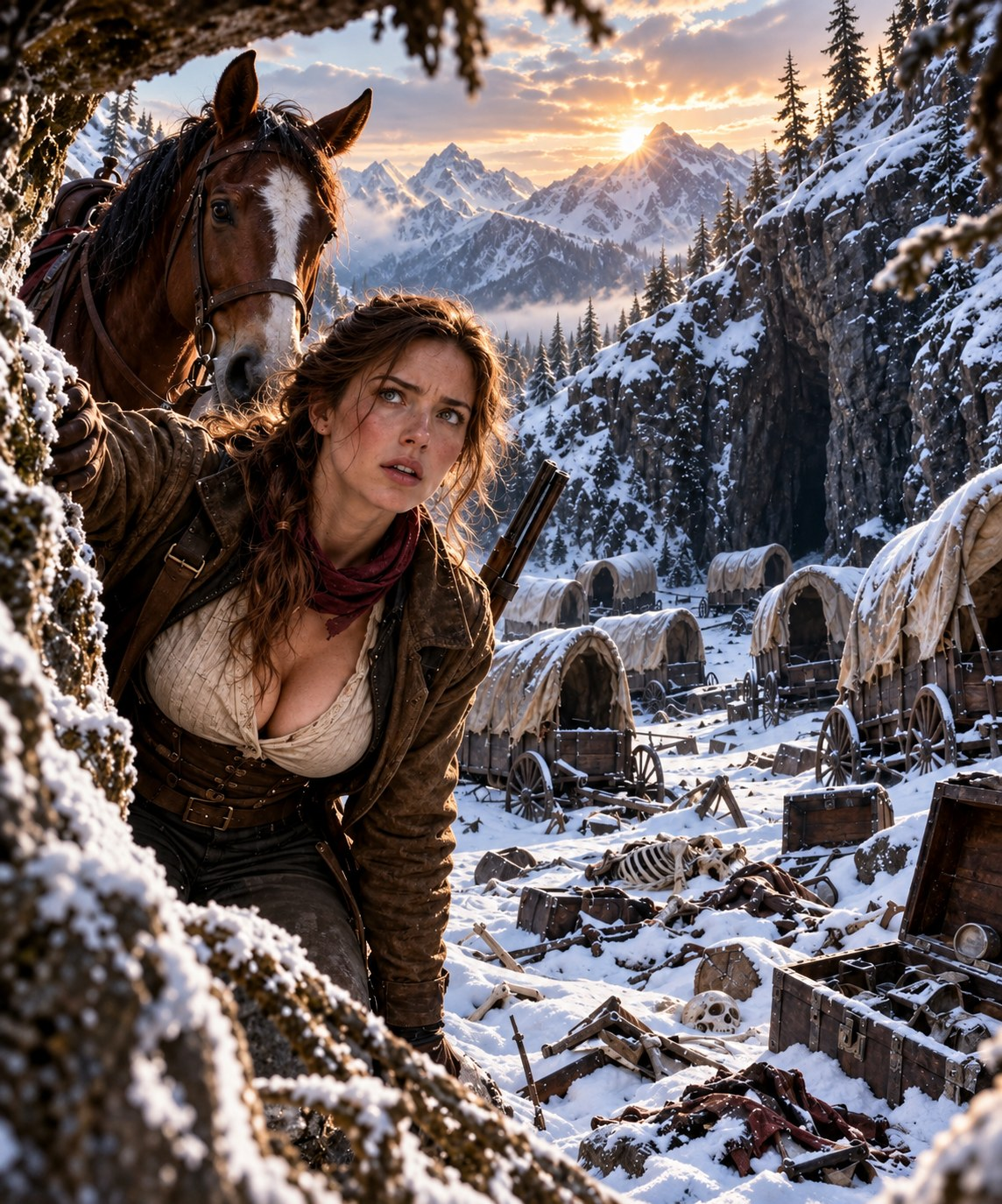
"RUN, NORA! THEY'VE FOUND THE SECOND CHILD!"
Elias's voice cut through the clearing.
A gunshot echoed between the mountains.
Everett turned toward the sound, and the stranger in the black coat instinctively ducked behind him.
I didn't wait to understand what had happened.
I ran.
The first bullet struck the wooden side of the sixth wagon.
The second shattered a lantern hanging from its rear frame.
Glass scattered across the snow.
I reached Juniper, grabbed the reins, and pulled the mare toward me.
"Come on, girl!"
She resisted.
Her ears were pinned backward, and her eyes were fixed on the men.
I untied the reins from the granite boulder and swung myself into the saddle.
Behind me, Everett shouted.
"Stop her!"
Another shot rang out.
This one passed so close that I heard it cut through the air.
Juniper lunged forward.
We raced between the wagons, scattering loose snow and broken branches.
I had no idea who had fired the first shot.
I had no idea whether Elias was alive.
And I certainly had no idea what the stranger meant when he said they had found the second child.
But I knew one thing.
Those men wanted the documents.
And they wanted me.
The narrow trail leading out of the clearing descended toward a frozen creek.
I leaned forward as Juniper picked her way between the rocks.
The mare was frightened, but she knew the terrain better than I did.
We reached the creek just as another gunshot echoed behind us.
I pulled her beneath an overhanging rock formation.
For several seconds, I listened.
Nothing.
Then I heard horses moving in the clearing.
They were preparing to follow.
I took the papers from inside my coat and checked them.
The account book was still there.
So was the birth record.
The photograph.
My father's letter.
I had lost nothing.
Except perhaps the only person who could explain what I had found.
Elias.
I closed my eyes briefly.
Then I heard something behind me.
A low whistle.
Three notes.
I turned.
A man stood between the pine trees.
He was holding a rifle.
I raised mine.
"Don't shoot."
The man stepped into the fading light.
He was older than Everett, perhaps in his early sixties, with a long gray beard and a weathered face.
His coat was dark green.
A leather satchel hung across his shoulder.
He looked at Juniper.
Then at me.
"Thomas's girl?"
I didn't lower the rifle.
"Who are you?"
"Caleb Mercer."
The name meant nothing to me.
He nodded toward the mountain trail.
"You need to get off that horse before they see you."
"Who sent you?"
"Nobody."
"Then how do you know my father?"
Caleb looked toward the clearing.
"Because I helped him bury the first box."
My fingers tightened around the rifle.
"What box?"
He shook his head.
"Not here."
"I've heard enough people tell me to wait."
"Then perhaps you'll listen when I tell you that the men behind us aren't interested in conversation."
He was right.
A distant horse whinnied.
Caleb moved toward a narrow opening between the rocks.
"There is a cabin about half a mile east. We can talk there."
I hesitated.
He noticed.
"Your father trusted me."
"That doesn't mean I should."
A faint smile crossed his face.
"Good. He taught you something useful."
I looked toward the trail.
Then toward Juniper.
I had no better option.
I followed him.
The cabin was hidden beneath a cluster of old pine trees.
It was little more than a one-room hunting shelter with a stone chimney, a narrow window, and a wooden door reinforced with iron.
Caleb opened it and stepped aside.
I entered first.
The interior smelled of wood smoke and dried herbs.
A small stove stood against the back wall.
There was a table, two chairs, and a narrow bed.
Several maps covered one side of the room.
I recognized the mountain ridges immediately.
They were similar to the markings on my father's map.
Caleb closed the door.
"Sit down."
"I'd rather stand."
He shrugged.
"Your choice."
He removed his coat and hung it beside the stove.
Then he placed his rifle against the wall.
I kept mine in my hands.
"Who was the man with Everett?"
Caleb looked at me.
"His name is Warren Crowell."
I felt my stomach tighten.
"Silas's relative?"
"His uncle."
I remembered the silver watch chain.
"Why was he there?"
"To make sure the papers never reached Coldwater."
"Why does Silas care so much about documents that are almost fifty years old?"
Caleb looked toward the maps.
"Because those documents could destroy the Crowell Reservoir Company."
I waited.
He continued.
"Before the reservoir company existed, the families in the valley had a common agreement. The water belonged to the people whose land bordered the original creek system. Nobody could sell the entire supply or deny another family access."
"And the thirty-one travelers?"
"They were carrying the original deeds."
"Why were they traveling through Harrow Pass?"
"Because they had discovered that someone was changing the land records."
"Jonathan Crowell?"
Caleb nodded.
"He wanted the water rights for himself. But the families refused to sell. So he arranged for their journey to end before they reached the courthouse."
I looked at the papers in my hand.
"Who helped him?"
"Men who were paid to guard the expedition."
"Everett's family?"
"No. Everett's family came later. His father worked for Silas's father."
Caleb pulled a chair away from the table.
"Sit down, Nora."
This time, I did.
He placed a kettle on the stove.
For a while, neither of us spoke.
Then he looked at me.
"Did you find the birth record?"
I took it from my coat.
His face changed when he saw the paper.
"Where did you get this?"
"Inside the sixth wagon."
He studied the handwriting.
Then he lowered himself into the chair opposite me.
"Caroline."
"That's my mother."
"I know."
"You knew her?"
Caleb nodded.
"She was a good woman."
I stared at him.
"Then tell me why her name appears on a document from 1834."
He rubbed his forehead.
"Because Caroline wasn't the first Caroline Whitfield."
The words settled between us.
I looked down at the paper.
"Explain."
Caleb took a long breath.
"Your mother was born Caroline Reed. Her mother was Margaret Reed, one of the thirty-one travelers. Her father was listed as unknown because the man who fathered her had disappeared before she was born."
I remembered the inscription inside the pocket watch.
CAROLINE WHITFIELD.
NOVEMBER 1834.
The date had not been a mistake.
My mother had inherited a name.
Not an identity.
"How did she become a Whitfield?"
Caleb reached toward one of the maps.
"Thomas's family took her in."
"Why?"
"Because the five survivors knew that the Crowells would eventually search for the child."
I stared at him.
"Why was she important?"
"Her mother had the original ownership certificate. It named the thirty-one families and established the rules governing the valley's water. Margaret died before she could deliver it to the courthouse."
"Where was the certificate?"
Caleb pointed toward the mountain.
"In one of the six wagons."
I remembered the locked compartment.
The brass key.
The message beneath the photograph.
THE FIRST WAGON IS NOT THE ONE YOU NEED.
"Was my mother the only child?"
Caleb looked down.
"No."
The room seemed to grow colder.
"Who was the second child?"
He didn't answer immediately.
I repeated the question.
"Who was the second child?"
He looked toward the window.
"Your mother's younger brother."
I felt my heart pounding.
"His name?"
"Samuel Reed."
I waited.
Caleb continued.
"Margaret had two children. Caroline was born shortly before the journey. Samuel was born during the crossing. The five survivors managed to get both children away from Harrow Pass."
"Then why did the document say the second child was never to be recorded?"
"Because Samuel disappeared."
"Where?"
Caleb shook his head.
"Nobody knows."
I leaned forward.
"Did he die?"
"Not according to your father."
I thought of the voice inside the wagon.
The pale hand.
The words written on the letter.
THE GIRL WAS NEVER MEANT TO BE YOURS.
I looked at Caleb.
"Was Samuel my father?"
He shook his head.
"No. Thomas was your father."
"Then why did that document say the girl was never meant to be his?"
Caleb remained silent.
I placed the letter on the table.
He read the final sentence.
His expression became grim.
"Where did you get this?"
"Everett gave it to me."
Caleb read the line again.
Then he looked at me.
"That's not Thomas's handwriting."
"I know."
"Do you recognize it?"
I shook my head.
He pointed toward the final sentence.
"This was written by Margaret Reed."
I stared at him.
"How can you be certain?"
"Because I saw her write it."
He folded the letter carefully.
"Your father never wanted you to find this particular message."
"Why?"
Caleb looked at the stove.
"Because it concerns your birth."
I felt my hands go cold.
"What about my birth?"
He stood and walked toward the maps.
"Thomas and Caroline were married for years before you were born. They wanted a child. They tried everything. Your mother lost two pregnancies, and the doctor eventually told them she might never carry another."
I looked down.
I knew none of this.
My parents had never discussed it.
Caleb continued.
"Then, one winter, a child was brought to their house."
I stared at him.
"What child?"
He turned.
"You."
I couldn't speak.
"You were brought to Coldwater as an infant. Thomas and Caroline raised you as their own."
I gripped the edge of the table.
"Who were my birth parents?"
Caleb hesitated.
"Your father was Thomas Whitfield."
"And my mother?"
"Caroline."
"Then why are you telling me I was brought to their house?"
"Because Caroline wasn't the woman who gave birth to you."
I stood abruptly.
"No."
Caleb didn't move.
"Your mother was your mother in every way that mattered."
"That's not what I asked."
"I know."
"Who gave birth to me?"
He looked at the birth record.
Then he spoke.
"Margaret Reed's daughter."
I stared at him.
"Caroline?"
"No."
"Then who?"
Caleb walked to the far end of the table and opened a small drawer.
He removed a folded paper.
It was a photograph.
He placed it in front of me.
The image showed a young woman standing beside a wooden fence.
She had dark hair, pale green eyes, and a small mark beneath her left eyebrow.
My mark.
I touched my face.
The woman was perhaps twenty years old.
She wore a simple dress and held a baby wrapped in a blanket.
I looked at the baby.
Then at the woman.
"Who is she?"
Caleb answered quietly.
"Your biological mother."
I looked at him.
"What was her name?"
"Elizabeth Reed."
I had never heard that name.
Not once.
"Where is she now?"
Caleb looked away.
"She died."
"When?"
"Seven months ago."
The room seemed to tilt.
"Seven months ago?"
He nodded.
"She was the woman who lived in the cabin beyond the northern ridge."
I remembered the figure between the trees.
The footprints.
The woman calling my name.
I gripped the photograph.
"Why didn't anyone tell me?"
"Because Thomas believed the truth would put you in danger."
"From Silas?"
"From the entire Crowell family."
I stared at the photograph again.
The woman had my eyes.
My chin.
My mother's expression.
I could see the resemblance immediately.
But there was something else.
A small crescent-shaped pendant hung around her neck.
The same pendant I had found in the sixth wagon.
I looked at Caleb.
"Why did she die?"
He didn't answer.
I asked again.
"How did Elizabeth die?"
Caleb walked toward the stove.
"She was found beside the creek."
"Was it an accident?"
He looked at me.
"No."
I waited.
"Someone had been following her."
I felt anger rise through my chest.
"Who?"
"We never proved it."
"But you suspect Silas."
"I suspect Warren Crowell."
I sat down again.
My head was full of questions.
My mother.
My biological mother.
The second child.
The six wagons.
The original deeds.
The man who had been hiding in the wagon.
Everything was connected.
But I still didn't understand why my father had left me the map.
I took the final letter from my coat.
It was dated seven months earlier.
The handwriting was unmistakable.
I unfolded it.
Nora,
If you are reading this, I have failed to finish what I promised Caroline.
I have spent most of my life protecting the truth because I believed silence would keep you safe.
I was wrong.
The Crowells have discovered that the original documents still exist.
They will come for the house.
They will come for the map.
And eventually, they will come for you.
Do not mistake the people who claim to help you for the people who deserve your trust.
The truth is not hidden in the wagons alone.
Look for the names nobody remembered.
Look for the child who was never counted.
And when you finally understand who you are, remember that you were loved long before you knew the truth.
Thomas.
I read the letter slowly.
Then I folded it.
Caleb was watching me.
"Your father wanted you to find the names."
"Why?"
"Because the names are proof."
"Proof of what?"
He returned to the table.
"That the Crowells stole the valley."
He opened the account book and turned to the last section.
There were thirty-one names.
Each one was followed by a description of a family property.
But the final pages contained something different.
A list of five names.
The survivors.
I recognized Elias Bennett.
The other four were unfamiliar.
Then I saw a name written beneath them.
ELIZABETH REED.
Beside it was a date.
OCTOBER 1869.
I looked at Caleb.
"Why is my mother's name here?"
He slowly closed the book.
"Because Elizabeth was one of the five survivors."
I felt the air leave my lungs.
"But you said she was born much later."
Caleb shook his head.
"No. I said the woman who raised you was Caroline. I didn't say Elizabeth was younger."
He turned the book around.
"Your biological mother was born in 1834. She was the second child carried out of Harrow Pass."
I stared at him.
The dates.
The names.
The photograph.
My mother.
Everything I thought I knew about my family had begun to collapse.
Then Caleb placed one final document on the table.
It was a handwritten statement.
At the top were the words:
THE ORIGINAL FIVE SURVIVORS.
Beneath them were four signatures.
And a fifth space.
It was blank.
I looked at the empty line.
"Who was supposed to sign this?"
Caleb's voice dropped.
"Samuel Reed."
"The second child?"
He nodded.
"Your uncle."
I looked toward the window.
Outside, the wind had begun to rise.
"Then why is his name missing?"
Caleb leaned closer.
"Because Samuel didn't disappear."
I stopped breathing.
He reached into his coat and removed a small photograph.
It showed a man standing beside a wagon.
His face was partially hidden by a hat.
But his left hand was visible.
There was a distinctive scar across the thumb.
I had seen that scar before.
On the pale hand reaching out of the first wagon.
Caleb placed the photograph beside the birth record.
Then he whispered:
"Samuel Reed was the man who knocked three times."






Comments 0