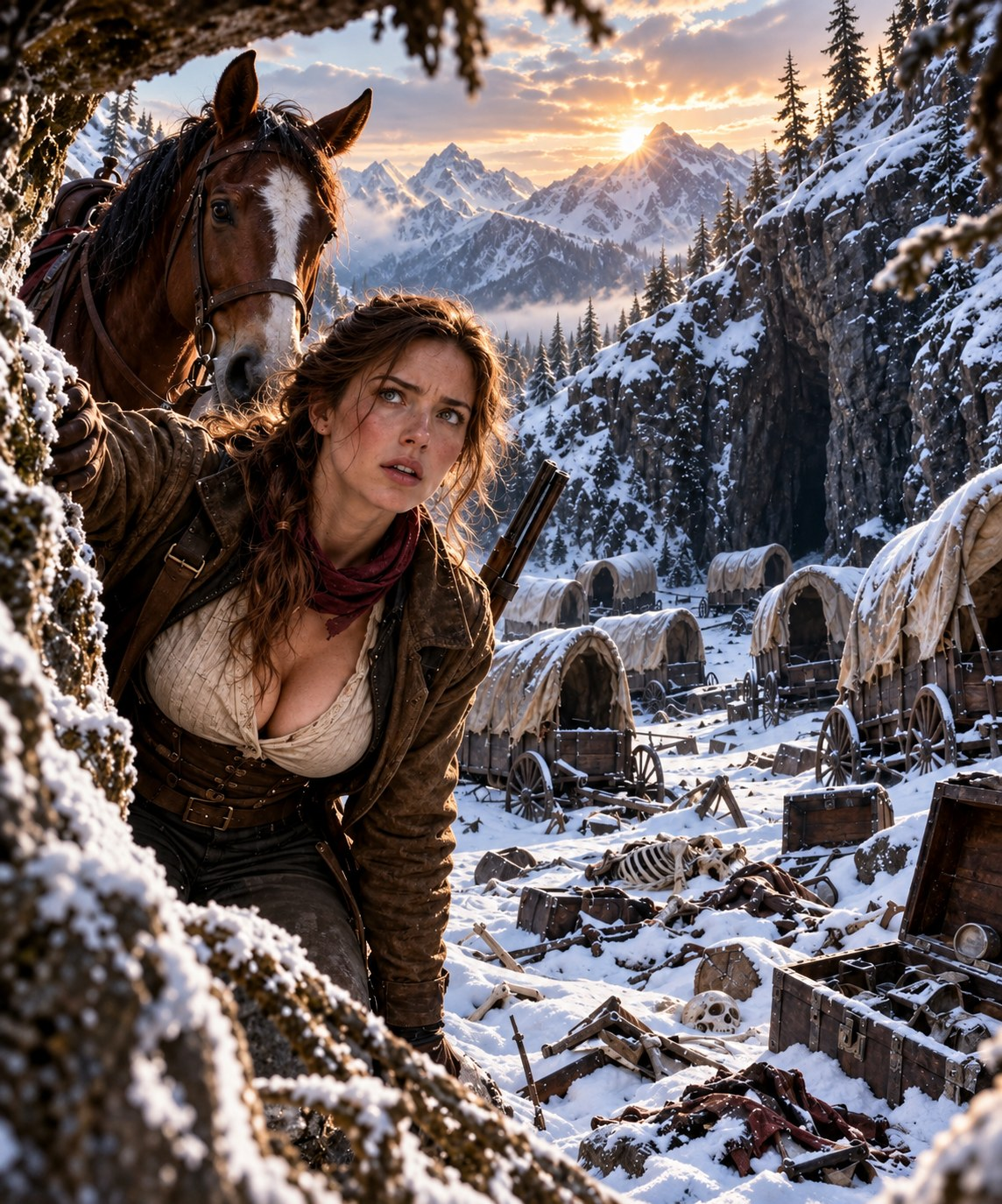
"Nora..."
The voice came from inside the sixth wagon.
I stood motionless in the middle of the clearing, the letter from my father clenched in my left hand and the Winchester pointed toward Everett Pike.
Nobody spoke.
Even the wind seemed to have stopped.
I looked toward the open rear door.
The darkness inside the wagon was almost complete. A thin strip of golden light reached across the wooden floor, revealing the edge of an old trunk and several pieces of broken furniture.
Then the voice came again.
"Nora, please."
It sounded like a woman.
A tired woman.
And somehow, impossibly, it sounded familiar.
I took one step toward the wagon.
Everett moved.
"Don't."
I turned the rifle toward him.
"I told you not to move."
He raised his hands.
"You don't understand what you're dealing with."
"I've heard that from enough men."
"You need to listen to me."
"No. You need to explain why you brought a letter from my dead father."
Everett glanced at the paper in my hand.
"Because he knew you would come."
"Why did he tell me not to trust you?"
"Because Thomas trusted nobody."
"That isn't an answer."
He looked toward the sixth wagon.
For the first time since arriving, he seemed genuinely frightened.
"Whatever you hear in there," he said quietly, "don't answer it."
I stared at him.
A strange feeling moved through my stomach.
"Why?"
Before he could reply, Elias stepped out from behind the first wagon.
He was leaning heavily against the wooden frame.
"She's right," he whispered.
I turned toward him.
"Who is?"
Elias looked at the sixth wagon.
"Your mother."
The word struck me harder than the cold.
I shook my head.
"My mother is dead."
"I know what they told you."
"They buried her."
"I know."
"I was there."
Elias looked at me with an expression I couldn't understand.
"Then tell me something, Nora. Did you see her face?"
I opened my mouth.
Nothing came out.
My mother had died when I was nine.
I remembered the funeral.
The black dresses.
The wooden coffin.
My father's hand resting on my shoulder.
The preacher speaking about a peaceful passing.
But I remembered something else.
The coffin had been closed.
I had asked why.
My father told me her face had been damaged by the illness.
He said I should remember her as she had been.
I had accepted that explanation.
I had been nine years old.
Now, standing among six abandoned wagons, I suddenly wondered whether I had ever seen my mother's body at all.
"Nora?"
The woman's voice came from inside the wagon.
This time, I recognized the way she pronounced my name.
The slight pause before the final syllable.
My mother had spoken that way whenever she called me in from the workshop.
I lowered the rifle slightly.
Everett noticed.
"Don't go in there."
I ignored him.
"Mother?"
The moment I spoke, Elias closed his eyes.
A soft sound came from inside the wagon.
Something between a sob and a laugh.
"Oh, my girl."
My knees weakened.
I moved toward the open door.
Everett suddenly stepped into my path.
I raised the rifle.
"Move."
He shook his head.
"Listen to me. That woman isn't who you think she is."
"Get out of my way."
"Thomas made me promise."
"Then you should have kept your promise to him."
I pushed past him.
The wagon floor creaked beneath my boots.
Inside, the air smelled of old wood, damp canvas, and something faintly medicinal.
A narrow bench ran along the left wall.
Several blankets were stacked near the back.
An iron lantern hung from a hook.
On the opposite side stood a large wooden trunk.
There was no woman.
I stopped.
"Where are you?"
A faint movement came from beneath the floor.
I turned.
A rectangular wooden panel had been fitted between two floorboards.
It was almost invisible beneath a layer of dust.
I crouched.
There was a small brass handle.
The same kind of metal used on the hidden compartment beneath the sixth wagon.
I pulled.
The panel didn't move.
I tried again.
Nothing.
Then I remembered the key in my pocket.
I took it out.
The number six was still visible on its head.
There was a narrow keyhole beneath the handle.
I inserted the key.
It turned with a heavy metallic click.
The panel shifted.
Cold air rose from beneath the floor.
A narrow staircase descended into darkness.
I looked over my shoulder.
Elias stood outside the wagon.
Everett was beside him.
Neither man appeared surprised.
"You knew this was here," I said.
Elias nodded.
"Your father found it."
"What's underneath?"
"Everything he spent twenty years trying to protect."
I looked down the stairs.
The darkness seemed endless.
"Is there someone down there?"
Elias hesitated.
Then he answered.
"There was."
I looked at him.
"What does that mean?"
He lowered his eyes.
"Go carefully."
I took the lantern from the wall and lit it.
Then I descended.
The staircase was narrow, with wooden steps reinforced by iron brackets.
The air grew colder as I went deeper.
At the bottom was a small underground chamber.
It was larger than I expected.
The walls were made of rough stone.
Several wooden shelves lined the sides.
There were boxes, metal containers, old blankets, and stacks of papers wrapped in oilskin.
A small iron stove stood in one corner.
Its chimney disappeared through the ceiling.
Someone had used the chamber as a shelter.
Recently.
I moved the lantern closer to the shelves.
There were dozens of objects.
A child's wooden horse.
A pair of leather boots.
A cracked mirror.
Several pieces of women's clothing.
A small silver necklace.
I recognized the necklace immediately.
It was shaped like a crescent moon.
The same pendant I had seen in the photograph.
My mother's pendant.
I picked it up.
The silver was cold.
There was a tiny scratch near the clasp.
I had seen that scratch on the necklace she wore throughout my childhood.
I turned it over.
Two initials were engraved on the back.
C.W.
Caroline Whitfield.
I pressed the necklace against my palm.
A memory surfaced.
My mother sitting beside the kitchen window.
Her hands moving through my hair.
The pendant resting against her blue dress.
Her voice telling me that no matter what happened, I should never let another person decide what my life was worth.
I swallowed hard.
Then I noticed a small wooden box beneath the shelves.
It was marked with my name.
NORA.
I placed the lantern beside it.
The lid was held shut by a simple brass clasp.
Inside lay a collection of letters tied together with faded ribbon.
There were twelve.
Each envelope carried the same handwriting.
My father's.
The first was dated 1869.
The second, 1871.
The third, 1874.
The final letter was dated only seven months earlier.
The month my father died.
I opened the first envelope.
The paper was yellowed and brittle.
It contained only a few lines.
Caroline,
The valley is changing. Crowell has begun buying the water rights from families who do not understand what they are signing. I found the original agreement. It names all thirty-one families.
They cannot take the land if the original document is produced.
I know what you asked me to do.
I am trying.
Thomas.
I read the letter twice.
Then I opened the second.
This one was longer.
My father described a meeting with several men from Coldwater.
He wrote about a missing ledger, a forged signature, and a payment made through the freight depot.
At the bottom, he had written:
Silas is not the first Crowell to use fear as a business tool. His grandfather learned it from men who disappeared in 1834.
I felt my fingers tighten.
The Crowell family had been connected to the disappearance from the beginning.
I placed the letters back into the box.
Then I noticed a larger container beneath the shelves.
It was made of oak, reinforced with iron corners.
The lid had a circular brass lock.
I tried the key.
It didn't fit.
There was a small inscription above the lock.
FOR THE ONE WHO REMEMBERS.
I stared at the words.
What was I supposed to remember?
I touched the brass plate.
Something clicked inside the container.
The lid opened slightly.
I lifted it.
Inside were several documents, an old family Bible, and a bundle of folded maps.
On top lay a leather-bound account book.
I opened it.
The first pages contained names and dates.
Some entries were written in faded ink.
Others had been added later.
I recognized several surnames from the list of thirty-one passengers.
Reed.
Harlow.
Bennett.
Whitfield.
Each name was followed by a description of land, water access, and family ownership.
This was not simply a passenger list.
It was a record of property.
The original owners of the valley.
I turned another page.
A handwritten note appeared in the margin.
THE SIX WAGONS CARRIED THE ORIGINAL DEEDS.
I stopped.
Then I understood why Silas wanted the wagons hidden.
The missing travelers had been carrying the legal documents that proved who owned the land and water.
If those documents still existed, the Crowell Reservoir Company might have no legitimate claim to the valley.
I continued reading.
The account book contained a detailed record of payments.
Several entries described money paid to men who were supposed to protect the travelers.
Other entries recorded money transferred to the Crowell family.
One date appeared repeatedly.
November 1834.
Beside it was a name.
JONATHAN CROWELL.
Silas's grandfather.
I felt a chill move through me.
The documents suggested that the Crowell family had arranged for the travelers to be intercepted before reaching Coldwater.
But why?
I turned another page.
A small piece of paper fell out.
I picked it up.
It was a birth record.
The name of the child had been written carefully.
CAROLINE ELIZABETH WHITFIELD.
Mother: Margaret Reed.
Father: Unknown.
Date of birth: November 1834.
My heart began beating harder.
I looked at the name again.
Caroline.
My mother's name.
I read the record several times.
Then I noticed something written beneath the date.
CHILD RECOVERED AT HARROW PASS.
I lowered the paper.
My mother had been born in 1834.
The year the six wagons disappeared.
She had been found at Harrow Pass.
But my father had never told me.
I returned to the account book.
Several pages later, I found another record.
It contained a different birth entry.
NORA CAROLINE WHITFIELD.
Mother: Caroline Whitfield.
Father: Thomas Whitfield.
The date was correct.
My own birth.
But beside my name, someone had written a note.
THE SECOND CHILD WAS NEVER TO BE RECORDED.
I felt dizzy.
I placed one hand against the shelf.
There was something wrong.
Something about my family that I had never known.
I had always believed I was an only child.
My father had never mentioned another baby.
My mother had never spoken about having another child.
Yet the record clearly referred to a second child.
I turned the page.
The ink was darker.
The handwriting was not my father's.
A single sentence had been written across the paper.
THE CHILD WAS TAKEN BEFORE THE RETURN.
I stood motionless.
Then I heard a noise from above.
Footsteps.
Several pairs.
I quickly closed the account book and slipped the birth record into my coat.
The footsteps moved across the wagon floor.
A man's voice spoke.
"Did she find it?"
Everett.
Elias answered.
"Not yet."
I froze.
They were lying.
I moved closer to the staircase.
Another voice spoke.
This one was unfamiliar.
"Silas wants the documents before sunrise."
My stomach tightened.
A second man had arrived.
I extinguished the lantern.
Darkness swallowed the chamber.
I remained still.
"Where is the girl?" the stranger asked.
Everett answered.
"Downstairs."
"Then get her."
"I tried."
A pause.
Then the stranger spoke again.
"Did you tell her about the child?"
"No."
"Good."
There was a sound of metal striking wood.
Then Elias spoke.
"You have no right to be here."
The stranger laughed.
"Neither did your friends in 1834."
Silence followed.
I could hear my own breathing.
Then a heavy object fell.
A chair, perhaps.
Someone cursed.
I reached for the Winchester.
I had left it beside the staircase.
My heart sank.
I had no weapon.
I looked around the chamber.
The iron stove.
The wooden shelves.
The boxes.
The old tools.
There was a narrow opening behind the shelves.
I moved toward it.
A wooden panel had been fitted into the stone wall.
I pushed.
It shifted slightly.
A passage.
I took the account book, the birth record, and the photograph from my satchel.
Then I heard Everett.
"Open the floor."
A heavy thud followed.
Someone had found the hidden entrance.
I moved through the narrow passage.
It was barely wide enough for my shoulders.
The stones scraped against my coat.
I kept one hand against the wall and moved forward.
Behind me, the wooden panel began to open.
A beam of lantern light entered the chamber.
"She's gone!"
The stranger shouted.
I moved faster.
The passage sloped upward.
After several yards, I reached a second wooden door.
I pushed against it.
It wouldn't move.
I tried again.
Something heavy blocked the other side.
I put my shoulder against the wood.
The door shifted.
A narrow line of cold air entered.
I pushed harder.
The door opened into a small storage space beneath the wagon's front platform.
I climbed out.
The sixth wagon was directly above me.
I could hear men moving inside.
I slipped through the side opening and dropped into the snow.
Juniper stood near the granite boulder.
The mare whinnied when she saw me.
I moved toward her.
Then a rifle shot cracked through the clearing.
Snow burst from the tree trunk beside my head.
I threw myself behind the wagon.
"Don't move, Nora!"
Everett's voice.
I looked toward the entrance.
He stood several yards away, holding my Winchester.
I had left it beside the first wagon.
He must have taken it when I entered the sixth.
His face was pale.
The stranger stood behind him.
He was a broad man wearing a black wool coat and a dark hat.
I had never seen him before.
But I recognized the silver watch chain across his chest.
The same design Silas wore.
"Come out," Everett ordered.
I remained behind the wagon.
The stranger stepped forward.
"We don't need to make this difficult."
I looked at Juniper.
She was tied to the granite boulder.
My father's compass was still in my coat pocket.
The map was in my satchel.
The documents were beneath my coat.
I had found enough to know that returning to Coldwater without proof would accomplish nothing.
But I also knew that if those men took the account book, I might never discover what happened to the missing travelers.
"Who sent you?" I called.
The stranger smiled.
"Silas Crowell."
"I thought so."
"He wants the papers."
"Then he should have come himself."
The stranger's expression hardened.
"Mr. Crowell doesn't waste time traveling through mountains for things that belong to him."
I stepped slightly away from the wagon.
"These papers don't belong to him."
He laughed.
"Everything in that valley belongs to the Crowell family."
"Not according to the records."
For the first time, he stopped smiling.
His eyes moved toward my coat.
"You found the ledger."
I said nothing.
He took another step.
"Give it to me."
"No."
Everett raised the rifle.
The stranger held up one hand.
"Not yet."
He looked at me with an expression that made my skin crawl.
"You don't understand what your father did."
"I understand that he tried to stop you."
"He destroyed everything."
"He was trying to protect the people who lived in Coldwater."
The stranger shook his head.
"Your father was protecting one person."
"Who?"
He looked toward the sixth wagon.
Then back at me.
"Your mother."
I felt the air leave my lungs.
"What did you do to her?"
The stranger's smile returned.
"Ask Elias."
I looked toward the first wagon.
Elias was standing in the doorway.
His hands were raised.
There was blood on his forehead.
He looked directly at me.
Then he slowly shook his head.
The stranger noticed.
"Tell her, Elias."
The old man said nothing.
"Tell her what happened in 1834."
Elias lowered his hands.
His voice was barely audible.
"Not here."
The stranger pulled a folded document from his coat.
He opened it.
I recognized the handwriting immediately.
My father's.
He held the paper up so I could see it.
At the top was a date.
November 14, 1834.
Beneath it was a sentence.
I, Thomas Whitfield, hereby acknowledge that the child known as Caroline Reed was placed under my protection.
My mouth went dry.
Thomas Whitfield.
My father.
But the document was dated decades before he was born.
I stared at the paper.
The stranger smiled.
"Now you understand why your father spent his life lying to you."
I shook my head.
"No."
He lowered the document.
"Then perhaps you should ask him yourself."
I looked at Elias.
The old man was crying.
And for the first time, I understood that the mystery of Harrow Pass was not simply about thirty-one people who disappeared.
It was about a child who had been taken from that mountain.
A child whose name had become part of my family.
A child whose story had been hidden for nearly fifty years.
The stranger stepped closer.
"Give me the ledger, Nora."
I tightened my grip around the papers beneath my coat.
"Tell me who Caroline really was."
He looked at Everett.
Then back at me.
"Your mother was the last surviving heir to the original water agreement."
I stopped breathing.
He continued.
"And you, Nora, are the reason Silas Crowell cannot afford to let you return to Coldwater."
Before I could answer, a gunshot erupted behind the sixth wagon.
Everett spun around.
The stranger dropped his document.
And Elias shouted:
"RUN, NORA! THEY'VE FOUND THE SECOND CHILD!"






Comments 0