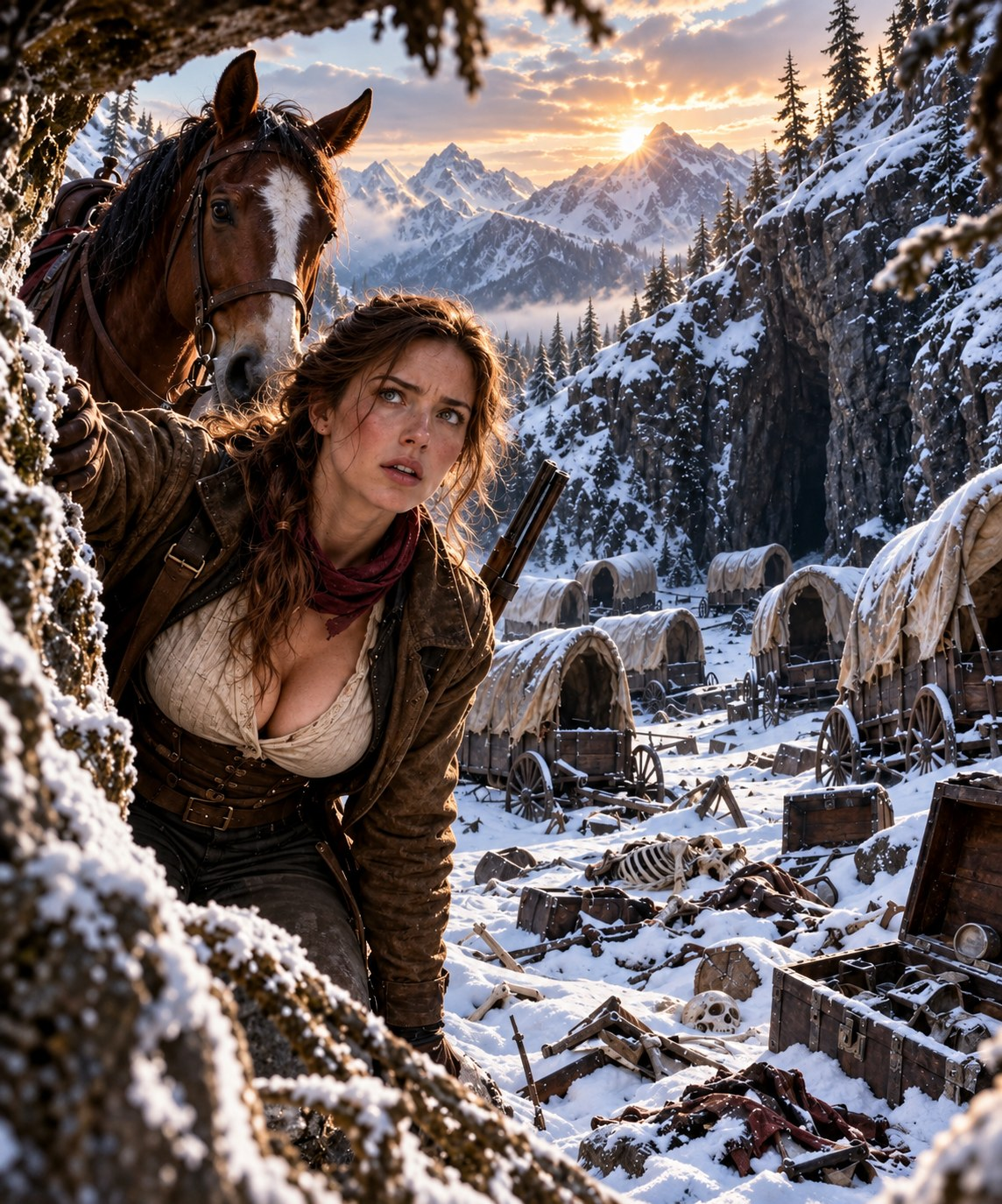
I was tightening my father's saddle when a man shouted from across the muddy street:
"You're going to die up there, Miss Whitfield!"
Silas Crowell stepped out of the Silver Bell Saloon and looked directly at me.
He carried a folded mortgage document bearing my father's signature.
But there was something written beneath the signature that I recognized immediately.
My father had never written those words.
And suddenly, I knew the debt was only the beginning.
Three days earlier, I had still been sitting at my father's kitchen table, trying to decide which of his remaining possessions I could sell to keep our house.
I had already sold two horses.
I had sold my mother's silver hair comb.
I had even sold the old brass clock that had stood above the fireplace since I was nine years old.
None of it had been enough.
Silas Crowell wanted eight hundred and forty dollars.
He wanted it within ten days.
If I failed to pay, he would take possession of the house where I had grown up.
It was a small wooden house at the eastern end of Coldwater, with a leaking roof, a crooked porch, and a workshop that smelled permanently of leather, sawdust, and horse sweat.
But it was the only home I had ever known.
My father, Thomas Whitfield, had built it with his own hands.
He had cut the timber, raised the walls, installed the windows, and repaired every broken board himself.
He had also taught me nearly everything I knew.
How to recognize a damaged wagon axle.
How to repair a leather harness.
How to read a compass.
How to ride through dangerous terrain.
How to keep an honest account of money.
And, most importantly, how to recognize when someone was trying to cheat me.
"Never let a man confuse confidence with honesty," he used to say.
I had thought he was talking about merchants.
After his death, I understood he had been talking about Silas Crowell.
My father had died seven months earlier.
He had been found unconscious beside his workbench after suffering a sudden collapse. The doctor called it a heart failure.
There had been no warning.
No final conversation.
No chance for me to ask the questions I had carried for years.
I buried him beside my mother, returned to the house, and tried to continue living.
Then Silas arrived with the mortgage.
According to his document, my father had borrowed eight hundred and forty dollars six months before his death.
The loan was supposedly secured against our house.
I had never heard of it.
My father hated borrowing money.
He kept his savings in coffee tins because he distrusted banks. He repaired other people's wagons for cash, traded labor when necessary, and wrote down every payment in a small account book.
He had once refused to borrow five dollars from a neighbor because he didn't like owing anyone.
Yet Silas wanted me to believe he had borrowed hundreds.
The signature looked convincing.
Almost convincing.
But something about the document bothered me.
My father always wrote the letter T in his surname with a small horizontal stroke that extended slightly beyond the vertical line.
The signature on the mortgage did not.
I had pointed this out to Silas.
He had smiled.
"Grief makes people imagine things, Nora."
I remembered those words every time I looked at the paper.
By the morning I found the map, I had nearly exhausted every possibility.
I was repairing the lining of my father's winter coat because I thought I might sell it.
It was a heavy brown wool coat with a torn pocket and a missing button.
As I turned the garment inside out, my fingers caught something unusual beneath the lining.
A section of stitching had been sewn differently from the rest.
I took a small pair of scissors from my sewing box and carefully opened the seam.
Something stiff slipped out.
It was a folded piece of oilskin.
Inside was a hand-drawn map.
I unfolded it on the kitchen table.
At first, I couldn't understand what I was looking at.
There were mountain ridges, narrow trails, a creek, and several markings that appeared to indicate elevation.
Then I recognized the name.
Harrow Pass.
I sat down.
For a long time, I simply stared at the paper.
I remembered the newspaper clipping I had discovered as a child.
SIX WAGONS MISSING IN AUTUMN STORM.
The article had described an expedition of thirty-one people who attempted to cross the mountains in November 1834.
Six covered wagons entered Harrow Pass.
None ever emerged.
Search parties had spent weeks looking for them.
They found no wreckage.
No abandoned horses.
No bodies.
Nothing.
Eventually, the search ended.
People began inventing explanations.
An avalanche.
Bandits.
Starvation.
A violent storm.
A group of travelers who had decided to disappear.
The story became part of Coldwater's local folklore.
But my father had never treated it like folklore.
When I was twelve, I had once asked him why he kept old newspaper articles about the missing wagons.
He had taken the clipping from my hands.
"Some things are better left where they are," he told me.
"Did you ever see them?"
He looked at me for a long moment.
Then he folded the newspaper.
"Never go looking for Harrow Pass."
I had asked why.
He gave me an answer I never forgot.
"Because mountains keep what men give them."
Now, seven months after his death, I was looking at a map that appeared to lead directly into that very place.
There were handwritten notes along the edges.
Some were difficult to read.
Others were unmistakably his.
I found a small drawing of a ridge and a circle containing six short lines.
Beside it, he had written:
THE WAGONS ARE STILL THERE.
I read it once.
Then again.
At the bottom of the map were seven words.
The wagons are still there. I saw them.
I pressed my fingers against the paper.
My father had found them.
After twenty years of searching, he had finally discovered what happened to the six missing wagons.
But why had he never told me?
And why had he hidden the map inside a coat he knew I might eventually sell?
I turned the paper over.
There was another message.
Not a date.
Not a location.
Just one sentence.
DO NOT TRUST THE MAN WHO OWNS THE WATER.
I felt my stomach tighten.
In Coldwater, only one man owned the water.
Silas Crowell.
He controlled the Crowell Reservoir Company, which held the rights to nearly every reliable irrigation channel in the valley.
Without his permission, farmers struggled to keep their fields alive.
He controlled the freight depot, the sawmill, two cattle yards, and most of the commercial buildings along Market Street.
His influence reached almost everywhere.
My father had worked for him occasionally.
Not often.
But enough that they knew each other.
I had always assumed their relationship was ordinary.
Now I wondered what had happened between them.
I folded the map carefully and placed it inside my coat.
I did not sleep much that night.
By sunrise, I had made my decision.
I would ride to Harrow Pass.
I had no money to hire a guide.
No one in town would volunteer to accompany me.
And I wasn't certain I could trust anyone with what I had discovered.
So I prepared alone.
I checked the Winchester rifle my father had left behind.
I packed a canvas bedroll, dried food, a canteen, matches, a small medical kit, and a compass.
I selected his old horse, a strong chestnut mare named Juniper.
She had carried him through more mountain trails than I could count.
She was getting older, but her legs remained steady.
I tightened the saddle straps and secured the bedroll.
Then I checked the map one final time.
Harrow Pass was marked beyond the northern ridge.
The journey would be difficult.
The October weather was turning.
Snow had already begun falling at higher elevations.
I knew all of that.
But I also knew what would happen if I did nothing.
In ten days, Silas would take our house.
The house my father had built.
The house where my mother had raised me.
The house that contained twenty years of my father's work.
I could not allow that to happen without understanding why he had borrowed against it.
Perhaps the answer was somewhere in those mountains.
Perhaps the missing wagons had something to do with the debt.
Perhaps I was chasing a story that had already consumed my father's life.
But I had no better option.
And I was tired of being told that I had none.
When I rode into the main street of Coldwater, the men outside the Silver Bell Saloon were already drinking coffee.
One of them noticed the rifle.
Another noticed the bedroll.
Then the laughter started.
"Look at that," a man called. "Thomas Whitfield's daughter is going hunting for ghosts."
Another man leaned against the wooden post beside the saloon.
"Maybe she'll find enough gold to pay her mortgage."
Several men laughed.
I kept my eyes on Juniper.
I had heard worse things.
Most of those men had known my father. They had eaten at our table, borrowed his tools, and asked him to repair their wagons.
Yet now that he was gone, they found entertainment in the trouble he had left behind.
"Miss Whitfield!"
I recognized the voice.
Silas Crowell stepped beneath the saloon awning.
The laughter gradually stopped.
He was fifty-three years old, tall and broad-shouldered, with neatly combed gray hair.
He wore a gray wool coat, polished black boots, and a silver watch chain.
Even in muddy streets, Silas somehow managed to look as though he had just stepped out of a banker's office.
He approached Juniper and examined the saddle.
"You planning a long trip?"
"Long enough."
"Where?"
"North."
He nodded slowly.
"Toward the mountains?"
I said nothing.
His eyes moved toward the rifle secured in the saddle scabbard.
"You heard about the weather coming in?"
"I did."
"Snow above nine thousand feet."
"I know."
Silas smiled patiently.
It was the kind of smile a man used when he believed he had already won an argument.
"Your father spent twenty years searching those mountains."
"My father spent twenty years saying something was hidden there."
"And he died owing me eight hundred and forty dollars."
I looked directly at him.
"That debt changed twice after he died."
His expression shifted.
It was brief.
Almost invisible.
But I saw it.
Then he smiled again.
"Grief makes numbers difficult."
"Not for me."
The men beneath the awning had stopped laughing.
Silas lowered his voice.
"You have ten days before I take possession of your house."
"My father built that house."
"Your father borrowed against it."
"So you say."
"So the signed papers say."
I reached into my coat and touched the folded map.
I wanted to ask him about the warning.
I wanted to know why my father had written that sentence.
But I held my tongue.
I had learned something from watching Silas.
He never answered a question unless he believed the answer would benefit him.
Instead, I climbed into the saddle.
Silas stepped closer and placed one gloved hand on Juniper's bridle.
The mare tossed her head.
"You want advice?"
"No."
"I'm giving it anyway. There's nothing in those mountains except old timber, bad trails, and weather that kills people who believe wanting something badly enough makes them clever."
I leaned forward.
"My father said almost the same thing about you."
His smile disappeared.
For one brief second, something passed through his eyes.
Not irritation.
Not anger.
Fear.
It was gone almost immediately.
But I had seen it.
Silas released the bridle.
"Come back before you freeze to death."
I turned Juniper north.
We had gone perhaps twenty feet when his voice followed us.
"If you find whatever Thomas Whitfield wasted his life looking for, remember something."
I looked back.
He stood alone in the middle of the muddy street.
"Some things disappear because nobody needs them found."
I watched him for another heartbeat.
Then I turned away.
I did not look back again.
The first afternoon passed slowly.
The trail followed a narrow creek through thick pine forest before climbing toward the mountains.
Juniper moved carefully over the uneven ground.
I stopped twice to check the compass and compare the ridges with my father's map.
The markings were unusually precise.
He had drawn small notches beside several bends in the trail.
At first, I thought they were measurements.
Then I realized they were landmarks.
A split pine.
A narrow waterfall.
A boulder shaped like an animal's head.
He had remembered every detail.
By sunset, the temperature had dropped sharply.
I made camp beside a sheltered rock formation and kept the rifle within reach.
The mountains were quiet.
Too quiet.
I ate a little dried meat and wrapped myself in a blanket.
For the first time since leaving town, I allowed myself to think about my father.
I remembered his hands.
The scars.
The smell of leather and tobacco.
The way he used to hum while repairing wagon wheels.
I remembered the last time he had returned from the mountains.
He had been exhausted.
His coat was torn.
His hands were trembling.
I had asked what happened.
He had looked at me and said:
"Some men will do anything to keep a secret buried."
I had thought he was talking about an argument with Silas.
Now I wasn't so sure.
The following morning, I continued north.
The trail grew steeper.
Fallen spruce trees blocked entire sections.
Rock slides had erased several switchbacks.
Twice, I had to dismount and lead Juniper across dangerous slopes.
By midday, the first snow began falling.
I pulled my scarf tighter and kept moving.
I checked the map repeatedly.
The ridge was close.
I could feel it.
Then, just before sunset, I saw something unusual.
A large granite boulder stood beside the trail.
It was partially covered in snow.
I dismounted.
Something had been carved into its surface.
I brushed the snow away with my glove.
A circle.
Inside it were six short lines.
My breath caught.
I pulled my father's map from beneath my coat.
I compared the drawing with the carving.
The two symbols were identical.
For several seconds, I couldn't move.
My father had been here.
Not only had he found the trail.
He had reached the exact location marked on his map.
I looked beyond the boulder.
Through the trees, the mountain clearing opened before me.
And there they were.
Six covered wagons.
Standing beneath the snow-covered pines.
Their wooden wheels were partly buried.
Their canvas coverings had faded and torn.
Broken crates lay scattered across the ground.
The settlement looked as though time itself had stopped.
I slowly stepped forward.
Juniper remained behind me, shifting nervously.
I counted the wagons.
One.
Two.
Three.
Four.
Five.
Six.
Exactly six.
I felt my knees weaken.
For twenty years, my father had searched for this place.
He had risked his life.
He had returned home injured.
He had hidden maps and newspaper clippings.
And now I understood why.
The wagons were real.
I approached the nearest one.
Its canvas covering moved slightly in the wind.
I could see an old wooden wheel beneath the side panel.
Then I noticed something lying in the snow beside it.
At first, I thought it was a piece of broken wood.
But as I came closer, I recognized the shape.
A human skull.
I stopped.
The wind moved through the clearing.
Somewhere behind me, Juniper made a low, uneasy sound.
I looked toward the remaining wagons.
There were more remains scattered across the snow.
A skeleton near a broken crate.
Another partially visible beneath a collapsed canvas covering.
My father's words returned to me.
Mountains keep what men give them.
I reached for the Winchester.
Then I noticed something carved into the nearest wagon.
Not a symbol.
Not a number.
A name.
I brushed away the snow.
The letters were old, but still readable.
THOMAS WHITFIELD.
My father's full name.
I stared at the carving.
My father had not merely found the six missing wagons.
He had been connected to them somehow.
I stepped backward.
The map trembled in my hand.
Then, from somewhere beyond the last wagon, I heard a sound.
Three sharp knocks.
Wood against wood.
I turned toward the darkness between the pine trees.
Juniper suddenly pulled against her reins.
And someone, or something, knocked three more times.






Comments 0