The woman standing in the doorway looked exactly like the photograph.
The same dark hair.
The same pale green eyes.
The same crescent-shaped pendant resting against her chest.
But her face was older now, marked by years of hardship.
I couldn't move.
Samuel had gone completely pale.
William stared at her as though the world had suddenly stopped making sense.
The woman looked at me first.
Then she looked at Samuel.
"Hello, Nora."
Her voice was quiet.
Familiar.
Impossible.
I took one step backward.
"Elizabeth?"
She nodded.
I looked at the death certificate lying on the table.
Then at the woman standing in front of me.
"You're alive."
Elizabeth gave a tired smile.
"Yes."
I felt anger rise through the confusion.
"Everyone told me you were dead."
"I know."
"Samuel told me you died seven months ago."
Elizabeth looked toward the old man.
"I needed him to believe that."
Samuel lowered his head.
I turned toward him.
"You knew?"
"I knew she might still be alive. I didn't know where she was."
Elizabeth stepped into the vault.
The iron door closed behind her.
Silas looked furious.
"You're not supposed to be here."
Elizabeth turned toward him.
"Neither are you."
For the first time since I had met him, Silas Crowell seemed unable to find the right words.
Elizabeth approached the table.
She looked at the original agreement, the birth records, and the photograph of her younger self.
Then she touched the document bearing her signature.
"Thomas kept his promise."
I looked at her.
"You knew my father?"
Elizabeth nodded.
"Thomas was the finest man I ever knew."
My throat tightened.
"Why did you leave us?"
Her expression changed.
"I never wanted to leave you."
"Then why did you?"
She pulled out a chair.
"Because Silas was watching the house. He knew Thomas had discovered the original deeds. He knew William was still alive. And he knew that if he found all three of us together, he could destroy the entire family."
She looked at William.
"My son."
William didn't move.
Elizabeth reached toward him.
He stepped back.
"Don't."
Her hand fell.
I understood his reaction.
He had spent his entire life believing his parents were dead.
Now the woman who had supposedly abandoned him stood in front of him.
I looked at Elizabeth.
"Tell us everything."
She nodded.
Then she began.
Elizabeth had been born into the Crowell family.
Her grandfather, Jonathan Crowell, had taught her that wealth was the same thing as power.
He told her that the families in Coldwater were incapable of managing their own land.
He said they needed someone strong enough to make decisions for them.
As a young woman, Elizabeth believed him.
Until she discovered the original water agreement.
She found it hidden inside a locked cabinet in her grandfather's office.
Alongside it were payment records.
Letters.
Instructions.
And a list of men hired to attack the travelers entering Harrow Pass.
She recognized the names.
Some belonged to people who had attended family dinners.
Others belonged to men who had helped her grandfather build the reservoir company.
She confronted Jonathan.
He didn't deny anything.
Instead, he told her that the attack had been necessary.
The families had refused to sell.
The Crowells needed the water.
And the easiest way to obtain it was to remove the people who owned it.
Elizabeth was horrified.
She began secretly helping Margaret Reed.
She copied the original documents and arranged for the children to be protected.
Then she fell in love with Samuel.
Jonathan discovered the relationship.
He threatened to have Samuel killed.
Elizabeth refused to surrender.
During the final confrontation, she escaped with the documents and disappeared into the mountains.
Margaret and the other survivors helped her establish a new identity.
She later married into the Reed family.
She gave birth to two children.
Caroline and Samuel.
The same children whose names had appeared in the records.
But Jonathan never stopped searching.
He found the family.
He separated the children.
Caroline was eventually placed with the Whitfields.
Samuel was taken by a family connected to the Crowells.
Elizabeth believed both children had died.
For years, she lived with that belief.
Then she discovered that Samuel was still alive.
He had returned to Coldwater under another name.
And Thomas, Samuel's son, had begun searching for the original deeds.
Elizabeth finally had a reason to hope.
She found Caroline.
Then she found me.
I listened without interrupting.
When she finished, I looked at her.
"Why did you let me believe you were dead?"
Elizabeth's eyes filled.
"Because Silas had discovered that you were the last living heir who could challenge the company."
I looked at Silas.
He said nothing.
Elizabeth continued.
"He arranged for the forged mortgage to be filed. He wanted to take your house, remove you from Coldwater, and make certain you never reached the original vault."
I looked at the document.
"And Thomas?"
Her expression became painful.
"Thomas discovered the plan."
"Did Silas kill him?"
Elizabeth looked toward the man standing beside the iron door.
Silas remained silent.
Then Elizabeth answered.
"Yes."
I felt the room grow colder.
She continued.
"Thomas came to me seven months ago. He had found the original payment ledger. He wanted to deliver everything to the county judge."
"Why didn't he?"
"Because Silas had already arranged to meet him."
I closed my eyes.
My father's final days.
The workshop.
The closed coffin.
The mortgage.
All the questions that had haunted me since his death.
"Tell me what happened."
Elizabeth took a breath.
"Thomas met Silas at the reservoir office. Silas demanded the documents. Thomas refused. They argued. Silas locked him inside the underground chamber and left him without help."
My hands began trembling.
"How long?"
"Long enough."
Samuel lowered his head.
William covered his mouth.
I looked at Silas.
He finally spoke.
"Your father was given an opportunity to cooperate."
I turned toward him.
"He was my father."
"He was an obstacle."
I stepped closer.
"His name was Thomas Whitfield."
Silas stared at me.
"He was a Reed," he replied.
"No. He was the man who raised me. The man who taught me to ride, repair a wagon, keep my word, and never let someone else decide what I was worth."
My voice remained steady.
"And he was more of a man than you will ever be."
Silas's expression darkened.
He reached toward the documents.
William caught his wrist.
"Don't."
Silas turned.
"Let go."
William held him firmly.
"I said don't."
For a moment, the two men struggled.
Then Silas pulled free and stepped backward.
Caleb raised his rifle.
Arthur moved toward the entrance.
Elizabeth placed one hand on the table.
"Enough."
Everyone stopped.
She looked at Silas.
"Jonathan's crimes ended with him. Yours don't have to."
Silas laughed bitterly.
"You think these papers will destroy me?"
"No," Elizabeth replied. "Your own records will."
She opened the leather case she had carried into the vault.
Inside were dozens of documents.
Bank statements.
Private correspondence.
Copies of the original mortgage.
And a detailed record of every payment made by the Crowell Reservoir Company over the previous twenty years.
Arthur stepped forward.
"Where did you get these?"
"From the company's private archive."
He examined the first pages.
Then his expression changed.
"These are the missing financial records."
Elizabeth nodded.
"They prove that Silas used company money to purchase land through fraudulent transfers. They also show payments made to officials who helped conceal the original deeds."
Arthur looked toward Silas.
"This is enough to begin a criminal investigation."
Silas said nothing.
For the first time, he seemed to understand that his control was slipping away.
But I wasn't finished.
I looked at William.
"There's something else we need to do."
He nodded.
He approached the table.
Then he took the original mortgage and placed it beside the birth declaration.
"I signed this document," he said.
His voice was quiet.
"I believed Silas when he told me Thomas was trying to destroy my life. I believed him when he said my family was dead."
He looked at me.
"I'm sorry."
I stared at him.
The apology didn't erase what had happened.
It didn't restore the years we had lost.
But it was honest.
And that mattered.
"I can't promise everything will be easy," I told him.
"I know."
"But you're my brother."
William looked down.
For the first time, he allowed himself to cry.
Samuel stepped forward and embraced him.
The old man held his son tightly.
"I thought I'd never see you again," he whispered.
William closed his eyes.
"I'm here."
Samuel shook with emotion.
I turned away for a moment.
Not because I was ashamed of my tears.
But because I wanted them to have that moment.
After nearly fifty years, a father had finally found his son.
And a family that had been divided by greed was beginning to come together.
The authorities arrived at the reservoir shortly before noon.
Arthur had sent the documents ahead through a trusted messenger.
The county judge arrived with two investigators and several deputies.
Silas attempted to leave.
He was stopped at the entrance.
When the investigators examined the documents, they immediately recognized the significance of the original agreement.
The mortgage was declared fraudulent pending a full legal examination.
The Crowell company's property transfers were frozen.
The officials who had accepted payments were placed under investigation.
Silas was arrested for fraud, conspiracy, unlawful property transfers, and his involvement in Thomas's death.
He didn't resist.
As the deputies led him away, he turned toward me.
"You think you've won?"
I looked at him.
"No."
He smiled faintly.
"Good."
"I think the people you stole from have finally been given a chance to win."
His smile disappeared.
Then he was gone.
William handed the original mortgage to Arthur.
"I want to make a statement."
Arthur nodded.
"We'll arrange it."
My brother looked toward me.
"I'll tell them everything."
I nodded.
"That's all anyone can ask."
The legal investigation lasted several months.
It was not simple.
The Crowell company had controlled Coldwater for decades.
Its records were complicated.
Some documents had been destroyed.
Others had been altered.
Several witnesses were afraid to speak.
But the original agreement changed everything.
The thirty-one families were identified through church records, old property maps, and surviving family letters.
Arthur helped locate their descendants.
Caleb traveled through neighboring settlements.
Samuel provided sworn testimony.
Elizabeth explained the original arrangement and identified the signatures.
William turned over the company's financial records.
And I delivered the final evidence.
The county judge eventually ruled that the Crowell Reservoir Company had obtained much of its property through fraudulent transfers.
The original water agreement was recognized.
The thirty-one families and their legitimate descendants were granted their rightful shares.
The reservoir became a public water cooperative.
No single family could own the entire supply.
The old irrigation channels were restored.
The farmers received access to water without paying the Crowell company's excessive fees.
The land transfers were reversed wherever the original ownership could be established.
And my father's house was returned to me.
The mortgage was officially voided.
I kept the original document.
Not because I wanted to remember the debt.
But because I wanted to remember the day someone had tried to take everything from me and failed.
William was not sentenced to prison.
He cooperated fully with the investigation, returned the money he had received, and provided evidence against Silas.
He accepted responsibility for his role in the fraudulent transfers.
The judge ordered him to assist with the restitution process.
He agreed without hesitation.
Silas, however, faced a different outcome.
The evidence connected him to the forged mortgage, the unlawful property transfers, the destruction of company records, and Thomas's death.
His influence no longer protected him.
He was convicted and sentenced.
The Crowell estate was placed under independent administration.
Elizabeth's inheritance was recognized.
And she chose to transfer her share of the remaining family property into a trust for the people of Coldwater.
She wanted no part of the fortune that had been built through the suffering of others.
Neither did I.
Spring arrived slowly in the mountains.
Snow melted from the upper ridges.
The creek grew stronger.
Juniper recovered from the long winter and returned to her usual habit of stealing apples whenever nobody was watching.
I spent most of March repairing my father's workshop.
The roof needed new boards.
The windows needed replacing.
The old workbench was still covered in hammer marks and scratches.
I refused to change them.
They were his.
One afternoon, William arrived carrying a box.
I was sanding a wooden wheel when I heard his horse outside.
He knocked on the workshop door.
I looked up.
"You're early."
He smiled.
"I brought something."
He placed the box on the workbench.
Inside were several of Thomas's old tools.
A set of chisels.
Two measuring instruments.
A small hammer with a cracked wooden handle.
And a leather notebook.
I recognized it immediately.
My father's repair journal.
I opened it.
The first page contained a list of jobs.
The second contained measurements.
The third had a handwritten note.
For Nora and William.
I looked at my brother.
"Where did you find this?"
"In the back room of the freight depot. Thomas left it with Arthur before he died."
I turned the page.
There were notes about wagon repairs, harness measurements, and wheel designs.
Near the end was a small drawing.
Two children standing beside a wooden wagon.
One was holding a hammer.
The other was holding a wooden horse.
Underneath, Thomas had written:
One day, I hope they will work together.
I couldn't speak.
William looked over my shoulder.
"He knew we'd find each other."
I nodded.
"Yes."
He touched the drawing.
"I wish I'd known him."
I closed the notebook.
"He would have liked you."
William looked at me.
"Even after what I did?"
"Especially after you told the truth."
He smiled.
Then he picked up the cracked hammer.
"Think we can repair this?"
I examined the handle.
"Of course."
For the next hour, we worked side by side.
It felt strange.
Not uncomfortable.
Just new.
We didn't know each other's habits.
We didn't know what jokes the other liked.
We didn't know the stories that siblings normally collected throughout childhood.
But we had time.
And for the first time, neither of us had to spend it hiding.
Elizabeth moved into a small house near the eastern edge of Coldwater.
It was not far from the place where Thomas had lived.
She spent her mornings tending a garden and her afternoons helping the families who had lost their land.
Some people welcomed her immediately.
Others needed time.
She never demanded forgiveness.
She simply continued helping.
One evening, I visited her.
She was sitting beside the window, holding the photograph of Caroline.
I sat opposite her.
For a while, we watched the sunlight move across the floor.
Then she spoke.
"I used to imagine what you would look like."
I smiled faintly.
"And?"
"You have your father's stubbornness."
"Everyone says that."
Elizabeth laughed softly.
"Your mother had it too."
I looked at the photograph.
"Do you think Caroline would have wanted me to know everything?"
Elizabeth took my hand.
"She would have wanted you to be safe. But she would never have wanted you to live inside a lie."
I nodded.
"I miss her."
"I know."
Elizabeth looked toward the garden.
"She loved you more than anything."
I swallowed.
"She was my mother."
"Yes," Elizabeth whispered. "And she always will be."
For the first time, I understood that discovering my biological family did not erase the family that had raised me.
Love was not a document.
It wasn't a name written on a birth certificate.
It was every meal Caroline had prepared.
Every story Thomas had told.
Every winter night they had kept me warm.
Every sacrifice they had made without asking for anything in return.
I had not lost my parents.
I had simply discovered how many people had loved me.
By early summer, the old irrigation channels were working again.
The farmers gathered near the reservoir for a public celebration.
There were tables filled with food.
Children ran between the buildings.
Men who had spent years avoiding one another finally stood together.
Arthur gave a short speech about restoring the valley's records.
Caleb spoke about the importance of preserving the original family documents.
Samuel refused to make a speech.
He claimed he had spent enough of his life talking about the past.
William stood beside me.
Elizabeth sat in the front row.
The original agreement had been placed inside a glass case.
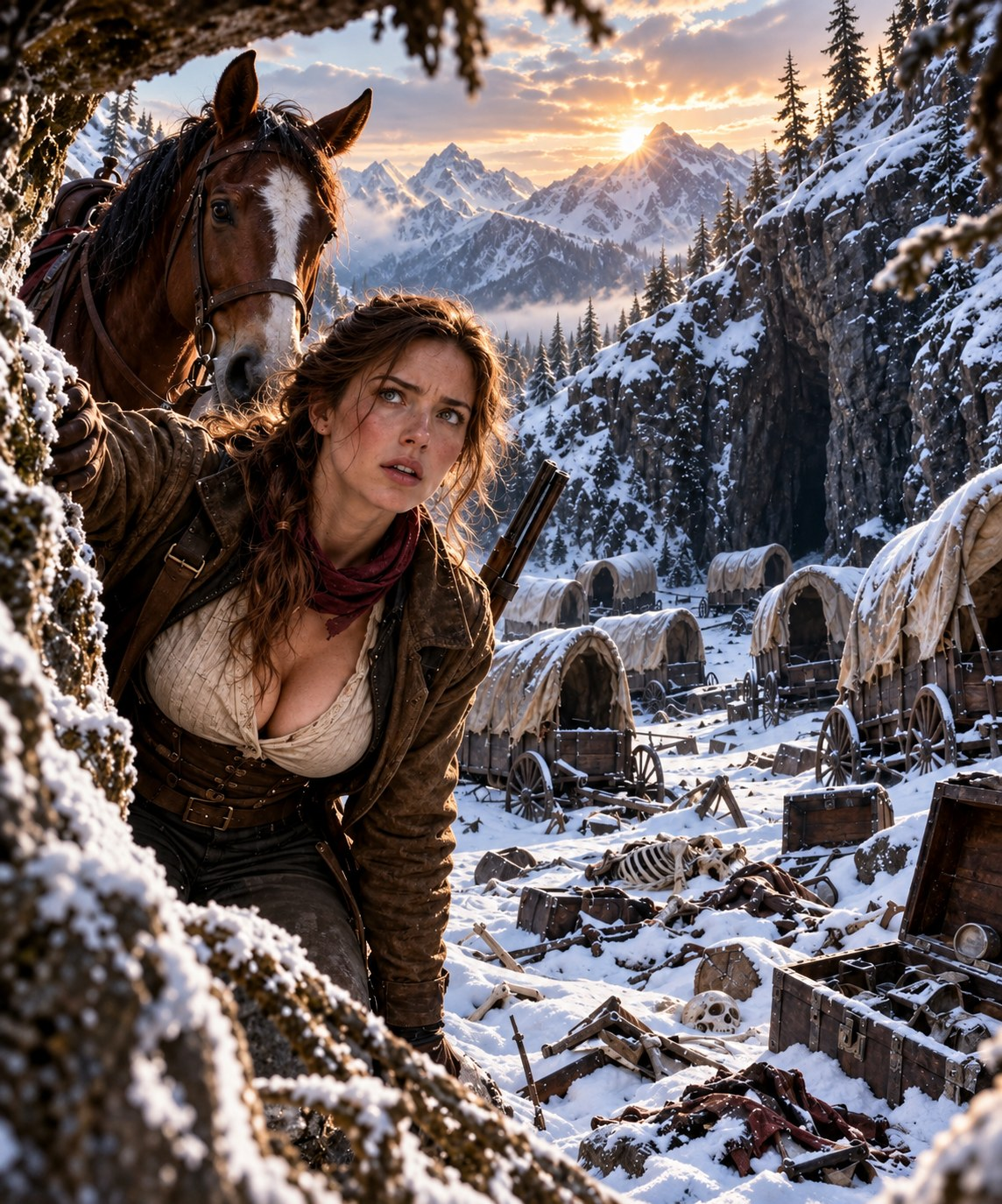
Beside it was a photograph of the six wagons.
I had found it among my father's papers.
The six vehicles stood beneath the mountain ridge.
Their canvas coverings were torn.
Their wooden wheels were damaged.
But they were still there.
I looked at the photograph.
The wagons had waited nearly fifty years for someone to understand what they carried.
And now their story could finally be told.
Samuel approached me.
He was walking more slowly these days.
His injured arm had healed, though he still complained about the cold.
He looked at the photograph.
"Your grandmother would have liked this."
I smiled.
"I wish I could have met her."
Samuel nodded.
"She would have liked you too."
He placed a hand on my shoulder.
Then he looked toward William.
"Both of you."
My brother smiled.
For a moment, I imagined what our lives might have been like if the family had never been separated.
Perhaps we would have grown up together.
Perhaps Thomas would have taught us both to repair wagons.
Perhaps Caroline would have told us stories beside the stove.
Perhaps Samuel would have visited every Sunday.
But there was no point in building a life around what had never happened.
We had something else now.
A future.
On the anniversary of my father's death, I rode Juniper to the eastern ridge.
I carried his old Winchester.
His brass compass.
And the photograph of the six wagons.
The trail was familiar now.
I knew every bend.
Every fallen tree.
Every narrow section where Juniper needed to slow down.
I stopped at the granite boulder.
The six lines were still carved inside the circle.
I dismounted and placed my hand against the stone.
For a long time, I stood there.
Then I removed a small brass plaque from my saddlebag.
It carried my father's name.
THOMAS WHITFIELD.
HUSBAND. FATHER. FRIEND.
He had not been perfect.
He had kept secrets.
He had made mistakes.
But he had spent his life trying to protect people who could not protect themselves.
I attached the plaque beneath the old carving.
Then I unfolded the final letter he had left me.
I had read it many times.
But there was one sentence I had never fully understood.
Remember that you were loved long before you knew the truth.
I finally understood.
My father hadn't wanted me to inherit a fortune.
He hadn't wanted me to inherit a company.
He had wanted me to inherit the freedom to choose who I would become.
And that was worth more than anything Silas Crowell had ever owned.
I folded the letter and placed it inside my coat.
Then I climbed onto Juniper.
When I returned to Coldwater, William was waiting outside the workshop.
Samuel was sitting on the porch.
Elizabeth had brought a basket of fresh bread.
Caleb was repairing a wagon wheel.
Arthur had arrived with the final court documents.
Everyone was there.
Not because someone had called a meeting.
Not because there was another secret to uncover.
But because we had finally become a family.
I dismounted.
William took Juniper's reins.
"How was the ride?"
"Beautiful."
Samuel looked toward the mountains.
"Did you visit the wagons?"
I nodded.
"And Father?"
I smiled.
"I think he would have been proud."
Elizabeth came forward and embraced me.
For the first time, I didn't feel that I was standing between two different families.
I was simply home.
The old workshop door stood open.
Inside, my father's tools were arranged along the wall.
The repair journal rested on the workbench.
And above it, William had hung a new wooden sign.
WHITFIELD AND REED WAGON WORKS.
I looked at him.
"You're serious?"
He smiled.
"Someone has to keep Father's business alive."
I laughed.
"Then we'd better get to work."
We walked inside together.
Outside, the irrigation channels carried fresh water toward the farms.
The reservoir belonged to the families again.
The missing names had been restored.
The false mortgage had been destroyed.
The truth about the six wagons had finally been recorded.
And the people who had spent generations living beneath the shadow of the Crowell family were free to build their own futures.
I had ridden into the mountains alone.
I had returned with the truth.
But the greatest thing I brought home wasn't a deed, a fortune, or a collection of old documents.
It was my family.
And this time, nobody would ever take that away from us.






Comments 0