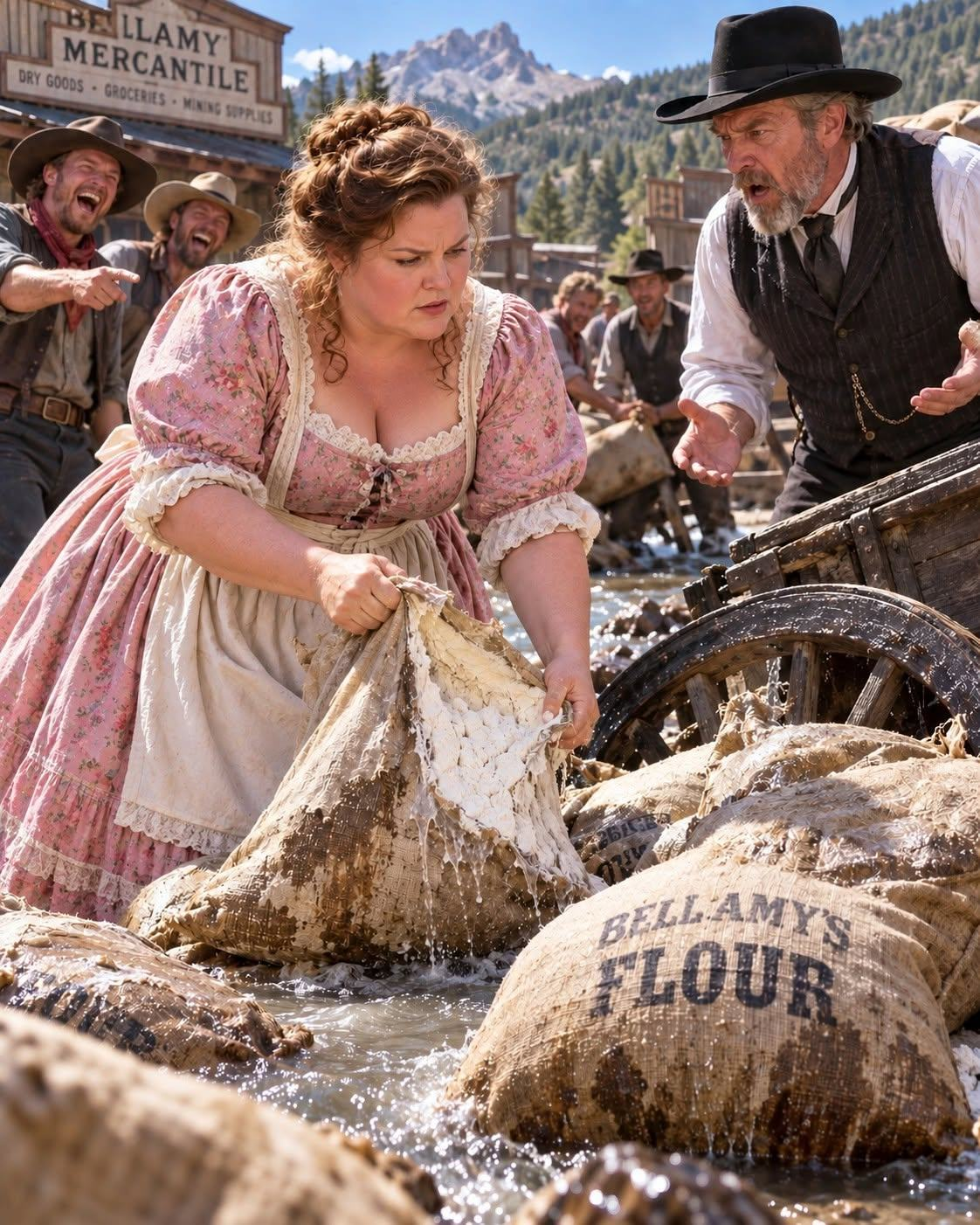
Dorothy Vance stared at the piece of burlap resting in her palm.
"Miss Vance, this came from underground."
The young miner stood outside the cookhouse, breathing heavily.
Dorothy turned the cloth over.
The faded lettering was unmistakable.
BELLAMY'S FLOUR.
She examined the torn edges. The burlap was damp, dirty, and stained with something dark.
"Where exactly did you find this?"
"In the sealed passage near the eastern shaft."
"Who found it?"
"Two timber workers. They were checking the old supports when one of them noticed something caught between the rocks."
Dorothy looked toward the mountain.
"Did they find anything else?"
The miner hesitated.
"An empty flour sack. And some footprints."
"How many?"
"Three different sets, according to the shift boss."
Dorothy folded the cloth.
"Take me there."
The young man shook his head.
"Mr. Grant ordered everyone to stay away."
"Then we'll speak to Mr. Grant."
She picked up her coat and followed him toward the foreman's office.
The morning had been unusually quiet.
Men were entering the mine in small groups, carrying tools and lunch tins. A few stopped to watch Dorothy as she crossed the yard.
She was not a familiar sight among the mining crews.
Most women in Copper Jack worked in boardinghouses, laundries, or the small shops along the main road.
A woman walking toward the mine office with a serious expression attracted attention.
Dorothy ignored it.
She had learned that curiosity was often harmless.
Suspicion was different.
And she was beginning to suspect that somebody had been moving supplies through places where nobody was supposed to be working.
Silas Grant was standing over a large mining map when Dorothy entered.
He looked up immediately.
"Miss Vance. I told you to keep the kitchen running."
"I found something."
She placed the burlap on his desk.
Grant stared at it.
His face changed.
"Where did you get this?"
"One of your miners brought it to me."
Grant picked it up.
He turned it over.
Then he looked toward the young man standing behind Dorothy.
"Who sent you?"
"Nobody, sir. I thought you ought to know."
Grant put the burlap down.
"Did anyone else see it?"
"The timber crew."
"Who else?"
The miner named two men.
Grant closed his eyes briefly.
"All right. You may go."
The young man left.
Dorothy remained.
Grant examined the cloth again.
"Bellamy's shipment."
"That's what I thought."
"How much of it was found?"
"An empty sack, apparently."
"An empty sack doesn't prove anything."
"No. But the sack came from a shipment that was supposedly damaged at the creek."
Grant looked at her.
"You're suggesting someone carried flour into the mine?"
"I'm suggesting someone carried something made from that shipment underground."
He leaned against the desk.
"Why would anyone do that?"
Dorothy did not answer immediately.
She looked at the mining map.
The eastern shaft was marked with a thick black line. Several smaller passages branched away from it.
One had been crossed out.
Another was marked SEALED.
"Could the sack have been used to carry something other than flour?"
"Possibly."
"Tools? Ore? Something else?"
Grant nodded slowly.
"That would make more sense."
"Then somebody has been using the old passage."
Grant rubbed his jaw.
"I'll send a crew to inspect it."
"Carefully?"
"Of course."
Dorothy looked at him.
"Mr. Grant, if the passage was sealed for a reason, I wouldn't send men inside until you know why."
He studied her for a moment.
"You're a cook, Miss Vance."
"Yes."
"Not a mining engineer."
"That's true."
"Then perhaps you should leave this to people who understand the mountain."
Dorothy placed both hands on the desk.
"And perhaps the people who understand the mountain should explain why a flour sack from a creek-side shipment ended up inside a sealed tunnel."
Grant did not answer.
She turned toward the door.
"One more thing."
He looked up.
"If the sack was carried underground, somebody knows where the rest of the flour went."
Dorothy left before he could respond.
By midday, the cookhouse was crowded.
The miners had returned from their morning shifts, and Eddie Morris was trying to keep the serving line moving.
Dorothy entered through the kitchen door.
"How many?"
"Sixty-two."
"Any late arrivals?"
"Four expected in the next half hour."
"Then prepare another pot of beans."
Eddie nodded.
Dorothy removed her coat and washed her hands.
She had promised Grant a properly organized kitchen.
She intended to keep that promise, regardless of what was happening underground.
The problem was that the pantry was becoming harder to manage every day.
The flour shortage was especially serious.
Ordinary biscuits were among the cheapest and most filling foods she could prepare.
Without enough flour, the mine would need to purchase more expensive provisions.
That meant fewer meals for the same budget.
She opened her notebook.
The salvage operation had produced several small quantities of usable flour, but she still needed a dependable method for determining which portions were suitable for cooking.
She could not simply call the entire shipment rescued.
Some of it had to be discarded.
Some could perhaps be used for non-food purposes.
And some, after careful examination, might be safe enough for a controlled kitchen test.
Dorothy returned to her shed that afternoon.
She brought a fresh supply of clean cloth and several small containers.
Her first task was to separate the remaining sacks.
She marked each one with its condition and date of inspection.
The completely submerged sacks remained untouched.
She had no intention of using them.
The partially wet sacks were opened only where the interior could be examined without dragging contaminated material through the dry portions.
The remaining flour was sifted, checked, and kept separate.
She worked slowly.
Every movement had a purpose.
By the time she finished, she had recovered another modest quantity of flour.
It was not enough to feed the mine for a week.
But it was enough for several controlled tests.
Dorothy looked at the small pile.
Then she remembered something her first employer in Wyoming had once told her.
A cook who could make expensive ingredients taste good was useful.
A cook who could make inexpensive ingredients go further was indispensable.
She had never forgotten it.
The next morning, Dorothy began experimenting with a different biscuit mixture.
She used a small quantity of the flour that had passed her inspection.
She added fresh lard, salt, and carefully measured liquid.
The first mixture was too stiff.
The second was too sticky.
She changed the proportions and tried again.
Eddie arrived while she was working.
He looked at the bowls.
"More biscuits?"
"Possibly."
"How many experiments have you done?"
"Enough to know that the first answer isn't always the right one."
He laughed.
"Mr. Grant asked whether you could make enough for the whole crew."
Dorothy continued kneading.
"Tell him I can make enough from ordinary flour if he gives me enough ordinary flour."
Eddie leaned against the counter.
"And the creek flour?"
"That depends on what the tests tell us."
He watched her work.
"People say you're trying to turn six hundred pounds of mud into bread."
"People say many things."
"Some are betting you'll give up before the end of the month."
Dorothy stopped kneading.
"Who?"
"Bellamy's cowboys. The tall one and the fellow with the red neckerchief."
She resumed working.
"How much did they bet?"
Eddie laughed.
"Five dollars."
"That's generous."
"Why?"
"Because they'll probably need the money for something useful."
Eddie grinned.
Dorothy placed the dough on the table.
She cut small rounds and arranged them on a baking tray.
When the biscuits were ready, she removed them from the oven and placed them on a clean cloth.
She waited.
Then she broke one open.
The center was cooked evenly.
The texture was not quite what she wanted, but it was improving.
Eddie took a small piece after she offered it.
He chewed.
Then he looked at her.
"That's better."
"Better than what?"
"Better than yesterday."
Dorothy nodded.
She made a note.
A little less liquid.
A slightly different mixing time.
She was not looking for a miracle.
She was looking for consistency.
That afternoon, Dorothy visited the mine office again.
She carried a notebook containing her updated inventory.
Grant was speaking with two supervisors when she entered.
One was a thick-necked man named Walter Briggs.
The other was a narrow-faced clerk named Thomas Hale.
Both men stopped talking.
"Miss Vance," Grant said. "What is it?"
"I need to discuss the food budget."
Briggs looked at her.
"Again?"
Dorothy turned toward him.
"Yes. Unless you'd prefer to discuss the possibility of running out of food."
Briggs frowned.
Grant motioned for her to continue.
Dorothy opened her notebook.
"The current supply will last approximately twelve days at the present rate of consumption, assuming no unexpected losses."
Hale looked surprised.
"That's longer than I estimated."
"Your estimate doesn't account for the potatoes that need to be used first."
She showed him the figures.
"These quantities also assume that the kitchen receives the next meat shipment on schedule."
Grant examined the page.
"Can you stretch the provisions further?"
"Somewhat. But I won't reduce the portions below what the men need to work safely."
Briggs crossed his arms.
"Men have survived on less."
Dorothy looked directly at him.
"Then perhaps you should ask the men how well they worked while surviving on less."
Briggs opened his mouth.
Grant interrupted.
"That's enough, Walter."
Dorothy continued.
"I can reduce waste, improve portion control, and make better use of the beans and vegetables. But I need the supply records."
Hale shifted uncomfortably.
"Those records are kept in the office."
"Then I'd like access to them."
Grant nodded.
"Approved."
Briggs looked irritated.
"You're giving a cook access to mine records?"
"She's responsible for the food supply."
"She's not responsible for the mine."
Grant's voice became firm.
"Neither are you, Walter. You're responsible for your shift."
The room fell silent.
Dorothy closed her notebook.
She had not intended to create an argument.
But she was beginning to understand that the food shortage was only one part of a much larger problem.
Somebody was making decisions without proper authorization.
Somebody was moving supplies.
And somebody was determined to keep the matter quiet.
On her way back to the cookhouse, Dorothy passed a group of miners sitting near the equipment shed.
One of them was an older man with a deep scar across his chin.
He was holding a tin cup.
"You're the cook, aren't you?"
Dorothy stopped.
"Yes."
"Name's Samuel Price."
She nodded.
"What can I do for you?"
He looked toward the mountain.
"Is it true you're using Bellamy's creek flour?"
"I'm testing a small portion that remained dry inside the sacks."
Samuel gave a slow nod.
"My wife used to bake with flour that got wet during a river crossing."
Dorothy looked interested.
"How did she handle it?"
"She never used anything that smelled wrong. Said flour had to be treated with respect."
Dorothy smiled faintly.
"Your wife sounds sensible."
"She was."
He took another sip from his cup.
"She's gone now."
Dorothy lowered her eyes.
"I'm sorry."
Samuel shrugged.
"That's life."
He looked at her again.
"Those biscuits you made yesterday. The ones Eddie brought down?"
Dorothy looked up.
"You tried them?"
"Half of one."
"And?"
He gave a small smile.
"Reminded me of home."
Dorothy felt something warm in her chest.
"That's a good thing."
"Yes, ma'am."
Samuel stood carefully.
"Keep at it. Men around here don't always know what they need until somebody puts it in front of them."
Dorothy watched him walk away.
She thought about the bread Peter's mother had left at her shed.
She thought about the miners eating meals far from their families.
And she thought about the six hundred pounds of flour.
Perhaps the shipment had been damaged.
Perhaps much of it would never be useful.
But even a small quantity, handled properly, could make a difference.
The following day, the cowboys appeared outside her shed.
The tall one leaned against the doorframe.
"Morning, Miss Vance."
Dorothy continued sorting the flour.
"Good morning."
His companion stepped inside.
"We hear you've got a new recipe."
Dorothy did not look up.
"Who told you that?"
"Everybody."
The tall cowboy grinned.
"Somebody says your biscuits are good."
"Somebody has a better sense of taste than you."
The second man laughed.
The tall one did not.
He looked toward the flour sacks.
"Still think you'll make money from all that?"
"I intend to."
"How much?"
"Enough."
He shook his head.
"You know, we were only having a little fun the other day."
Dorothy finally looked at him.
"Was that what it was?"
He shifted his weight.
"Nothing personal."
"It rarely is."
The second cowboy picked up a small cloth bag from the table.
Dorothy's voice became sharp.
"Put that down."
He froze.
"It's only flour."
"It's my flour."
He replaced it.
The tall man looked uncomfortable.
"Bellamy says you might be trying to sell some of it to the mine."
Dorothy returned to her work.
"Bellamy should spend less time discussing my business."
"He says the mine won't buy it."
"Then Bellamy can keep his opinion."
The cowboys exchanged glances.
Before leaving, the tall man turned.
"There's something else you should know."
Dorothy waited.
"Somebody's been asking questions about the flour shipment."
"Who?"
"Don't know. A man from outside town."
"When?"
"Yesterday."
"Where?"
The cowboy hesitated.
"At Bellamy's store."
Dorothy looked up.
"What did he want?"
"He asked whether all the damaged sacks had been sold."
She stared at him.
"Did Bellamy answer?"
The cowboy nodded.
"He said he sold them to you."
The second man added, "Then the stranger asked where you were working."
Dorothy's hands became still.
"Did Bellamy tell him?"
"Yes."
The two men left.
Dorothy stood in the middle of the shed.
Someone from outside Copper Jack was interested in the damaged shipment.
And that interest had begun only after she purchased it.
She looked at the remaining sacks.
Then she checked the door.
For the first time since buying the flour, she wondered whether the shipment had been worth more than Bellamy had admitted.
That evening, Dorothy returned to the cookhouse with a tray of biscuits.
She placed them on the counter.
Eddie looked at them.
"Are those the new ones?"
"Yes."
He picked one up.
The surface was golden.
The inside was lighter than the previous batch.
He broke it in half.
"That's the best one yet."
Dorothy nodded.
She had finally found a mixture that behaved consistently in her small tests.
It still needed further evaluation before she could use the salvaged flour in larger quantities.
But the result was encouraging.
Grant entered the kitchen.
He took one biscuit.
"May I?"
"Go ahead."
He tasted it.
Then he took another bite.
"That's good."
"Thank you."
He looked toward the flour samples.
"How much can you produce?"
"From the inspected flour? A limited quantity."
"Enough for the next few days?"
"Possibly, if I continue separating the questionable portions and use only what passes inspection."
Grant nodded.
"That's better than nothing."
Dorothy placed the remaining biscuits on a clean tray.
"Mr. Grant, I need to ask you something."
"What?"
"Did anyone authorize the movement of flour through the old eastern passage?"
His expression changed.
"No."
"Are you certain?"
"Absolutely."
"Then someone has been moving supplies without your permission."
Grant looked toward Eddie.
"Leave us."
Eddie placed his cup down and stepped outside.
Grant lowered his voice.
"Miss Vance, I found something this afternoon."
He reached into his coat.
It was a small folded paper.
He opened it on the counter.
Dorothy recognized the handwriting immediately.
It was the same writing she had seen in the mine inventory.
The note contained a list of supplies.
Timber.
Rope.
Lamp oil.
Flour.
And beneath the quantities was a delivery instruction.
Dorothy read it twice.
"Where did you find this?"
"In the old eastern office."
"Who wrote it?"
Grant shook his head.
"I don't know."
Dorothy looked closer.
There was a date.
September 17.
And a location.
The sealed passage.
Grant folded the paper.
"Someone has been using that passage for more than a week."
Dorothy felt her stomach tighten.
"Then the flour sack wasn't an accident."
"That's what I'm afraid of."
Before she could answer, the cookhouse door slammed open.
Eddie rushed inside.
"Mr. Grant!"
The foreman turned.
"What happened?"
"A timber crew just came back from the eastern shaft."
"And?"
Eddie swallowed.
"They found another sack."
Grant grabbed his coat.
"Where?"
Eddie looked at Dorothy.
"Inside the sealed passage."
Dorothy stepped forward.
"Is it empty?"
Eddie shook his head.
"No, ma'am."
He looked toward the mine.
"There's something inside it."
Grant moved toward the door.
"What?"
Eddie's voice dropped.
"A ledger."
Dorothy felt the room grow suddenly cold.
"Whose ledger?"
Eddie hesitated.
Then he reached into his coat and pulled out a dirty, water-stained book.
He opened the cover.
A name had been written across the first page.
RUFUS BELLAMY.
But beneath that name was a second signature.
One that Dorothy recognized immediately.
SILAS GRANT.






Comments 0