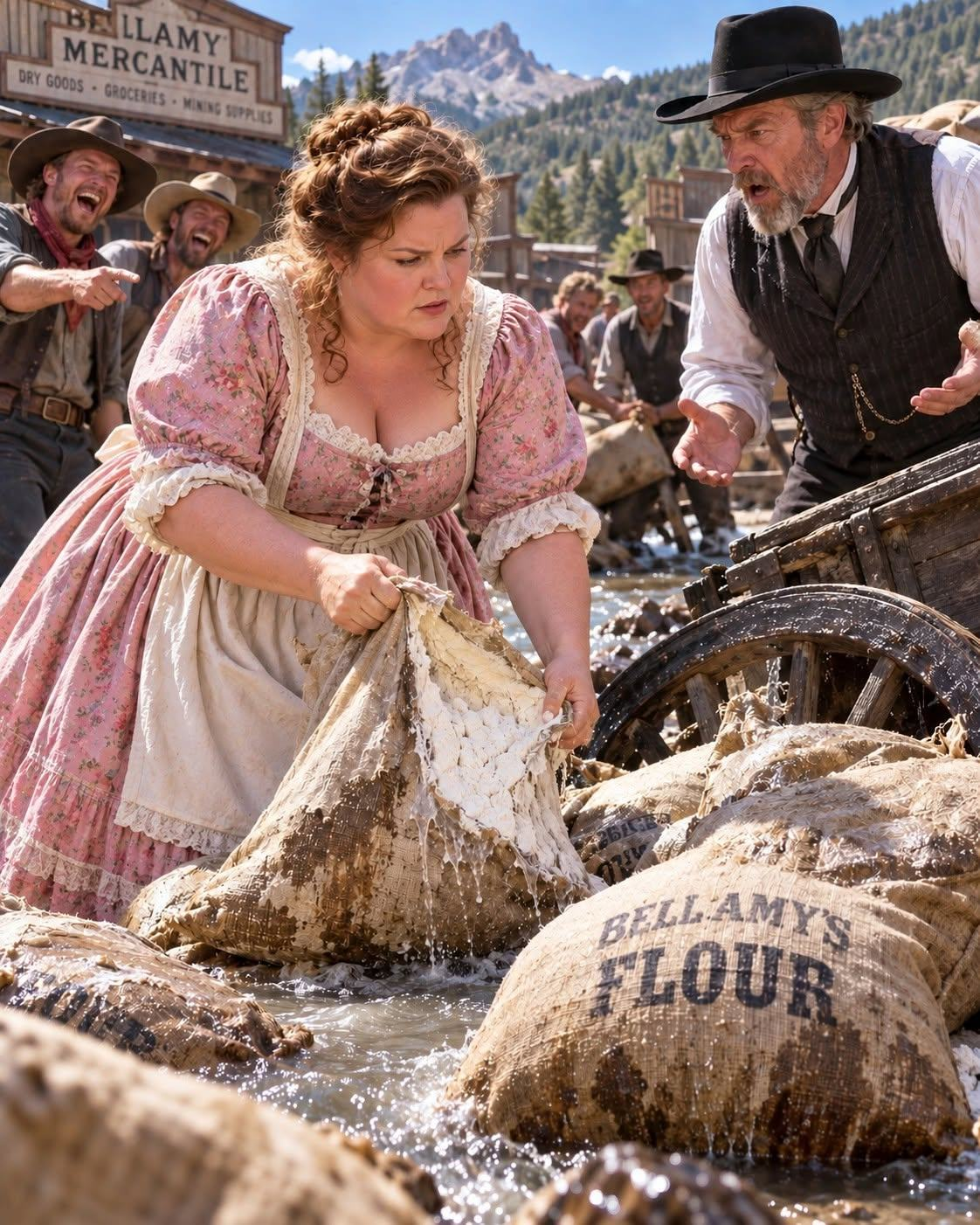
Dorothy Vance dragged a soaked flour sack out of the creek.
"Look at that! She's buying garbage!"
When Rufus Bellamy, the wealthiest merchant in Copper Jack, arrived, he found six hundred pounds of ruined flour piled beside his freight wagon.
One small section of a sack was still completely dry.
Dorothy had noticed it.
The merchant was about to make the most expensive mistake of his life.
Four weeks later, twenty-eight men would be waiting beneath a mountain, and the woman they had laughed at would become their only hope.
But that afternoon, nobody knew any of that.
All they saw was a large woman in a burgundy dress standing beside a muddy creek, holding a sack of flour that looked as though it had been buried in a swamp.
Dorothy Vance was thirty-five years old.
She weighed 270 pounds, had auburn hair arranged in a thick braided bun, and wore a mustard-brown apron over her Victorian working dress.
Her leather boots were covered in mud.
A few strands of hair had escaped around her face.
She looked tired.
She had been traveling for days, and the last thing she needed was another group of strangers deciding what she could or could not do based on her appearance.
Unfortunately, Copper Jack had already made its opinion known.
Three hours earlier, Dorothy had walked into Bellamy Mercantile looking for work.
She had arrived in town with thirty-seven dollars, two dresses, a bedroll, a canvas case of kitchen knives, and enough determination to keep herself moving through another winter.
She had spent twelve years cooking for men who rarely remembered her name.
Cattle camps.
Freight stations.
Boarding houses.
A hotel kitchen outside Helena.
She knew how to feed sixty hungry men with twenty pounds of beef. She knew how to turn inexpensive ingredients into meals that made exhausted workers feel human again.
Most importantly, she knew how to manage a kitchen without wasting money.
That skill had cost her twelve years to develop.
And she was tired of watching other people profit from it.
The first place she visited was the Copper Jack Mine cookhouse.
The manager barely looked at her.
"We've filled the position."
Dorothy asked whether he knew anyone else who needed a cook.
He shook his head.
The second place was the town hotel.
Its kitchen supervisor examined her from head to toe.
"We need somebody quicker."
Dorothy did not argue.
She had heard that particular insult in several different forms.
The third place was Bellamy Mercantile.
Rufus Bellamy sat behind a polished wooden counter surrounded by shelves of coffee, canned peaches, lamp oil, tobacco, dry goods, and mining supplies.
He was fifty-two, with sandy blond hair streaked with gray and the carefully maintained appearance of a man who considered himself important.
He read Dorothy's application.
Then he looked at her.
Then he looked at the application again.
"You're Dorothy Vance?"
"Yes, sir."
"I need somebody who can move fast."
"I can."
His eyes traveled toward her waist.
Dorothy knew what he was thinking.
She had known men like him for years.
"My aisles are narrow," Bellamy said.
Two cowboys drinking coffee beside the stove exchanged glances.
One of them covered a grin with his cup.
Dorothy placed both hands on the counter.
"Are you asking whether I know I'm fat?"
Bellamy cleared his throat.
"I'm discussing practical concerns."
"So am I."
She leaned forward slightly.
"Can your last cook make biscuits?"
"He was adequate."
"Can he make gravy without burning the flour?"
Bellamy said nothing.
"Can he stretch twenty pounds of beef across sixty plates without making sixty men feel cheated?"
The cowboys stopped talking.
Dorothy continued.
"Can he look at a pantry and tell you within five dollars what next week's shortages will be?"
Bellamy closed the application.
"I can offer twenty dollars a month and a room."
Dorothy almost laughed.
She had earned more at the worst cattle camp she had ever worked.
"No."
His expression hardened.
"That's the offer."
"Then you still need a cook."
She collected her hat and walked out.
The two cowboys followed her onto the porch.
One was tall and narrow-faced. The other wore a faded blue shirt and a red neckerchief.
The second man called after her.
"Ma'am! Be careful in that kitchen. Wouldn't want you melting into the biscuits!"
His companion burst into laughter.
Dorothy stopped for half a second.
She could have turned around.
She could have told them exactly what she thought of their intelligence.
Instead, she continued walking.
Twelve years around men who enjoyed humiliating women had taught her something.
Some people did not want an argument.
They wanted evidence that they had hurt you.
Dorothy refused to give them that evidence.
She reached Copper Jack Creek shortly before noon.
That was when she heard the shouting.
A freight wagon had slipped sideways into a hidden channel near the ford.
One wheel was almost underwater.
Several men were unloading sacks as quickly as they could.
Flour.
Hundreds of pounds of it.
Dorothy recognized Bellamy's name printed across the burlap.
She also recognized the merchant himself when he came hurrying down the muddy bank.
"What happened?"
The wagon driver wiped his forehead.
"Wheel dropped into a hole. Eight sacks went completely under. Maybe thirty more caught water."
Bellamy grabbed one sack and pressed his palm against it.
Gray paste squeezed between the burlap fibers.
"Ruined."
The driver hesitated.
"Some might still be—"
"Ruined!" Bellamy repeated.
He threw the sack down.
Dorothy stood several feet away, watching.
She was not watching the men.
She was watching the flour.
That distinction mattered.
For twelve years, she had worked in kitchens where money was scarce and waste could mean somebody went hungry.
She had learned to recognize the difference between something that was damaged and something that was useless.
Those were not always the same thing.
Eight sacks had been completely submerged.
They were probably lost.
Some others were soaked halfway through.
But several sacks had only been splashed along the outside.
The burlap was wet.
The flour inside might not be.
Dorothy walked closer.
She crouched beside one of the sacks.
Bellamy noticed her.
"Careful. That stuff is worthless."
Dorothy did not answer.
She pressed the outside of the burlap gently.
Then she examined the stitching along the top.
There was a small tear near the seam.
Through it, she could see pale flour.
Not gray.
Not muddy.
White.
She touched a tiny amount with the tip of her finger.
It felt dry.
She rubbed it between her thumb and forefinger.
The texture was still fine.
Her eyes moved toward the next sack.
Then the next.
Bellamy watched her with growing irritation.
"What exactly are you doing?"
"Looking."
"At what?"
"Your flour."
He gave a short, dismissive laugh.
"My flour is ruined."
"Some of it."
"All of it."
Dorothy straightened.
"How much are you asking for the damaged shipment?"
Bellamy stared at her.
For a moment, he seemed unable to understand the question.
"You want wet flour?"
"Some of it isn't wet inside."
The tall cowboy from the mercantile had followed the commotion down to the creek.
He recognized Dorothy immediately.
"Well, I'll be damned."
His companion joined him.
"She's going to bake with creek water!"
Both men laughed.
Dorothy ignored them.
She turned toward the freight driver.
"How many sacks were on the wagon originally?"
"Forty."
"And how many were completely submerged?"
"Eight."
"How many are only wet along the outside?"
The driver scratched his beard.
"Couldn't tell you."
"Did anyone cut them open?"
"No."
"Then nobody knows."
Bellamy crossed his arms.
"Miss Vance, I don't have time for this."
Dorothy looked at him.
"Neither do I."
The answer caught him off guard.
She pointed toward the sacks.
"I want to examine them before you throw them away."
"You want to examine garbage?"
"I want to examine flour."
Bellamy looked toward the cowboys.
They were enjoying the conversation.
He decided to entertain them.
"Fine. Take a look. Perhaps you'll discover gold in there."
Dorothy knelt again.
She inspected the seams of three sacks.
One was completely ruined.
Another had water damage extending through most of the contents.
The third had a wet outer layer, but its center remained dry.
She separated the possibilities in her mind.
Dry flour.
Partially damp flour.
Completely soaked flour.
Each category had a different use, if handled properly.
She had not yet worked out the entire process.
But she knew there was something worth investigating.
"How much?" she asked again.
Bellamy sighed.
"Six hundred pounds."
"I can see that."
"Then you can also see that it's worth nothing."
"Nothing to you."
His face tightened.
Dorothy reached into her apron and counted her money.
Thirty-seven dollars.
She needed that money for food, lodging, and the journey ahead.
She had planned to save enough to purchase a used chuck wagon.
She knew exactly what she was risking.
But she also knew that six hundred pounds of flour could become an extraordinary resource if she handled it correctly.
"How much will you take for the entire damaged shipment?" she asked.
Bellamy laughed.
"You intend to buy all of it?"
"Yes."
The four men behind him erupted.
The tall cowboy slapped his thigh.
"She's buying six hundred pounds of mud!"
His companion nearly doubled over.
Bellamy looked at Dorothy's purse.
Then at the flour.
Then back at Dorothy.
He saw an opportunity to recover a little money from something he had already decided to discard.
"Five dollars."
Dorothy studied him.
"Three."
"Four."
"Three, and you load every sack onto the wagon."
Bellamy narrowed his eyes.
"You don't have a wagon."
"Then I'll arrange one."
He glanced toward the cowboys.
They were still smiling.
He extended his hand.
"Three dollars."
Dorothy shook it.
She counted three dollars into his palm.
It was almost a tenth of everything she owned.
Bellamy pocketed the money.
"Well, Miss Vance, I hope you enjoy your purchase."
"I expect I will."
The merchant shook his head.
He turned toward his driver.
"Get those sacks out of my way."
Dorothy watched the men begin moving the flour.
She did not celebrate.
She did not smile.
She simply started making a list in her head.
A place to dry the flour.
Clean cloth.
Fresh water.
Enough space to separate the damaged portions.
A way to protect the usable flour from insects and moisture.
And, most importantly, time.
She needed time.
A wagon creaked somewhere behind her.
Dorothy turned.
A small wooden cart had arrived beside the road.
Its driver was an older man she had not seen before.
He looked at the sacks.
Then at Dorothy.
"You're the one buying Bellamy's ruined shipment?"
"Yes."
He shook his head.
"That's an unusual investment."
"Most useful things look unusual before somebody knows what to do with them."
The old driver gave a quiet laugh.
"Where do you want them?"
Dorothy looked toward the far end of town.
There was an abandoned storage shed near the creek, once used by a freight company.
She had noticed it while walking into Copper Jack.
Its roof appeared intact.
It might provide enough room for her work.
"That shed near the eastern road," she said.
The driver nodded.
"I know the place."
They began loading.
Dorothy insisted on keeping the sacks separate.
She marked the worst ones with a piece of charcoal.
The partially wet ones went into another group.
The sacks that seemed dry inside were kept apart.
The cowboys watched.
One of them called out.
"Don't forget to save some for breakfast!"
Dorothy did not turn around.
She was counting.
One sack.
Two.
Three.
She checked each one.
By the time the last sack was loaded, the sun had moved lower behind the mountain ridge.
Bellamy had returned to his store.
The cowboys had gone back to their coffee.
And Dorothy Vance had just spent three dollars on six hundred pounds of damaged flour.
She climbed onto the cart beside the driver.
Her hands smelled of wet burlap.
Her dress was muddy.
Her stomach was empty.
But for the first time since arriving in Copper Jack, she felt she had found something that belonged to her.
Not a job.
Not a room.
Not another man's kitchen.
An opportunity.
She looked back at Bellamy Mercantile.
The sign swung slightly in the afternoon breeze.
The driver followed her gaze.
"People around here won't understand what you're trying to do."
Dorothy adjusted her bonnet.
"They don't have to."
He nodded toward the sacks.
"Still, I'd be careful. Some of that flour might be worse than you think."
Dorothy looked at the nearest sack.
A small patch of white flour was visible through the torn seam.
She had seen enough to know that the shipment was not entirely lost.
But she had not yet tested how much of it could be saved.
"Then I'll find out," she said.
The cart began moving.
Behind them, laughter rose from the mercantile porch once more.
Dorothy did not look back.
She had no idea that within four weeks, the same men who had mocked her would be searching for her in the middle of the night.
And she certainly did not know that twenty-eight miners would soon be trapped beneath Copper Jack Mountain.
For now, she had six hundred pounds of flour, three dollars less than she had owned that morning, and an abandoned shed to turn into a kitchen.
Then, just as the cart reached the eastern road, the driver suddenly pulled the reins.
A rider was approaching from the direction of the mine.
His horse was exhausted.
His face was pale.
And he was carrying a folded piece of paper bearing the official seal of Copper Jack Mine.
He looked directly at Dorothy.
"Are you Dorothy Vance?"
She nodded.
The rider glanced at the flour sacks.
Then he looked back at her.
"There's something you need to know about the mine."
Lưu ý về độ dài: Bộ truyện gồm 12 chương, mỗi chương khoảng 2.000 từ (tổng khoảng 24.000 từ). Để giữ chất lượng và không bị cắt giữa chừng, truyện cần được gửi thành nhiều lượt liên tiếp.
Chương 1 đã hoàn thành ở trên. Các chương tiếp theo sẽ nối trực tiếp từ cảnh người đưa tin xuất hiện, giữ nguyên nhân vật, diễn biến cốt lõi, mốc thời gian năm 1893 và hướng kết thúc có hậu ở Chapter 12.






Comments 0