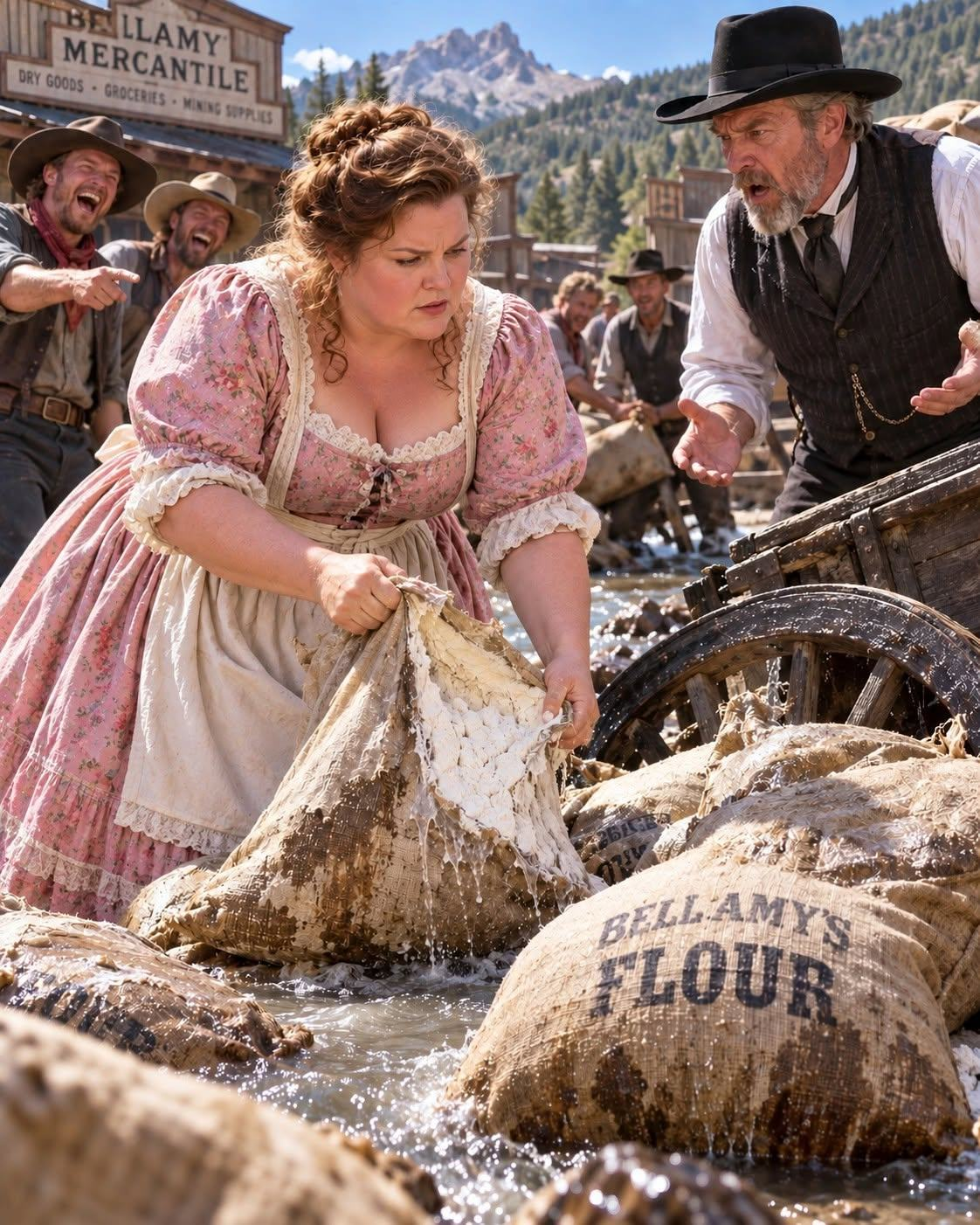
The rider pulled his exhausted horse to a stop beside Dorothy's cart.
"There's something you need to know about the mine."
Dorothy looked at the folded paper in his hand.
"What happened?"
The man glanced toward the flour sacks.
"Nothing yet. That's the trouble."
He dismounted, almost losing his balance when his boots touched the muddy road. His coat was covered in dust, and a dark streak of sweat ran beneath his hat.
"My name's Caleb Turner. I'm a messenger for Copper Jack Mine."
Dorothy nodded.
"All right, Mr. Turner. What does that have to do with me?"
He looked uncomfortable.
"Probably nothing. But I was told to find anyone who might be willing to take a temporary cooking position."
Dorothy almost laughed.
She had spent the entire morning asking for work.
Now, after purchasing six hundred pounds of damaged flour, somebody had finally come looking for a cook.
"Who sent you?"
"Foreman Silas Grant."
Dorothy knew the name. She had heard it mentioned during her walk through town.
"Didn't the mine already fill its cooking position?"
Turner shifted his weight.
"The regular cook is leaving."
"Why?"
"His wife is sick. He's taking her back to Helena."
Dorothy considered the offer.
"How much does the mine pay?"
"Thirty dollars a month, plus meals and a room."
It was better than Bellamy's offer.
Not by a little.
Dorothy glanced at the cart.
"Is that all?"
Turner frowned.
"What do you mean?"
"Does the position come with authority over the kitchen, the pantry, and the food budget?"
He seemed surprised by the question.
"I suppose."
"Suppose isn't an answer."
Turner rubbed his forehead.
"I don't handle those arrangements. You'd have to speak with Grant."
Dorothy looked toward the distant mine buildings.
She had already learned that a good salary meant very little if the employer expected her to accept every insult that came with it.
"Tell Mr. Grant I'll speak with him tomorrow."
Turner nodded.
Then his eyes moved toward the flour.
"You're really taking that stuff?"
"Yes."
"Bellamy said it was ruined."
"Bellamy isn't a cook."
Turner looked at the sacks again.
"Well, I hope you know what you're doing."
"So do I."
He climbed back onto his horse.
Before riding away, he turned once more.
"There's something else. The mine's been having trouble with its supply deliveries. The freight road is getting worse, and winter is coming early."
Dorothy looked at the mountain.
That mattered.
A mining town with unreliable deliveries could not afford to waste food.
"How many men?"
"Almost three hundred underground and around the surface operation combined."
"How many eat at the cookhouse?"
"Usually between sixty and seventy at a time."
Dorothy nodded slowly.
She had cooked for larger groups.
"Tell Mr. Grant I want to inspect the pantry before agreeing to anything."
Turner tipped his hat.
Then he rode toward town.
Dorothy watched him disappear.
The old cart driver cleared his throat.
"Thirty dollars a month sounds better than buying creek flour."
"It does."
"Perhaps you ought to reconsider."
Dorothy looked at him.
"Perhaps."
But she did not ask him to turn the cart around.
The storage shed stood at the eastern edge of Copper Jack, just beyond the last row of houses.
It had once belonged to a freight company that had gone out of business.
The building was weathered but sturdy.
Its roof needed repairs along the northern edge, and one shutter hung loosely from its hinges.
Still, it had a wide wooden floor, two small windows, and enough room to store the flour away from the damp ground.
Dorothy stepped down from the cart.
"How much do I owe you?"
The driver named a modest price.
She paid him and thanked him.
Then she stood alone in front of her new purchase.
Six hundred pounds.
It looked considerably larger when it was no longer somebody else's problem.
Dorothy took off her bonnet and tied her sleeves back.
The first task was unloading.
She did not rush.
Each sack had to be inspected before it went inside.
The completely submerged sacks went near the doorway.
The partially soaked sacks were placed along the southern wall.
The sacks with dry interiors went on a raised wooden platform.
She used scraps of charcoal to mark them.
One line for completely ruined.
Two lines for questionable.
Three lines for potentially salvageable.
She had learned that organization was often the difference between a kitchen and a disaster.
By the time the last sack was inside, her back ached.
Her hands were sore.
And her stomach was reminding her that she had eaten nothing since breakfast.
She opened her canvas case.
Inside were six kitchen knives, a wooden spoon, a small rolling pin, and several tools she had collected during her years of work.
She removed a narrow-bladed knife.
Then she approached the first questionable sack.
The burlap was damp, but the stitching was still intact.
Dorothy carefully opened the seam.
A cloud of pale powder rose into the afternoon light.
She held her breath.
The flour looked clean.
She placed a small amount on a piece of dry cloth.
Then she examined it.
No visible mud.
No dark discoloration.
No unpleasant smell.
She rubbed it between her fingers.
The center was dry.
She moved to the next sack.
This one was worse.
The flour near the outside had become sticky, while the center remained mostly dry.
She separated the two portions.
Then she moved to another.
By sunset, she had examined eleven sacks.
Four were completely unusable.
Three contained substantial wet sections.
Four had enough dry flour to justify further testing.
Dorothy sat back on her heels.
It was not a fortune.
But it was a beginning.
She looked toward the window.
The sunlight had turned orange.
Somewhere in town, a bell rang.
She realized she had been working for hours without noticing the time.
Her stomach growled again.
Dorothy laughed softly to herself.
"All right. Supper first."
She had no proper stove in the shed.
No table.
No kitchen shelves.
But she did have a small iron pot, a fire grate, and enough dry kindling to prepare something simple.
She made a thin vegetable stew from the few ingredients she had carried with her.
Then she ate sitting on an overturned crate.
It was not an impressive meal.
But it was hers.
For the first time in years, nobody was standing behind her telling her to work faster.
Nobody was complaining about the size of her body.
Nobody was deciding whether she deserved to be in a kitchen.
She washed her spoon and placed it beside her knives.
Tomorrow would be difficult.
She needed clean water, fresh cloth, a drying rack, and permission to use the abandoned shed for longer than a few days.
She also needed money.
Thirty-four dollars remained.
She could not afford many mistakes.
The following morning, Dorothy woke before sunrise.
She washed her face with cold water and braided a loose strand of auburn hair back into place.
Then she examined the flour again.
The sacks had remained dry overnight.
That was encouraging.
She began separating the flour into smaller quantities.
The wet portions required special attention.
Simply leaving them exposed would invite contamination.
She would have to remove any muddy material, separate usable sections, and dry the flour carefully in thin layers.
It would take time.
It would also require clean equipment.
She wrote a list.
Then she folded the paper and put it in her apron pocket.
At seven o'clock, she walked into town.
The first stop was the blacksmith.
She asked whether he could make a simple iron frame for drying trays.
He examined her sketch.
"What's it for?"
"Flour."
"You're still working on that creek shipment?"
"Yes."
He shook his head.
"I heard about that."
Dorothy waited.
He smiled awkwardly.
"People are talking."
"People usually are."
The blacksmith studied the drawing again.
"Could make it for two dollars."
"One dollar and fifty cents."
"One seventy-five."
She agreed.
Next, she visited a general household supplier and purchased clean muslin cloth.
She bought two wooden sieves from a widow who operated a small kitchenware stall.
She also found a used wooden table.
It was scratched, uneven, and missing one small section of trim.
But it was sturdy.
She paid for it and arranged to have it delivered.
By the time she reached Bellamy Mercantile, the town was fully awake.
Two miners were carrying supplies toward the mine road.
A woman was sweeping the porch of the hotel.
The same two cowboys who had mocked Dorothy the previous day were standing outside Bellamy's store.
The tall one spotted her.
"Well, look who's back."
Dorothy continued toward the entrance.
His companion grinned.
"How's breakfast? Still tasting like the creek?"
The tall man laughed.
"Maybe she can sell mud pies to the miners."
Dorothy stopped.
She turned toward them.
"That depends."
The men looked at her.
"On what?" the second cowboy asked.
"Whether they have better manners than you."
A nearby shopkeeper covered a smile.
The cowboys looked offended.
Dorothy entered the mercantile.
Bellamy was behind his counter, writing in a ledger.
He looked up.
"Miss Vance."
"Mr. Bellamy."
"Come to buy more flour?"
"No. I need clean muslin, two pounds of salt, a sack of dried beans, and a small quantity of lard."
Bellamy reached for his ledger.
"Anything else?"
"Two bars of soap."
He began calculating.
While he worked, Dorothy noticed several fresh flour sacks stacked near the back wall.
"How much is your regular flour?"
Bellamy named his price.
Dorothy studied the sacks.
"Has your supplier been reliable?"
"Usually."
"Usually isn't always."
Bellamy looked up.
"Are you giving me business advice?"
"I'm asking a question."
"Then yes. Deliveries have been inconsistent."
Dorothy nodded.
"How long can you keep your shelves stocked?"
"That depends on the freight road."
She looked toward the window.
"Winter could make things difficult."
Bellamy closed the ledger.
"Are you suggesting I should have bought your creek flour?"
"No."
"Good."
"I'm suggesting you should stop assuming that every damaged shipment is worthless."
His mouth tightened.
"Miss Vance, I sell merchandise. I don't conduct experiments."
Dorothy collected her purchases.
"Sometimes those are the same thing."
She walked out.
Bellamy watched her leave.
For the first time, his expression contained something other than amusement.
He was beginning to wonder what she intended to do.
By noon, Dorothy had returned to the shed.
The blacksmith's assistant delivered the iron frame.
The table arrived shortly afterward.
She arranged the tools, spread the clean muslin, and began working through the flour.
Her process was slow.
She opened each sack carefully.
She separated the visibly wet flour from the dry interior.
She sifted the usable portions.
Then she spread thin layers across clean cloth.
The warm afternoon air would help remove residual moisture, but she understood that appearance alone could not establish whether the flour was safe.
She kept the questionable portions separate.
Anything with an unpleasant smell, visible dirt, or signs of spoilage would be discarded.
She would not risk making somebody sick merely to prove that Bellamy had been wrong.
By midafternoon, she had filled three shallow trays with flour that appeared clean and dry.
She examined a small amount between her fingers.
The texture was encouraging.
She had saved something.
Not all six hundred pounds.
Perhaps not even half.
But enough to justify continuing.
A knock sounded at the open doorway.
Dorothy turned.
A young boy stood outside holding a wooden bucket.
He looked about twelve.
His clothes were worn, and one boot had a patch tied around its toe.
"Are you Miss Vance?"
"Yes."
"Mr. Bellamy sent me."
Dorothy wiped her hands.
"What does he want?"
The boy looked at the flour.
"He said to tell you that he wants the three dollars back."
Dorothy blinked.
"Why?"
"He says you bought something that wasn't yours to sell."
Dorothy stared at him.
For a moment, she thought she had misunderstood.
"Did he say that?"
The boy nodded.
"He says the driver shouldn't have let you take the shipment."
Dorothy placed the cloth on the table.
"What's your name?"
"Peter."
"Peter, did you see the driver load those sacks onto my cart?"
"Yes, ma'am."
"Did you see me pay Mr. Bellamy?"
"Yes, ma'am."
"Then you can tell him that I bought the flour fair and square."
Peter nodded.
But he did not leave.
Dorothy noticed the way he was looking at the trays.
"Have you eaten today?"
The boy hesitated.
"A little."
"What does that mean?"
"My mother had some bread."
Dorothy looked at his thin face.
She had seen hunger before.
It was rarely dramatic.
Sometimes it simply made a child reluctant to answer an ordinary question.
She took a small piece of bread from her bag and handed it to him.
Peter accepted it cautiously.
"Thank you."
"You're welcome."
He ate quickly.
Dorothy watched him.
"Does your mother work?"
"She washes clothes at the hotel."
"And your father?"
Peter lowered his eyes.
"He died in the mine last winter."
Dorothy said nothing for a moment.
"I'm sorry."
Peter shrugged.
"Everybody dies somewhere."
The words sounded too old for him.
Dorothy felt something tighten in her chest.
"Not everybody."
He looked up.
She handed him another piece of bread.
"Take this home."
Peter hesitated.
"Mr. Bellamy said I shouldn't help you."
"Then you can tell him you didn't."
The boy almost smiled.
He slipped the bread into his pocket and left.
Dorothy watched him disappear down the road.
Then she returned to the flour.
She had not bought six hundred pounds of it simply to win an argument.
But she was beginning to understand that the people who needed food most were often the same people who had the least power to obtain it.
Late that afternoon, Dorothy carried a small sample of the salvaged flour to the hotel kitchen.
The supervisor, a thin man named Arthur Pike, looked at the cloth in her hands.
"What is that?"
"Flour."
He stared at her.
"I can see that."
"I'd like to test a small batch."
"With creek flour?"
"With flour I've carefully separated and inspected."
Pike folded his arms.
"You're the woman Bellamy sold the damaged shipment to."
"Yes."
He laughed.
"You're becoming famous."
Dorothy placed the sample on his counter.
"I don't need to use your kitchen. I only need a clean work surface and permission to use a small portion of your stove."
"Why would I let you?"
"Because if the flour is unsuitable, you'll know before I sell anything."
Pike studied her.
He was not cruel in the way Bellamy could be.
He was simply convinced that his judgment was better than hers.
"I've got no time for experiments."
Dorothy picked up the cloth.
"Then I'll find another kitchen."
She turned toward the door.
"Wait."
Pike looked at the flour again.
"What exactly are you trying to make?"
"Biscuits."
He laughed.
"Out of that?"
"Yes."
"You're wasting your time."
"Perhaps."
He rubbed his chin.
"How much flour?"
"Less than a pound."
"One batch. That's all."
Dorothy nodded.
She cleaned the work surface herself.
She mixed a small quantity of flour with fresh ingredients, carefully checking its smell and texture before using it.
The dough came together slowly.
It was not perfect.
The first batch was too dense.
The second was better.
She adjusted the liquid and worked the mixture again.
Pike watched from the other side of the kitchen.
When the biscuits came out of the oven, he picked one up.
He broke it open.
The center was pale and firm.
He tasted a small piece.
Dorothy waited.
Pike chewed.
Then he swallowed.
"Well?"
He looked at the biscuit.
"It's not bad."
"That's not what I asked."
He looked annoyed.
"It's good."
Dorothy nodded.
She had not expected applause.
She simply wanted evidence that her method could produce something useful.
But she also knew that one successful batch did not make the entire shipment safe.
There would be more testing, more sorting, and careful decisions about what to discard.
She wrapped the remaining biscuits in a clean cloth.
Then she returned to the shed.
The sun was setting.
The mountain cast a long shadow over the town.
She had spent another day working without earning a single dollar.
Yet she felt closer to something important than she had felt in years.
She had a small quantity of usable flour.
A drying frame.
A worktable.
And a method worth improving.
But she still needed a place where she could cook commercially.
The mine might provide that opportunity.
At eight o'clock, a knock sounded against the shed door.
Dorothy looked up from her notes.
A broad-shouldered man stood outside.
He wore a dark work coat and a weathered hat.
His beard was gray, and his expression was serious.
"Miss Vance?"
"Yes."
"Silas Grant. Copper Jack Mine."
Dorothy stood.
"Mr. Grant."
He looked around the shed.
His eyes moved over the flour trays, the muslin cloth, the iron drying frame, and the neatly separated sacks.
Then he looked at her.
"I was told you bought Bellamy's damaged shipment."
"I did."
"I was also told you know how to cook."
"I do."
Grant pulled out a chair.
"Then perhaps we should talk."
Dorothy remained standing.
"What do you need?"
He removed his hat.
"The mine needs a cook. But before I offer you the position, I want to know something."
"What?"
Grant glanced toward the six hundred pounds of flour.
"Why would a woman with thirty-seven dollars to her name spend three of them on something everybody else considered worthless?"
Dorothy looked at him.
Then she answered quietly.
"Because everybody else decided it was worthless before they bothered to examine it."
Grant studied her for several seconds.
He seemed to be considering something.
Finally, he placed a folded document on the table.
"I thought you might say that."
Dorothy opened it.
It was a list of provisions required for the mine's winter stores.
At the bottom, someone had written a warning in dark ink.
She read it twice.
Then she looked up.
"Mr. Grant, how long have you been having trouble with your food deliveries?"
His expression changed.
"Long enough."
He reached into his coat and removed another piece of paper.
This one carried a date.
Dorothy recognized the handwriting.
It belonged to the mine's supply clerk.
Grant placed it beside the first document.
"There's something happening on the mountain road," he said.
Dorothy looked down.
The paper contained a single sentence.
The next freight shipment may be the last one before winter closes the pass.
Then Grant leaned closer.
"And there's another problem. One that nobody in town knows how to solve."
He reached for the door and called toward the darkness outside.
"Bring him in."
A moment later, someone answered.
"Foreman, he's here."
Grant looked at Dorothy.
"Miss Vance, I believe you need to meet the man responsible for the mine's next delivery."
Then the shed door began to open.
And the person standing outside was Rufus Bellamy.






Comments 0