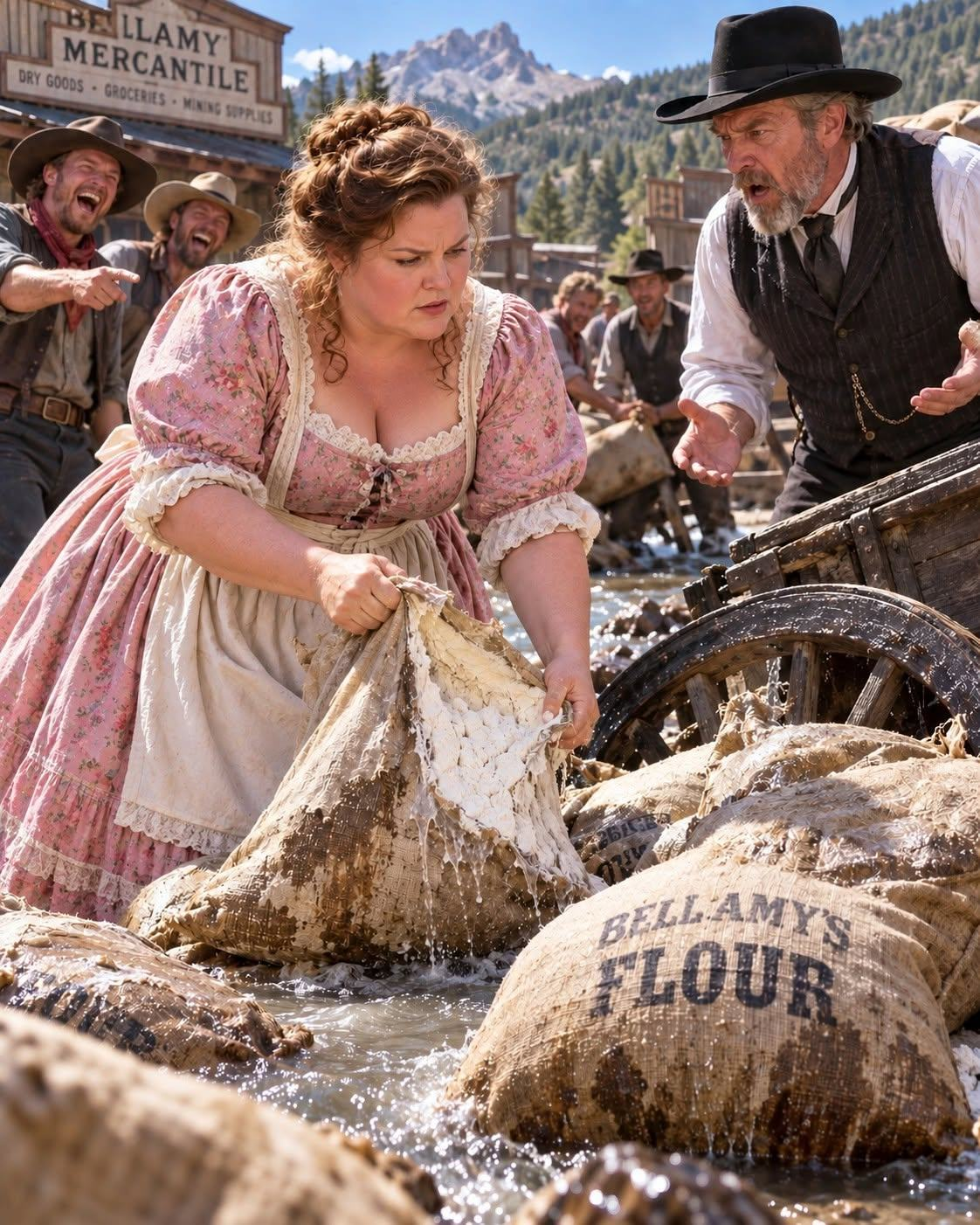
Rufus Bellamy stepped into Dorothy's shed without removing his hat.
"Well, Miss Vance. I see you've made yourself quite comfortable with my merchandise."
Dorothy stood beside the worktable, her hands covered in flour.
"Good evening, Mr. Bellamy."
Silas Grant looked between them.
"You two know each other?"
Bellamy gave a humorless laugh.
"Unfortunately. Miss Vance purchased six hundred pounds of my damaged flour yesterday. Apparently, she believes she's discovered a way to turn creek water into supper."
Dorothy wiped her hands on her apron.
"I purchased your flour after you agreed to sell it."
"I know what happened."
"Then we have nothing to discuss."
Grant raised one hand.
"Enough. I didn't bring you both here to argue."
Bellamy glanced toward the drying trays.
"Then perhaps you should explain why the mine foreman needs to visit a woman who's collecting garbage."
Grant's expression hardened.
"Because she's the only person in this town who asked to inspect our pantry before accepting a cooking position."
Bellamy said nothing.
Dorothy noticed the slight change in his expression.
It was small, but important.
For the first time, he seemed to realize that Grant had not come to the shed merely out of curiosity.
The foreman pulled a chair away from the wall.
"Sit down, Bellamy."
The merchant reluctantly obeyed.
Grant unfolded the supply document he had brought earlier.
"Our winter provisions are short."
"That's not my problem," Bellamy replied.
"It becomes your problem when the men working underground cannot get fed."
Bellamy leaned back.
"I have already placed orders with two freight companies."
"One canceled."
"Because of the road."
"The other has delayed its shipment twice."
"Weather and road conditions are beyond my control."
Grant tapped the paper.
"Then perhaps you should explain why the quantities on your invoice don't match the quantities we received."
Dorothy looked up.
Bellamy's face became still.
"What are you suggesting?"
"I'm suggesting that I paid for flour that never arrived."
"Freight losses happen."
"Not every week."
The room fell silent.
Dorothy looked from one man to the other.
She had not expected to hear a dispute over missing provisions.
She had expected to discuss a cooking position.
Instead, she was witnessing something that might determine whether the mine had enough food for winter.
Grant turned toward her.
"Miss Vance, how much of that shipment have you managed to save?"
"Too early to give you an exact amount."
"Can you produce enough to feed the mine?"
"Not from what I've examined so far."
Bellamy laughed.
"At least she's honest."
Dorothy looked at him.
"I haven't finished."
She picked up a clean cloth from the table and unfolded it.
Inside lay a small quantity of flour.
It was pale, fine, and dry.
Grant leaned forward.
"That's from the creek shipment?"
"Yes."
"You're certain?"
"I'm certain it came from the center of a sack that was wet only along the outside. I've inspected it, sifted it, and separated it from the damaged material."
Bellamy shook his head.
"You cannot guarantee the condition of flour that has been dragged through a creek."
"No. That's why I'm testing it in small quantities and discarding anything questionable."
Grant examined the sample.
"Could it be used?"
"Possibly. But I won't sell or serve anything until I'm satisfied it's safe."
The foreman nodded.
That answer seemed to impress him more than any claim of success would have.
He returned to the document.
"I need someone who understands food. Not somebody who can simply follow a recipe."
Dorothy listened.
"I need somebody who can manage shortages, calculate portions, and make provisions last."
"How many men?"
"Sixty-four at the cookhouse. More during emergencies."
"How much money is allocated for food?"
Grant named the figure.
Dorothy calculated quickly.
It was not generous.
But with careful purchasing and proper inventory management, it might be possible.
"What authority would I have?"
Grant looked at her.
"Explain."
"I won't accept responsibility for feeding sixty-four men if someone else controls every ingredient I use. I need access to the pantry. I need to know what is being purchased. I need permission to refuse spoiled food."
Bellamy snorted.
"Listen to her. She's negotiating like a hotel owner."
Dorothy ignored him.
"And I need my wages paid on time."
Grant considered her conditions.
"Thirty dollars a month. A room near the cookhouse. Meals. Full authority over the kitchen."
Dorothy nodded.
"That sounds reasonable."
Bellamy stood.
"You're making a mistake, Silas."
Grant did not move.
"That's my decision."
The merchant looked toward Dorothy.
"If she ruins your food stores, don't come asking me to replace them."
Dorothy met his eyes.
"If I ruin them, I'll take responsibility. But if your deliveries continue disappearing, perhaps you should start keeping better records."
Bellamy's jaw tightened.
Grant looked down at the invoice again.
Then he folded it carefully.
"That's enough for tonight."
Bellamy picked up his hat.
But before leaving, he paused beside the worktable.
He looked at the flour sample.
Then at the six hundred pounds stacked along the wall.
"You're going to regret buying that shipment."
Dorothy answered without looking up.
"Perhaps. But at least I'll know why."
Bellamy walked out.
Grant remained seated.
For several seconds, neither of them spoke.
Finally, the foreman said, "I think I understand why the hotel turned you away."
Dorothy looked at him.
"Why?"
"Because you don't make it easy for people to tell you what you're worth."
She considered that.
Then she folded the cloth over the flour sample.
"Mr. Grant, I don't need people to tell me what I'm worth."
He smiled faintly.
"Good. Because Copper Jack has enough people who think they already know."
The following morning, Dorothy arrived at the mine cookhouse before sunrise.
The building was larger than she expected.
It had a broad stone chimney, two iron stoves, several preparation tables, and a long dining room with benches arranged in rows.
A pantry occupied the rear wall.
Inside were barrels of beans, sacks of potatoes, dried onions, salted pork, coffee, and several containers of flour.
Dorothy began inspecting everything.
She checked the lids.
Examined the storage shelves.
Looked for signs of insects.
She asked when each barrel had been opened.
The assistant cook, a young man named Eddie Morris, followed her around with a puzzled expression.
"You're checking all of it?"
"Yes."
"Even the coffee?"
"Especially the coffee."
Eddie laughed.
"Nobody checks the coffee."
"That's why people complain about it."
He grinned.
Dorothy found three containers of flour with different dates written on their sides.
One was nearly empty.
Another had been opened recently.
The third contained a mixture of flour from two separate deliveries.
She frowned.
"Who mixed these?"
Eddie shrugged.
"Previous cook, I suppose."
"Do you know where it came from?"
"No."
"Then we won't use it until we've examined it."
Eddie looked surprised.
"You're serious?"
"Completely."
She continued through the pantry.
The inventory was worse than she expected.
The mine had enough beans for several weeks, but the supply of meat was declining.
The potatoes were beginning to soften.
The coffee shipment was short.
And the flour reserves were insufficient for a long winter.
Dorothy took out her notebook.
She calculated the number of meals required each day.
Then she calculated how much food the mine would need for thirty days.
When she finished, she understood why Grant had been worried.
Even with careful management, the current supplies would not last if freight deliveries stopped.
"How often does the mine receive shipments?" she asked.
"Every ten days, usually."
"And how long since the last full delivery?"
Eddie scratched his head.
"Nearly three weeks."
Dorothy stopped writing.
"Three weeks?"
"Yes, ma'am."
"Why didn't anybody tell the workers?"
Eddie looked uncomfortable.
"Mr. Grant says we're waiting for the road to clear."
Dorothy closed her notebook.
She had spent years watching employers hide shortages until the day the pantry was nearly empty.
Then they blamed the cook.
She was not going to let that happen again.
"I want a complete list of everything in this kitchen."
Eddie nodded.
"All right."
"And I want the next meal prepared using the oldest safe ingredients first."
"Understood."
Dorothy studied him.
"One more thing."
"Yes?"
"If anyone tells you to use spoiled food because the good food is running low, send them to me."
Eddie smiled.
"I think I'll enjoy working here."
At noon, Dorothy returned to her shed.
She had accepted Grant's offer, but she had not yet decided how much of her salvaged flour could be used.
That question mattered more than her new position.
She washed her hands thoroughly and began another round of inspections.
The first group of sacks had yielded a disappointing result.
Some flour had absorbed too much moisture.
Some had become discolored.
One sack had developed a sour smell.
She discarded those portions.
She did not hesitate.
Saving money was important, but feeding people unsafe food was unacceptable.
The second group was more promising.
Several sacks had wet burlap but dry centers.
Dorothy opened them carefully and examined the flour.
She sifted small quantities through the wooden sieves.
Then she spread the flour across clean muslin.
She kept the trays separated and labeled.
A portion that looked perfectly acceptable could still be unsuitable if moisture had reached the center or contamination had entered through a damaged seam.
She would not take that risk.
By midafternoon, she had recovered several pounds of flour that appeared clean and dry.
It was a modest amount.
But it gave her enough material for another controlled baking test.
She carried a small portion to the cookhouse.
Eddie helped prepare the ingredients.
Dorothy mixed a simple biscuit dough.
She worked it gently, careful not to add too much liquid.
The flour behaved differently from the ordinary commercial flour she had used before.
It absorbed moisture unevenly.
She adjusted the mixture.
Then she let it rest.
When the biscuits entered the oven, she watched them closely.
Eddie stood beside her.
"Think they'll turn out?"
"They'll tell us."
"That's not very reassuring."
Dorothy almost smiled.
"Cooking isn't a promise. It's a process."
The biscuits began to rise.
Their surfaces turned golden.
When she removed the tray, she waited several minutes before cutting one open.
The center was cooked.
The texture was firm but not heavy.
She examined the inside.
Then she smelled it.
No unpleasant odor.
She tasted a small piece.
Eddie watched her face.
"Well?"
Dorothy swallowed.
"It's promising."
"Can we serve them?"
"Not yet."
His shoulders dropped.
"What else do you need?"
"More testing. And I want the remaining flour examined before we make any larger batch."
Eddie nodded.
He seemed disappointed, but he understood.
Dorothy wrapped the sample and wrote the date on the cloth.
She would not let excitement replace caution.
That evening, Dorothy walked back toward the shed.
The town was quieter than usual.
Several miners were leaving the boardinghouse.
A group of women stood outside the hotel, talking about the upcoming winter.
Dorothy heard her name as she passed.
"That's the woman who bought Bellamy's ruined flour."
"Yes. Six hundred pounds, apparently."
"She must be desperate."
Another woman laughed.
Dorothy continued walking.
She was used to hearing people discuss her as though she were not close enough to understand.
But this time, something bothered her.
It was not the insult.
It was the assumption that a woman who made an unusual decision must be desperate.
She had not bought the flour because she lacked options.
She had bought it because she had examined it.
There was a difference.
When she reached the shed, she found a small package outside the door.
It was wrapped in brown paper and tied with string.
No name.
No note.
She looked around.
Nobody was nearby.
Dorothy carried it inside and placed it on the table.
She untied the string.
Inside was a small loaf of bread.
It was still fresh.
Beneath it lay a folded piece of paper.
The handwriting was uneven.
Dorothy opened it.
Thank you for giving Peter something to eat yesterday.
There was no signature.
But she recognized the careful handwriting of someone who had taken time to form each letter.
She folded the note and placed it in her apron pocket.
Then she cut the bread in half.
She ate one piece and saved the other.
It reminded her why she had wanted to work for herself.
Food was never just food.
For a man underground, it could be the difference between finishing a shift and collapsing from exhaustion.
For a widow, it could mean having enough to feed her child.
For a town preparing for winter, it could determine whether families stayed together or scattered in search of work.
Dorothy looked at the flour trays.
She had not yet solved the problem.
But she was beginning to understand how much depended on it.
The next morning, Grant came to the cookhouse.
He found Dorothy checking the pantry.
"How are things?"
"Not good."
His expression tightened.
"Explain."
"Your flour stores are lower than your records suggest. The meat supply is declining, and some of the potatoes need to be used immediately."
"Can we manage?"
"For now."
"And winter?"
Dorothy closed the pantry ledger.
"Not with the deliveries you've been receiving."
Grant rubbed his forehead.
"That's what I was afraid of."
"How many men are scheduled underground today?"
"About eighty."
"Then I need a more accurate count of meals."
Grant nodded.
"I'll have the shift clerk bring you the numbers."
Dorothy looked at him.
"Mr. Grant, I also need to know whether the mine plans to expand its underground operations."
He frowned.
"Why?"
"Because if you're increasing the number of workers, your food requirements will change."
"We're not expanding."
"Then why did I find an order for additional provisions in the pantry records?"
Grant stared at her.
"Where?"
She handed him the ledger.
He read the entry.
His expression changed.
"Who gave you this?"
"It was already in the book."
He examined the handwriting.
Then he looked toward the office.
"That's not my authorization."
Dorothy waited.
Grant closed the ledger.
"Someone has been ordering supplies without my approval."
"Could it be the supply clerk?"
"Possibly."
He looked troubled.
"I'll investigate."
Dorothy returned to the pantry.
But she noticed that Grant did not leave immediately.
He stood near the doorway, looking at the shelves.
Then he spoke.
"Miss Vance, there's another reason I wanted you here."
She turned.
"What is it?"
"The mine's been losing equipment."
"Equipment?"
"Timber supports. Drill parts. Rope. Small things at first."
"Are they being stolen?"
"I don't know."
Grant lowered his voice.
"But last week, one of the shift bosses reported something strange."
Dorothy waited.
"He found fresh timber marks inside a passage that had been sealed for months."
She looked at him.
"What does that mean?"
"It means somebody may have been working in a section of the mine that nobody was supposed to enter."
Dorothy felt a chill that had nothing to do with the cold pantry.
Grant put on his hat.
"I don't want rumors spreading. The men need to keep working."
He started toward the door.
Then he stopped.
"Keep your inventory records safe. Don't let anyone alter them."
Dorothy nodded.
He left.
She looked down at the open ledger.
The unexplained supply order remained on the page.
She turned it over.
There was another entry written on the reverse side.
A name.
A date.
And a quantity of timber that had never appeared in the official mine records.
Dorothy leaned closer.
Then she recognized the signature.
It belonged to the man who had just walked out of her kitchen.
Silas Grant.
But before she could examine the writing again, someone outside shouted her name.
She hurried toward the doorway.
A young miner was running up the path.
His face was pale.
His breathing was ragged.
He stopped directly in front of her.
"Miss Vance!"
Dorothy stepped outside.
"What happened?"
The miner looked toward the mountain.
Then he pointed toward the mine entrance.
"Mr. Grant told us not to let anybody go down there."
Dorothy stared at him.
"Why?"
The young man swallowed.
"Because we just found something inside the sealed passage."
He reached into his coat and pulled out a small object wrapped in a dirty cloth.
Dorothy unfolded it.
A piece of burlap fell onto her palm.
It was wet.
And printed across its surface were the faded words:
BELLAMY'S FLOUR.
Then the miner whispered five words that made Dorothy's blood run cold.
"Miss Vance, this came from underground."






Comments 0