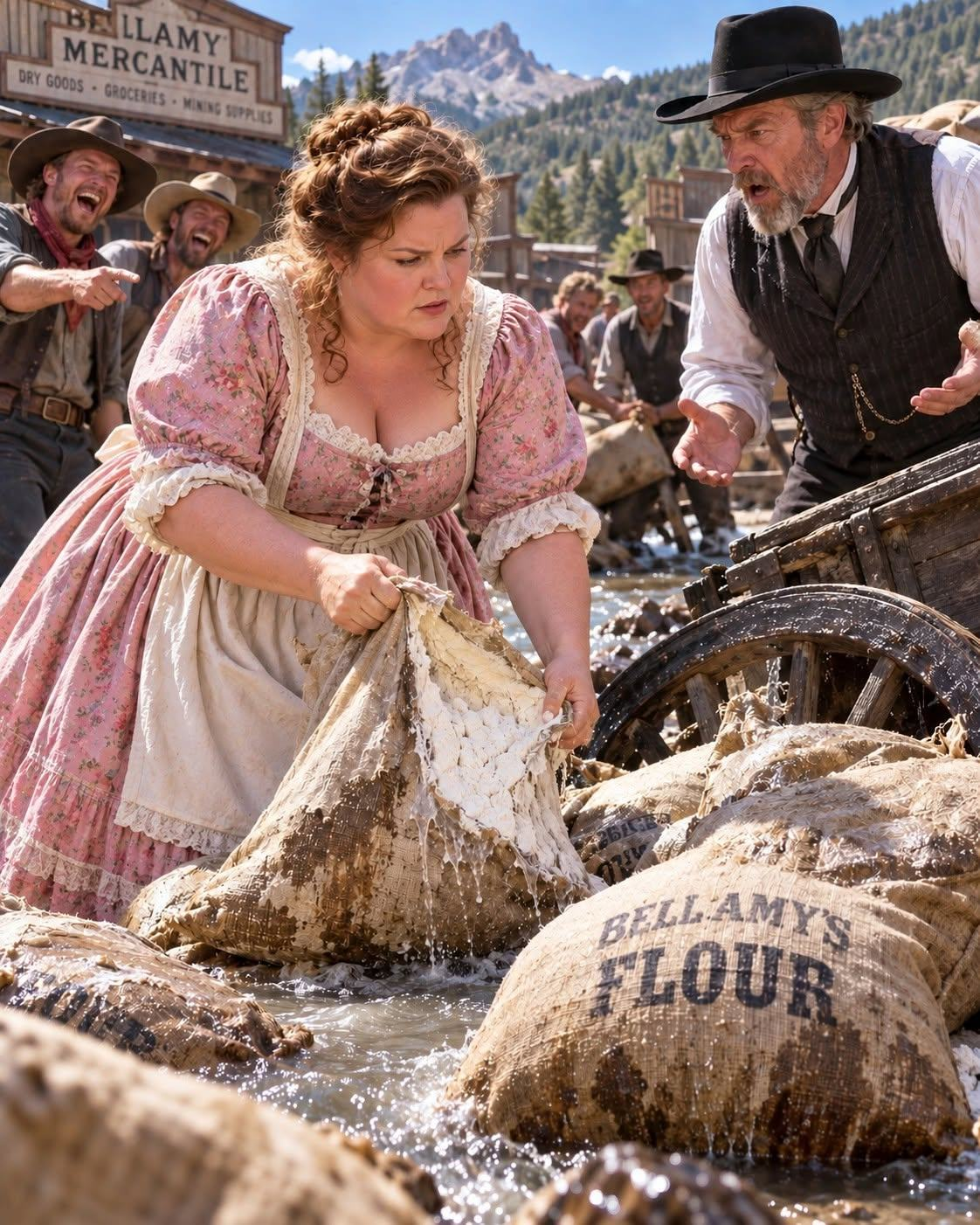
Dorothy Vance stared at the open ledger.
RUFUS BELLAMY.
The name was written in dark ink across the first page.
Beneath it appeared another signature.
SILAS GRANT.
For several seconds, nobody spoke.
Eddie Morris stood beside the kitchen counter, holding the book with both hands. Silas Grant looked as though someone had struck him.
Dorothy slowly placed the biscuit tray down.
"Where did you find this?"
"Inside the flour sack," Eddie answered. "The timber crew found it near the sealed eastern passage."
Grant took the ledger.
"Who else has seen it?"
"Only the two men who found it. They brought it straight to the office."
Grant turned toward the door.
"Get them here. Nobody discusses this with anyone."
Eddie hurried outside.
Dorothy remained beside the counter.
Grant opened the ledger again.
He turned several pages.
There were dates, quantities, delivery numbers, and signatures. Some entries referred to timber. Others listed rope, lamp oil, blasting equipment, and food supplies.
Dorothy noticed something strange.
The flour quantities appeared repeatedly.
Not in ordinary cooking amounts.
In hundreds of pounds.
"Mr. Grant."
He looked up.
"Yes?"
"Why would someone need so much flour inside an abandoned mine passage?"
Grant examined the entries.
"I don't know."
"Could it have been used to carry something?"
"Perhaps."
Dorothy pointed to a line near the bottom of the page.
"Look at this."
The entry read:
Six hundred pounds. Eastern passage. September 17.
Dorothy felt her stomach tighten.
Six hundred pounds.
The exact quantity of flour she had purchased from Bellamy.
She looked at Grant.
"That cannot be a coincidence."
He closed the ledger.
"Miss Vance, I want you to understand something. Until we know what this means, you must not repeat what you've seen."
"Why?"
"Because if someone has been stealing from the mine, that person may be dangerous."
Dorothy considered his words.
"Then perhaps you should have told me that before giving me access to the supply records."
Grant did not answer.
A knock sounded against the kitchen door.
The two timber workers entered.
One was a broad-shouldered man named Henry Cole. The other was younger, with a dark beard and a scar across his cheek.
Grant placed the ledger on the table.
"Tell me exactly where you found this."
Henry pointed toward the book.
"It was inside a flour sack caught behind a timber support."
"Was the sack open?"
"Partly."
"Did you touch anything else?"
The younger man shook his head.
"Just the book."
Grant looked at Dorothy.
She asked the next question.
"Was there flour inside?"
Henry hesitated.
"A little. Most of it was gone."
"Was it wet?"
"Yes, ma'am. The sack was damp."
Dorothy examined the book.
"Did you notice whether the flour was mixed with anything?"
Henry looked confused.
"What do you mean?"
"Oil, dust, metal particles, anything unusual?"
The younger worker answered.
"There was a strange smell."
Grant turned toward him.
"What kind of smell?"
"Like lamp oil."
Dorothy looked at the ledger again.
The entry for lamp oil appeared several pages before the flour shipment.
She did not like the connection.
"Mr. Grant, I think you need to investigate every entry involving the eastern passage."
Grant nodded.
"I intend to."
Then he closed the book and placed it inside his coat.
"Both of you, return to your work. And remember what I said."
The men left.
Dorothy watched Grant.
"You're going to the eastern shaft?"
"Yes."
"Then I suggest you take someone you trust."
Grant looked at her.
"Why?"
"Because whoever wrote those entries knew how to move supplies without being noticed."
He considered her words.
Then he nodded.
That evening, Dorothy returned to her shed.
The worktable was covered with clean cloth, small containers, and notes from her flour experiments.
She had spent the previous days separating the damaged shipment into different categories.
The completely submerged sacks had been discarded.
The questionable portions remained isolated.
Only the flour that appeared dry, clean, and free from contamination was being considered for further testing.
She had recovered more than she expected.
But the discovery of the ledger had changed everything.
She could no longer think about the flour as merely a damaged shipment.
Someone had apparently moved supplies through an abandoned mine passage.
Someone had recorded six hundred pounds.
And someone had signed the transaction using the names of two men who now occupied very different positions in Copper Jack.
Dorothy washed her hands and began organizing her notes.
A knock sounded.
She looked toward the door.
Peter stood outside.
The boy held a small basket.
"Good evening, Miss Vance."
"Good evening, Peter. What brings you here?"
"My mother sent these."
He lifted the basket.
Inside were several onions, a small piece of smoked meat, and a folded cloth.
Dorothy looked at him.
"Your mother didn't need to do that."
"She said you helped us. She wanted to help you."
Dorothy accepted the basket.
"Tell her thank you."
Peter looked around the shed.
"Are you still making bread?"
"Trying to."
"People say you bought six hundred pounds of bad flour."
Dorothy smiled faintly.
"People are very interested in my flour."
"They say you're going to lose all your money."
"That is possible."
Peter looked worried.
"Then why keep doing it?"
Dorothy considered the question.
"Because I haven't finished finding out what can be saved."
The boy nodded.
He seemed to understand more than his age suggested.
Then he noticed the flour sacks near the wall.
"Are those all yours?"
"Yes."
Peter approached one of them.
He looked at the faded lettering.
"That's the same flour my mother used to buy."
Dorothy examined him.
"From Bellamy?"
"Yes. She said it used to be good flour."
"Do you remember when?"
"Before the big delivery problems."
Dorothy stopped moving.
"What delivery problems?"
Peter looked toward the door.
"I don't know. My mother said Bellamy used to have plenty of flour. Then the sacks started coming in smaller amounts."
"When?"
"Before summer."
Dorothy thought about the ledger.
The recorded quantities.
The missing supplies.
The flour found underground.
"Did your mother ever mention anyone taking flour to the mine?"
Peter shook his head.
"She doesn't talk about the mine."
Dorothy nodded.
She did not want to frighten him with questions he could not answer.
"How is your mother?"
"She has a cough."
"Has she seen a doctor?"
"Not yet. She says doctors cost money."
Dorothy looked at the basket.
She took a small portion of the onions and smoked meat and placed them back inside.
"Take these home."
Peter frowned.
"But they're for you."
"I have enough for tonight."
He hesitated.
Dorothy placed her hand gently on his shoulder.
"Take them. Your mother needs them more than I do."
The boy nodded.
Before leaving, he turned.
"Miss Vance?"
"Yes?"
"Somebody came to our house asking about you."
Dorothy's expression changed.
"Who?"
"I don't know his name. He wore a black coat and had a silver watch chain."
She thought of Bellamy.
"Did he say why?"
"He asked whether you were keeping all the flour inside the shed."
Dorothy went still.
"What did your mother tell him?"
"She said she didn't know."
Peter looked uncomfortable.
"Then he asked whether you had opened any of the sacks."
Dorothy's eyes moved toward the flour.
"Did he say anything else?"
Peter shook his head.
But before leaving, he added something.
"He told my mother that you should stop asking questions."
The following morning, Dorothy arrived at Bellamy Mercantile shortly after opening.
She had not planned to visit the store.
But the conversation with Peter had changed her priorities.
If someone was asking about the flour, she wanted to know why.
Bellamy stood behind the counter.
He looked up when she entered.
"Miss Vance."
"Mr. Bellamy."
"Come to buy something?"
"I have a question."
He closed his ledger.
"About what?"
"Did someone visit your store yesterday asking about the damaged flour shipment?"
Bellamy's expression remained neutral.
"Several people have asked about it."
"Who?"
"Why?"
"Because someone came to Peter Morris's house asking about the flour."
Bellamy looked toward the back of the shop.
Then he returned his attention to Dorothy.
"I don't know anything about that."
"Did you sell the damaged shipment to anyone before me?"
"No."
"Did you authorize anyone to move it after I purchased it?"
"Absolutely not."
Dorothy studied him.
"Then why is there a record of six hundred pounds being moved through the eastern passage of Copper Jack Mine?"
Bellamy's face changed.
Only slightly.
But she noticed.
"What record?"
"A ledger."
He looked away.
"You're involving yourself in matters you don't understand."
"Then explain them."
Bellamy leaned forward.
"Miss Vance, you're a cook. You've been in town less than a week. You bought some damaged flour, and now you seem to believe you've uncovered some grand mystery."
Dorothy remained still.
"I'm asking about a shipment."
"And I'm telling you to leave the matter alone."
"Why?"
Bellamy straightened.
"Because it isn't your concern."
Dorothy picked up a small packet of salt from the counter.
"That will be all."
She paid and turned toward the door.
Behind her, Bellamy spoke again.
"One more thing."
She stopped.
"If I were you, I'd concentrate on getting that flour out of your shed before somebody gets hurt."
Dorothy turned.
"Is that a warning?"
Bellamy looked directly at her.
"It's advice."
She left without answering.
At the mine, Silas Grant had spent the morning examining the eastern passage.
He returned shortly after noon.
His coat was dusty.
A small cut marked his forehead.
Dorothy was waiting outside the cookhouse.
"What happened?"
Grant removed his hat.
"We found signs of recent activity."
"How recent?"
"Within the last few days."
Dorothy looked toward the mine entrance.
"Did you find the rest of the flour?"
"No."
"Then what did you find?"
Grant hesitated.
"Fresh timber supports. An oil lamp. Some rope. And a section of wall that had been disturbed."
"Was the passage safe?"
"Not entirely."
Dorothy considered the ledger.
"Did you find anything else?"
Grant looked around to make sure nobody was close enough to hear.
"One of the supports had been deliberately weakened."
Her expression tightened.
"Could it collapse?"
"Possibly."
"Then why hasn't it been repaired?"
Grant looked toward the mountain.
"Because somebody wants that section to remain accessible."
Dorothy was silent.
Grant continued.
"I've ordered the eastern passage closed until we understand what's happening."
"Who knows?"
"My supervisors. The shift bosses. A few men I trust."
"And Bellamy?"
Grant's jaw tightened.
"I haven't spoken with him."
Dorothy nodded.
Then she asked the question that had been troubling her since the ledger appeared.
"Why is your signature in that book?"
Grant looked at her.
For a long moment, he said nothing.
Then he answered.
"I haven't signed anything in that ledger."
Dorothy felt her stomach tighten.
"You're certain?"
"Absolutely."
"Could somebody have copied your signature?"
Grant nodded slowly.
"That is what I believe."
"Then somebody is trying to make it appear that you authorized the deliveries."
"Yes."
Dorothy looked toward the mine.
"Who would benefit from that?"
Grant did not answer.
Over the next several days, Dorothy's work continued.
She had been formally hired by the mine, and she now had access to the cookhouse pantry.
The men began recognizing her.
Some greeted her respectfully.
Others remained skeptical.
A few still made jokes about the flour.
But the kitchen was becoming more organized.
Dorothy introduced a proper inventory system.
Every barrel was dated.
Every sack was inspected.
Every delivery was recorded.
Eddie helped her maintain the lists.
The portions became more consistent.
Waste declined.
The men noticed.
One evening, Samuel Price approached the serving counter.
"Miss Vance."
Dorothy looked up.
"Yes, Samuel?"
He held an empty plate.
"Those biscuits were good."
"Thank you."
"Better than the ones we had last month."
Dorothy nodded.
"Tell Eddie. He helped."
Samuel smiled.
"I will."
Then he leaned closer.
"There's something else."
"What?"
"Men are talking about the eastern passage."
Dorothy's hands stopped.
"What are they saying?"
"That someone has been going down there at night."
"Who?"
"Nobody knows."
Samuel looked toward the dining room.
"But yesterday, one of the night watchmen heard a wagon moving near the old entrance."
Dorothy lowered her voice.
"Did he see anyone?"
Samuel shook his head.
"Just a lantern."
She looked at the kitchen door.
The mine was becoming a place where even ordinary movements carried suspicion.
Dorothy returned to her work.
But she began keeping the inventory ledger locked away.
Two nights later, rain swept across Copper Jack.
Dorothy was in her shed checking the remaining flour when she heard a sound outside.
A wagon wheel.
She looked through the window.
A small cart stood near the road.
No driver was visible.
She waited.
Then a man stepped out from behind the storage shed.
He wore a dark coat and a wide-brimmed hat.
His face was difficult to see.
Dorothy moved away from the window.
The man approached the door.
Three knocks.
She did not answer.
Another three knocks.
Then his voice came through the wood.
"Miss Vance."
Dorothy recognized neither the voice nor the accent.
"Who are you?"
"I have business concerning the flour."
Dorothy looked toward the table.
Her notes were spread across it.
The man continued.
"I'd like to make you an offer."
She approached the door but did not open it.
"What kind of offer?"
"One that would make your investment worthwhile."
Dorothy remained silent.
"Ten dollars for every usable sack."
She frowned.
Ten dollars.
It was far more than she had paid for the entire shipment.
But the offer made no sense.
If the flour was worthless, why would anyone pay so much?
"Why do you want it?"
"That isn't important."
"It is to me."
The man gave a short laugh.
"You're a difficult woman, Miss Vance."
Dorothy looked through the narrow gap beside the window.
He was standing with one hand inside his coat.
She could not see what he was holding.
"Come back tomorrow," she said.
"Tomorrow may be too late."
"Then perhaps you should explain."
The man stepped closer to the door.
"Some things are better left alone."
Dorothy felt a chill run through her.
She had heard almost the same words from Bellamy.
"Who sent you?"
The man did not answer.
Instead, he placed a small envelope on the doorstep.
"Read that before you make another decision."
He turned and walked toward the cart.
Dorothy waited until she heard the wheels moving away.
Then she opened the door.
The envelope was damp from the rain.
There was no name on the outside.
She carried it inside.
The paper contained a single handwritten sentence.
The flour you bought was never supposed to reach Bellamy's store.
Dorothy read it again.
Then she noticed something folded inside the envelope.
A small piece of paper.
A delivery receipt.
The date was September 17.
The quantity was six hundred pounds.
And the destination was not Bellamy Mercantile.
It was the eastern passage of Copper Jack Mine.
Dorothy stared at the document.
At the bottom, beneath the delivery instructions, was a signature.
Not Rufus Bellamy's.
Not Silas Grant's.
It belonged to the man who had just visited her shed.
Walter Briggs.
The next morning, Dorothy went directly to Grant's office.
She placed the receipt on his desk.
He examined it.
His face turned pale.
"Where did you get this?"
"Someone left it at my door."
Grant looked at the signature.
"Briggs."
"Do you know him?"
"He's been my senior shift supervisor for six years."
"Then perhaps you should ask him why he authorized the flour delivery."
Grant stood.
"Don't move."
He took the receipt and walked toward the door.
Dorothy remained beside the desk.
She heard his footsteps crossing the office.
Then his voice echoed through the corridor.
"Bring Walter Briggs here. Now."
A few minutes passed.
Then another set of footsteps approached.
The office door opened.
Walter Briggs entered.
He looked at Grant.
Then at Dorothy.
Then at the receipt on the desk.
His expression changed.
And for the first time since Dorothy had arrived in Copper Jack, Walter Briggs looked genuinely afraid.
"Where did you get that paper?" he whispered.






Comments 0