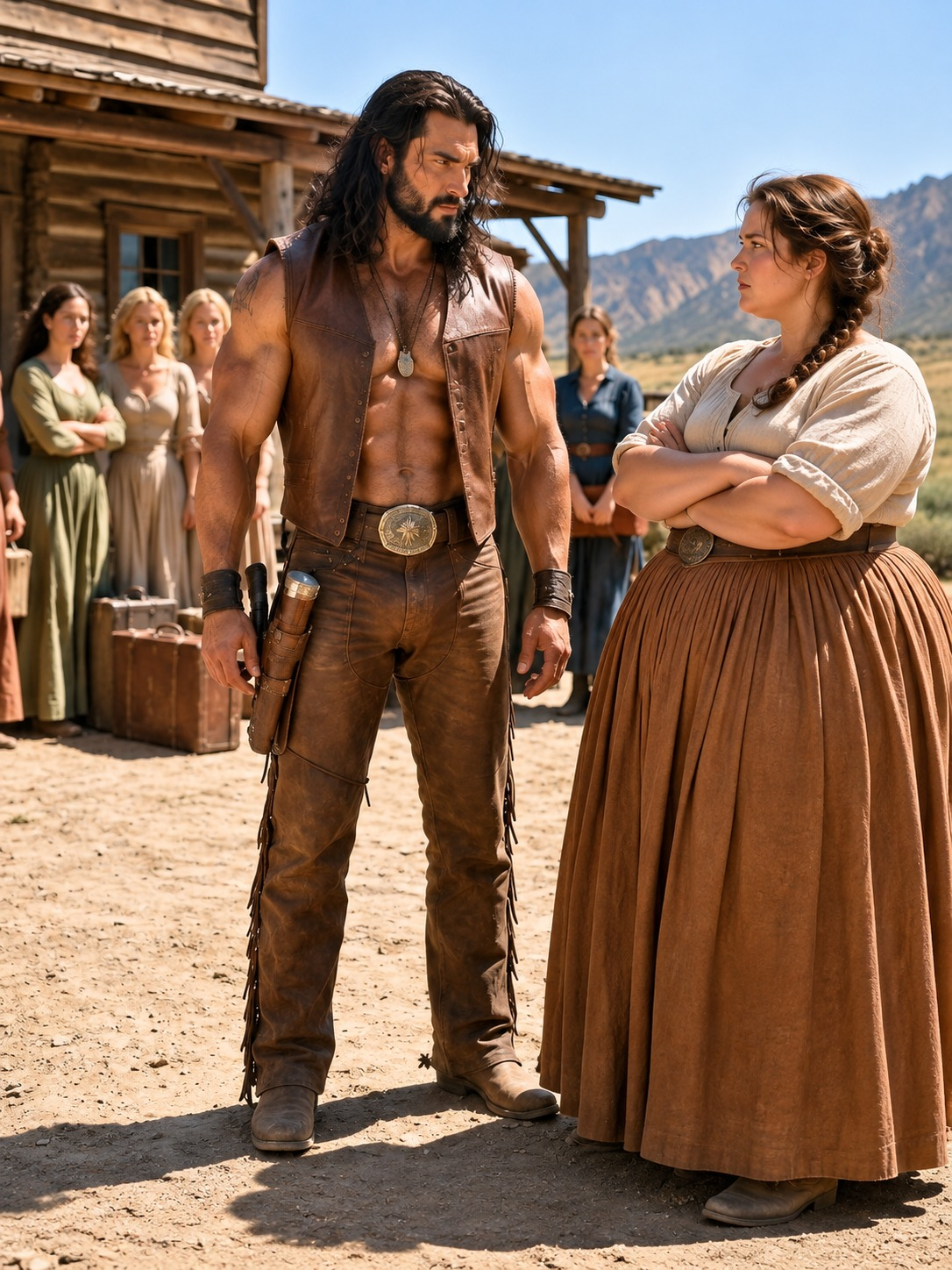
Mason recognized Harlon's horse before the rider reached the gate.
He set down his coffee.
"Stay inside," he told me.
I looked toward the window.
"Is something wrong?"
"Probably not."
He reached for his hat.
That answer sounded familiar.
It was the kind of answer men gave when they wanted a woman to stop asking questions.
I followed him outside anyway.
Harlon Price rode into the yard, his old brown hat tilted backward and a leather mailbag hanging from his saddle.
He looked tired.
But not frightened.
"Morning, Mason."
"Harlon."
The postmaster climbed down slowly.
His eyes moved toward me.
"Miss Whitmore. I hope the mountain hasn't been too unkind."
"Not yet, Mr. Price."
He gave a small nod.
"Good. That's more than I can say for the road."
Mason took the mailbag.
"Anything important?"
"Just the usual letters. A bill from the feed supplier. Two notices from the bank."
Mason's expression hardened.
"Bracken?"
Harlon nodded.
"His office seems particularly interested in your business lately."
"His office has always been interested."
Mason removed two envelopes and examined them.
One bore the bank's seal.
The other was addressed to him in unfamiliar handwriting.
He placed both inside his coat.
I noticed that he didn't open either one.
Harlon watched him.
"Still carrying them around?"
Mason looked up.
"What's that supposed to mean?"
"Nothing."
Harlon adjusted his hat.
"Just thinking that some things get heavier when you refuse to look at them."
Mason gave him a warning glance.
The old postmaster wisely changed the subject.
"I'll be back in town by sundown. Let me know if you need anything."
He climbed onto his mule.
Before leaving, he looked at me.
"Don't let the quiet fool you, Miss Whitmore. This valley has a way of making ordinary days complicated."
I smiled.
"I'll remember that."
Harlon rode away.
Mason watched him until he disappeared beyond the fence.
Then he turned toward the barn.
I stood beside the porch.
"Are you going to open those letters?"
"Later."
"Why not now?"
"Because I have work."
He walked away.
I looked at the two envelopes still visible beneath his coat.
I understood that the bank notices frightened him more than he wanted anyone to know.
But I didn't understand why.
The first four days on the mountain passed more quickly than I expected.
There was always something to do.
The ranch required attention from sunrise until the evening shadows stretched across the pasture.
Mason woke before daylight.
He fed the horses, checked the cattle, repaired fences, and worked in the barn.
I learned where everything belonged.
I also learned that Mason had an unusual relationship with silence.
He could spend an entire morning working beside someone without speaking a single word.
At first, I found it uncomfortable.
Then I discovered that he didn't seem to mind conversation when it concerned something practical.
He would answer questions about the horses.
He explained how to recognize a sick calf.
He showed me how to use the water pump without spilling half the bucket.
But whenever I asked about his family, his childhood, or the women who had left, he became quiet.
There was a particular photograph on the mantel.
It showed a younger Mason standing beside an older man.
The older man had the same broad shoulders and serious eyes.
"Your father?" I asked one morning.
Mason glanced toward it.
"Yes."
"What was his name?"
"Thomas Callahan."
"Was he a rancher too?"
"He was."
Mason picked up his hat.
"He built most of what you see here."
I looked at the photograph again.
"He looks like a good man."
"He was."
Something in Mason's voice told me not to ask more.
So I didn't.
I was beginning to understand that living with Mason required patience.
Not the kind of patience that meant accepting poor treatment.
The kind that meant knowing when someone needed time to find his words.
On the second morning, I discovered the back fence had broken loose.
Mason had been working with the cattle since dawn.
I found him in the mud beside the lower pasture, struggling to keep a young calf from slipping beneath a damaged section of fencing.
The animal was frightened.
Its mother stood nearby, restless and protective.
Mason looked toward me.
"Stay back."
I stopped.
The calf struggled again.
Mason grabbed the loose section of rope.
"Easy, girl. Easy."
He was speaking to the cow.
I moved closer.
"Can I help?"
"No."
He tried again.
The calf slipped.
Mason's boot sank into the mud, and he nearly lost his balance.
I grabbed the loose rope before it could pull away.
"Now?"
He looked at my hands.
Then at the animal.
"Keep it steady."
I did.
Together, we managed to free the calf and guide it toward its mother.
Mason checked the animal carefully.
There was a small cut along its leg, but nothing serious.
When the calf finally stood and began nursing, I let out a breath I hadn't realized I was holding.
"Thank goodness."
Mason wiped his hands against his trousers.
"You did well."
I looked at the mud covering my dress.
"I believe my mother would have preferred me to remain indoors."
"Your mother?"
"She taught me that helping someone doesn't become less important because the work is dirty."
Mason looked at me for a long moment.
Then he nodded.
We walked back toward the house.
Neither of us mentioned the fact that he had allowed me to help.
But I noticed that he no longer told me to stay inside whenever something needed doing.
By the third day, I had begun to recognize the sounds of the ranch.
The barn doors creaked in the morning wind.
The horses stamped their hooves when they heard Mason approaching.
The old kitchen clock lost nearly five minutes every afternoon.
And Mason always placed his boots beside the back door, never on the rug.
I learned these things without asking.
He learned a few things about me too.
He discovered that I preferred coffee without sugar.
That I liked to read before bed.
That I could mend a torn shirt faster than he could finish repairing a fence.
He also discovered that I talked to animals.
The first time he heard me speaking to a stubborn hen, he stood in the doorway and watched.
"She isn't listening," he said.
"She is. She's just disagreeing."
He looked at the hen.
Then at me.
"Sounds familiar."
I turned toward him.
For a second, I thought he was making a joke.
Then I saw the faintest change in his expression.
He was almost smiling.
It was gone before I could respond.
But I carried that small moment with me for the rest of the day.
On the fourth morning, I made biscuits again.
Mason came downstairs while I was setting the table.
He stopped when he saw the arrangement.
Two plates.
Two cups.
Two knives.
He looked at them for a moment.
Then he sat down.
No hesitation.
No awkward explanation.
Just a chair being pulled away from the table.
I poured his coffee.
"How did you sleep?"
"Well enough."
"Any dreams about cattle escaping?"
He looked at me.
"Why would I dream about cattle?"
"Because you spend more time with them than with people."
He took a drink.
"Probably safer company."
I laughed.
This time, he didn't look surprised.
He broke a biscuit in half.
Then he reached for the butter and passed it to me.
It was a small gesture.
But I began to suspect that the smallest gestures were the ones Mason understood best.
That afternoon, I found him sitting on the porch.
A piece of paper rested on his knee.
He was staring at it.
The bank's seal was visible in the corner.
I sat on the opposite chair.
"Is it bad?"
He folded the letter.
"Not yet."
"That doesn't sound reassuring."
"It isn't supposed to."
I waited.
After a while, he spoke.
"Bracken has been trying to get this ranch for six years."
"Why?"
"Because of the spring."
"The water?"
He nodded.
"There's a spring above the north pasture. It runs through every season. When the valley gets dry, the ranches down below depend on whatever water they can find."
"And he wants to own it?"
"He wants to own the land around it. Once he controls the spring, everyone else has to come to him."
I looked toward the mountains.
"Can't you refuse to sell?"
Mason gave a humorless laugh.
"That's what the mortgage is for."
He stood and placed the letter inside his coat.
"Don't concern yourself with Bracken."
"How can I not?"
"Because I brought you here to live, not to worry about bank papers."
I looked at him.
"Mason, I didn't marry a bank notice. I married you."
He froze.
It was the first time I had used the word so directly.
For a moment, his eyes met mine.
Then he looked away.
"You haven't known me long enough to say that."
"Perhaps not."
I stood.
"But I know enough to understand that you don't have to carry everything alone."
He didn't answer.
I went inside.
Behind me, the porch boards creaked as he sat down again.
That evening, I noticed something strange.
The second coffee cup was missing from the kitchen shelf.
I found it beside the wash basin, turned upside down.
I picked it up.
It was the same worn tin cup Mason had placed on the table that morning.
There was a small dent near its rim.
I carried it back to the kitchen.
When Mason came inside, he saw it in my hands.
"Where did you find that?"
"Beside the wash basin."
He took it from me.
"I thought I'd put it away."
"Would you like me to wash it?"
"No."
His answer came too quickly.
He placed the cup back on the shelf.
Then he stood there, looking at it.
I realized that the cup might have belonged to someone else.
Perhaps one of the women who had left.
Perhaps it had become a reminder of something he couldn't bear to explain.
I didn't ask.
Instead, I began preparing supper.
Mason stood quietly for another moment.
Then he reached into the cupboard and took out two plates.
He placed them on the table.
The next morning, the ranch was unusually quiet.
Mason had gone to inspect the upper pasture.
I was hanging laundry when I heard a horse approaching.
At first, I assumed it was another ranch hand.
Then I saw the rider.
Harlon Price.
He was coming faster than before.
His mule was covered in sweat, and the old postmaster held a leather folder against his chest.
He didn't stop at the barn.
He rode directly to the house.
I hurried toward the porch.
"Mr. Price?"
He climbed down.
"Where's Mason?"
"Up in the north pasture."
Harlon looked toward the mountain.
His face had changed.
"Miss Whitmore, I need you to understand something."
"What?"
He opened the leather folder.
Inside were several documents.
One carried the seal of the county courthouse.
Another bore the signature of Silas Bracken.
Harlon handed me the top page.
I looked at the printed words.
I couldn't understand every legal term, but one sentence stood out.
A claim had been filed against the water rights of the Callahan ranch.
I looked up.
"What does this mean?"
Harlon swallowed.
"It means Bracken has finally made his move."
Then he told me the county records had lost the original document proving Mason's father owned the spring.
And the only living witness who could confirm the original filing was an eighty-one-year-old man named Amos Dutton.
A man who owed Bracken's bank more money than he could ever repay.
Harlon lowered his voice.
"There's something else, Miss Whitmore."
"What?"
"Bracken has already spoken to Amos."
He glanced toward the mountain road.
"And he's given him an ultimatum."
Just then, Mason's horse appeared over the ridge.
Harlon looked at him.
Then he said the words that would change everything.
"If Amos testifies for Mason, Bracken will call in every dollar of his debt..."






Comments 0