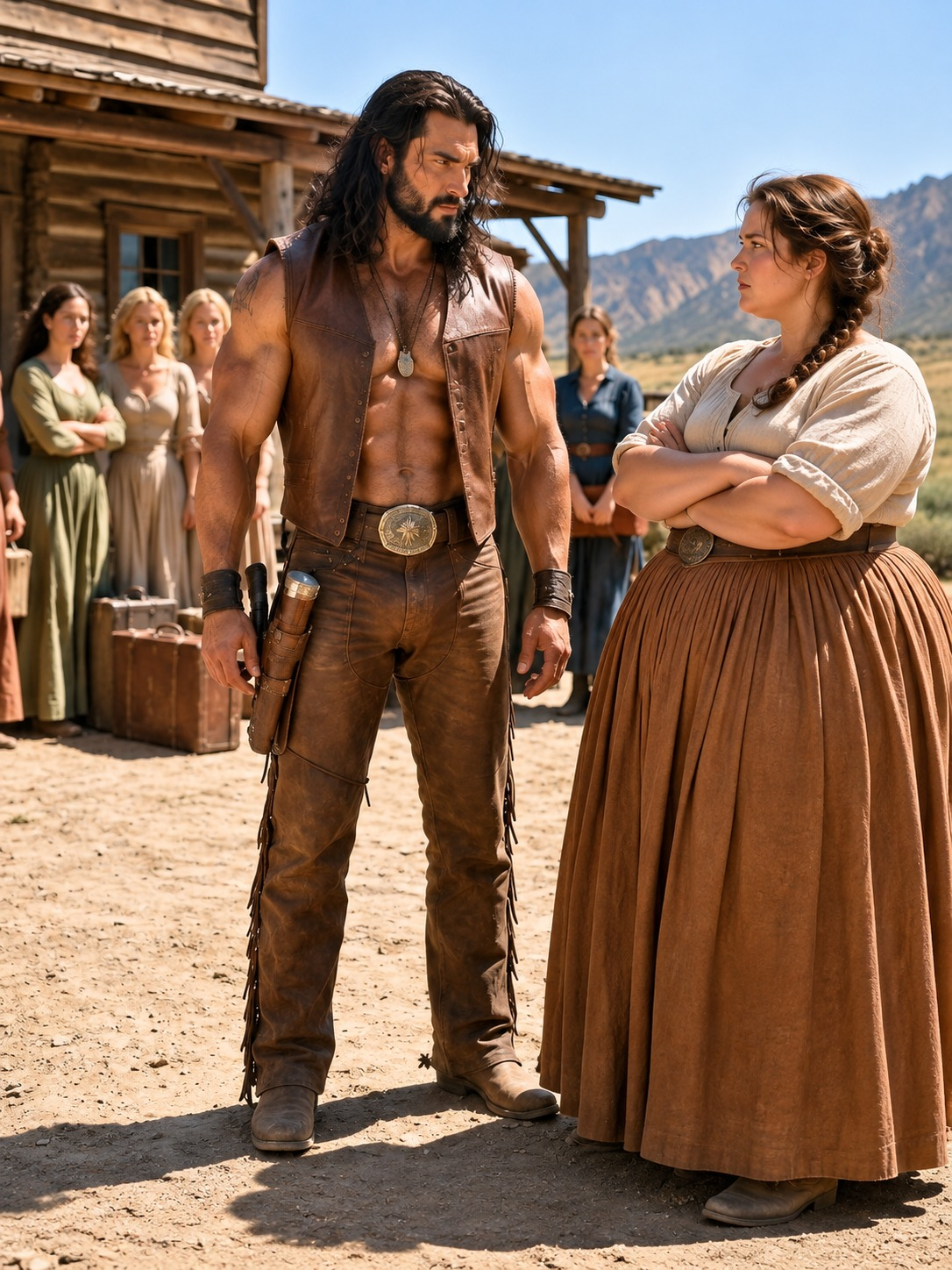
Mason dismounted before the horse had completely stopped.
I remained in the saddle, watching him approach the porch with his rifle held low.
The object lying beside the front door was a folded piece of paper, weighted down by a small stone.
Mason glanced at it.
Then his jaw tightened.
"What's wrong?" I asked.
"Nothing you need to worry about."
He picked up the paper and slipped it into his coat.
I didn't believe him.
But I had known the man for less than an hour, and I understood that asking too many questions might close whatever small door he had allowed me to approach.
He turned toward me.
"Come down. I'll take your horse."
I shifted carefully in the saddle. Mason reached up and steadied my arm while I climbed down.
His touch was brief and practical.
He immediately stepped away.
The ranch house stood at the edge of a wide clearing, surrounded by a weathered fence and several wooden outbuildings. A barn stood to the right, its large doors open. Beyond it, cattle moved slowly across the distant pasture.
The house was modest.
Two stories, with a broad front porch and a chimney that looked recently repaired.
There were no flowers.
No curtains moving in the windows.
No signs that a woman had ever lived there.
Yet everything appeared clean.
The porch had been swept. The windows were clear. A stack of chopped firewood sat neatly beneath the eaves.
Mason noticed me looking.
"I keep things in order."
"I can see that."
He took my suitcase from the mule.
"Come inside."
The front door opened with a soft wooden creak.
I stepped into a room that smelled faintly of coffee, leather, and cedar.
The furniture was simple.
A sturdy table stood near the kitchen. Two chairs were positioned beside it, though one appeared to have been used much more often than the other.
There was a fireplace, a wooden cabinet, and a small shelf holding several books.
Everything had its place.
Nothing suggested that anyone had ever stayed long enough to leave something behind.
Mason set my suitcase beside the stairs.
"Kitchen's there. Water pump's outside. There's a washroom behind the house."
I nodded.
He pointed toward a narrow hallway.
"Your room is at the back."
I followed him.
He opened a door to a small bedroom with a clean bed, a wooden dresser, and a window overlooking the pasture.
A folded quilt rested at the foot of the bed.
On the inside of the door was a sturdy metal bolt.
I examined it.
Mason noticed.
"That locks from the inside."
"I see."
"You can keep it locked whenever you want. Nobody comes into this room without your permission."
He spoke as though he had repeated those words many times.
Perhaps he had.
I turned toward him.
"Thank you."
He nodded.
Then he stepped back into the hallway.
"Supper's at six."
He started to leave.
"Mason?"
He stopped.
"Yes?"
"Where do you sleep?"
"Upstairs."
"Will I be in your way?"
He looked genuinely confused.
"No."
It was the first time I had seen him struggle to answer a simple question.
He cleared his throat.
"There's enough room."
Then he walked away.
I closed the bedroom door and rested my back against it.
For the first time since leaving home, I allowed myself to breathe.
The room was clean.
The bed was comfortable.
There was a bolt on the inside of the door.
Everything a woman might need to feel safe.
And yet, standing alone in that little room, I felt an unexpected sadness.
Not because I was afraid.
Because the house felt as though it had been prepared for someone who was never expected to arrive.
I unpacked my few dresses and hung them in the dresser.
Then I placed my father's old photograph beside the window.
He had been a quiet man, too.
But unlike Mason, he had always known how to fill a room with conversation when someone needed it.
I wondered what my father would have thought of this marriage.
Probably that I had chosen a difficult road.
He would have been right.
At six, I entered the kitchen.
Mason was already there.
He had changed into a clean burgundy shirt, though his dark ranch trousers and boots remained dusty.
A pot of beef stew simmered on the stove.
Two plates sat on the table.
Two forks.
Two spoons.
Two glasses of water.
I noticed the arrangement.
Mason followed my gaze.
"Sit down."
I took the chair opposite him.
He served the stew without saying anything.
The food was good.
Better than I expected from a man who seemed to spend most of his life outdoors.
"Did you make this?" I asked.
"Yes."
"You're a better cook than most men I've known."
He looked at his plate.
"I've had practice."
I waited for him to say more.
He didn't.
For several minutes, we ate in silence.
I tried not to make the silence uncomfortable.
But it was becoming clear that Mason had built his life around avoiding conversation.
Finally, I put down my spoon.
"Can I ask you something?"
He looked up.
"Depends."
"Why did the other women leave?"
His expression changed.
Only slightly.
But I saw it.
He pushed his plate away.
"I don't know."
"Did they tell you?"
"No."
"Did you ask?"
He stared at the table.
"Once."
"And?"
"They said nothing."
I studied him.
"All nine?"
"Not all at once."
His voice was low.
"The first one said she couldn't live somewhere so lonely. The second left a note saying the house was too quiet. The others didn't explain."
"Did you try to stop them?"
"No."
"Why not?"
He looked directly at me.
"Because I wasn't going to keep someone somewhere they didn't want to be."
I understood the words.
But I also heard everything he hadn't said.
He wasn't describing nine failed marriages.
He was describing nine departures he had never understood.
He leaned back in his chair.
"Every one of them, I gave them the room with the bolt. I fed them. I fixed whatever needed fixing. I kept my distance so they would feel safe."
His fingers tightened around his glass.
"And every one of them left."
For the first time that evening, his voice sounded less like a rancher giving instructions and more like a man admitting defeat.
I looked at him carefully.
"I think you did everything a person could ask," I said.
His eyes lifted.
"But?"
I took a breath.
"And I think a person can starve to death in a house that's safe and fed if nobody in it will ever let them close enough to matter."
He became completely still.
I hadn't intended to hurt him.
But I wasn't going to pretend that food and a locked bedroom were everything a woman needed.
Mason looked down at his hands.
"I don't know how to do that."
"Do what?"
"Let someone close."
His answer was so quiet that I almost missed it.
I softened my voice.
"You don't have to learn everything tonight."
He said nothing.
I picked up my spoon again.
After a moment, he did the same.
We finished supper without another difficult question.
When I stood to clear the plates, he immediately reached for them.
"I'll do it."
"I can wash dishes."
"You've traveled all day."
"And you've cooked."
He hesitated.
Then he handed me one of the plates.
"All right."
It was a small thing.
But it felt like the first agreement we had made as two people rather than strangers sharing a roof.
I washed.
He dried.
Neither of us spoke much.
When I reached for the second plate, our hands touched.
Mason withdrew his hand as though he had accidentally crossed a boundary.
I pretended not to notice.
Later, he showed me where the lamp oil was kept and reminded me that the back door sometimes stuck in damp weather.
Then he returned to the barn.
I watched him through the kitchen window.
He walked beneath the last light of the evening, his shoulders slightly bent, carrying the weight of a life that had taught him not to expect anything from anyone.
I wondered how many times he had watched a woman leave through that same front door.
I wondered whether he had stood in the kitchen afterward, staring at an empty chair.
And I wondered whether he had ever understood that people could leave even when nobody had given them a reason to hate the place.
I went to my bedroom and locked the bolt.
Not because I feared Mason.
Because he had promised me the choice.
That mattered.
I slept deeply for the first time in several nights.
The next morning, I woke to the sound of a horse moving outside.
Sunlight filtered through the curtains.
I dressed, pinned my copper-red hair back, and went downstairs.
The kitchen was empty.
A coffee pot sat on the stove.
Beside it was a single tin cup.
I poured myself some coffee and stepped outside.
Mason was in the corral, checking a fence.
"Good morning," I called.
He looked up.
"Morning."
I carried my cup toward him.
"Where's the nearest place to buy flour?"
"Town."
"How far?"
"Half a day by wagon."
I considered that.
"Then I suppose I'll have to make do with what you have."
He leaned against the fence.
"There's flour in the pantry."
"How much?"
"Enough."
I looked at him.
"Enough for breakfast or enough for a week?"
He seemed to think about it.
"Probably breakfast."
I laughed.
It wasn't a loud laugh.
Just a brief sound of amusement.
Mason looked at me as though he hadn't expected to hear it.
Then something almost resembling a smile touched the corner of his mouth.
It disappeared quickly.
But I had seen it.
I finished my coffee and went inside.
The pantry held flour, cornmeal, salt, sugar, and a small quantity of dried apples.
I found a mixing bowl and began preparing biscuits.
My mother had taught me to make them when I was little.
She used to say that a good biscuit could make an ordinary morning feel like a celebration.
I had never forgotten.
The kitchen gradually filled with the smell of warm flour and butter.
When Mason came inside, he stopped in the doorway.
"What are you making?"
"Breakfast."
He looked at the table.
There were biscuits cooling on a plate, eggs cooking in a skillet, and coffee ready to pour.
"You didn't have to do that."
"I know."
He stood there for a moment.
Then his eyes moved toward the shelf beside the stove.
There was an old tin cup sitting near the back.
He reached for it.
Stopped.
Then he took a second cup from the shelf.
He placed both on the table.
I watched him.
He didn't seem to notice what he had done.
But I did.
Two cups.
Not one.
He pulled out a chair.
"Coffee?"
"Please."
He poured mine first.
Then his.
We sat across from each other.
Outside, the morning wind moved through the grass.
Mason broke a biscuit in half.
He took a bite.
Then he looked at me.
"These are good."
I smiled faintly.
"That's fortunate. They're all we have."
He lowered his eyes.
And for the first time, the silence between us didn't feel like a wall.
It felt like a beginning.
But before either of us could say another word, a distant horse whinnied from the direction of the valley.
Mason looked toward the window.
A rider was approaching the ranch at an unusually fast pace.
And when the man finally came into view, Mason recognized the horse immediately.
It belonged to Harlon Price.
Something had happened in Red Hollow.
Something serious enough that the old postmaster had ridden through the morning without stopping...
Comments 0