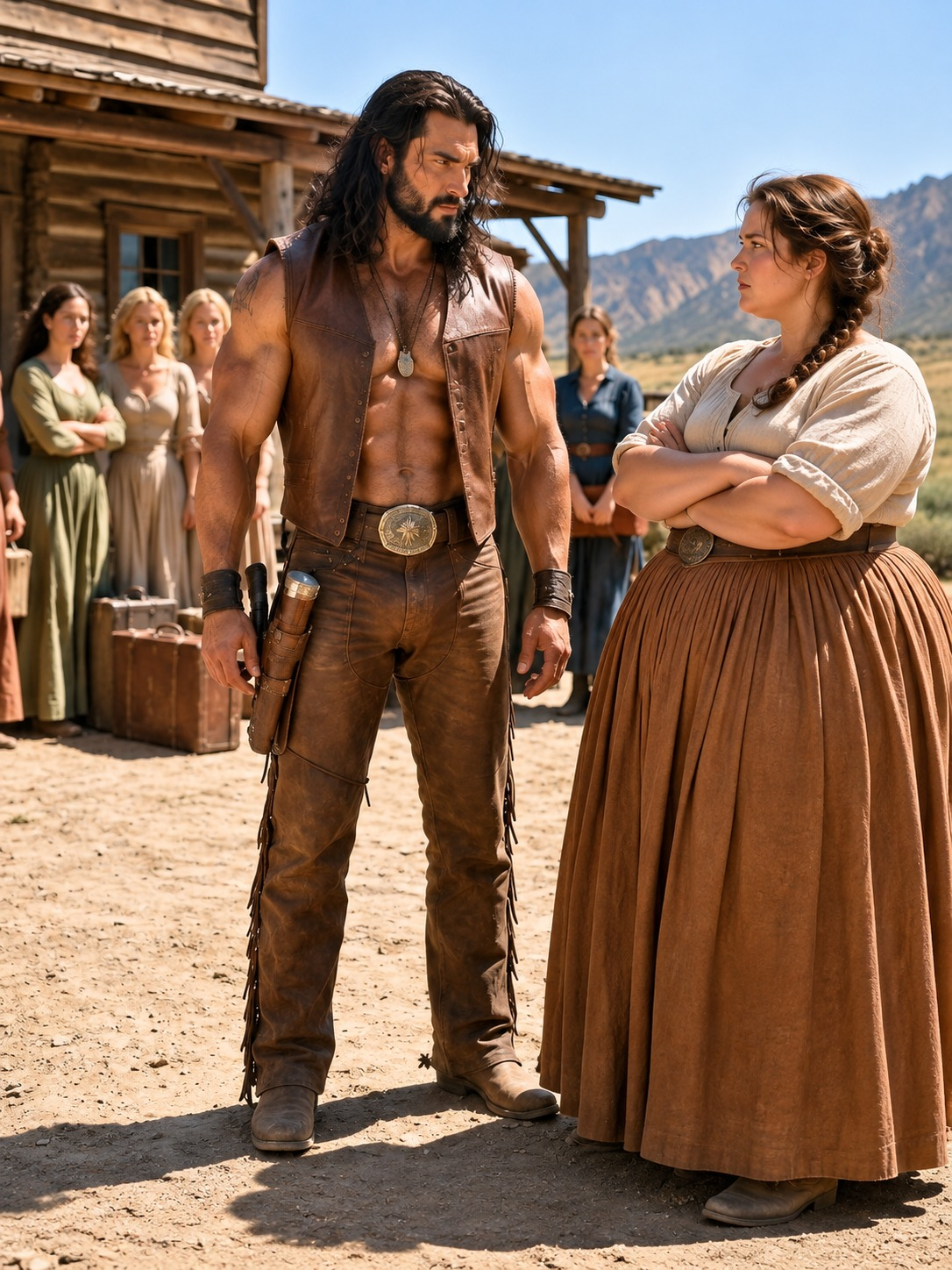
A woman stepped down from a stagecoach and refused to get back on.
"That mountain will swallow you alive, Miss Whitmore!"
Silas Bracken approached her, holding a folded bank notice.
On its bottom corner was Mason Callahan's ranch name.
But Eleanor Whitmore had already made her decision.
She wasn't going anywhere.
The stagecoach door slammed behind me, and the sound seemed louder than it should have been.
I stood in the middle of Red Hollow Valley with one hand gripping the handle of my battered leather suitcase. The other held a folded letter that had traveled with me across three states.
The paper was soft at the edges from being opened too many times.
Mason Callahan's name was written across the front.
I had never met the man.
Yet I had traveled nearly a thousand miles to become his wife.
The driver climbed back onto his seat, glanced at me, and shook his head.
"Last chance, Miss. I wouldn't want to be the one leaving you up there."
"Then I suppose it's fortunate you aren't responsible for my decisions."
He looked at me as though he couldn't decide whether I was brave or foolish.
Perhaps I was a little of both.
The horses shifted impatiently, their harnesses creaking in the afternoon heat. A cloud of dust drifted behind the coach and settled over my traveling dress.
The mercantile stood across the street, its wooden sign swinging gently above the porch.
Several people had gathered to watch my arrival.
They weren't smiling.
They were studying me.
I recognized that expression. I had seen it before, back in Missouri, when I told my neighbors I intended to travel west to marry a man whose only photograph showed him standing beside a dead tree.
People had looked at me the same way.
As if I had announced that I intended to walk into a burning building.
A gray-haired man emerged from the mercantile.
He wore a dusty brown jacket and an old hat that had lost much of its original shape.
"Miss Whitmore?"
"Yes."
"I'm Harlon Price. Postmaster."
He removed his hat.
"I'm sorry to meet you under these circumstances."
I glanced toward the road leading into the mountains.
"Are the circumstances really that bad?"
Harlon hesitated.
Then he looked toward the people watching us.
"Nine women have gone up that road before you."
I waited.
"Nine?"
"Nine."
"And what happened to them?"
"They left."
"All of them?"
"Every last one."
He lowered his voice.
"The longest lasted a month. Most didn't stay a week. Some came back on the stagecoach. Others walked down the mountain with nothing but the clothes they were wearing."
I looked at the road again.
"Did they tell you why?"
Harlon shook his head.
"Not a word."
A woman standing near the mercantile porch whispered something to another woman.
They both looked at me.
I pretended not to notice.
Harlon studied my face.
"People around here have their opinions about Mason Callahan."
"And what are yours?"
He looked down at his hands.
"I've delivered letters to that ranch for years. Sometimes I watched him ride down to collect them. He never opened them in town."
"Why not?"
"He carried them inside his coat. Like they were something precious."
That surprised me.
Harlon continued.
"A cold man doesn't protect letters like that. I reckon he's a man who's been left too many times to believe anyone might stay."
I looked at the folded letter in my hand.
There were only six lines in it.
Mason had written that he owned a working cattle ranch, that the mountain was isolated, and that life there required patience.
He had also written something I had read dozens of times.
I cannot promise you an easy life, Miss Whitmore. But I can promise you a roof, food, and a place where nobody will lay a hand on you.
It wasn't a romantic letter.
There were no declarations of love.
No promises of a grand house or expensive dresses.
But I had found something honest in those words.
And honesty was worth more to me than a beautiful lie.
Before I could answer Harlon, another man stepped onto the wooden porch.
He wore an expensive navy waistcoat, a cream shirt, and a burgundy necktie. A gold watch chain crossed his chest.
His boots were so polished they looked strangely out of place in the dusty street.
Silas Bracken.
I knew his name from Mason's letters.
He was the valley banker.
He was also the man who held mortgages against much of the mountain property.
"Miss Whitmore," he said, offering a smile that never reached his eyes.
"Mr. Bracken."
"I understand you've come to marry Callahan."
"I have."
He glanced at my suitcase.
"Then I suggest you reconsider."
I said nothing.
"That man is a poor investment. His cattle are declining, his land is heavily mortgaged, and his temper is legendary."
"Have you known him long?"
"Long enough to know what happens to people who trust him."
Harlon shifted uncomfortably.
Silas ignored him.
"Nine women have already discovered the truth. I doubt you'll be any different."
I tightened my fingers around the suitcase handle.
"Did any of those women tell you that he mistreated them?"
Silas's smile disappeared for a moment.
"That isn't the point."
"It seems like rather an important point to me."
He looked irritated.
"Miss Whitmore, I am offering you practical advice. When you come back down that mountain, my bank may have a position available. Honest work. A warm room. Regular meals."
I studied him.
"And what would you want in return?"
His eyebrows lifted.
"Excuse me?"
"Nobody offers a stranger a room and a job without expecting something."
For the first time, Harlon almost smiled.
Silas buttoned his waistcoat.
"Simply that you understand where your interests lie."
"My interests are my own, Mr. Bracken."
I turned away.
He watched me for several seconds before speaking again.
"That mountain has a way of breaking stubborn people."
I didn't answer.
Instead, I carried my suitcase toward the horse trough and sat on its wooden edge.
The stagecoach driver gave me one final look before cracking his whip.
The horses moved.
The coach rolled away.
And just like that, I was alone in a town where nobody wanted to help me.
The afternoon heat pressed against my shoulders.
I had enough money for perhaps two meals, provided I found somewhere willing to serve them. My dress was faded from the journey, and my boots had begun to rub against my heels.
But I wasn't going back.
Not after everything.
My mother had died when I was twenty-four. My father had followed three years later, leaving behind debts and a small house that eventually had to be sold.
I had spent the next decade working wherever I could.
I had learned to mend clothes, keep accounts, cook for large households, and stretch a handful of flour into enough biscuits for a family.
I wasn't looking for a prince.
I wanted a home where my work mattered and where I could wake up without wondering whether the roof would still belong to me next month.
Mason Callahan had offered that possibility.
Perhaps he was difficult.
Perhaps he was lonely.
Perhaps the stories were true.
But I intended to discover the truth myself.
A shadow fell across the dirt.
I looked up.
A tall man had ridden into the street on a dun horse.
He wore a dark forest-green ranch coat over a burgundy shirt. His ash-blond hair was short and slightly wavy, and a reddish-brown beard covered his jaw.
His face was weathered.
His shoulders were broad.
His eyes were gray-blue and difficult to read.
He dismounted without hurry.
Nobody needed to introduce him.
I knew.
Mason Callahan.
He walked toward the mercantile and began loading a few supplies onto his saddle.
He didn't look toward me.
I waited.
A minute passed.
Then another.
Finally, I stood.
"You didn't come to meet the coach."
He paused.
His eyes moved toward me.
"No."
"Did you know I was arriving today?"
"Yes."
"Then I suppose you had somewhere better to be."
He looked at my suitcase.
"I figured you'd be gone by the time I got here."
There was no anger in his voice.
Only a tired certainty.
I felt something tighten inside my chest.
"Well, I'm still here."
He studied me.
For a moment, neither of us spoke.
Then he reached for the canteen hanging from his saddle.
"Drink."
I blinked.
"What?"
"Water. You look like you've been sitting in that sun for hours."
I accepted it.
The canteen was warm from the afternoon heat, but the water inside was welcome.
"Thank you."
He nodded once.
Then he picked up my suitcase.
"Is this everything?"
"Everything I brought."
He examined the worn leather and the twine holding its damaged handle together.
Without comment, he secured it to the pack mule.
I watched him work.
There was something strange about the way he handled my belongings.
Carefully.
As if he had learned that small things could matter to someone.
When he finished, he turned toward his horse and extended his hand.
"Come on. It's a long climb."
I looked past him toward the mountains.
The road disappeared between two dark ridges.
Somewhere beyond them stood the ranch where nine women had refused to remain.
I placed my hand in his.
He helped me mount the dun horse.
Before climbing up behind me, he looked once toward Silas Bracken.
The banker was still standing on the mercantile porch.
Their eyes met.
Neither man spoke.
But something passed between them that I couldn't understand.
Mason took the reins.
"There's something you ought to know about Bracken," he said.
I turned slightly.
"What?"
"He owns paper on nearly every ranch up here. Mine included."
He guided the horse toward the mountain road.
"He's been waiting six years for me to fail."
"Why?"
"Because there's a spring on my property. It runs all year, even when the valley dries up."
His jaw tightened.
"In this country, the man who owns the water owns everybody."
I looked back toward the town.
Silas Bracken was still watching us.
Then Mason added something that made me understand why he had never come down to meet the coach.
"He's not going to let you stay without making trouble."
I looked at him.
"Then I suppose he'll have to get used to being disappointed."
Mason said nothing.
But his hand tightened slightly around the reins.
We climbed higher.
The town disappeared behind us.
And when the ranch finally came into view, Mason suddenly pulled the horse to a stop.
His gaze fixed on the front porch.
Someone had left something there.
Something that hadn't been there when he rode down that morning.
Mason's expression changed.
"Stay on the horse," he said.
Then he reached for the rifle strapped beside his saddle and rode toward the porch...






Comments 0