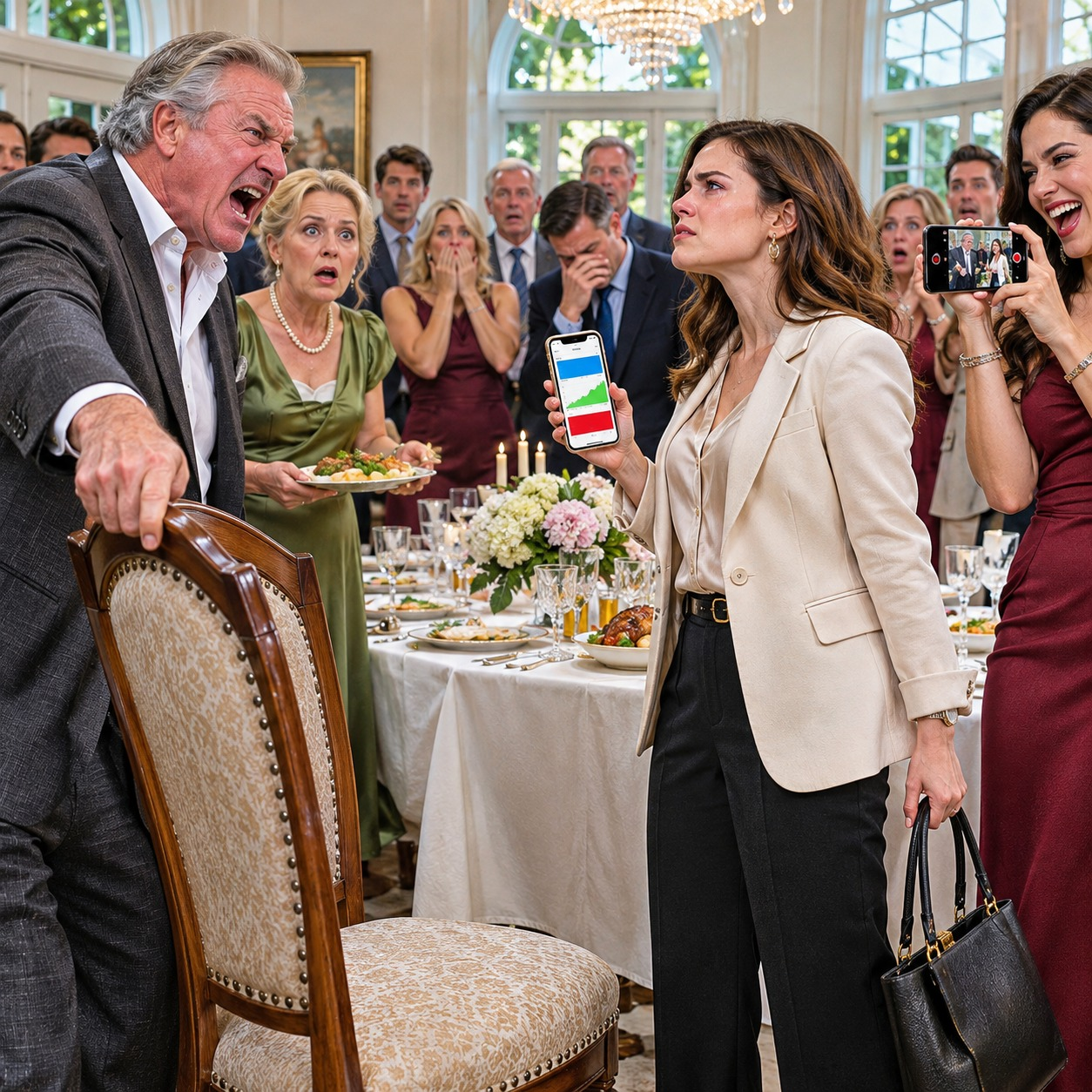
"And this time, the decision is about Graham."
Aunt Evelyn placed the sealed folder on the conference table.
My father stood beside her, his face pale.
Tessa kept her eyes on the floor.
For several seconds, nobody moved.
I looked from Evelyn to Dad, then back to the unsigned renewal agreement in front of me.
"What decision?" I asked.
Evelyn took her seat.
"First, I want everyone to understand that this decision was made through the company's proper governance process. It wasn't made because of a family disagreement."
Dad lowered himself into a chair.
He looked exhausted.
Evelyn opened the folder.
"The advisory board has completed its review of the company's handling of the proposed technology acquisition, the disputed agreement, and the decisions surrounding the software renewal."
I felt Lauren straighten beside me.
Rebecca closed her notebook.
Marcus folded his hands.
Evelyn continued.
"The review found serious failures in document controls, executive oversight, and the separation of personal interests from company decisions."
Dad stared at the table.
"Specifically," Evelyn said, "the company allowed an internal acquisition proposal to develop without the participation of the business owner whose company was being discussed. Documents inaccurately suggested that Maya had been informed or had agreed to certain arrangements."
My throat tightened.
"An unauthorized signature image was later placed on a proposed agreement. And although the evidence does not establish that Graham personally directed that specific act, he acknowledged retaining the resulting document despite knowing Maya had not executed it."
The room remained silent.
Evelyn turned a page.
"The company also allowed a commercial renewal decision to become entangled with those disputed historical claims."
She looked at my father.
"Graham has accepted responsibility for his failures of oversight and judgment."
I stared at him.
He didn't argue.
Didn't interrupt.
Didn't accuse anyone of misunderstanding him.
He simply nodded.
Evelyn continued.
"Effective immediately, Graham will step back from day-to-day executive management for six months. Marcus Reed will serve as acting chief executive during that period, with support from the existing management team."
I looked at Marcus.
He seemed almost uncomfortable.
Not surprised.
Just aware of the responsibility being placed on him.
Evelyn continued.
"Graham will retain his ownership interest and may continue to participate in appropriate governance matters, subject to the company's established procedures. The management structure will be reviewed at the end of the six-month period."
Dad looked up.
For a moment, I saw the man who had spent decades building Whitaker Hospitality Supply.
The man who had worked long hours.
Taken risks.
Made difficult decisions.
And gradually convinced himself that building a company meant he had the right to control everyone connected to it.
Now he was being asked to step aside.
Not forever.
Not as a public humiliation.
But long enough for the business to operate without his anger directing every decision.
Evelyn looked toward Tessa.
"Tessa has also agreed to step down from her executive responsibilities while the company completes its review of her involvement in the document-production process."
My sister swallowed.
She nodded.
"She will cooperate with the remaining inquiries through counsel," Evelyn continued. "Any future role will be considered only after those matters have been properly resolved."
I looked at Tessa.
Her eyes were wet.
But she didn't protest.
Then Evelyn closed the folder.
"These are the board's recommendations and the corresponding management decisions Graham has accepted. They do not resolve any separate legal questions. Those will continue through the appropriate channels."
She turned toward me.
"Maya, I wanted you to hear this directly because the company's conduct affected you. But I also want to make something clear."
I waited.
"Your renewal agreement is a separate commercial matter. You are under no obligation to sign because of anything we've decided today."
I looked at the contract.
For years, my father's company had represented something much larger than a customer account.
It represented the approval I had wanted since childhood.
Now the people around the table were finally treating it as what it actually was.
A business relationship.
Between two independent companies.
"Thank you," I said quietly.
Evelyn nodded.
Then she looked toward Marcus.
"Shall we proceed with the commercial discussion?"
Marcus opened the final agreement.
The twelve-month term began after the existing contract expired on March thirty-first.
The monthly subscription was eight thousand nine hundred dollars.
The service levels were clearly defined.
The transition provisions protected both companies.
And the strategic cooperation language had been rewritten so that Whitaker Hospitality Supply could request consideration for future projects without receiving any automatic rights to my company's technology.
No hidden ownership claims.
No compulsory acquisition discussions.
No special family obligations.
Rebecca had reviewed every paragraph.
Lauren had checked the financial terms.
Ben had confirmed the technical commitments were realistic.
I looked at Marcus.
"Are your operations and procurement teams comfortable with the agreement?"
He nodded.
"Yes. We've reviewed the scope, pricing, and transition obligations. This is the recommendation of the people responsible for using the system."
I smiled.
"Then we're comfortable proceeding."
Dad shifted in his chair.
Everyone looked toward him.
For one uncomfortable second, I thought he might object.
Instead, he said, "Marcus, I trust your judgment."
Marcus looked surprised.
So did I.
Dad continued.
"You've been telling me for three years what the system does for our warehouses. I should have listened sooner."
Marcus nodded slowly.
"Thank you, Graham."
Dad turned toward me.
"And Maya?"
I met his eyes.
"Yes?"
He swallowed.
"I won't ask you to discount your work because you're my daughter."
My throat tightened.
He looked at the contract.
"If the service is worth the price, we should pay the price."
I didn't know what to say.
Not because the statement was extraordinary.
Because it was ordinary.
It was exactly how a business owner should think.
And I had waited years to hear my father say something so simple.
I nodded.
"Thank you."
Rebecca slid the signature page toward me.
I picked up my pen.
This time, nobody moved my chair.
Nobody laughed.
Nobody suggested I didn't belong.
I signed my name.
Maya Whitaker.
Founder and chief executive.
The signature was mine.
Placed there by my own hand.
On a document I had read, understood, and chosen to accept.
Marcus signed on behalf of Whitaker Hospitality Supply under the authority granted to him for the transaction.
Rebecca and Helen confirmed the execution process.
Then Marcus extended his hand.
"Looking forward to another successful year."
I shook it.
"So am I."
And just like that, the contract was signed.
No dramatic music.
No applause.
No victory speech.
Just two businesses agreeing to work together.
It was exactly what I'd wanted.
After the meeting, Evelyn asked me to walk with her.
We stepped into the hallway.
Through the windows, I could see the warehouse below.
Forklifts moved between shelves.
Workers checked schedules.
Trucks backed toward loading bays.
Life continued.
Evelyn stood beside me.
"How do you feel?"
I thought about it.
"Relieved."
She smiled.
"Good."
"And sad."
Her expression softened.
"That's understandable."
I looked at her.
"Aunt Evelyn, I never wanted Dad to lose his position."
"I know."
"I didn't want Tessa to lose her job."
"I know that too."
She folded her hands.
"But the consequences of their decisions aren't yours to carry."
I looked down.
She continued.
"Graham built a successful company. That deserves recognition. But success doesn't excuse poor judgment."
I nodded.
"And Tessa?"
Evelyn sighed.
"She's talented. She's capable. But she has to learn that loyalty doesn't mean doing whatever someone powerful asks."
I looked through the window.
"Do you think she'll be okay?"
"I think she has an opportunity to become someone she can respect."
I smiled faintly.
"That's a very Aunt Evelyn answer."
She laughed.
Then she took my hand.
"Maya, I owe you an apology too."
I looked at her.
"For what?"
"For not challenging your father sooner."
I shook my head.
"You weren't responsible for everything he did."
"No. But I saw how he treated you at family gatherings. I told myself it wasn't my place to interfere."
I felt my throat tighten.
Evelyn continued.
"At his birthday dinner, when I watched him pull that chair away, I realized how much silence had allowed."
I looked down.
"I appreciate you speaking up."
She squeezed my hand.
"You should never have needed someone else to tell him you deserved respect."
I blinked back tears.
Then I hugged her.
She held me tightly.
And for the first time, I understood that a family could change without pretending the past had been harmless.
The final document examination took several more weeks.
Rebecca kept me informed as the independent examiner completed the work.
The findings confirmed that the signature image on the disputed strategic agreement had been reproduced from my legitimate software-services contract.
The electronic records from the outside document-production service supported the same conclusion.
The service had received instructions through a chain of company correspondence.
Tessa had authorized the final production request.
Patricia had forwarded supporting materials and failed to challenge instructions that should have raised questions.
My father had not been shown to have personally directed the copying, but he had retained the completed document after becoming aware that I had not executed it.
The final report did not pretend to answer questions beyond the evidence.
It didn't need to.
The central fact was established.
I had never signed the strategic agreement.
I had never authorized anyone to reproduce my signature.
And I had never agreed to transfer or restrict my company's ownership rights.
Whitaker Hospitality Supply formally withdrew the disputed agreement and acknowledged in a written settlement that it had no ownership, acquisition, or intellectual-property rights arising from that document or the related internal authorizations.
The company agreed not to rely on those materials again.
It also agreed to cover the reasonable costs my company had incurred responding to the disputed claims and completing the document review.
Rebecca negotiated the terms carefully.
No one asked me to forgive anyone as a condition of resolving the dispute.
No one asked me to sign away future rights.
And no one tried to disguise the settlement as a family favor.
It was a proper resolution to a serious commercial problem.
The original services agreement remained valid through its expiration.
The new renewal took effect afterward.
There was no interruption to the warehouse systems.
No emergency migration.
No damaged customer data.
No retaliation against employees.
The business continued.
And my company remained mine.
We also learned the truth about the anonymous messages.
Patricia had sent them.
She admitted it during the document review.
After leaving Whitaker Hospitality Supply, she had kept copies of certain records she believed might become important.
She had photographed the locked desk drawer during a visit to the Whitaker home when she was helping Mom organize old company files.
The photograph showing the open drawer had been taken after Mom moved the folder, not during a theft.
Patricia had known Mom was worried about the documents, but she hadn't wanted to expose her without permission.
Her anonymous messages had been an attempt to warn me while avoiding responsibility for what she herself had helped facilitate.
It had been a terrible way to handle the situation.
The secrecy had frightened me.
The unexplained photographs had frightened Mom.
And the messages had made an already complicated dispute more confusing.
Patricia apologized.
She gave Rebecca a complete account of what she'd done and cooperated with the remaining review.
I accepted her explanation.
But I told her something I wished everyone in my father's world had learned earlier.
"If you know the truth, hiding behind anonymous messages isn't the same as telling it."
She nodded.
"I understand."
I believed she did.
The courier request was also traced.
It had been initiated by a temporary administrative employee who believed the original agreement needed to be collected for the legal review.
The employee had used an outdated internal collection procedure and had not received authorization from Nathan Price's office.
There was no evidence of an attempted break-in or threat against Mom.
The company corrected its document-handling procedures, and the original folder remained preserved throughout the examination.
For weeks, I'd imagined someone moving through my parents' house trying to steal the truth.
The reality was less dramatic.
A confusing instruction.
Poor coordination.
An anxious mother.
And a family already so frightened of one another that an ordinary knock at the door felt dangerous.
I was grateful Mom had been safe.
I was even more grateful that the questions finally had answers.
Tessa and I didn't become close overnight.
There was no magical conversation that erased what she'd done.
She had authorized the use of my signature.
She had lied about representing me.
She had mocked me in front of our relatives.
And she had posted a video of my humiliation because she expected strangers to laugh.
Those things mattered.
She couldn't simply cry and make them disappear.
But she did something I hadn't expected.
She stopped making excuses.
Through her attorney, she cooperated fully with the document review and accepted responsibility for authorizing the signature reproduction.
The company resolved the internal matter with her departure from its executive team.
After consulting her own counsel and completing the required cooperation, she decided not to seek reinstatement.
She told me she needed to find work where her success wasn't dependent on agreeing with Dad.
I thought that was a good decision.
A few weeks later, she asked if we could meet for coffee.
I agreed.
We sat at a small table near the window.
For a while, we talked about ordinary things.
Then she looked at me.
"Maya, I owe you a real apology."
I waited.
She took a breath.
"I was jealous of you."
I blinked.
"Of me?"
She nodded.
"You had something I didn't."
I almost laughed.
"Tessa, Dad gave you everything."
"Exactly."
I stared at her.
She continued.
"He gave me a job. A title. An office. His approval. But I was always afraid he'd take it away."
I looked down.
"You built your company without him. You made your own decisions. You didn't need him to tell you that you were doing well."
I swallowed.
"I wanted him to tell me."
"I know."
She wiped her eyes.
"That's what makes it worse. You wanted something I had, and I wanted something you had."
I looked at her.
"What?"
"Freedom."
For a moment, neither of us spoke.
Then Tessa continued.
"I laughed at the birthday dinner because Dad was laughing. I posted the video because I thought it would make him happy."
I felt the old pain return.
She looked directly at me.
"That was cruel. And I was wrong."
I nodded.
"Yes."
She swallowed.
"I can't undo it. But I want to become someone who would never do that again."
I studied her.
For once, she wasn't asking me to protect her.
She wasn't blaming Dad.
She wasn't pretending she had been helpless.
She was accepting that she'd made choices.
Bad ones.
And that changing meant making better ones without a guarantee that anyone would reward her.
"I hope you do," I said.
She nodded.
"Me too."
We didn't hug that day.
But when we left, I told her she could call me the following week.
And she did.
Over the following months, we rebuilt a cautious relationship.
We met for lunch.
Talked about books.
Shared memories that didn't revolve around Dad.
Sometimes the conversations were awkward.
Sometimes I needed distance.
She respected that.
Eventually, we found moments when we could laugh together without either of us wondering who might be hurt by the joke.
It wasn't the relationship we'd had as children.
It was something more honest.
And that was enough to begin with.
Dad's changes were slower.
At first, he struggled with stepping away from daily management.
He called Marcus too often.
Asked unnecessary questions.
Tried to offer advice nobody had requested.
But Marcus held the boundaries the company had established.
And Evelyn supported him.
Gradually, Dad stopped treating every decision made without him as a personal insult.
He spent time with Mom.
He started taking long walks.
He met with a counselor who helped him examine the way he'd confused authority with affection.
I didn't attend those sessions.
I didn't need to know everything he discussed.
I only needed to see whether his behavior changed.
And over time, it did.
He stopped criticizing my car.
Stopped asking why I didn't work for him.
Stopped referring to my company as a little software business.
When we met for dinner, he asked questions and listened to the answers.
Sometimes he slipped.
Once, he started telling me how I should structure a new product launch.
Then he stopped himself.
"Sorry," he said. "You didn't ask for advice."
I smiled.
"No, I didn't."
He nodded.
"Would you like to tell me about it instead?"
I almost laughed.
"Yes, Dad. I would."
So I did.
And he listened.
That was how our relationship began to change.
Not through one enormous apology.
Through small moments when he chose respect instead of control.
At the end of his six-month leave, Whitaker Hospitality Supply's governance review concluded.
Marcus remained chief executive, with the company's formal leadership structure adjusted to reflect the responsibilities he had already been carrying.
Dad retained his ownership interest and a defined governance role, but he did not return to day-to-day management.
He accepted the arrangement.
And for the first time, he seemed genuinely relieved not to have to control every decision.
The company continued to perform well.
Its warehouses remained busy.
Its employees continued improving operations.
And the software renewal proved commercially successful.
Nobody needed to pretend that one person deserved all the credit.
My own company had a remarkable year.
We signed new customers.
Expanded our engineering team.
Improved our inventory forecasting tools.
And introduced features Ben had been planning for months.
Lauren strengthened our financial reporting and helped us establish a more predictable growth plan.
Olivia became a team lead.
The original sixteen employees grew into a larger, more confident organization.
We still had difficult days.
Software bugs.
Demanding customers.
Unexpected expenses.
Late-night calls when an integration stopped working.
But those problems belonged to the business we'd chosen to build.
They weren't family battles disguised as commercial disputes.
One Friday afternoon, Lauren walked into my office carrying a small box.
"What's that?" I asked.
She placed it on my desk.
"A present."
I frowned.
"Why?"
"Because Ben and I have been waiting three years to give it to you."
I opened the box.
Inside was a small brass plaque.
It read:
MAYA WHITAKER
FOUNDER
YOU BUILT THIS.
I stared at it.
Then I looked at Lauren.
She was smiling.
Ben appeared in the doorway.
"Before you ask," he said, "yes, we argued about the wording."
I laughed.
"What was your version?"
He grinned.
"'The Woman Who Survived Our First Product Launch.'"
Lauren rolled her eyes.
"Too long."
"More accurate."
I laughed harder.
Then my eyes filled with tears.
I stood and hugged them both.
For years, I'd waited for my father to tell me I had built something worthwhile.
But the people who had actually built it with me had known all along.
The following spring, Mom invited everyone to dinner.
A small family gathering.
No elaborate birthday decorations.
No speeches.
No pressure.
Just dinner.
I hesitated when she asked.
She understood.
"You don't have to come," she said.
I thought about it.
Then I agreed.
Not because everything had been forgotten.
Because enough had changed that I wanted to try.
When I arrived, Dad opened the door.
He smiled.
"Hi, Maya."
"Hi, Dad."
He stepped aside.
"Come in."
The house smelled like roasted chicken and fresh bread.
Mom was in the kitchen.
Tessa was setting the table.
Aunt Evelyn sat in the living room talking with Daniel.
For a moment, it felt like an ordinary family evening.
Then I saw the dining room.
The same table.
The same cream upholstered chairs.
The same place where Dad had pulled a chair away from me.
I stopped.
My chest tightened.
Dad noticed.
He followed my gaze.
Then he looked at me.
"Maya."
I turned.
His expression was serious.
"I've been thinking about that night."
I swallowed.
"Me too."
He nodded.
"I know I can't change what happened."
"No."
"But I want you to know something."
I waited.
He looked toward the table.
"You never needed to earn a seat here."
My eyes filled.
He continued.
"I made you feel like you did. That was my failure."
I looked down.
For a moment, I couldn't speak.
Then I whispered, "Thank you."
Dad nodded.
He didn't ask whether I forgave him.
Didn't try to hug me.
Didn't turn the moment into a speech.
He simply stepped aside and let me decide what to do next.
I walked into the dining room.
Tessa looked up.
"Hey."
I smiled.
"Hey."
She pulled out a chair beside her.
"Want to sit here?"
I looked at it.
Then at her.
"Sure."
She smiled.
And I sat down.
No one laughed.
No one made a joke.
No one treated my presence as something to be granted or withdrawn.
We ate dinner.
Talked about work.
Argued cheerfully about which movie to watch afterward.
Mom told a story about accidentally planting flowers in the wrong part of her garden.
Daniel made everyone laugh.
Aunt Evelyn asked about my company's newest product.
Dad listened while I explained it.
Then he said, "That sounds impressive."
I smiled.
"Thanks."
He nodded.
And the conversation moved on.
No dramatic moment.
No demand that everyone acknowledge what he'd said.
Just a father telling his daughter he was impressed by her work.
I had waited a long time for that.
Later that evening, Dad and I stood on the back porch.
The sky was dark blue.
The garden lights glowed softly along the walkway.
Inside, I could hear Mom and Tessa laughing.
Dad leaned against the railing.
"Maya, can I ask you something?"
"Sure."
"Are we okay?"
I thought about the question.
A year earlier, I might have lied to make him feel better.
I might have said yes because I didn't want another argument.
Now I knew better.
"We're getting there," I said.
He nodded slowly.
"That's fair."
I looked at him.
"I forgive you, Dad."
His eyes filled.
He opened his mouth.
But I continued.
"That doesn't mean what happened was okay. And it doesn't mean I want things to go back to the way they were."
He nodded.
"I understand."
"I want us to keep building something better."
He looked at me.
"I want that too."
For a moment, neither of us spoke.
Then he said, "I'm proud of you, Maya."
My throat tightened.
He smiled faintly.
"Not because your company makes money. Not because Marcus says your software is good. Not because anyone else thinks you're successful."
I looked at him.
"I'm proud of the person you've become."
Tears slipped down my cheeks.
Dad's eyes were wet too.
"I should have told you that when you were little," he whispered.
I nodded.
"Yes."
He looked down.
"I'm sorry."
I stepped forward and hugged him.
He held me carefully.
Not tightly enough to keep me there.
Just enough to let me know he was glad I had chosen to stay.
A few weeks later, my company moved into a larger office.
We had outgrown the old space.
The new building had wide windows, bright meeting rooms, and enough desks for the team we were becoming.
On the first morning, I arrived before everyone else.
I walked through the quiet office carrying a box of photographs.
There was one from our original workspace above the printing shop.
One from our first product launch.
One of Ben asleep at his desk after a long night fixing a software issue.
One of Lauren holding the cake we'd bought when we signed our tenth customer.
And one from the day our team celebrated reaching fifty customers.
I placed the photographs on a shelf.
Then I walked into the main conference room.
A long table stood beneath the windows.
Around it were comfortable chairs.
Enough for everyone.
I stood there for a moment.
Then I remembered the birthday dinner.
The chair my father had pulled away.
The laughter.
The humiliation.
The words that had hurt me more than I wanted to admit.
I don't sit with a poor, useless kid.
I looked around the room.
At the desks waiting for my employees.
At the screens that would soon display our software.
At the space we'd earned through years of work.
I thought about everything that had happened since that dinner.
The disputed contract.
The false signature.
The family secrets.
The difficult conversations.
The apologies.
The choices.
And the people who had stood beside me.
Then I smiled.
Because the most important thing I'd learned wasn't that my father had finally recognized my worth.
It was that my worth had never depended on his recognition.
The door opened behind me.
Lauren walked in carrying coffee.
"You're early."
I laughed.
"So are you."
She looked around.
"Pretty good, huh?"
I nodded.
"Pretty good."
Ben appeared a moment later.
He carried a box of cables and looked deeply offended by the building's elevators.
"Who designed the loading entrance?" he demanded.
Lauren laughed.
"Good morning to you too."
I smiled.
"Welcome to our new office."
Ben looked around.
Then he grinned.
"Not bad for a little software company."
We all laughed.
Soon the rest of the team arrived.
The office filled with voices.
Boxes were unpacked.
Computers were connected.
Someone brought pastries.
Someone else played music.
And the work began.
Real work.
The kind that mattered.
At noon, Lauren called everyone into the conference room.
She had arranged a small celebration.
There was cake.
Coffee.
And a handwritten card signed by the entire team.
I stood at the head of the table, looking at the people who had helped build the company.
For a moment, I couldn't speak.
Then I smiled.
"Thank you."
Ben raised his coffee cup.
"To Maya."
I shook my head.
"To all of us."
Everyone cheered.
I looked around the table.
Every chair was occupied.
Every person belonged.
And I realized that the thing I'd spent so many years searching for had been right in front of me.
Not my father's money.
Not his company.
Not his permission.
A place where people were respected.
Where their work mattered.
Where no one had to earn dignity by pleasing the person in charge.
A place I'd helped build.
After the celebration, everyone returned to their desks.
I stayed in the conference room for a moment.
Sunlight filled the windows.
The city stretched beyond them.
I pulled out a chair and sat down.
My own chair.
At my own table.
In the company I had built.
And for the first time in my life, I didn't need anyone to tell me I belonged.
I already knew.






Comments 0