The signature looked like mine.
That was the first thing that frightened me.
Not because I believed I had signed the document.
I knew I hadn't.
But whoever had placed my name at the bottom had done enough to make a stranger hesitate.
The capital M curved the way mine did. The W had the same sharp middle point. Even the long stroke beneath my last name resembled the flourish I'd developed after signing hundreds of business documents.
I sat at my kitchen table, staring at the screen.
The PDF was five pages long.
Its title was Preliminary Strategic Cooperation and Future Rights Agreement.
The first three pages described a potential partnership between my software company and Whitaker Hospitality Supply.
The fourth discussed a proposed right of first negotiation if I ever decided to sell my business.
The fifth contained a paragraph claiming that I had acknowledged the arrangement and agreed to discuss any future transfer of certain technology rights with Whitaker before approaching outside buyers.
Then came the signature.
My name.
A date from three years earlier.
And a line identifying me as the owner and chief executive of my company.
I hadn't signed it.
I hadn't approved it.
I hadn't even known it existed.
I immediately called Rebecca Shaw.
She answered after the second ring.
"Maya?"
"I just received something."
My voice sounded strange.
Too calm.
The kind of calm that arrives when you're so frightened your mind hasn't decided how to react.
"What did you receive?"
"A document claiming I signed an agreement with my father's company three years ago."
There was a pause.
"Send it to me."
"I already forwarded it."
"Don't reply to the sender. Don't contact your father. And don't alter the file."
"I won't."
"Do you recognize the document?"
"No."
"The signature?"
"It resembles mine."
"Did you sign it?"
"Absolutely not."
"Then that's where we begin."
I closed my eyes.
Rebecca's voice remained steady.
"Maya, listen carefully. A document that appears to contain your signature isn't automatically genuine. We need to establish its origin, how it was executed, and whether there's any supporting evidence."
I swallowed.
"Could Dad use it against me?"
"He can make a claim. That doesn't mean the claim will succeed."
I looked at the email again.
The sender was a law firm I didn't recognize.
The message stated that its client was reviewing certain historical commercial rights and requested that my company preserve relevant records.
It did not identify an existing court case.
It did not include a formal demand for ownership.
But the implication was clear.
Someone wanted me to believe my father's company might possess rights beyond our software-services contract.
"Rebecca," I whispered, "why would anyone do this?"
She didn't answer immediately.
Then she said, "That's what we're going to find out."
I barely slept.
By seven the next morning, I was sitting in Rebecca's office with a paper copy of the disputed agreement spread across a conference table.
Lauren sat beside me.
Rebecca had invited a colleague who specialized in commercial disputes and document authentication.
His name was David Mercer.
He was a quiet man in his fifties who examined paperwork with the same intensity Ben gave to malfunctioning code.
David read the agreement twice.
Then he placed it on the table.
"First," he said, "we need to separate what this document claims from what it could actually establish."
I nodded.
He pointed to the signature page.
"This is a scanned image. We don't have the original paper document, a verifiable electronic-signature audit trail, or reliable evidence showing how the signature was obtained."
"Because I never signed it," I said.
"I understand. Our job is to establish that through evidence."
Rebecca opened another folder.
"We also have the company's corporate records. There's no board approval, no corresponding negotiation history, and no executed agreement in Maya's files."
Lauren added, "And our original services agreement contains no reference to this document."
David nodded.
"All useful facts."
I looked at him.
"Can someone simply copy a signature onto a document?"
"It's possible to manipulate scanned documents. But we shouldn't conclude that's what happened without examining the source files."
I leaned back.
"How long will that take?"
"That depends on what records we can obtain."
Rebecca folded her hands.
"We're requesting the native file, execution history, and any correspondence supporting the claimed agreement."
I stared at the signature again.
It was unnerving to see my own name used in a way I couldn't explain.
For years, Dad had dismissed my company.
Now a document existed suggesting he might have attempted to secure rights connected to it.
I thought about Tessa's warning.
Dad doesn't know everything.
And Patricia's reaction when she saw the altered executive authorization.
That's not the version I approved.
A terrible possibility formed in my mind.
What if my father wasn't the only person responsible?
I pushed the thought away.
I needed proof.
Not another suspicion.
Rebecca looked at me.
"There's something else we should discuss."
"What?"
"Your sister."
I stiffened.
"What about her?"
"She appears in the original meeting summary as your representative. She also received Marcus's warning that no one should claim your consent without authorization."
I nodded.
"We need to establish what she said and whether she had any involvement in preparing this new document."
I stared at the table.
"She came to my office yesterday."
"I know."
"She seemed frightened."
Rebecca's expression softened.
"People can be frightened for many reasons, Maya."
I knew that.
But I couldn't stop thinking about the way Tessa had looked at Patricia.
Not angry.
Not merely embarrassed.
Afraid.
At ten-fifteen, I returned to my office.
Ben was waiting near the conference room.
He looked at my face.
"Bad morning?"
"Complicated morning."
He held out a paper cup.
"Coffee."
I accepted it.
"Are you secretly monitoring my emotional stability?"
"No. Lauren told me to make sure you ate something."
He produced a breakfast sandwich from behind his back.
I laughed.
"Of course she did."
"She said you were not allowed to run a company on caffeine and family drama."
I took the sandwich.
"She's right."
"Usually."
We walked into my office.
Ben closed the door.
"I heard there's a disputed document."
"Yes."
"Do you need anything from engineering?"
"Maybe."
He nodded.
"Whatever it is, we'll handle it."
I looked at him.
There was no hesitation in his voice.
No question about whether helping me might be inconvenient.
He had worked beside me for years.
He knew what our company was worth.
Not because of a valuation report.
Because he'd helped build it.
"Ben, do you remember our first customer?"
He smiled.
"North Ridge Distribution."
"Remember their warehouse manager?"
"Frank. The guy who called our dashboard 'the little blue miracle.'"
I laughed.
"He still calls it that."
Ben leaned against the desk.
"Why?"
I looked at the photograph of our team.
"Because Dad keeps saying he gave me my business."
Ben's smile disappeared.
"Maya."
"I know."
"No. I want you to hear this."
He pointed toward the office beyond the glass wall.
"Those people aren't here because Graham Whitaker did you a favor."
I swallowed.
"They're here because we built a product customers need. Because you kept going when the company was barely surviving. Because you didn't give up when the first version broke during a demonstration."
I smiled faintly.
"That was a terrible day."
"It was."
He grinned.
"You cried in the parking lot."
"I did not."
"You absolutely did."
I laughed.
Then my eyes filled with tears.
Ben's expression softened.
"Your father doesn't get to rewrite our history."
I looked away.
"Thank you."
He nodded.
Then he stood.
"Now eat your sandwich. Lauren scares me more than any production outage."
At noon, my phone began buzzing.
One message.
Then another.
Then five more.
I glanced at the screen.
A text from my cousin Daniel.
Maya, have you seen what Tessa posted?
My stomach dropped.
I opened the message.
There was a link to a social media video.
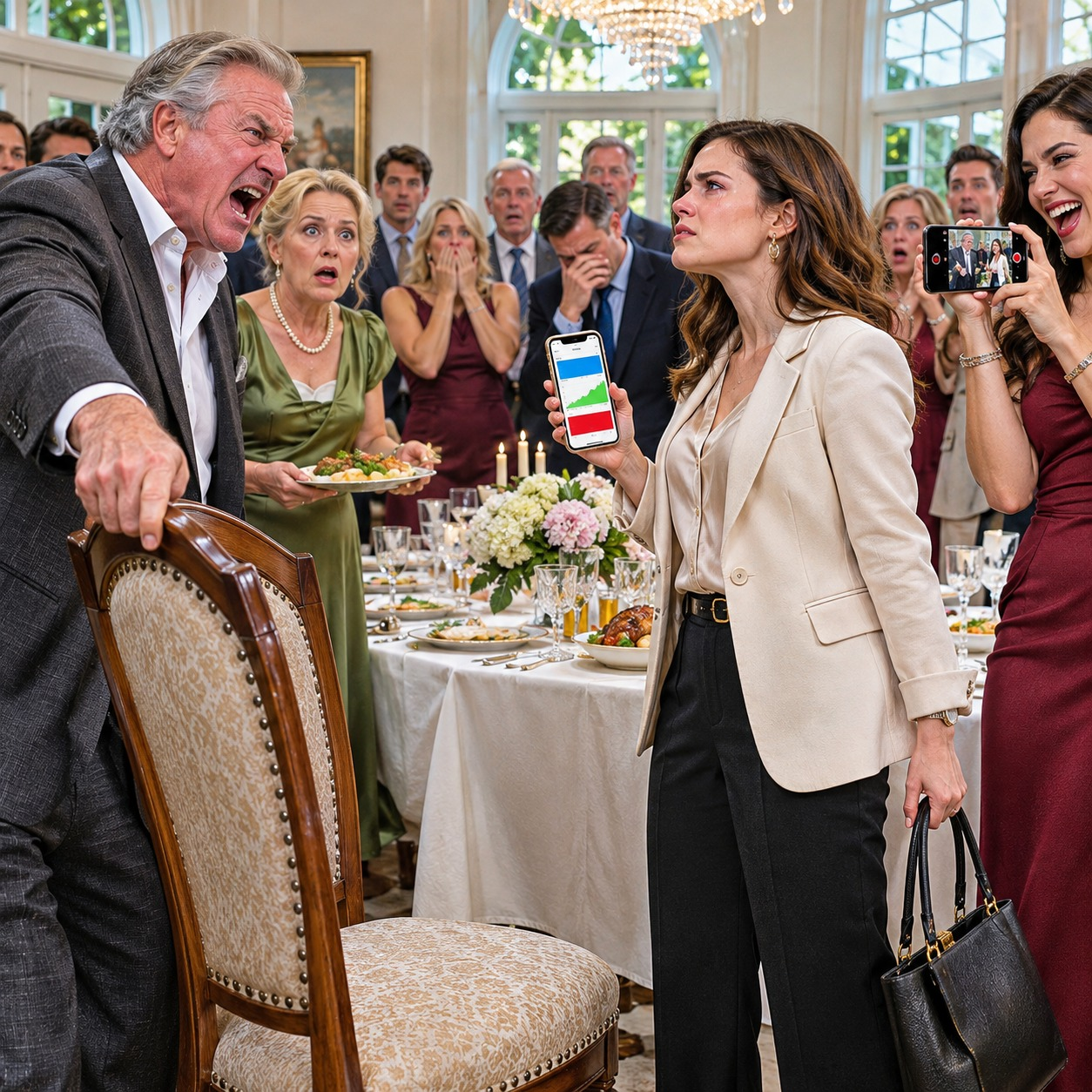
The thumbnail showed my father's dining room.
The white tablecloth.
The birthday decorations.
And me standing beside the chair he had dragged away.
For a moment, I couldn't move.
Then I pressed play.
The video began with Tessa laughing behind the camera.
My father stood near the head of the table, smiling broadly.
I appeared at the edge of the frame, reaching for the chair.
Then he grabbed it.
Dragged it backward.
And said the words I had been trying not to hear again.
"I don't sit with a poor, useless kid."
Laughter erupted.
I watched myself straighten my jacket.
My face was pale.
But my voice was steady.
"You just made a very expensive mistake."
Then I turned and walked away.
The video ended.
I stared at the screen.
Tessa had posted it.
Publicly.
The caption read:
When your sister can't take a joke at Dad's birthday dinner.
I felt heat rise in my face.
Not from embarrassment.
From disbelief.
She had recorded my humiliation.
She had replayed it for the family after I left.
And now she'd shared it with strangers.
I scrolled down.
The video had already attracted thousands of views.
Comments were appearing faster than I could read them.
Most weren't reacting the way Tessa had expected.
That's not a joke. That's cruel.
Why would a father humiliate his daughter like that?
The way she stayed calm was impressive.
Someone needs to explain why the sister thought this was funny.
I kept scrolling.
One comment stopped me.
Wait. Is that Maya Whitaker, the software company founder?
Another person replied.
I think so. My company uses her platform.
Then another.
If that's her, she's definitely not poor.
I stared at the screen.
The story was escaping the family.
People were connecting the woman in the video to the business I'd built.
And Tessa had apparently believed the public would laugh along with her.
My phone rang.
Lauren.
"Have you seen it?"
"Yes."
"Don't respond."
"I wasn't planning to."
"Good. Rebecca's office is already aware."
I looked at the view count.
It was climbing.
"How bad is this going to get?"
Lauren hesitated.
"I don't know."
I closed my eyes.
For years, I'd tried to keep my family life separate from my business.
Now my sister had placed both in the same public conversation.
And I couldn't control what strangers would say next.
By two o'clock, the video had spread beyond Tessa's original post.
Someone had shared it on a local business discussion page.
Another account had reposted it with a caption about workplace respect and family expectations.
A third had identified Whitaker Hospitality Supply.
That worried me.
Not because I wanted to protect Dad from criticism.
But because his company employed people who had nothing to do with the dinner.
Warehouse workers.
Drivers.
Customer-service representatives.
People who deserved to go to work without being dragged into a public family dispute.
I called Rebecca.
"The video is spreading."
"I've seen it."
"What should I do?"
"Nothing publicly for now."
"People are identifying the companies."
"I know."
"I don't want our employees caught in this."
"Then let's prepare an internal message."
That made sense.
I gathered Lauren and Ben.
We drafted a short statement for our team.
It explained that a personal family incident had appeared online, that our company remained fully operational, and that employees should direct any media or customer inquiries to management.
We didn't attack anyone.
We didn't discuss the contract.
We didn't mention the disputed document.
We simply reassured our people that their work would continue normally.
I sent the message at three-fifteen.
Within minutes, replies began arriving.
We're with you.
Let us know if you need help.
The product speaks for itself.
One message came from our newest customer-support specialist, Olivia.
My dad used to say things like that. I'm glad you walked away.
I stared at her words.
Then I closed my laptop for a moment.
I hadn't realized how many people might recognize themselves in that video.
To me, it was one terrible dinner.
To someone else, it might look like years of being told they weren't enough.
At four, Tessa called.
I let it ring.
She called again.
Then a third time.
Finally, I answered.
"What?"
Her voice was sharp.
"You need to tell people to stop attacking me."
I stared at the wall.
"Excuse me?"
"The comments. They're horrible."
"You posted the video."
"It was supposed to be funny."
"It wasn't."
"You could at least defend me."
I almost laughed.
She had publicly shared a recording of our father humiliating me.
And now she wanted me to protect her from the reaction.
"Tessa, I haven't said anything about you."
"That's the problem."
I closed my eyes.
"No. The problem is that you posted something cruel and expected everyone to laugh."
She was silent.
Then she said, "You always have to make me look bad."
I felt something inside me harden.
"I didn't post the video."
"You knew people would react like this."
"I didn't know you were going to share it."
Her breathing grew uneven.
"People are messaging my coworkers."
"I'm sorry that's happening."
"Then fix it."
"I can't control strangers."
"You can tell them it was a joke."
I looked at the photograph on my desk.
"No."
She went quiet.
Then her voice changed.
Lower.
More desperate.
"Maya, Dad is furious."
"At me?"
"At everyone."
"That doesn't surprise me."
"He says this could hurt the company."
I took a breath.
"Then perhaps he should consider apologizing."
Tessa laughed bitterly.
"You really don't understand him."
"I understand him very well."
"No, you don't."
She hesitated.
Then she whispered, "He's blaming me."
I sat upright.
"For posting the video?"
"For everything."
I didn't answer.
She continued.
"He says I made the family look bad. He says I should have known better."
I thought about the dinner.
Dad laughing.
Tessa filming.
Mom looking away.
Fourteen people watching.
For years, my sister had been rewarded for joining Dad whenever he mocked me.
Now the same behavior had consequences.
And she seemed genuinely shocked.
"Tessa," I said carefully, "you made a choice."
"I know."
"You can take the video down."
"I already did."
I checked.
The original post was gone.
But copies remained everywhere.
The internet had done what the internet often did.
It had made a private cruelty impossible to contain.
Tessa's voice trembled.
"Can we just make this stop?"
I felt a flicker of sympathy.
Then I remembered the false meeting representation.
The disputed authorization.
The signature that looked like mine.
"Tessa, if you want to repair anything between us, you need to start telling the truth."
She went silent.
"About what?"
"About the meeting three years ago."
Her breathing stopped for a moment.
"Maya—"
"And the document with my signature."
She whispered something I couldn't hear.
"What?"
Then she said, "I didn't know they were going to use it."
My heart slammed against my ribs.
I sat completely still.
"What did you say?"
Silence.
"Tessa."
She began crying.
"I didn't know."
I gripped the phone.
"Know what?"
She took a shaky breath.
"That Dad would send it to a lawyer."
I closed my eyes.
There it was.
Not a full confession.
Not proof.
But an admission that she knew more about the document than she'd told me.
"Tessa, did you create that agreement?"
"No."
"Did you sign my name?"
"No!"
"Then who did?"
She was crying harder now.
"I can't talk about this on the phone."
"Why?"
"Because Dad checks everything."
I frowned.
"What does that mean?"
She didn't answer.
"Tessa, if someone used my signature without permission, you need to tell me."
"I know."
"Then tell me."
A long silence.
Finally, she whispered, "I need to show you something."
My pulse quickened.
"What?"
"Not here. Not at the office."
"Where?"
She hesitated.
"Somewhere Dad won't know."
I stared at the phone.
For the first time, my sister sounded less like the confident executive who mocked me and more like the frightened little girl who used to hide behind Mom when Dad lost his temper.
I didn't know whether to trust her.
But I knew I needed to hear what she had to say.
"Send the information to Rebecca," I said.
"No."
"Tessa—"
"Please, Maya. Just meet me."
I closed my eyes.
I wasn't going to walk blindly into another family confrontation.
"If we meet, it will be somewhere public, and I'll tell my attorney where I'm going."
She hesitated.
Then she said, "Fine."
At six-thirty, I met Tessa at a quiet café across town.
I arrived early.
Chose a table near the front window.
And texted Rebecca the location.
Tessa appeared fifteen minutes later.
She wasn't wearing her usual polished expression.
Her hair was pulled into a messy ponytail.
Her eyes were red.
She looked exhausted.
For a moment, I barely recognized her.
She sat across from me without ordering anything.
"Thank you for coming," she whispered.
I folded my hands.
"What did you want to show me?"
She glanced around.
Then reached into her handbag.
For a moment, I thought she was going to produce another document.
Instead, she placed her phone on the table.
The screen showed a video file.
A different video.
Not the birthday dinner.
A recording from three years earlier.
I stared at the thumbnail.
It showed my father's conference room.
The same room from the photograph Patricia had brought.
Tessa looked at me.
"I recorded this because Dad wanted me to take notes."
My heart began pounding.
"Recorded what?"
"The meeting."
I looked at the screen.
"With Andrew Collins?"
She nodded.
"Part of it."
"Why didn't you tell me?"
Tears filled her eyes.
"Because I was afraid."
"Of Dad?"
She looked down.
"Of what I helped him do."
I felt cold.
"Tessa, what did you do?"
She wiped her cheeks.
"I told Andrew I was speaking for you."
"I know."
"I thought Dad would eventually talk to you."
"He didn't."
"I know."
She looked at the phone.
"Then he asked Patricia to prepare paperwork."
I leaned forward.
"What paperwork?"
"The authorization."
"And the agreement with my signature?"
She shook her head.
"I didn't see that version until later."
I stared at her.
"How much later?"
She hesitated.
"After the meeting."
My throat tightened.
"Did you know my signature was on it?"
She began crying again.
"Yes."
I sat back.
For a moment, the noise of the café seemed to disappear.
I could see people moving.
A barista carrying cups.
A couple laughing near the window.
But everything sounded distant.
My sister had known.
For three years.
She had known there was a document bearing my signature.
And she had said nothing.
"Tessa," I whispered, "why didn't you tell me?"
She covered her face.
"Because I thought it would never matter."
I stared at her.
Then she lowered her hands.
"I was wrong."
She pushed the phone toward me.
"Watch this."
I looked at the video.
The recording was paused at the beginning.
I could see my father sitting at the head of the conference table.
Andrew Collins sat beside him.
Patricia was taking notes.
And Tessa stood near the window.
I pressed play.
My father's voice filled the space between us.
"We need to establish a stronger relationship with Maya's company."
Andrew replied, "That would require her participation."
Dad laughed.
"She's my daughter."
The recording continued.
Andrew said something about formal consent.
Then my father leaned forward.
And spoke a sentence that made Tessa reach across the table to stop the video.
But I had already heard the first words.
"If Maya won't sign it herself, then..."






Comments 0