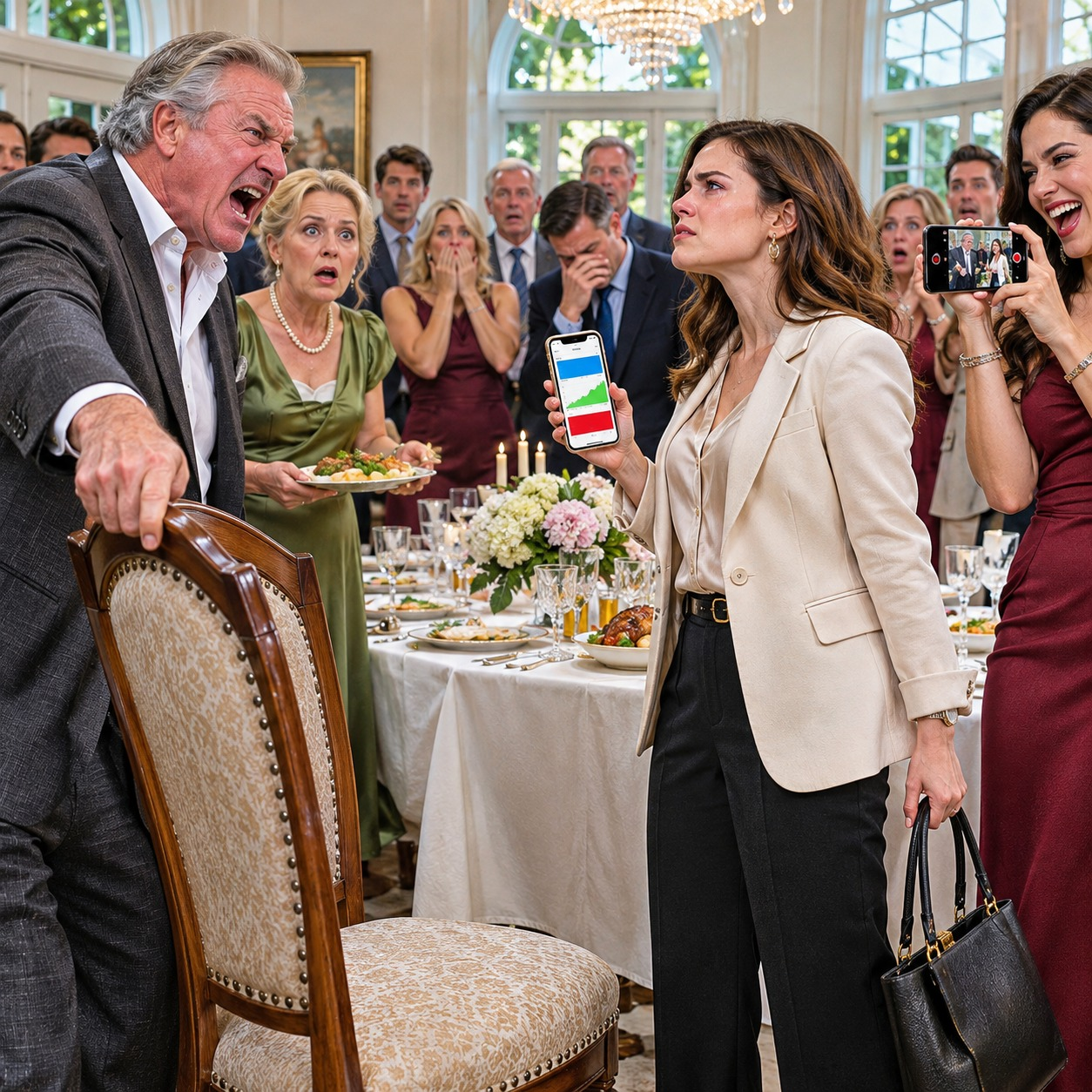
"If Maya won't sign it herself, then we'll have to find another way to get her attention."
My father's voice came through Tessa's phone.
The café seemed to go silent around me.
I watched the recording as Graham Whitaker leaned back in his leather chair, wearing the confident expression I knew so well.
Across from him, Andrew Collins shook his head.
"Mr. Whitaker, there is no alternative to obtaining the owner's informed consent."
Dad waved a hand.
"She's my daughter."
"That doesn't change the legal requirements."
"She'll come around."
Andrew looked uncomfortable.
"Then the appropriate course is to approach her directly with a proposal."
My father laughed.
"You don't know Maya. She gets emotional about these things."
I felt my jaw tighten.
Emotional.
That was his favorite word whenever I disagreed with him.
When I wanted to study computer science instead of business administration, I was emotional.
When I refused to join his company, I was emotional.
When I insisted on negotiating a legitimate software contract, I was emotional.
And when he humiliated me at his birthday dinner, apparently I was emotional for leaving.
On the recording, Andrew leaned forward.
"Mr. Whitaker, I need to be clear. My firm cannot proceed with an acquisition assessment based on the assumption that your daughter will eventually agree."
Dad's smile disappeared.
"Then perhaps I've hired the wrong firm."
Andrew gathered his papers.
"That's your decision."
Tessa reached across the café table and paused the video.
Her hand was trembling.
"There's more," she whispered.
I stared at her.
"Then play it."
She shook her head.
"Not here."
"Tessa, you brought me here to show me this."
"I know."
"Then don't stop halfway."
She looked around the café.
A couple near the window was laughing over coffee. A barista was wiping down the counter. Nobody seemed interested in us.
But Tessa looked terrified.
"Maya, I need you to understand something."
I folded my hands.
"I'm listening."
"Dad wasn't trying to steal your company."
I stared at her.
"Then what was he trying to do?"
"He wanted to bring it into the family business."
"Without asking me?"
She looked down.
"He thought you'd agree eventually."
I felt a sharp pain behind my ribs.
That word again.
Eventually.
My father had built an entire relationship with me around the assumption that I would eventually surrender.
Eventually, I would stop arguing.
Eventually, I would accept his judgment.
Eventually, I would understand that his approval mattered more than my own decisions.
And apparently, eventually, I would hand over something I'd spent years building.
"Tessa," I said quietly, "did you ever tell him that I might not want that?"
She swallowed.
"No."
"Why?"
"Because he wouldn't have listened."
I looked at the paused video.
For the first time, I saw something in my sister's face that I recognized.
Fear.
Not fear of losing money.
Not fear of public embarrassment.
Fear of disappointing our father.
It was a feeling I knew intimately.
The difference was that I had spent years trying to escape it.
Tessa had built her entire life around avoiding it.
I took a slow breath.
"Did you know about the document with my signature?"
She nodded.
"When?"
"Three years ago."
"Did you sign it?"
"No."
"Did you see who did?"
She hesitated.
"No."
I studied her.
"Then what do you know?"
She looked at the phone.
"After Andrew refused to continue the assessment, Dad was furious. He said the consultant didn't understand how family businesses worked."
That sounded exactly like him.
"He told me to arrange another meeting," she continued. "This time with someone who understood private-company transactions."
"Who?"
"I don't remember the firm's name."
"Did you attend?"
"Part of it."
"What happened?"
She wiped her eyes.
"Dad talked about your software. He said Whitaker Hospitality Supply was one of your most important customers. He thought that gave him leverage."
I felt sick.
"Leverage to do what?"
"To negotiate an investment."
"With me?"
She shook her head.
"He wanted to prepare everything before approaching you."
I stared at her.
"So he wanted to decide the terms of a transaction before asking whether I was interested."
Tessa looked miserable.
"Yes."
I leaned back.
"And the agreement?"
She took a shaky breath.
"A draft appeared in the files afterward. I saw your name on it."
"Was it signed?"
"Not when I first saw it."
My pulse quickened.
"What happened next?"
"I don't know."
"Tessa."
"I swear."
She looked directly at me.
"I saw the draft without a signature. A few weeks later, there was another version with your name at the bottom."
I felt cold.
"Did you ask Dad about it?"
"Yes."
"What did he say?"
She hesitated.
"He told me not to worry about paperwork I didn't understand."
I closed my eyes.
That sentence was so familiar it almost hurt.
Dad had used it on me when I was seventeen.
On Mom when she questioned his business expenses.
On employees who challenged his decisions.
He made ignorance sound like a personal failing.
And he made obedience sound like loyalty.
I looked at Tessa.
"Why didn't you tell me?"
She began crying.
"Because I thought it was just a draft. Because Andrew had already refused to proceed. Because nothing happened."
"Something did happen."
"I know."
"My name ended up on a document I never signed."
"I know."
"And now Dad's lawyers are using it."
She covered her face.
"I'm sorry."
The words surprised me.
Tessa had apologized for small things before.
Being late.
Forgetting a birthday.
Borrowing something without asking.
But I couldn't remember the last time she'd apologized for something that actually mattered.
I looked at her.
"Are you sorry you did it, or sorry it came out?"
She lowered her hands.
Her eyes were red.
"I don't know how to answer that."
I nodded slowly.
At least it was honest.
"Then don't answer yet."
I asked Tessa to preserve the original video and send it to Rebecca through a secure method Rebecca could arrange.
She agreed.
I also told her not to delete messages or alter any documents connected to the old meetings.
For once, she didn't argue.
When we left the café, she stood beside her car for a moment.
"Maya?"
I turned.
"Yes?"
"Do you hate me?"
The question caught me off guard.
I looked at my younger sister.
The girl who had once followed me around the house asking me to help with homework.
The teenager who had cried when she failed her driving test.
The woman who had laughed while our father pulled a chair away from me.
I didn't know how to reconcile those versions of her.
"No," I said finally.
She looked relieved.
"But I don't trust you."
Her face fell.
I continued.
"And I can't pretend that doesn't matter."
She nodded.
Then she got into her car.
I watched her drive away.
For the first time in years, I wasn't sure whether my sister was trying to protect our father or finally trying to escape him.
The next morning, I met Marcus Reed at Whitaker Hospitality Supply's main warehouse.
I had requested the meeting after our conversation about the renewal.
Not to discuss the disputed documents.
Not to confront Dad.
But to understand the operational consequences if his company decided to replace our platform.
Marcus met me near the loading docks.
He wore a reflective safety vest over his shirt.
"Thanks for coming," he said.
"Of course."
We walked through the warehouse.
Forklifts moved between tall shelves.
Workers scanned shipment labels.
Trucks waited outside the loading bays.
The building was loud, busy, and remarkably organized.
I recognized the scheduling screens mounted near the supervisors' stations.
Our software.
Our work.
A warehouse manager named Jerry approached us.
He was older now, with gray hair and a familiar grin.
"Maya!"
I smiled.
"Jerry."
He shook my hand.
"Haven't seen you in a while."
"How's everything running?"
"Better than it used to."
He pointed toward the scheduling display.
"That thing still saves my life every Monday."
I laughed.
"I hope it's not quite that dramatic."
"You didn't work here before we had it."
Marcus smiled.
Jerry continued.
"Used to spend half my morning chasing missing paperwork. Now I can see what's arriving, what's delayed, and which dock is available."
I looked at the screen.
A green status indicator showed that the current appointment schedule was synchronized.
Our platform wasn't glamorous.
It didn't have a flashy consumer brand.
It didn't make headlines.
But it solved real problems for real people.
And that mattered more to me than any expensive office.
Marcus led me into a small meeting room overlooking the warehouse floor.
He closed the door.
"Maya, I wanted you to see something."
He placed a folder on the table.
Inside were updated operational reports.
The first showed scheduling accuracy over the previous three years.
The second summarized reductions in overtime caused by avoidable loading delays.
The third compared inventory exception resolution times before and after implementation.
I studied the figures.
They were impressive.
But I also knew better than to claim all the improvement for our software.
Marcus had made changes to staffing.
Jerry had improved training.
Warehouse supervisors had redesigned procedures.
Technology was part of the solution, not the entire solution.
"These are strong results," I said.
Marcus nodded.
"Your platform made the improvements possible to sustain."
I looked up.
"What do you mean?"
"We could have reorganized the warehouse without your software. But we would still have been relying on paper schedules and disconnected spreadsheets."
He pointed toward the window.
"Your system gives our people the information they need when they need it."
I nodded.
"That's what we built it for."
Marcus leaned back.
"And that's why I'm concerned about Graham's replacement plan."
I looked at him.
"Has he selected another vendor?"
"Not yet."
"Then he still has options."
"He does. But he's making the decision emotionally."
I almost laughed.
The irony was painful.
Dad had spent years accusing me of being emotional.
Now he was considering replacing an essential business system because he didn't like the person who owned the company supplying it.
Marcus opened another folder.
"I asked our operations team to estimate the work involved in migrating to a new platform."
I read the report.
Data conversion.
Integration testing.
Employee training.
Parallel operations.
Contingency planning.
The timeline was longer than Dad seemed willing to accept.
"That's realistic," I said.
Marcus nodded.
"Even if we found a suitable vendor tomorrow, rushing the transition could create unnecessary risk."
I looked at the numbers.
"Then don't rush."
He sighed.
"I've told Graham."
"What did he say?"
"He said we'd figure it out."
I shook my head.
"That's not a migration plan."
"No," Marcus agreed. "It isn't."
He stood and walked toward the window.
For a moment, he watched the warehouse workers moving below.
Then he turned back to me.
"Maya, can I tell you something?"
"Of course."
"When I first met you, I didn't know whether your company could handle an account our size."
I smiled faintly.
"Neither did I."
He laughed.
"At least you're honest."
He sat down again.
"But you asked the right questions. You listened to the warehouse managers. You didn't pretend to know everything."
I looked down.
"That was important to me."
"It showed."
He paused.
"Your father didn't understand why I chose your company."
"I know."
"He thought I was doing him a favor."
I looked up.
Marcus shook his head.
"I told him the truth. We needed better software, and your team had the best solution for our requirements."
I swallowed.
"Thank you."
He smiled.
"Don't thank me. You earned the contract."
For a moment, I couldn't speak.
Then Marcus continued.
"There's something else you should know."
My stomach tightened.
"What?"
"Three years ago, when Graham was exploring the possibility of acquiring an interest in your company, I told him it was a bad idea."
I stared at him.
"Why?"
"Not because your company lacked value."
He leaned forward.
"Because he didn't understand what made it valuable."
I looked at him.
Marcus continued.
"He thought the technology was the asset. He didn't understand that the people, the customer relationships, and the knowledge behind the product mattered just as much."
I felt something warm and painful move through my chest.
For years, Dad had looked at my company and seen a collection of subscriptions.
Marcus had looked at it and seen a business.
A real one.
Built by people.
Sustained by trust.
And valuable because it solved problems.
"Did you tell him that?" I asked.
"Yes."
"What did he say?"
Marcus smiled sadly.
"He told me I was getting sentimental."
I laughed.
Of course he had.
At eleven, we returned to Marcus's office.
He offered coffee.
I accepted.
Then he opened his computer.
"I want to show you something else."
He displayed a spreadsheet.
It compared the cost of our proposed renewal with the estimated costs of alternative software options.
Some vendors offered lower monthly subscription fees.
But their implementation costs were substantial.
Others required expensive integrations.
Several lacked features Whitaker's warehouses already used.
I studied the comparison.
"Did procurement prepare this?"
"Yes."
"Have they verified all the assumptions?"
"They're working on it."
I nodded.
"Good."
Marcus pointed to the bottom.
"The point is that eight thousand nine hundred dollars a month isn't unreasonable when we consider the full service scope."
I looked at him.
"That's what we've been saying."
"I know."
He sighed.
"Graham keeps comparing the new price to the old one."
"Because the old one was a discount."
"Exactly."
I leaned back.
"Marcus, I'm not asking Whitaker to pay more because Dad insulted me."
"I know."
"I'm asking the company to pay the same kind of commercial rate our other customers pay for comparable services."
"I understand."
"And if the company chooses another vendor, we'll cooperate with a proper transition."
Marcus nodded.
"That's why I respect you."
I looked down.
It was strange.
The man who had worked beside my father for nearly twenty years understood my business better than Dad ever had.
And he respected me without needing me to prove that I deserved it.
At noon, Marcus invited me to lunch in the employee cafeteria.
I hesitated.
"Are you sure?"
"Of course."
"What if Dad sees me?"
Marcus smiled.
"Then he'll have to decide whether he wants to join us."
I laughed.
We carried our trays to a table near the windows.
Jerry joined us.
So did a warehouse supervisor named Angela.
They talked about delivery schedules, staffing challenges, and a recent improvement to the inventory-alert system.
Nobody asked about the viral video.
Nobody mentioned the birthday dinner.
They treated me like a professional.
Like someone whose work mattered.
It was such a simple thing.
And somehow, it felt extraordinary.
Halfway through lunch, Marcus's phone buzzed.
He glanced at the screen.
His expression changed.
"Excuse me."
He stood and walked away.
I watched him through the cafeteria window.
He spoke quietly into the phone.
Then he turned toward me.
For a moment, I couldn't read his expression.
When he returned, he didn't sit down.
"Maya, I need to speak with you privately."
My stomach tightened.
"Is something wrong?"
He glanced at Jerry and Angela.
"Please."
I followed him into the hallway.
He led me toward a small office near the warehouse entrance.
Then he closed the door.
"What happened?" I asked.
Marcus looked at his phone.
"Your father's attorney just contacted our legal department."
I felt cold.
"About the renewal?"
"Not exactly."
I stared at him.
"What then?"
Marcus took a slow breath.
"They've received a formal challenge to the authenticity of the agreement bearing your signature."
I blinked.
"From whom?"
He hesitated.
"That's the part I don't understand."
My pulse quickened.
"Marcus."
He looked directly at me.
"The challenge came from someone inside Whitaker Hospitality Supply."
I stared.
"Who?"
He opened the message.
Then his face went pale.
"Maya," he whispered, "I think you need to sit down."
I didn't move.
He turned the screen toward me.
At the top was a name.
A name I recognized immediately.
And beneath it were the words:
I witnessed the preparation of the document. The signature was not placed there by Maya Whitaker.
I reached for the phone.
Before I could read the name, Marcus's office door swung open.
My father stood in the doorway.
And behind him was a man carrying the original agreement.






Comments 0