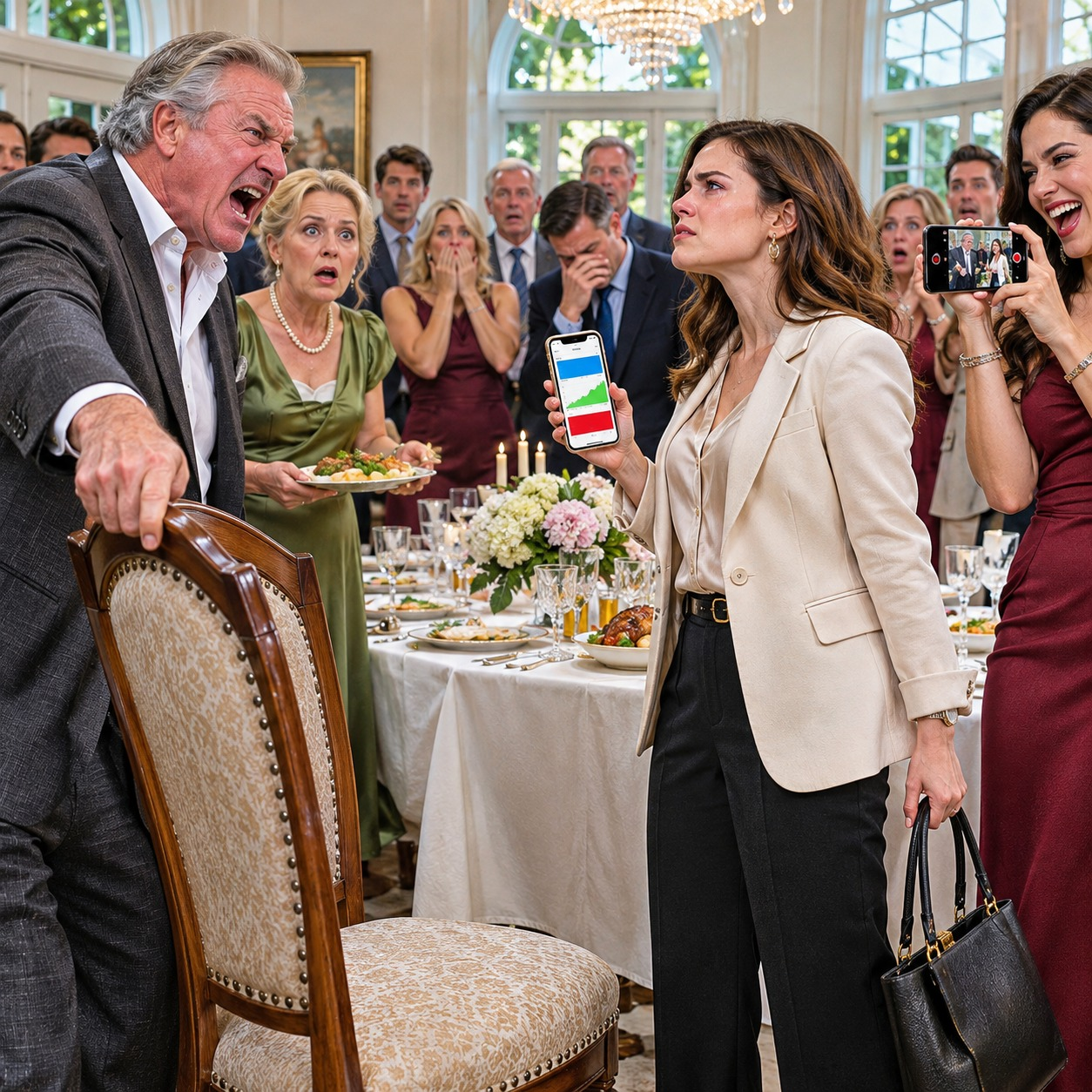
The woman standing on my porch was Patricia Wells.
For a moment, I couldn't move.
She held a thick white envelope against her chest, her silver bracelet catching the light from my porch lamp. Her face looked pale and exhausted.
I had known Patricia since I was a child.
She had organized company Christmas parties, remembered my birthdays, and once brought me a ridiculous stuffed giraffe after I broke my ankle.
Now she stood outside my house carrying what looked like another piece of the nightmare that had consumed my life.
My phone was still pressed to my ear.
"Tessa," I whispered, "Patricia's here."
There was silence.
Then my sister said something that made my stomach tighten.
"Don't let her leave."
I looked through the glass.
Patricia shifted nervously.
"Why?"
"Because she knows."
"Knows what?"
Tessa began crying again.
"Maya, please. Just listen to her."
The call ended.
I stood there for another moment.
Then I remembered Rebecca's warning.
I called her.
"Patricia is at my front door."
Rebecca was silent for a second.
"Has she said why?"
"No."
"Don't discuss the documents without counsel. Ask whether she'll meet us at my office."
I looked through the glass.
Patricia raised her hand.
Not to knock.
Just a small, uncertain gesture.
I opened the door with the security chain still fastened.
"Patricia?"
Her eyes filled with tears.
"Maya."
"What are you doing here?"
She looked at the envelope.
"I need to give you something."
"Rebecca wants us to meet at her office."
Patricia nodded immediately.
"That's fine."
I studied her.
"Are you okay?"
She gave a tired smile.
"I don't think I've been okay for a while."
I felt a flicker of sympathy.
But I wasn't ready to trust her.
"Let's go to Rebecca's office."
Patricia nodded.
"I'll follow you."
Then she looked down at the envelope.
"And Maya?"
"Yes?"
"I'm sorry I didn't come forward sooner."
Forty minutes later, we sat in Rebecca's conference room.
David Mercer was there.
So was Patricia's attorney, a quiet woman named Susan Hale.
Patricia placed the white envelope on the table.
Nobody touched it immediately.
Rebecca looked at Susan.
"Before we begin, I want to confirm that your client understands this is a voluntary discussion and that we're not asking her to waive any rights."
Susan nodded.
"She understands."
Patricia took a breath.
"I asked to come because I don't want another day to pass without telling Maya what I know."
I sat across from her.
My hands were folded so tightly my fingers hurt.
"Then tell me."
Patricia looked at me.
"Three years ago, your father wanted a document showing that your company had agreed to consider a future transaction with Whitaker Hospitality Supply."
I nodded.
"We know that."
"He asked for an agreement to be prepared."
"We know that too."
She swallowed.
"The first draft was unsigned. I saw it. I reviewed the administrative details."
I waited.
"Then Tessa told me the family had reached an understanding."
My chest tightened.
"That wasn't true."
"I know."
Patricia's eyes filled.
"At the time, I didn't question it enough."
Rebecca leaned forward.
"What happened next?"
Patricia opened the envelope.
Inside were printed emails, an invoice, and a copy of a document-production work order.
She placed them on the table.
"Tessa asked me to send the draft to an outside document service. She said they needed a clean version for the executive file."
I looked at the papers.
The work order contained an instruction to reproduce a signature image from an earlier contract.
My stomach turned.
Patricia continued.
"I forwarded the materials. But I didn't approve the final signature page."
David looked at the work order.
"Who did?"
Patricia swallowed.
"Tessa."
The room went silent.
I stared at her.
"You're saying my sister authorized someone to copy my signature?"
Patricia nodded.
"According to the records, yes."
I felt cold.
For a moment, I couldn't speak.
Then I remembered Tessa's words.
The person who signed your name wasn't Dad.
She hadn't said it was herself.
She had said the person wasn't Dad.
I looked at Patricia.
"Did Tessa physically sign it?"
"No."
"Then who did?"
Patricia pointed to the work order.
"The document service inserted a scanned signature image. They appear to have treated the request as an authorized reproduction."
I stared at the page.
My name.
My signature.
Copied from a legitimate contract.
Placed onto a document I'd never approved.
The room seemed to tilt.
I pressed my palms against the table.
"Did the service know I hadn't agreed?"
Patricia shook her head.
"I don't know. Their records suggest they believed the request came from authorized company representatives."
Rebecca nodded.
"That's something we'll need to establish through the original records and witness statements."
I looked down.
The answer wasn't dramatic.
It wasn't a confession shouted across a courtroom.
It was worse.
A series of ordinary administrative steps.
A request.
An attachment.
A work order.
An invoice.
A final file.
And somewhere in that process, my signature had been separated from my consent.
I sat silently while David examined the documents.
Patricia watched me.
"Maya, I should have stopped it."
I looked up.
"Yes."
She nodded.
"I know."
"Why didn't you?"
Her eyes filled with tears.
"Because I trusted Tessa. Because Graham was pushing everyone to finish the executive file. Because I told myself it was only a draft."
I stared at her.
"And when you saw the signed version?"
She looked down.
"I knew something was wrong."
"Then why didn't you tell me?"
She swallowed.
"I was afraid of losing my job."
I closed my eyes.
There it was again.
Fear.
The invisible force that had kept so many people silent around my father.
Mom had been afraid of conflict.
Tessa had been afraid of losing her position.
Patricia had been afraid of losing her job.
And Dad had been afraid of losing control.
Everyone had been protecting something.
Except me.
I had been the person expected to live with the consequences.
Patricia continued.
"I left Whitaker Hospitality Supply partly because I couldn't keep pretending everything was normal."
I looked at her.
"Did Dad know the signature had been copied?"
She hesitated.
"I believe he knew by the time the final version was archived."
"Did he authorize it?"
"I can't say that."
Rebecca nodded.
"That's an important distinction."
Patricia looked at me.
"But he didn't remove the document when I raised concerns."
I swallowed.
That matched what Dad had admitted.
He'd seen the signed version.
He knew I hadn't personally executed it.
And he'd kept it because he wanted the option of using it.
I looked at the work order again.
"Where's the original?"
Susan answered.
"The folder recovered from the Whitaker residence is being preserved. The outside service also has archived electronic records."
Rebecca nodded.
"We'll coordinate examination through counsel."
I leaned back.
For the first time, the story was beginning to make sense.
Not because anyone had planned a perfect conspiracy.
But because several people had made small, terrible decisions and then convinced themselves the consequences would never arrive.
The next morning, Tessa came to my office.
I had asked Rebecca to join us.
Lauren sat beside me.
Tessa arrived alone.
She looked exhausted.
Her hair was pulled back.
Her eyes were swollen.
She stood in the doorway for a moment.
"Can I come in?"
I nodded.
She sat across from me.
For several seconds, nobody spoke.
Then I placed a copy of the work order on the table.
"Did you authorize this?"
Tessa stared at it.
Her face crumpled.
"Yes."
The word was barely audible.
I felt something inside me break.
Not because I hadn't suspected it.
But because hearing her admit it made the betrayal real.
"Why?"
She began crying.
"Dad wanted the executive file completed."
"That doesn't explain why you used my signature."
She wiped her cheeks.
"I thought it was only for internal planning."
I stared at her.
"You copied my signature onto an agreement."
"I know."
"An agreement I never saw."
"I know."
"An agreement that suggested I had accepted future negotiating obligations."
She covered her face.
"I'm sorry."
I felt anger rise.
"Do you understand what you did?"
She nodded.
"No," I said. "I don't think you do."
She lowered her hands.
I leaned forward.
"You took something that represented my consent and used it without asking me."
Her eyes filled again.
"You made it look as though I had agreed to something I didn't even know existed."
She whispered, "I know."
"And then you spent three years pretending nothing happened."
She looked down.
I took a shaky breath.
"At Dad's birthday dinner, you laughed when he humiliated me."
Tessa began crying harder.
"And afterward, you posted the video because you thought strangers would laugh too."
"I was stupid."
"You were cruel."
She flinched.
I continued.
"And when the truth started coming out, you warned me not to look."
She nodded.
"Yes."
I stared at her.
"Why?"
She took a long breath.
"Because I thought if you found out, I'd lose everything."
I looked at her.
"Your job?"
She nodded.
"Your position?"
Another nod.
"Dad's approval?"
She closed her eyes.
"Yes."
I leaned back.
For years, I'd believed Tessa had everything I wanted.
Dad's praise.
His confidence.
A place at his table.
But now I saw the price she'd paid.
She had learned to agree with him.
To laugh when he laughed.
To protect him when he was wrong.
And eventually, to do something she knew was dishonest because she was afraid of losing the life he'd given her.
I felt pity.
But pity didn't erase responsibility.
"Tessa," I said quietly, "you need to cooperate fully with the review."
She nodded.
"I will."
"And you need your own attorney."
"I've already spoken to one."
"Good."
I took a breath.
"And I need space."
Her face fell.
"Maya—"
"I love you. But I don't trust you right now."
She began crying again.
I continued.
"Trust isn't something you get back because you finally tell the truth after being caught."
She nodded.
"I know."
I looked at her for a long moment.
Then I said, "If you want a relationship with me, it has to be built on honesty. Not Dad's approval. Not family appearances. Honesty."
She wiped her cheeks.
"I want that."
I nodded.
"Then start there."
By Friday, the independent document review had begun.
The original paper agreement was examined under an agreed process.
The outside document service produced archived files and correspondence.
The preliminary findings were consistent with the signature image having been copied from the legitimate software-services agreement.
The final report would take longer.
But the available evidence had become difficult to ignore.
Whitaker Hospitality Supply's general counsel advised the company not to rely on the disputed agreement.
The proposed technology restructuring remained suspended.
And the renewal negotiations were separated from the historical document dispute.
For the first time in weeks, my company could focus on business.
Real business.
Customers.
Software.
Employees.
Problems we could actually solve.
Lauren brought me updated financial projections.
Ben showed me a new feature his team had been developing.
Olivia reported that several customers had sent supportive messages after seeing the birthday video.
I thanked her.
Then I asked everyone to return their attention to the work.
We had a company to run.
And I refused to let my father's behavior become the center of it.
That afternoon, Marcus called.
"Maya, I have an update."
I leaned back in my chair.
"Good news?"
"Possibly."
I smiled faintly.
"That's better than the usual answer."
He chuckled.
"The advisory board has recommended that Whitaker continue negotiations with your company under standard commercial terms."
I sat upright.
"Really?"
"Yes."
"And Dad?"
Marcus hesitated.
"He's agreed not to interfere with the procurement team's evaluation."
I stared at the wall.
That was significant.
Not because Dad had suddenly become reasonable.
But because he was finally allowing professionals to do their jobs.
Marcus continued.
"The company wants to discuss a twelve-month renewal at your proposed monthly rate, with clear service levels and a transition provision."
I took a breath.
"That's a reasonable starting point."
"I thought you'd say that."
I smiled.
"Send the proposal to Lauren and Rebecca."
"I will."
He paused.
"Maya, there's something else."
My stomach tightened.
"What?"
"Graham has asked to meet with you."
I closed my eyes.
"About the contract?"
"No."
I waited.
"He says it's personal."
I stared at the window.
For a moment, I didn't know what to say.
Dad had already apologized.
He had admitted he was wrong.
But an apology wasn't the same as change.
And I wasn't ready to pretend everything was fixed.
"Tell him I'll think about it," I said.
Marcus nodded.
"I will."
Then he added quietly, "For what it's worth, he seems different."
I looked down.
"Maybe."
Marcus hesitated.
"He's been spending time with the warehouse managers."
I frowned.
"Dad?"
"Yes."
"Why?"
"He asked them to explain the scheduling system."
I stared.
Marcus chuckled softly.
"Jerry nearly fell out of his chair."
I laughed.
For the first time in days, it was a genuine laugh.
Marcus continued.
"Graham asked what the software actually does for the warehouse."
I felt something tighten in my chest.
"After three years?"
"Yes."
I looked toward the team working beyond my glass office wall.
"Better late than never, I guess."
Marcus was quiet.
Then he said, "He also asked me something I never expected."
"What?"
"He asked whether I thought you were a good CEO."
My breath caught.
"What did you say?"
Marcus didn't hesitate.
"I told him you were one of the most capable founders I've worked with."
I closed my eyes.
Tears filled them.
"Thank you."
He chuckled.
"Don't thank me. I told him the truth."
That evening, I met Mom for dinner.
Not at my parents' house.
Not at a restaurant Dad had chosen.
Just a small neighborhood place with wooden tables and warm lighting.
Mom arrived early.
She hugged me.
I hugged her back.
For a moment, we stood there holding each other.
Then we sat.
She looked nervous.
"Maya, I know things aren't fixed."
I nodded.
"They aren't."
She took a breath.
"But I'm glad you're talking to me."
I looked at her.
"Me too."
We ordered soup and sandwiches.
For a while, we talked about ordinary things.
Her garden.
My employees.
A book she'd been reading.
It felt strange.
Almost unfamiliar.
We had spent so many years discussing Dad's moods that we'd forgotten how to talk about anything else.
Halfway through dinner, Mom set down her spoon.
"Your father has been asking about you."
I looked up.
"I know."
"He wants to make things right."
I took a breath.
"That takes time."
She nodded.
"I told him."
I smiled faintly.
"Really?"
"Yes."
She looked down.
"And I told him he can't buy forgiveness."
I stared at her.
Mom continued.
"He asked whether he should offer to invest in your company."
I almost laughed.
"Of course he did."
She smiled sadly.
"I told him that was exactly the wrong thing."
I looked at her.
"What did he say?"
"He was quiet."
I nodded.
Mom reached across the table.
"Maya, I think he's beginning to understand that money isn't what you've wanted from him."
My throat tightened.
"No."
She squeezed my hand.
"I know."
For a moment, I couldn't speak.
Then I whispered, "I just wanted him to be proud of me."
Mom's eyes filled.
"I am proud of you."
I looked down.
She continued.
"I should have said it more often."
I squeezed her hand.
"Thank you."
When I returned home, I found a small envelope in my mailbox.
My name was written on the front.
No return address.
Inside was a handwritten note.
From Dad.
I recognized his handwriting immediately.
Short.
Angular.
Carefully controlled.
Maya,
I don't expect you to forgive me because I apologized. I know I've damaged your trust. I also know I can't repair that with money or business favors.
I have spent years confusing control with care. I thought providing opportunities meant I had the right to make decisions for other people.
I was wrong.
I am proud of what you've built. I should have told you that long ago.
I hope someday you'll let me show you that I can be different.
Dad.
I read the note twice.
Then a third time.
My eyes filled with tears.
For years, I had imagined hearing those words.
I had imagined Dad standing in front of me, admitting that my company mattered.
That I mattered.
Now the words were on a piece of paper.
And I didn't know what to do with them.
I placed the note on my kitchen table.
Then I sat down.
I didn't call him.
I didn't text him.
I simply let myself feel everything.
The anger.
The grief.
The relief.
The uncertainty.
All of it.
At nine-fifteen, Rebecca called.
"Maya, I have the latest update from Whitaker's counsel."
I sat upright.
"Okay."
"The company has formally withdrawn any suggestion that it possesses ownership rights in your software based on the disputed agreement."
I closed my eyes.
Relief washed through me.
"That's good."
"Very good."
"And the document review?"
"Continuing. But the available evidence supports your denial of execution."
I nodded.
"What about Tessa?"
"She's cooperating through her attorney."
I looked toward Dad's note.
"And Dad?"
"His counsel has confirmed he won't rely on the disputed document."
I took a breath.
For the first time in weeks, the business threat felt as though it might actually end.
Rebecca continued.
"There's one more matter we need to discuss."
My stomach tightened.
"What?"
"The renewal."
I smiled faintly.
"Marcus mentioned it."
"Whitaker has submitted a formal proposal."
"At eight thousand nine hundred?"
"Yes."
I exhaled.
"Good."
"But there's an additional condition."
My smile disappeared.
"What condition?"
Rebecca hesitated.
"They want a multi-year strategic cooperation clause."
I frowned.
"What kind?"
"Not ownership. Not acquisition. But they want your company to commit to a preferred-provider relationship for certain future technology projects."
I leaned back.
"That's negotiable."
"It is."
I thought for a moment.
"Only if it's clearly defined and doesn't restrict our independence."
Rebecca nodded.
"Exactly."
I looked at Dad's note.
Then I said something that surprised even me.
"Rebecca, I want to make sure we're not making this decision because of what happened with Dad."
She was quiet.
Then she said, "That's the right approach."
I took a breath.
"We should evaluate the proposal like we would for any other customer."
"Agreed."
"And if the terms are fair, we can sign."
"Yes."
I nodded.
For the first time, I felt as though the choice truly belonged to me.
Not to Dad.
Not to Tessa.
Not to the family.
To me.
The next morning, Lauren and I reviewed the renewal proposal.
The commercial terms were reasonable.
The service levels were clear.
The implementation obligations were manageable.
But the preferred-provider clause needed revision.
We proposed language that allowed Whitaker to request first consideration for future projects without requiring us to accept them or restricting our ability to serve other customers.
Rebecca approved the approach.
Marcus agreed it was sensible.
By late afternoon, the parties were close to a final agreement.
I sat in my office, looking at the contract.
For years, I'd wanted Dad's company to be one of our customers because I believed it would prove something.
Now I understood that the contract didn't prove my worth.
It was simply a business relationship.
One that could continue if the terms made sense.
Or end if they didn't.
Either way, my company would survive.
I looked through the glass wall.
Ben was laughing with Olivia.
Lauren was reviewing a spreadsheet.
Two engineers were arguing cheerfully over a design decision.
This was my real work.
My real responsibility.
My real achievement.
I smiled.
Then my phone buzzed.
A message from Marcus.
Maya, the revised terms look good. We're ready to proceed.
I typed:
Great. Let's finalize through counsel.
He replied:
One more thing. Graham wants to attend the signing.
I stared at the screen.
My stomach tightened.
I thought about the birthday dinner.
The chair.
The humiliation.
The years of dismissal.
Then I thought about Dad's handwritten note.
His apology.
His admission that he'd been wrong.
I took a breath.
And made a decision.
He can attend, I typed. But this is a business meeting. No speeches. No family pressure. No special treatment.
Marcus replied immediately.
Understood.
I put the phone down.
Then I looked at Dad's note again.
For the first time, I wondered whether we might actually find a way forward.
Not by pretending the past hadn't happened.
But by refusing to let it control every decision we made next.
On Monday morning, I arrived at the conference room where the renewal would be signed.
Lauren stood beside me.
Rebecca was already reviewing the final documents.
Marcus greeted us warmly.
The room was quiet.
Professional.
Exactly as I'd requested.
Dad hadn't arrived yet.
I took my seat.
Not at the head of the table.
Not because anyone had assigned it to me.
But because it was the seat closest to the documents I needed to sign.
Lauren smiled.
"Ready?"
I nodded.
"Yes."
Rebecca placed the agreement in front of me.
Everything was in order.
The pricing.
The service scope.
The term.
The transition provisions.
The carefully revised cooperation clause.
No hidden ownership rights.
No family obligations.
No language pretending someone else could speak for me.
Just a contract between two independent companies.
I picked up my pen.
Then the conference-room door opened.
Dad stepped inside.
He wasn't alone.
Behind him stood Tessa.
And between them was a woman carrying a sealed folder.
I recognized her immediately.
Aunt Evelyn.
She looked at me.
Then at the unsigned contract.
"Maya," she said, "before anyone signs, there's one final decision the board has made."
I slowly lowered my pen.
Dad's face was pale.
Tessa looked terrified.
Evelyn placed the sealed folder on the table.
Then she said, "And this time, the decision is about Graham."






Comments 0