"Your mother isn't the only one who knows what's inside."
I stared at the message beneath the photograph of my father's locked desk drawer.
Then I called the number.
It rang once.
Twice.
On the third ring, someone answered.
But nobody spoke.
"Hello?"
Silence.
I could hear faint movement in the background. A door closing. Footsteps. Then the unmistakable sound of someone breathing close to the phone.
"Who is this?" I asked.
The call ended.
I sat at my desk, holding the phone against my ear long after the connection disappeared.
Someone had photographed my father's private office.
Someone knew about the locked drawer.
And someone wanted me to know there was something inside it.
The obvious possibility was that the message came from a member of my family.
But that explanation created more questions than answers.
My mother had just mentioned the drawer.
My father had interrupted our conversation.
And Tessa had spent the previous twenty-four hours warning me not to examine documents connected to the original software agreement.
I opened the photograph again.
The desk was unmistakable.
Dark mahogany.
Brass drawer handles.
A small scratch near the right corner that had been there since I was a teenager.
Dad had bought it when Whitaker Hospitality Supply opened its second warehouse. He called it his executive desk, although it eventually ended up in the home office where he paid bills and complained about taxes.
I remembered sitting across from it when I was seventeen, asking whether he would help pay for a summer programming course.
He had barely looked up.
"Computer classes again?"
"It's an advanced course at the university."
"How much?"
I told him.
He shook his head.
"That's ridiculous. If you want to spend money on hobbies, earn it yourself."
I worked weekends at a grocery store and paid for the course.
That summer, I learned techniques I still used years later.
Dad never asked how it went.
Now, nearly two decades afterward, the same desk appeared in a photograph sent by someone who seemed determined to expose something my father had hidden.
I forwarded the image and messages to Rebecca Shaw, my attorney.
Then I called Marcus.
He answered immediately.
"Maya?"
"Did you send me a photograph?"
"What photograph?"
I explained.
He listened without interrupting.
When I finished, he exhaled.
"That doesn't sound good."
"Do you know who might have access to Dad's home office?"
"Besides your family?"
"Yes."
"His housekeeper, perhaps. Your mother. Maybe Tessa."
"Patricia Wells?"
Marcus paused.
"Patricia used to help organize some of Graham's personal business records, but that was years ago."
I looked at the image.
"Do you think she could have sent it?"
"I wouldn't speculate."
"Marcus, somebody is sending me pieces of a story they won't explain."
"I understand."
"Do you?"
His voice softened.
"Maya, I've worked with your father for almost twenty years. I've watched him make excellent business decisions and terrible personal ones. But I've never seen him this defensive about a routine contract renewal."
I leaned back.
"Why do you think that is?"
"I don't know yet."
He hesitated.
"But I think you should stop trying to solve this alone."
Rebecca called twenty minutes later.
Her first words were practical.
"Do not go to your father's house looking for that drawer."
"I wasn't planning to."
"Good. And don't ask anyone to obtain private documents for you."
"I understand."
She continued.
"An anonymous photograph isn't proof of anything. Preserve the messages, don't engage with the sender, and let us focus on records we can obtain properly."
I appreciated her caution.
It was one of the reasons I'd hired her.
Rebecca didn't tell me what I wanted to hear.
She told me what would protect my company.
"Have you reviewed the documents Marcus brought?" I asked.
"Yes."
"And?"
"The original software agreement is straightforward. The separate executive authorization is not part of the signed contract between the companies. It cannot simply create obligations for your business because your father signed it."
"Then why does it bother me so much?"
"Because someone wrote that you agreed to something you didn't agree to."
Exactly.
That was the part I couldn't ignore.
The money mattered.
The renewal mattered.
But the possibility that my name had been used to support an arrangement I knew nothing about felt deeply personal.
Rebecca continued.
"I've asked Lauren to preserve the original account correspondence and access history. We should be able to establish what your company received, when it received it, and whether anyone acted on the disputed document."
"Will that tell us what Dad intended?"
"Maybe not. But it will tell us what actually happened."
After we hung up, I looked at the photograph of my team.
Sixteen people depended on me to make sound decisions.
I couldn't let family drama distract me from that responsibility.
So I closed the anonymous message.
Opened my product-development report.
And tried to work.
I lasted eleven minutes.
Then my sister called.
"Maya, you need to stop digging."
Tessa didn't bother saying hello.
I put the call on speaker and placed the phone beside my keyboard.
"Good afternoon to you too."
"I'm serious."
"So am I."
"You have no idea what you're getting involved in."
"Then explain it."
Silence.
I could almost picture her standing in her expensive office at Whitaker Hospitality Supply, one hand on her hip, her burgundy manicure wrapped around her phone.
Tessa had always believed that confidence meant speaking louder than everyone else.
When we were children, she could turn any disagreement into a performance.
If I wanted to watch a different television show, she cried until Mom gave in.
If I earned better grades, she told Dad my classes were easier.
If I received an award, she somehow found a reason the ceremony was unfair.
For years, I had excused it as ordinary sibling rivalry.
But ordinary sibling rivalry was supposed to become less important when people grew up.
Tessa had turned it into a career.
"Did you send me that photograph?" I asked.
"What photograph?"
"The one of Dad's desk."
Her breathing changed.
Only slightly.
But I heard it.
"Maya, what are you talking about?"
"Someone sent me a picture of his locked drawer."
"Why would I do that?"
"I didn't say you did."
"You implied it."
"I asked."
She exhaled sharply.
"This is exactly what Dad means. You twist everything."
I looked at the ceiling.
"Tessa, you called me."
"Because you're trying to destroy his company."
"No. I'm offering his company a standard renewal."
"Almost nine thousand dollars a month!"
"Correct."
"That's insane."
"It's our commercial rate for the service scope."
"You think you're worth that?"
I closed my eyes.
There it was.
The same question Dad had been asking my entire life.
Not whether the product worked.
Not whether the pricing was competitive.
Whether I deserved to be paid.
"Tessa, our other customers pay according to the same pricing model."
"You're family."
"That didn't seem particularly important on Saturday."
She went quiet.
For a moment, I wondered whether she might apologize.
Then she laughed.
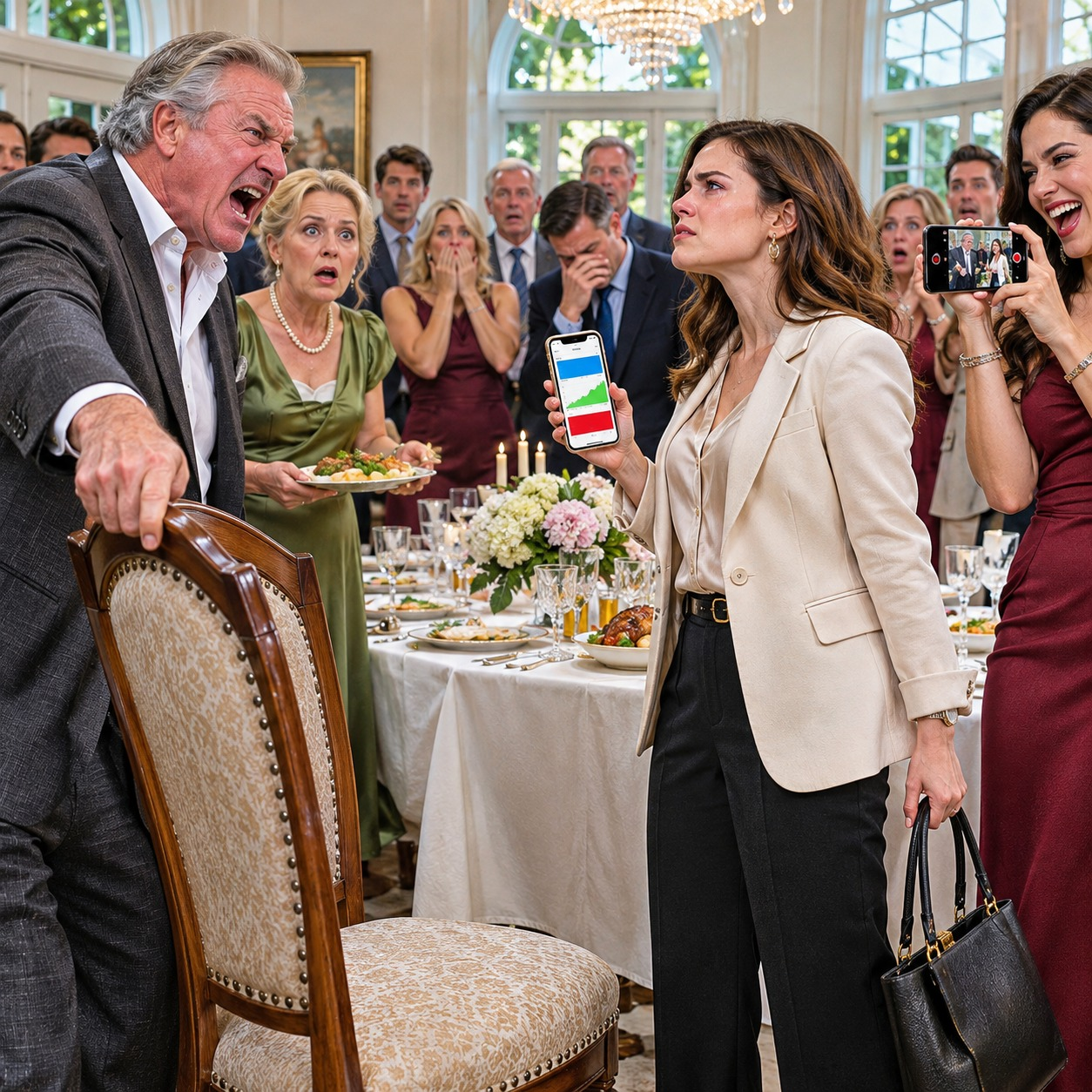
"Oh, come on. You're still upset about the chair?"
I stared at the phone.
"Yes."
"Dad was joking."
"He deliberately pulled it away while I was trying to sit."
"You didn't fall."
"That doesn't make it acceptable."
"You always make everything about your feelings."
I felt something settle inside me.
Not anger.
Clarity.
"Tessa, you recorded it."
"So?"
"Why?"
"Because I knew you'd overreact."
"I didn't."
"You stormed out."
"I left after being insulted."
"Same thing."
I looked at the framed photograph of my employees.
I thought about how I would respond if one of them described a manager humiliating them in front of coworkers.
I wouldn't call them sensitive.
I wouldn't tell them to laugh.
I would take the complaint seriously.
Yet for years, I had accepted behavior from my family that I would never tolerate in my workplace.
"Tessa," I said, "I'm not discussing Saturday with you anymore."
"Fine."
"And I'm not negotiating Dad's business contract through you."
Her voice sharpened.
"You think you're better than us now?"
"No."
"Then why are you acting like it?"
"Because I expect to be treated professionally."
She laughed again.
"You've always been so full of yourself."
I waited.
Then she said something that made me sit upright.
"You should be grateful Dad didn't follow through with his original plan."
My hand tightened around the edge of the desk.
"What plan?"
Silence.
"Tessa?"
"I have to go."
"What original plan?"
"Forget I said anything."
The call ended.
I sat staring at my phone.
Dad's original plan.
The photograph of the meeting.
The proposed technology-services division.
The executive authorization.
Pieces of a puzzle were beginning to fit together, but I still couldn't see the whole picture.
I opened my notebook and wrote down what I actually knew.
Three years earlier, Dad had considered a closer commercial relationship with my software company.
Tessa had participated in internal discussions.
Marcus had warned that no ownership arrangement existed without my agreement.
Someone had nevertheless prepared a document suggesting a personal understanding between Dad and me.
Now Dad was attempting to use that document to support his position in a renewal dispute.
Those were facts.
Everything else was speculation.
I underlined that last word.
Speculation.
I wasn't going to accuse anyone of something I couldn't prove.
But I wasn't going to ignore warning signs either.
At four-thirty, Lauren appeared at my door.
"Do you have a minute?"
"Please tell me something normal happened today."
She smiled faintly.
"Ben fixed the reporting bug."
"Wonderful."
"And we signed a new customer in Indianapolis."
I looked up.
"Seriously?"
"Three-year agreement. Standard pricing. No family discounts."
I laughed.
"Best news I've heard all day."
She stepped inside.
"There's more."
My smile faded.
"Of course there is."
"Marcus sent the archived email he promised."
She handed me a printed copy.
It was the original message warning Patricia Wells not to suggest I had agreed to any ownership arrangement.
The timestamp matched the period immediately before the original contract signing.
Marcus had copied another person.
Tessa Whitaker.
I stared at her name.
"She received this?"
"According to the email header."
I read the message carefully.
Marcus had written in plain language that no proposed partnership, ownership interest, or future commercial obligation involving my company could be represented as agreed without my direct participation and formal approval.
Tessa had received that warning.
Yet three years later, she was telling me I should be grateful Dad hadn't followed through with his original plan.
"What does Rebecca think?" I asked.
"She says it strengthens the evidence that Marcus objected to the wording. But it doesn't establish what happened afterward."
I nodded.
That was fair.
Still, the email changed something.
Tessa hadn't merely attended a meeting where people discussed possibilities.
She had been explicitly warned that my consent mattered.
And she had never mentioned any of it to me.
Lauren studied my face.
"You okay?"
"I don't know."
She sat down.
"Maya, can I ask you something personal?"
"Sure."
"Why did you keep giving them the discount?"
I looked toward the window.
Outside, traffic moved slowly along the street.
People were going home from work.
Ordinary people with ordinary problems.
I wished mine felt ordinary.
"Because I wanted Dad to be proud of me," I admitted.
Lauren didn't speak.
I continued.
"When we first signed the contract, I thought maybe he'd finally understand what I did. I thought if the software helped his company, he'd see that my work mattered."
"And did he?"
I shook my head.
"He just told everyone he'd given me a customer."
Lauren's expression softened.
"That's a painful way to spend three years."
I laughed quietly.
"Try thirty-five."
She reached across the desk and squeezed my hand.
For a moment, I felt close to tears.
Not because of the contract.
Because someone had finally asked the question I'd avoided asking myself.
Why had I kept trying so hard to impress someone who refused to be impressed?
That evening, I drove past my parents' neighborhood on the way home.
I didn't turn onto their street.
I didn't stop.
But I slowed at the intersection where I could see the entrance to their subdivision.
I had grown up there.
The sidewalks were familiar.
The trees were taller now.
The houses looked smaller than I remembered.
As a child, I had believed that becoming successful would make everything easier.
I imagined Dad attending my graduation and telling everyone how proud he was.
I imagined him visiting my office.
Meeting my employees.
Asking thoughtful questions.
Maybe even admitting that he hadn't understood my career at first.
Instead, he had spent years measuring my life against Tessa's.
Her Mercedes.
Her title.
Her expensive clothes.
Her office in his company.
And I had kept trying to win a competition I never wanted to enter.
At a red light, my phone rang.
Mom.
I answered through the car's hands-free system.
"Hi."
"Maya, are you driving?"
"Yes."
"Can you talk?"
"Of course."
She sounded tired.
"Your father has been in his office all afternoon."
I kept my eyes on the road.
"Okay."
"He says the company is facing unnecessary expenses."
"The renewal hasn't been signed."
"I know."
"He can negotiate the scope, compare vendors, or accept the proposal. Those are normal business decisions."
Mom sighed.
"I tried telling him that."
I was surprised.
"You did?"
"Yes."
The light turned green.
I continued driving.
"What did he say?"
"That I don't understand business."
I almost laughed.
Dad had used that sentence on both of us for years.
"Mom, I'm sorry."
"Don't be."
She paused.
"I should have said something Saturday."
I felt my throat tighten.
"You tried."
"Not enough."
I didn't answer.
She continued.
"When he moved that chair, I saw your face."
I swallowed.
"Mom—"
"You looked exactly like you did when you were little and he told you your science project wasn't worth his time."
My eyes stung.
I hadn't realized she remembered.
"I thought you were too young to understand how cruel he was being," she whispered. "But you understood."
I gripped the steering wheel.
For several seconds, neither of us spoke.
Then Mom said, "I don't want you to keep accepting that treatment because you're afraid of losing us."
I pulled into a parking lot.
Stopped the car.
And let myself breathe.
"Mom, I don't want to lose you."
"You won't."
Her voice trembled.
"I love both my daughters. But loving someone doesn't mean pretending they haven't done anything wrong."
It was the closest she'd ever come to acknowledging the pattern that had shaped our family.
I wiped a tear from my cheek.
"Thank you."
She hesitated.
"There's something I need to tell you about Saturday night."
I straightened.
"What?"
"After you left, your father kept laughing. He told everyone you would come crawling back once you needed money."
I closed my eyes.
Of course he had.
"But then Daniel said something."
I opened my eyes.
"What did he say?"
"He told your father that he'd looked up your company. He said you had more customers than Dad realized."
I felt a small smile.
Daniel had always been kind.
"How did Dad react?"
"He got angry."
"At Daniel?"
"At everyone."
Mom took a breath.
"He said you were exaggerating your success. Then Tessa showed him the video she'd recorded."
My smile disappeared.
"What video?"
"The chair."
I stared through the windshield.
"She played it at the table?"
"Yes."
I felt sick.
Tessa hadn't merely recorded my humiliation.
She had replayed it after I left.
"What happened?"
Mom hesitated.
"Nobody laughed the second time."
I said nothing.
"Your aunt Evelyn told Graham he should be ashamed of himself."
That surprised me.
Aunt Evelyn had always avoided conflict.
"Then Daniel said something else."
"What?"
"He asked whether Dad understood that your company was the same one providing software to his warehouses."
I sat completely still.
Mom continued.
"Your father said he knew. He called it a little scheduling program."
I almost smiled.
That sounded exactly like him.
"Then Daniel asked why a company with forty-three customers would need Dad's charity."
I closed my eyes.
I could picture the room.
The white tablecloth.
The silver candlesticks.
The chair sitting several feet away from the table.
My father surrounded by people who had finally begun questioning his version of my life.
"What did Dad say?"
"Nothing at first."
That was unusual.
"Then he told Daniel to mind his own business."
I looked down at my hands.
Mom's voice became quieter.
"Maya, I think your father was embarrassed."
I gave a tired laugh.
"He should have been."
"I know."
She paused.
"But there's something else."
I waited.
"After everyone left, Tessa went into his office. They argued for almost an hour."
"About the contract?"
"I think so."
I remembered her earlier warning.
You should be grateful Dad didn't follow through with his original plan.
"Mom, did you hear anything specific?"
She hesitated.
"I heard your father say that he had taken care of the paperwork years ago."
My heart began pounding.
"What paperwork?"
"I don't know."
Then she said, "Tessa told him the paperwork wouldn't protect them if you found the original."
I stared at the dashboard.
"The original what?"
"I couldn't hear."
A car passed through the parking lot.
Its headlights swept across my windshield.
Mom lowered her voice.
"There's one more thing."
"What?"
"Your father asked Tessa whether she'd kept her copy."
I felt cold.
"Her copy of what?"
"I don't know, sweetheart."
Then I heard movement on her end.
A door opening.
Mom stopped speaking.
"Mom?"
She whispered, "I have to go."
The call ended.
I sat motionless.
For the first time, I wondered whether the photograph and anonymous messages were connected to something more complicated than a pricing dispute.
But I refused to invent explanations.
I needed evidence.
Not guesses.
I started the car and drove home.
At 8:17 that evening, Rebecca sent me an email.
She had completed her preliminary review of the documents.
Her conclusion was clear.
My company had no obligation to renew at the old price.
The executive authorization did not establish any ownership rights.
And there was no evidence in our corporate records that I had agreed to sell, transfer, or encumber any interest in the business.
I read the email twice.
Then I forwarded it to Lauren.
For the first time all day, I felt a little steadier.
Whatever my father had imagined three years earlier, my company remained mine.
The software belonged to the business I had built.
Our employees were protected by legitimate agreements.
And the renewal could proceed through normal commercial channels.
I made dinner.
Washed the dishes.
Changed into comfortable clothes.
Then I sat on the couch with a book I couldn't concentrate on.
At 9:04, my phone buzzed.
An email from Marcus.
Subject: Additional Account Records.
I opened it.
He had attached several archived documents, including a list of people who attended the original partnership-planning meetings.
Graham Whitaker.
Tessa Whitaker.
Patricia Wells.
Marcus Reed.
And one outside consultant.
A man named Andrew Collins.
I didn't recognize the name.
I opened the next attachment.
It was a consulting invoice.
The description read:
Strategic technology acquisition assessment.
I stared at the words.
An acquisition assessment.
Three years ago.
Connected to my company.
I scrolled to the bottom.
The invoice had been approved by Tessa.
I leaned back slowly.
My sister hadn't merely attended those meetings.
She had authorized payment for outside advice about a potential acquisition.
That didn't mean an acquisition had occurred.
But it meant the idea had been serious enough for someone to spend company money evaluating it.
I opened the final attachment.
A calendar invitation.
The meeting title was simple.
Whitaker Technology Strategy — Final Review.
The date was two days before the original software agreement was signed.
I examined the attendee list.
Then I noticed something strange.
My name appeared as an optional attendee.
But the email address beside it wasn't mine.
It was an unfamiliar address using my first and last name.
I stared at the screen.
Someone had created an invitation that made it appear I had been included.
But it had never been sent to my actual email account.
I reached for my phone to call Rebecca.
Before I could dial, another message arrived from the unknown number.
This time, there was no photograph.
Only six words.
Check who attended in your name.
Then a second message appeared.
And ask Tessa who answered.






Comments 0