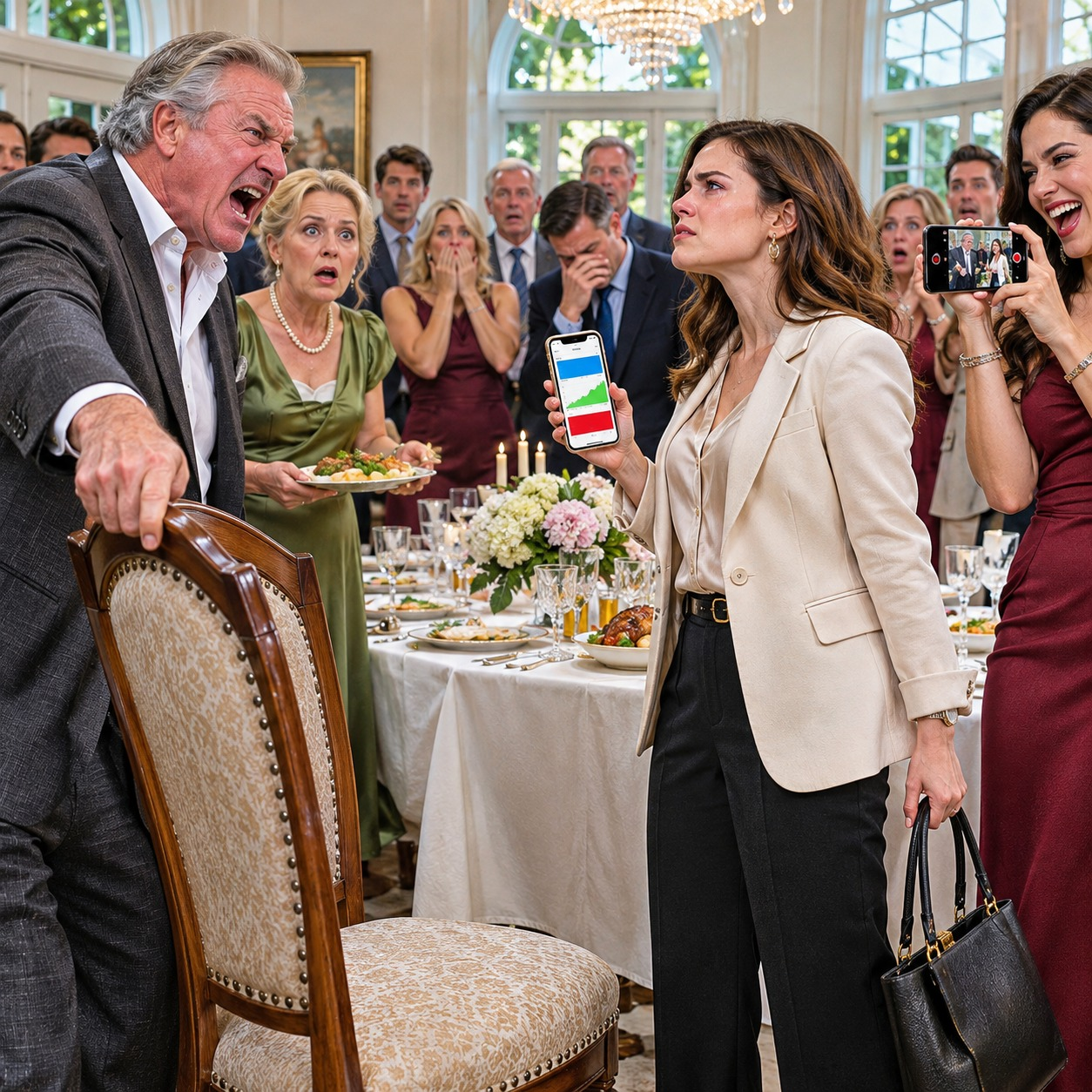
"Get that chair away from her!"
My father grabbed the carved wooden back and dragged it across the dining room floor.
His company founder's watch flashed beneath his charcoal jacket sleeve.
On my phone, a contract renewal showed one number: $8,900.
He had no idea whose signature he needed.
The chair legs shrieked against the hardwood.
Fourteen people stopped talking.
My mother stood beside the dining table holding a platter of roasted vegetables. My aunt Evelyn froze with her wineglass halfway to her lips. My cousin Daniel stared at the empty space where my chair had been.
And my younger sister, Tessa, did what she always did when someone else was suffering.
She reached for her phone.
"I don't sit with a poor, useless kid," my father announced.
Then he smiled.
Not an embarrassed smile. Not the awkward expression of a man who had said something cruel without thinking.
He looked pleased with himself.
As though humiliating his thirty-five-year-old daughter were the evening's entertainment.
My name is Maya Whitaker.
At the time, I owned a software company with sixteen employees and forty-three business customers. We developed warehouse scheduling and inventory-management systems for distribution companies across the Midwest.
But none of that mattered to Graham Whitaker.
To my father, success had four wheels, a luxury badge, and a price tag large enough to impress strangers.
I drove a seven-year-old Ford.
Therefore, in his mind, I was poor.
I lived in a modest townhouse outside Cincinnati.
Therefore, I was unsuccessful.
And because I had never begged him for money or purchased things simply to demonstrate that I could afford them, he had convinced himself that I was barely surviving.
The strangest part was that his own company had been using my software for three years.
He knew that.
He simply didn't understand what it meant.
"Well?" Dad asked, spreading his hands toward the family. "Are you going to stand there all night?"
Tessa laughed.
She was thirty-two, three years younger than me, and the vice president of marketing and partnerships at Whitaker Hospitality Supply.
Dad introduced her with that title everywhere.
At restaurants.
At charity dinners.
Even to neighbors who were only trying to collect their mail.
Tessa wore a fitted burgundy dress that evening, with her dark hair arranged in perfect waves over one shoulder. Her gold bracelet caught the chandelier light as she lifted her phone.
I could see the red recording indicator.
She wasn't even pretending to hide it.
"Come on, Maya," she said. "Dad's joking."
I looked at her.
"Then why are you recording?"
Her smile faltered for half a second.
"Because you're being dramatic."
"I haven't said anything."
That seemed to irritate her more than an argument would have.
Dad gave a dismissive wave.
"Your sister has a sense of humor. You should try developing one."
My mother finally set down the platter.
"Graham, that's enough."
He turned toward her.
"What? I can't make a joke in my own house?"
Nobody answered.
I watched my mother's fingers tighten around the edge of the table.
She was wearing an olive-green satin dress and the pearl necklace Dad had bought her for their thirtieth anniversary. She had spent the entire morning preparing his birthday dinner.
She had called me twice that week to make sure I was coming.
"Your father would love to see you," she had said.
I had almost laughed when she told me that.
But I went anyway.
Because she asked.
Because some part of me still wanted to believe that a family dinner could be just a family dinner.
And because I was tired of letting my father's opinions determine where I felt welcome.
I had arrived twenty minutes earlier carrying a wrapped cookbook for Mom.
She collected recipes from every state she visited, and I had found a beautiful collection of regional American dishes at a small bookstore downtown.
Tessa had greeted me at the front door.
"You actually made it."
"Of course."
Her eyes dropped toward the driveway.
"That old Ford still running?"
"Perfectly."
"Wow. Impressive."
She said it the way someone might congratulate a child for tying her shoes.
Behind her, I could see her new Mercedes SUV parked beside Dad's black BMW.
My Ford sat at the edge of the driveway.
I hadn't thought anything of it until Tessa mentioned it.
That was how my family operated.
They could turn an ordinary detail into evidence against you.
The car you drove.
The clothes you wore.
The neighborhood you lived in.
The job title on your business card.
Everything was a competition, and Dad had appointed himself the judge.
Inside, the dining room looked like something from a luxury home magazine.
Tall arched windows.
White linen.
Crystal glasses.
Silver candlesticks.
Fresh flowers.
The chandelier sparkled above the table while relatives discussed vacations, investments, and expensive renovations.
Dad stood near the fireplace showing my uncle photographs of a luxury hotel group his company had recently signed.
"Tessa handled the partnership strategy," he announced.
He placed an arm around her shoulders.
"That's what it looks like when somebody builds something real."
Then he glanced at me.
I knew that look.
It was an invitation to defend myself so he could turn my defense into another joke.
Instead, I kissed Mom on the cheek and asked whether she needed help in the kitchen.
For a while, I thought I might get through the evening.
I helped carry dishes.
I talked with Daniel about his new apartment.
I listened to Aunt Evelyn describe a cruise she was planning.
Then Dad asked how my business was doing.
The question sounded harmless.
It wasn't.
"Pretty well," I answered. "We added several accounts this year. We're up to forty-three customers."
Dad put down his wine bottle.
"Forty-three?"
"Yes."
He laughed.
"Forty-three little software subscriptions don't make you a businesswoman, Maya."
Daniel shifted in his chair.
"They're business customers, Uncle Graham. That's actually—"
Dad cut him off.
"Daniel, I've been running a real company for thirty years. I think I know what a business looks like."
I kept my voice even.
"I'm glad yours is doing well."
He narrowed his eyes.
"You always have to get the last word."
I hadn't raised my voice.
I hadn't insulted him.
I hadn't even disagreed.
But with my father, refusing to look ashamed was apparently an act of rebellion.
Mom appeared with another serving dish.
"Dinner's ready."
For one foolish moment, I felt relieved.
I picked up my napkin and walked toward the empty chair beside her.
That was when Dad stepped in front of me.
His hand closed around the carved wooden back.
And the evening became something I would never forget.
Now, standing in the silence after his insult, I looked at the chair.
It was an expensive piece of furniture, upholstered in cream-colored fabric with decorative brass studs.
Dad had once bragged about what the dining set cost.
He probably thought removing that chair made a statement about my worth.
What he didn't realize was that I had spent years quietly paying for something far more valuable than furniture.
His company's warehouse operations depended on software my team had developed.
Three years earlier, Whitaker Hospitality Supply had become one of our first major customers.
The agreement covered two warehouses, integration with their existing ERP system, scheduling tools, inventory alerts, and ongoing technical support.
At the time, we charged them $3,250 per month.
It was a fair early-customer rate.
We had also waived implementation fees because their chief operating officer, Marcus Reed, believed in our platform before we had established a large customer base.
Over the next three years, our company grew.
Our software improved.
Our customer list expanded.
Our pricing changed.
Comparable accounts now paid substantially more.
But Dad's company remained on its original rate.
Every time my finance lead questioned it, I gave the same answer.
"They trusted us early."
I never told Dad how much the arrangement benefited his company.
He never asked.
Instead, at family gatherings, he told people he had given me my first real customer.
I let him.
Not because it was entirely true.
But because arguing with him had never changed anything.
Six weeks before his birthday dinner, our finance department had prepared the renewal proposal for Whitaker Hospitality Supply.
Their thirty-six-month agreement would expire on March 31.
There was no automatic renewal at the old price.
The standard commercial rate for their current requirements was $8,900 per month.
I had asked my team to calculate a possible discounted twenty-four-month legacy offer.
It would have been a substantial favor.
One I had not approved.
One Dad didn't know I was considering.
And one that suddenly seemed much harder to justify.
"Maya?"
Mom's voice brought me back to the dining room.
She looked frightened.
Not of me.
Of what might happen next.
Dad was still smiling.
Tessa still had her phone raised.
I could have shouted.
I could have listed every achievement Dad had ignored.
I could have told the entire table how much money his company had saved because I refused to treat family like an ordinary commercial account.
But doing that would have turned my business into a weapon in front of people who had nothing to do with the contract.
And I had spent too many years building something legitimate to cheapen it that way.
So I simply straightened my cream-colored jacket.
Looked my father directly in the eye.
And said, "You just made a very expensive mistake."
For a moment, he stared at me.
Then he burst out laughing.
"What are you going to do, sweetheart? Send me a software bill?"
Tessa laughed too.
Several relatives looked away.
I picked up my black handbag.
"Good night, Mom."
My mother stepped toward me.
"Maya, please."
I leaned forward and kissed her cheek.
"I love you."
Then I walked out.
Behind me, Dad called, "Don't be so sensitive!"
I kept walking.
Mom followed me into the hallway.
Her hand caught my sleeve before I reached the front door.
"Please don't leave over one stupid comment," she whispered.
I turned toward her.
Her eyes were wet.
For years, she had tried to keep peace in our family by pretending that cruel moments were smaller than they really were.
A bad joke.
A misunderstanding.
A stressful day.
Something everyone should forget by morning.
But this time, I couldn't help her pretend.
"He didn't accidentally move that chair, Mom."
She looked down.
"And everybody in that room knows it."
She didn't answer.
I gently touched her hand.
Then I opened the front door.
Outside, the cold Ohio air stung my cheeks.
I crossed the driveway past Tessa's Mercedes and Dad's BMW.
My Ford waited at the edge of the property.
I got inside, locked the doors, and sat without starting the engine.
Through the dining room windows, I could still see the chandelier.
People were moving around the table again.
Dinner was continuing.
My absence had already become another inconvenience everyone was expected to ignore.
I placed my handbag on the passenger seat.
Then I took out my phone.
There was a message from my finance lead, Lauren.
Whitaker renewal approval is still pending. Do you want us to proceed with the legacy discount proposal?
I read it twice.
The proposed discount had never been promised to Dad's company.
It was an internal option.
My own company would absorb the difference for another two years if I approved it.
I thought about Marcus Reed, who had trusted us when we were small.
I thought about the warehouse employees who relied on our platform.
I thought about my sixteen employees, who deserved to work for a company that priced its services responsibly.
Then I thought about the chair.
Not because a chair was worth thousands of dollars.
But because I finally understood how casually my father expected me to accept disrespect while continuing to give him things he never acknowledged.
I opened the approval screen.
Two options appeared.
Standard commercial pricing.
Proposed family legacy discount.
I selected the discount proposal.
Changed its status to declined.
And confirmed the decision.
I did not cancel the existing contract.
I did not interrupt his company's operations.
I did not change an invoice.
I simply decided that the new agreement would be offered at the same commercial rate appropriate for a customer of that size and complexity.
Then I sent Lauren a message.
Please issue the standard renewal proposal Monday morning. No special family discount.
She replied a minute later.
Understood. I'll have the account team prepare it.
I put the phone down.
Started the engine.
And drove home.
I slept better that night than I had expected.
Sunday passed quietly.
I worked for a few hours, bought groceries, and ignored two messages from Tessa.
The first said I had embarrassed Dad.
The second said I needed to apologize before the family started taking sides.
I didn't respond.
On Monday morning, I arrived at my office shortly before eight.
Our building wasn't impressive by my father's standards.
No marble lobby.
No enormous company logo.
No receptionist behind a desk designed to look like a bank.
Just a practical office with good computers, comfortable chairs, and sixteen people who knew exactly why their work mattered.
At 8:47, Lauren confirmed that the renewal proposal had been sent.
At 9:03, Marcus Reed opened the document.
At 9:11, my phone rang.
Dad.
I stared at his name for a moment before answering.
"Good morning."
"Maya."
His voice was sharp.
"There's a serious mistake in this contract."
I looked at the renewal on my computer screen.
The monthly fee was printed clearly.
$8,900.
"No, Dad," I said. "There isn't."
Silence.
Then I heard paper rustling.
"You expect me to believe my monthly bill nearly tripled overnight?"
"Your existing agreement is still in effect until March 31. This is the standard rate for the new term."
"Don't play games with me."
"I'm not."
He exhaled angrily.
"Marcus says this is the commercial price. What happened to our preferred rate?"
"The original contract is expiring."
"Then renew it."
"That's what the proposal is for."
His voice dropped.
"Maya, I'm your father."
I closed my eyes briefly.
It was remarkable how easily he remembered that when he wanted something.
"I know."
"You wouldn't do this to family."
I looked toward the office window.
For the first time, I didn't feel the need to explain myself.
"I'm offering your company the same standard commercial terms we use for comparable customers."
He said nothing.
Then, somewhere on his end of the call, I heard another voice.
A man's voice.
Calm.
Firm.
Familiar.
"Graham, put the phone on speaker."
It was Marcus Reed.
And from the sound of his voice, he had something my father wasn't ready to hear.






Comments 0