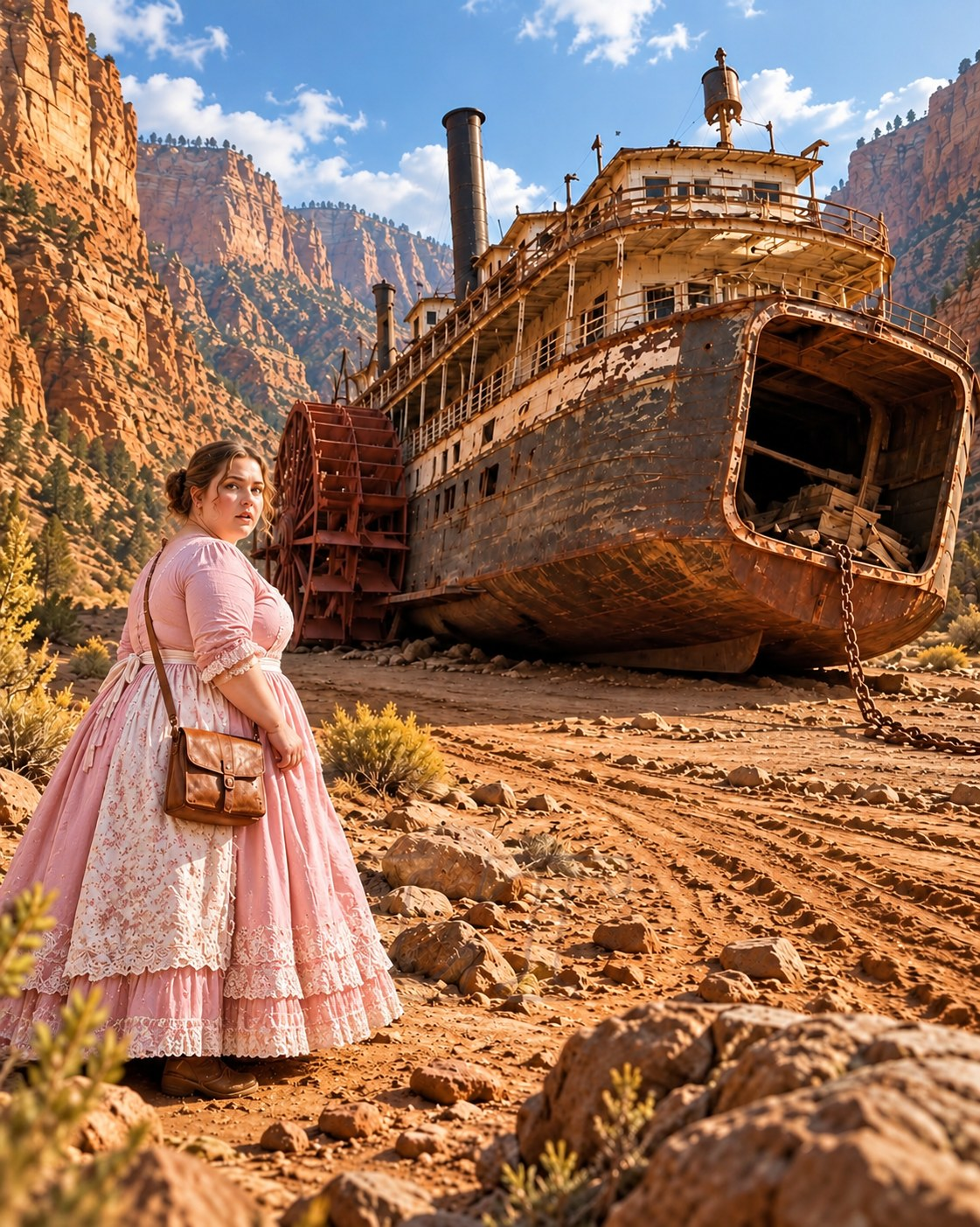
I was halfway down the boardinghouse stairs when Mrs. Hargrove grabbed my arm.
"Clara, wait."
I turned.
She was holding a folded newspaper in one hand and looking toward the window.
"Did you hear what happened last night?"
I glanced toward the street.
"No. What happened?"
"Someone was seen near that abandoned ship."
My stomach tightened.
"Who?"
"Nobody knows. A rancher passing through the basin said he noticed a light moving across the upper deck."
I stared at her.
"Was it a lantern?"
"That's what he thought."
I remembered the light I had seen from my bedroom window.
One light near the edge of the basin.
Then another behind the upper windows.
I had assumed it was a trick of the darkness, perhaps a reflection from a distant settlement or a passing wagon.
But the second light had moved.
And I was certain of what I had seen.
"Did the rancher go aboard?" I asked.
Mrs. Hargrove shook her head.
"He wasn't foolish enough to investigate."
I released a slow breath.
"Perhaps someone was checking the vessel."
"Checking what?"
I looked at her.
"My ship."
She frowned.
"Clara, that thing has been abandoned for twenty years. If somebody is wandering around it at night, I would be more worried than curious."
I understood her concern.
But there was something I wanted to establish before allowing rumors to grow.
I needed to know whether anyone had been aboard the Silver Dawn.
And if someone had, I needed to know why.
I finished breakfast quickly.
Then I collected my father's toolbox, my lantern, and the folded bill of sale.
Mrs. Hargrove watched me from behind the counter.
"You're going out there today?"
"Yes."
"Alone?"
"Yes."
She looked toward the door.
"At least tell someone where you're going."
"I will."
I placed my remaining coins on the counter to pay for another night.
She glanced at them.
"You don't have much left, do you?"
I hesitated.
"Not much."
Her expression softened.
"There's no shame in changing your mind."
"I know."
"That ship could be dangerous."
I picked up my toolbox.
"Then I'll be careful."
She shook her head, but she did not try to stop me.
Outside, the town was already awake.
A delivery wagon stood in front of the general store. Two men were unloading sacks of flour, while a woman swept dust away from the entrance of a small bakery.
As I walked past, I noticed several people watching me.
The news had traveled faster than I expected.
A man standing beside the water tower nudged his companion.
"That's her."
The companion looked at my toolbox.
"She really bought it?"
"Every cent she had, apparently."
I kept walking.
A few yards farther down the street, an older woman approached me.
"Miss Whitmore?"
I stopped.
"Yes?"
"I'm Eleanor Price. I own the little shop near the courthouse."
"Nice to meet you."
She studied my face.
"I heard about your purchase."
I nodded.
"Then you've probably heard the same things everyone else has."
She smiled faintly.
"That you're crazy?"
I almost smiled, but stopped myself.
"Something like that."
Eleanor glanced toward the distant basin.
"My husband used to work on the riverboats. He knew that vessel when she was still operating."
"Did he?"
"Yes. He always said she was a beautiful ship."
I felt a flicker of excitement.
"Do you know anything about her construction?"
"Only what my husband told me. She was built to carry heavy cargo and passengers. Strong hull. Good machinery. Expensive equipment."
"Do you know why she was abandoned?"
Eleanor's expression changed.
"Nobody agrees on that anymore."
"What do you mean?"
"Some say the company ran out of money. Others say the river was becoming unreliable long before the company collapsed. There were arguments about whether the ship should be moved."
"Could it have been moved?"
She shrugged.
"My husband believed it could have been saved if someone had acted sooner."
I looked toward the basin again.
"Thank you."
Eleanor touched my arm.
"Don't let the town make you feel foolish for trying."
It was the first encouraging thing anyone had said to me since arriving.
I continued toward the land office.
Harold Beckett was standing outside, speaking with another man.
When he noticed me, his expression immediately became serious.
"Miss Whitmore."
"Good morning, Mr. Beckett."
"Have you reconsidered?"
"No."
He sighed.
"I was afraid you'd say that."
The other man looked between us.
"What's going on?"
Harold gave him a reluctant smile.
"Our new steamship owner."
The man laughed.
"You're joking."
"No."
The man turned toward me.
"You're the woman who bought the Silver Dawn?"
"Yes."
He looked at my toolbox.
"Planning to repair her yourself?"
"If necessary."
He laughed again.
"That's a good one."
I did not respond.
Harold stepped forward.
"Clara, I want to make something clear. The ownership transfer is legitimate. But the town has no obligation to provide assistance."
"I haven't asked for any."
"Good."
He adjusted his spectacles.
"Because people here have already lost money trying to restore abandoned property."
I looked at him.
"Did anyone actually inspect the Silver Dawn?"
"Years ago, a few men went aboard."
"What did they find?"
"Nothing worth saving, according to them."
"Did they inspect the boilers?"
Harold hesitated.
"I wouldn't know."
"The hull?"
"I wouldn't know that either."
"Then how did they determine the vessel was worthless?"
He looked irritated.
"Miss Whitmore, I am a land official, not a shipbuilder."
"Exactly."
I walked away before he could answer.
The road toward the basin was uneven.
I carried the toolbox in my right hand and the lantern in my left.
The farther I walked, the more enormous the Silver Dawn appeared.
From the town, the vessel had seemed like a strange object sitting in the desert.
Up close, it looked like a sleeping giant.
Its upper deck rose above the surrounding landscape.
The two smokestacks stood against the sky like dark monuments.
The paddle wheels were covered in rust, but their wooden supports remained surprisingly complete.
I stopped several yards from the hull.
For a moment, I simply looked.
There was something strangely moving about seeing such a magnificent machine standing alone.
I imagined the noise that must once have filled the basin.
Steam escaping from the boilers.
Men shouting orders.
Passengers leaning over the railings.
The paddle wheels turning through deep water.
The ship had once been part of a living world.
Now it sat in silence.
I walked toward the lower hull.
The first thing I noticed was the condition of the metal.
It was badly weathered.
Rust had spread across several plates, and the paint had almost completely disappeared.
But the rivets appeared intact.
I placed my hand against the hull.
The metal felt warm from the sun.
I tapped it gently with my father's small hammer.
The sound was solid.
I moved several feet to the left and tapped again.
Another solid sound.
Then another.
I began making notes in a small notebook.
I had no formal training in shipbuilding, but I understood how to examine materials, record defects, and distinguish visible damage from actual structural failure.
The same principles had helped me repair the store's failing storage equipment.
I worked slowly.
I examined the exposed supports.
I checked the condition of the lower wooden structures.
I marked areas where the surface appeared damaged.
After nearly an hour, I discovered something unexpected.
Most of the original wooden framework was still sound.
There were sections of rot near the lower edge, particularly where water had once collected.
But the deterioration was not nearly as extensive as I had expected.
I stepped back and examined my notes.
The ship was not in good condition.
That much was obvious.
But it was not necessarily beyond repair.
I placed the hammer inside the toolbox and looked for a way aboard.
A narrow metal ladder led toward the lower deck.
Some of its steps were rusted.
I tested each one carefully before putting my weight on it.
The ladder creaked.
I stopped.
Then I tested the next step.
It held.
I climbed slowly until I reached the deck.
Dust covered everything.
The wooden planks were faded and cracked in places, but most remained firmly attached.
Old ropes lay in tangled piles near the railing.
Several empty barrels had rolled against a wall.
A rusted bell hung above a doorway.
I touched it lightly.
It moved without ringing.
I walked farther.
The air smelled of old wood, dry dust, and metal.
I opened the first door.
Inside was a storage room.
Broken crates occupied one corner.
A few empty shelves lined the walls.
There was nothing particularly valuable.
I checked the next compartment.
It contained old tools and several damaged pieces of equipment.
I wrote down what I found.
Then I continued toward the stairs leading below deck.
The steps were dark.
I lit my lantern.
Its warm glow revealed the narrow passageway.
I held the railing and descended carefully.
The engine room was larger than I expected.
Two enormous boilers occupied the central space.
Their surfaces were covered in corrosion, and several pipes had separated from their original fittings.
But the construction was impressive.
Thick metal plates.
Heavy support brackets.
Large valves.
Carefully arranged pipework.
I approached the nearest boiler.
The metal was stained and rough, but the outer structure remained substantial.
I wiped away a layer of dust.
Underneath, I found a small manufacturer's plate.
The lettering was difficult to read.
I leaned closer.
Some of the words had survived.
I copied what I could into my notebook.
Then I examined the joints.
A few fittings needed replacement.
Several pipes would require attention.
The gauges were damaged.
But the boilers did not appear to have collapsed or suffered the kind of catastrophic deterioration I had feared.
I moved toward the second boiler.
It was in similar condition.
I stood between them, looking at the enormous machinery.
Someone had built these boilers to last.
Not cheaply.
Not carelessly.
Every support had been fitted with precision.
Every major connection appeared deliberately reinforced.
I thought about the captain.
Why had he stayed?
Why had he refused to abandon the vessel when everyone else had left?
Perhaps he had believed it could sail again.
I ran my hand over one of the thick iron supports.
"Someone cared about you," I whispered.
My voice echoed through the engine room.
For the first time, I felt a genuine connection to the ship.
It was no longer simply an object I had purchased.
It was something I wanted to understand.
I spent the next several hours inspecting the machinery.
I made a list of damaged components.
I recorded the measurements of the larger fittings.
I identified sections where additional support might be necessary.
The work was exhausting.
My hands became dusty.
My skirt collected dirt.
My shoulders ached from carrying the toolbox.
But I did not stop.
When I finally returned to the upper deck, the sun was beginning to lower.
I leaned against the railing and looked toward Dry Creek Hollow.
Several figures stood near the road.
They appeared to be watching me.
One man raised his hand to shield his eyes.
Another pointed toward the ship.
I knew what they were thinking.
The new owner was wasting her time.
I looked down at the notebook in my hand.
Then I looked back at the enormous vessel.
I had discovered something they had never bothered to examine.
The ship was damaged.
But much of it was still intact.
And that meant my purchase might not have been the foolish mistake everyone believed.
I climbed down from the deck and collected my tools.
As I approached the road, I noticed a man standing beside a darksmith's wagon.
He was tall, broad-shouldered, and dressed in a worn work shirt with the sleeves rolled up.
His dark brown hair was slightly longer than most men's in town, and a short beard covered his jaw.
A leather apron hung around his waist.
He was watching the ship with an expression I could not quite read.
"You're the new owner," he said.
"Clara Whitmore."
He wiped his hands on a cloth.
"Nathaniel Brooks."
I recognized the name.
Mrs. Hargrove had mentioned the local blacksmith.
"Nice to meet you."
He glanced toward my toolbox.
"Been working aboard?"
"Inspecting."
"What did you find?"
I studied him.
"Why do you ask?"
He gave a small shrug.
"Because I saw you carrying that toolbox out here this morning, and I was curious whether you'd discovered anything."
I considered his question.
"The hull is in better condition than people seem to believe."
Nathaniel raised an eyebrow.
"Is that so?"
"Most of the visible damage appears concentrated around the lower sections. The main framework seems sound."
He looked toward the vessel.
"And the machinery?"
"The boilers are corroded, but the structure is still there."
For the first time, his expression changed.
Not amusement.
Interest.
"Nobody's said that in years."
"Nobody seems to have looked very closely."
Nathaniel laughed softly.
"You're probably right."
He stepped closer.
"Mind if I ask you something?"
"Go ahead."
"Have you been inside the captain's cabin?"
"No. I haven't reached it yet."
He looked toward the upper deck.
"There's a reason people don't go in there."
I waited.
Nathaniel lowered his voice.
"Captain Everett stayed aboard until he died."
"I heard about that."
"Most people thought he'd gone strange after his wife and daughter died."
I felt something tighten in my chest.
"What happened to them?"
"Nobody knows the whole story. They were traveling when the river flooded years ago. Their boat never returned."
I looked toward the ship.
"And Captain Everett?"
"He never left the Silver Dawn."
Nathaniel paused.
"People said he spent his final years waiting for someone."
"Waiting for whom?"
He shook his head.
"That's what nobody could figure out."
The wind moved across the basin.
I glanced at the ship's upper windows.
"Was the captain's cabin left untouched?"
Nathaniel nodded.
"As far as I know."
"Why?"
He looked directly at me.
"Because the door has a lock unlike anything else on that ship."
I frowned.
"What kind of lock?"
"An intricate one. Brass, steel, several moving parts. My father once tried to examine it. He couldn't figure out how it worked."
"Could it be opened with a key?"
"Nobody knows."
I considered that.
"Do you think something valuable is inside?"
Nathaniel was quiet for a moment.
"Captain Everett never allowed anyone near that room."
He looked back at the ship.
"Not even the men who worked for him."
I felt a sudden curiosity.
"Have you seen the lock yourself?"
"Once. When I was a boy."
"Would you recognize it?"
He nodded.
"Without a doubt."
I looked toward the darkening sky.
"Then I suppose I'll have to see it."
Nathaniel gave a faint smile.
"Just be careful, Miss Whitmore."
He turned toward his wagon.
"Some doors are locked for a reason."
I watched him leave.
Then I looked up at the Silver Dawn.
For the first time, I wondered whether the most valuable thing aboard the vessel had anything to do with its machinery.
Perhaps the ship had been carrying something far more important.
I climbed back onto the deck and walked toward the upper staircase.
I wanted to find the captain's cabin before nightfall.
The corridor above was narrow and covered in dust.
I passed several abandoned rooms.
Then I reached a heavy oak door at the end of the passage.
Unlike the other doors, it had no visible handle.
A complicated brass mechanism occupied the center.
Several narrow metal plates were arranged in a circular pattern.
Tiny engraved markings surrounded the central piece.
I moved closer.
My lantern illuminated the strange mechanism.
Then I noticed something that made my heart beat faster.
The lock was not rusted.
Not even slightly.
Despite twenty years of abandonment, the brass was remarkably clean.
Someone had protected it.
Someone had wanted it to remain functional.
I slowly reached toward the mechanism.
And just as my fingertips touched the central brass plate, I heard three sharp knocks from the other side of the door.
Tăng độ dài lên đúng 2.000 từ Sửa lỗi đánh máy “darksmith’s wagon”






Comments 0