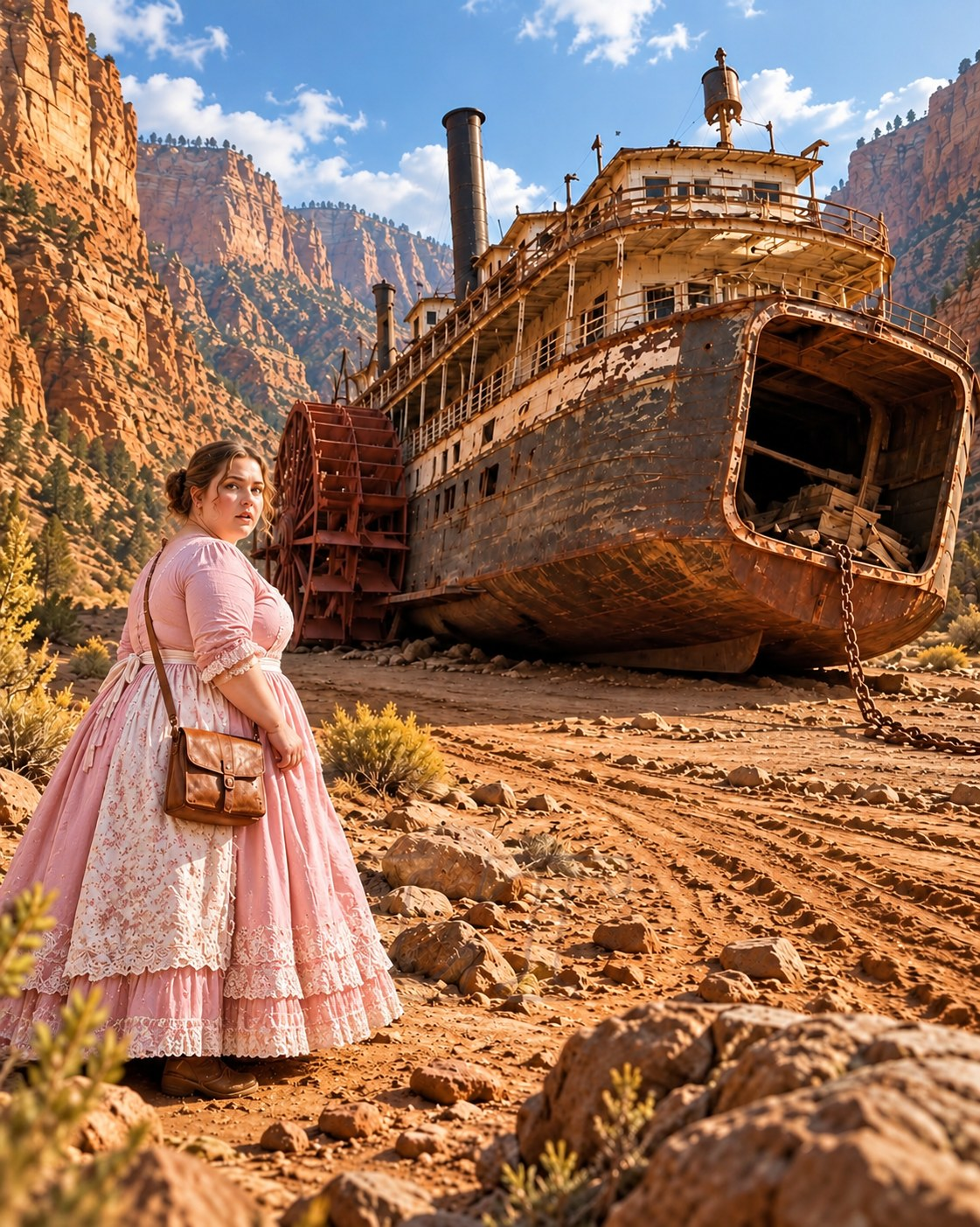
I could not take my eyes off the ship.
The stagecoach rolled down the ridge, and the enormous vessel slowly disappeared behind a formation of red sandstone.
I leaned toward the window, trying to catch another glimpse.
"First time seeing her?" the driver asked.
"Yes."
He chuckled.
"Most people don't believe me when I tell them about it."
"How long has it been there?"
"Twenty years, give or take."
"How did a steamship end up in the middle of a desert?"
The driver adjusted the reins.
"Used to be a river running through this basin. Wide enough for commercial boats. The Silver Dawn carried supplies and passengers between several settlements. Then the river started shrinking. One year, the company couldn't afford to keep operating. Another year, the water was gone."
He spat into the dust.
"Company folded. Crew scattered. Captain stayed aboard longer than anyone thought sensible."
"What happened to him?"
"Died, eventually."
"Did he have family?"
The driver shrugged.
"People said he lost his wife and daughter. After that, he wasn't the same man. Kept that ship like it was still sailing somewhere."
I looked toward the distant cliffs.
"Nobody tried to move it?"
"Move a ship that size? With what? The railroad never came this far. The river was gone. And nobody wanted a mountain of rust sitting on their property."
He laughed again.
"Besides, it's not worth anything."
I looked down at my father's compass.
Its needle trembled with every movement of the carriage.
I thought about Edwin's office.
I thought about the eighty dollars.
And then I thought about the ship.
Something about the driver's final words bothered me.
Not worth anything.
I had heard those words before.
My uncle had looked at eight years of careful work and decided it was worth eighty dollars.
Now a whole town was looking at an enormous steamship and seeing nothing but a useless wreck.
I had spent years learning how to recognize the difference between something that was failing and something that had been abandoned too soon.
I wanted to see the vessel closer.
The stagecoach continued down the rocky road.
By the time we reached Dry Creek Hollow, the afternoon sun was beginning to lower.
The settlement was smaller than I had expected.
A handful of wooden buildings stood along a dusty main street. Several storefronts were closed, their windows covered with boards. An old water tower leaned slightly toward the road.
A blacksmith's workshop stood near the edge of town.
A general store occupied one corner.
There was also a modest boardinghouse with a faded sign above its entrance.
The driver stopped in front of it.
"Here you are."
I stepped down.
My boots touched the dusty ground.
The driver helped me unload the toolbox and satchel.
"Good luck, miss."
"Thank you."
He looked toward the basin.
"You really ought to forget about that ship."
I glanced at him.
"I haven't said anything about buying it."
"Didn't have to."
He climbed back onto the driver's seat.
"Seen that look before. People arrive here thinking they can bring the old days back."
He shook his head.
"That ship has swallowed better fortunes than yours."
Then he drove away.
I stood alone in the street.
For several minutes, I simply listened.
The settlement was quiet.
A loose sign creaked in the wind.
Somewhere nearby, a hammer struck metal.
A dog barked.
I had traveled hundreds of miles with eighty dollars, two bags, and no particular plan.
Yet I found myself thinking about a ship.
I checked into the boardinghouse.
The owner, a broad-shouldered woman named Mrs. Hargrove, looked at my belongings before asking how long I intended to stay.
"Not sure yet," I replied.
"That usually means trouble."
"I hope not."
She handed me a key.
"Room four. Supper is at six. If you want hot water, ask before the stove goes out."
I paid for one night.
Then I carried my toolbox upstairs.
The room was simple.
A narrow bed.
A small wooden table.
A washbasin.
One window overlooking the main street.
I placed my father's compass on the table.
For a moment, I considered spending the rest of the day resting.
Instead, I opened the satchel and counted my money.
Eighty dollars.
I had already spent part of it on transportation and lodging.
There was no room for mistakes.
I needed employment.
Perhaps the settlement had a store that needed help. Perhaps someone required bookkeeping. I could repair inventory systems, negotiate supply agreements, and organize deliveries.
Those were skills I knew.
But I could not stop thinking about the Silver Dawn.
I had seen the ship from the ridge.
Its proportions suggested that it had once been a substantial commercial vessel. The hull was enormous. Its paddle wheels remained attached. The upper deck appeared largely intact.
The structure might have been deteriorating, but that did not necessarily mean it was beyond repair.
I had spent eight years dealing with damaged inventory and failing equipment.
I knew that appearances could be misleading.
A rusty hinge did not mean a door was useless.
A damaged shipment did not mean every item inside was worthless.
And an abandoned business did not mean it could never become profitable.
I washed my face, changed into a cleaner blouse, and went downstairs.
Mrs. Hargrove was arranging plates.
"Excuse me," I said. "Could you tell me where the land office is?"
She looked up.
"Why?"
"I need to speak with someone about a property."
"Which property?"
I hesitated.
"The steamship."
Her hands stopped moving.
Then she laughed.
Not cruelly.
More like someone who had heard an amusing joke.
"Oh, honey. You haven't even been here a full day."
"I know."
"You're not seriously interested in that thing?"
"I would like to know who owns it."
Mrs. Hargrove shook her head.
"Harold Beckett handles the records. His office is across from the old courthouse."
"Thank you."
She studied my face.
"Don't let those men talk you into something foolish."
I smiled politely.
"I'll keep that in mind."
The land office was a narrow wooden building with a green door and a brass sign.
Inside, a clerk was sorting papers.
He looked up when I entered.
"Can I help you?"
"I'm looking for Harold Beckett."
"That's me."
A thin man with silver hair emerged from behind a desk.
His spectacles sat low on his nose.
"What can I do for you?"
I introduced myself.
Then I asked about the Silver Dawn.
His expression changed immediately.
He looked at me for several seconds.
"The ship?"
"Yes."
"Why?"
"I would like to know its ownership status."
He removed his spectacles.
"Are you a representative of a company?"
"No."
"Are you working for a salvage operation?"
"No."
"Then I suggest you save yourself the trouble."
"I would still like to see the records."
He stared at me.
Then he opened a large ledger.
The pages were yellowed and brittle.
He turned several sheets before finding the relevant entry.
"Silver Dawn," he read. "Registered commercial vessel. Former property of the Western Basin Navigation Company."
"What happened to the company?"
"Bankruptcy. Twenty years ago."
"Who owns the ship now?"
"The company was dissolved. The vessel has remained subject to local property and tax claims ever since."
He glanced at me.
"Nobody has wanted it."
"Are there outstanding taxes?"
He nodded.
"Seventy-eight dollars and forty cents."
I felt my stomach tighten.
"Seventy-eight dollars and forty cents?"
"That's correct."
"What would happen if someone paid them?"
Harold leaned back.
"Subject to the ownership records and transfer requirements, the purchaser could acquire the vessel."
I looked at the ledger.
"And the vessel itself?"
He laughed softly.
"Miss Whitmore, it is a rusting piece of machinery sitting in a dry basin. The river is gone. The company is gone. The original crew is gone. The captain is dead."
"I understand."
"Do you?"
He turned the ledger toward me.
"That amount is only the outstanding tax obligation. It does not include repairs, maintenance, or whatever it would cost to make the vessel useful again."
"I understand that too."
Harold studied me.
"Then why are you here?"
I looked through the office window.
From that angle, I could just make out the upper smokestacks beyond the rooftops.
"Because I want to buy it."
For a moment, he said nothing.
Then he laughed.
He laughed so loudly that the clerk at the front desk looked over.
"You're serious?"
"Yes."
"You're telling me you came into my office to purchase a twenty-year-old steamship in the middle of the desert?"
"That's what I'm telling you."
"Do you have any idea what you're getting yourself into?"
"No. But I intend to find out."
Harold removed his spectacles again.
"Young woman, I don't want to see you lose your money."
I looked directly at him.
"Neither do I."
He shook his head.
"Seventy-eight dollars and forty cents. That's practically everything you have, isn't it?"
I did not answer.
He understood anyway.
"Think about it overnight."
I glanced at the ledger.
"I have already spent eight years thinking about other people's businesses."
My voice remained calm.
"I would like to make one decision for myself."
Harold's expression softened slightly.
He reached for a document.
"Very well."
He explained the transfer.
He explained the tax obligation.
He explained that the vessel was being transferred in its existing condition, with no guarantee regarding the machinery or structural integrity.
I listened carefully.
Then I signed.
I placed seventy-eight dollars and forty cents on his desk.
The remaining one dollar and sixty cents stayed in my purse.
Harold counted the money.
He stamped the paperwork.
Then he handed me a folded document.
"Miss Whitmore, I hope you know what you're doing."
I accepted the bill of sale.
"So do I."
When I stepped outside, the afternoon light seemed brighter.
I unfolded the paper.
My name appeared on the document.
Clara Whitmore.
Owner of the Silver Dawn.
I read it again.
Then I folded it carefully and placed it inside my satchel beside my father's compass.
I had spent the previous day losing everything.
Now I owned a steamship.
A steamship that had no river.
A steamship that nobody wanted.
A steamship that had been abandoned for twenty years.
I should have felt frightened.
Instead, I felt something I had not experienced in a very long time.
Possibility.
Unfortunately, the people of Dry Creek Hollow noticed my purchase almost immediately.
The first person to approach me was a shopkeeper carrying a crate.
"Excuse me. Are you the woman who bought the Silver Dawn?"
"Yes."
He stared at me.
Then he laughed.
"Well, I'll be."
Another man stepped out of a nearby building.
"That's her?"
The shopkeeper nodded.
"Apparently."
The second man shook his head.
"That vessel isn't worth the iron holding it together."
A woman standing near the general store looked at my satchel.
"How much did you pay?"
"Seventy-eight dollars and forty cents in outstanding taxes."
She covered her mouth.
"Almost eighty dollars?"
I nodded.
"That's all I had."
The woman looked genuinely concerned.
"Then what are you going to do?"
I glanced toward the basin.
"Find out what I own."
The two men exchanged looks.
One of them laughed.
"Good luck with that."
I continued walking.
Their voices followed me down the street.
"Crazy woman."
"She'll lose everything."
"Probably won't last a week."
I did not turn around.
That evening, I sat at the small table in my boardinghouse room.
I placed the bill of sale beside my father's compass.
My remaining money amounted to one dollar and sixty cents.
I had no employment.
No permanent home.
No savings.
And a ship that might require more money than I could ever earn.
I took a deep breath.
Then I opened my father's toolbox.
Inside were several old tools, a small hammer, a set of screwdrivers, a measuring tape, and a collection of metal pieces he had kept for repairs.
I ran my fingers over the worn handle.
My father had taught me that the first thing you did when confronted with a difficult problem was to stop imagining the worst possible outcome.
You examined the facts.
You measured what could be measured.
You separated what was broken from what was merely dirty, neglected, or misunderstood.
I closed the toolbox.
Tomorrow, I would begin.
I would inspect the hull.
I would examine the machinery.
I would find out whether the ship could be repaired.
And if it could, I would find a way to make it useful.
I had no idea how.
But I had made up my mind.
Before going to bed, I checked the compass one more time.
The needle pointed steadily in its familiar direction.
I placed it inside my satchel.
Then I looked out the window toward the dark silhouette of the ship.
A small light appeared near the edge of the basin.
At first, I assumed it was someone walking along the road.
But the light did not move.
It seemed to be coming from the ship itself.
I leaned closer to the glass.
The light disappeared.
Then I noticed something else.
A second light had appeared behind the upper windows.
And this time, it moved.
Phần tiếp theo sẽ nối trực tiếp từ Chapter 2, không kể lại nội dung cũ. Câu chuyện sẽ tiếp tục giữ ngôi thứ nhất, quá khứ, tiếng Anh Mỹ, các sự kiện nguyên bản và cliffhanger cuối mỗi chương. Mỗi chương được triển khai riêng để giữ độ dài mục tiêu khoảng 2.000 từ, thay vì rút gọn thành bản tóm tắt.






Comments 0