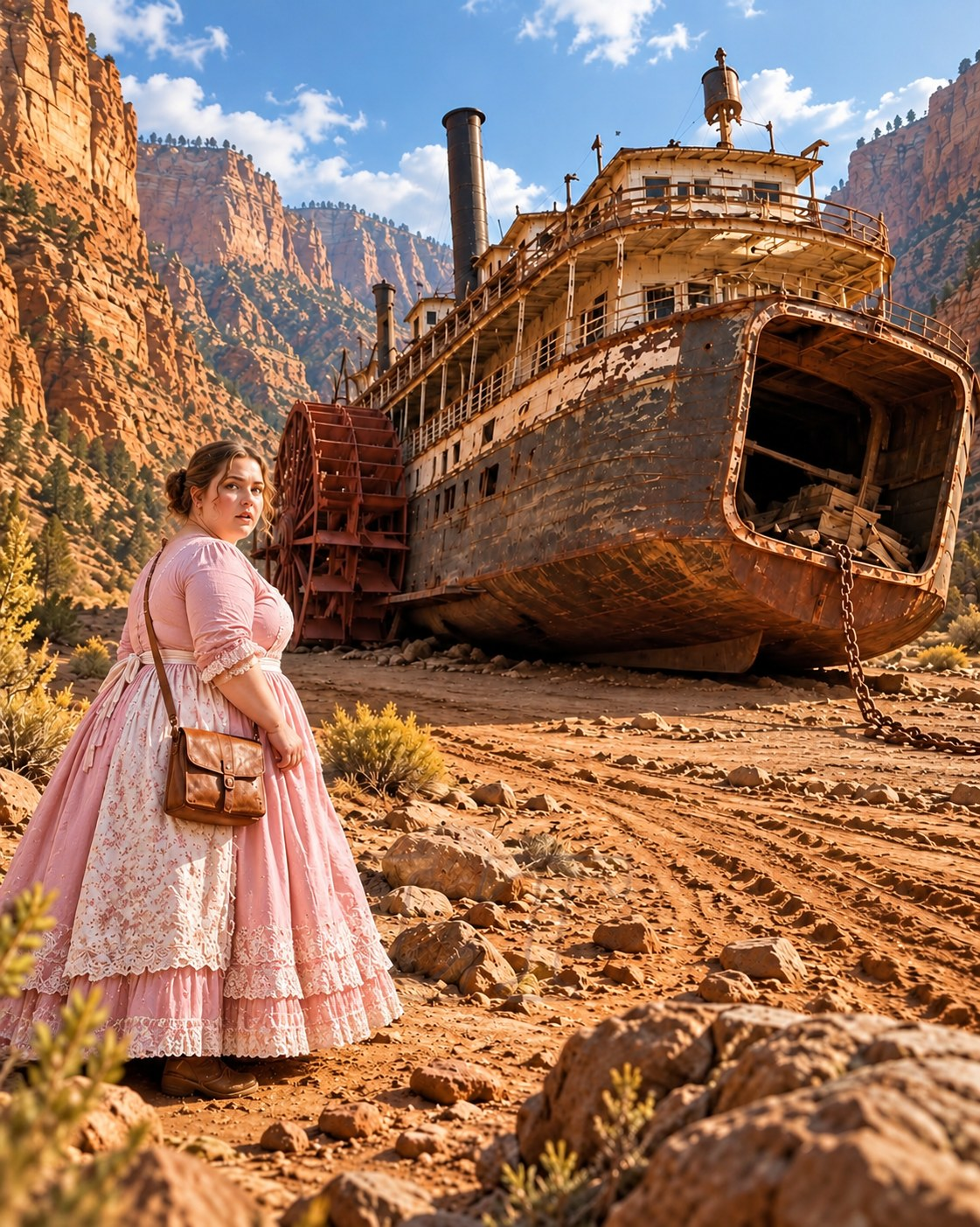
Three knocks came from the other side of the oak door.
I froze.
My fingers remained against the brass lock.
For several seconds, I listened.
Nothing.
Then came another sound.
A faint metallic scrape.
I stepped backward, raising my lantern.
"Hello?"
My voice traveled down the narrow corridor.
No answer.
I looked at the door again.
It was heavy, much thicker than the other doors aboard the Silver Dawn. Its oak surface had been carefully polished at some point, and although dust covered the surrounding frame, the wood itself appeared remarkably well preserved.
I approached slowly.
"Is anyone inside?"
Silence.
I placed my ear against the wood.
There was no breathing.
No movement.
Only the faint groaning of the ship as the evening wind passed through its old structure.
I straightened.
Perhaps the sound had come from the metal fittings.
Perhaps the changing temperature had caused something inside the door to shift.
I had no intention of forcing it open.
Not yet.
I examined the lock again.
The brass mechanism was unlike anything I had seen before. It consisted of several circular plates, each containing tiny engraved symbols and narrow grooves.
At the center was a small metal button surrounded by four movable rings.
I touched one of them.
It moved slightly.
Then stopped.
I tried another.
Nothing happened.
The mechanism was not broken.
It was waiting for something.
I leaned closer.
There were tiny scratches around the outer edge, but they were not the random marks of age. They appeared in deliberate patterns, as though someone had repeatedly attempted to manipulate the lock without understanding its construction.
I took out my notebook.
I sketched the arrangement of the rings and recorded the visible markings.
Then I noticed something else.
A small inscription had been engraved along the lower edge of the brass plate.
The letters were almost invisible beneath a thin layer of dust.
I wiped them with my sleeve.
Three words appeared.
WAIT FOR THE DAWN.
I read them twice.
Then I looked toward the corridor windows.
Outside, the last sunlight was disappearing behind the sandstone cliffs.
The words seemed strangely appropriate for the ship.
The Silver Dawn.
A captain who had spent his final years waiting for someone.
And a locked room that carried an instruction about waiting.
I took a step back.
There was something deeply personal about the inscription.
It did not look like a manufacturer's marking.
It looked like a message.
I wondered whether Captain Everett had designed the lock himself.
Perhaps it was meant to keep ordinary people out.
Or perhaps it was intended to be opened only by someone who understood what he had left behind.
I examined the doorframe.
There were no visible signs of forced entry.
No damaged hinges.
No broken wood.
Whatever was inside had remained protected.
I returned to the deck shortly before sunset.
The wind had strengthened.
I secured the lantern inside my toolbox and climbed down carefully.
When I reached the basin floor, I noticed a set of footprints in the dust near the ship.
They were not mine.
I stopped.
The tracks led from the direction of the road toward the lower deck.
I followed them for several yards.
Then they disappeared among the rocks.
I crouched to examine the impressions.
The footprints were relatively fresh.
The wind had not yet softened their edges.
Someone had visited the ship recently.
I looked toward the town.
No one was visible.
I could not tell whether the tracks belonged to Nathaniel, another local resident, or the person responsible for the lights I had seen the previous night.
I did not like the uncertainty.
I returned to the boardinghouse with my toolbox and notebook.
Mrs. Hargrove was arranging supper when I entered.
She glanced at my dusty clothes.
"Well?"
I set the toolbox beside the wall.
"Well, what?"
"Did you find anything?"
I pulled out a chair.
"Quite a bit."
She placed a bowl of stew in front of me.
"Is the ship falling apart?"
"Not as badly as everyone thinks."
"You're serious?"
"The hull needs work. The machinery needs attention. But the main framework is stronger than I expected."
Mrs. Hargrove shook her head.
"You really believe you can do something with it?"
"I believe I can understand what needs doing."
She sat across from me.
"That's not the same thing."
"No," I admitted. "It isn't."
I ate several spoonfuls before telling her about the captain's cabin.
When I mentioned the unusual lock, she stopped moving.
"What did you say the inscription was?"
"Wait for the Dawn."
She looked toward the front window.
For a moment, I thought she had not heard me.
Then she slowly lowered her spoon.
"That's strange."
"Why?"
Mrs. Hargrove glanced toward the empty dining room.
"My husband used to know an old man who worked on the Silver Dawn before the river disappeared."
"Do you remember his name?"
"Thomas Bell. He died years ago."
I waited.
"He used to say Captain Everett had a peculiar habit."
"What habit?"
"He would walk onto the upper deck before sunrise every morning. Sometimes he'd stand there for an hour without speaking to anyone."
I thought about the inscription.
"Did he say why?"
"No. But Thomas once told my husband that Everett believed the ship was supposed to carry something important."
"Something important?"
Mrs. Hargrove nodded.
"Not cargo. Not passengers. Something he had promised to protect."
I felt a chill despite the warmth of the room.
"Did he ever say what it was?"
"No."
She looked at me carefully.
"Clara, I don't know what you're getting yourself into. But if that captain went to such lengths to protect something, perhaps you should think twice before disturbing it."
I considered her words.
"Wouldn't you want to know what it was?"
She sighed.
"Curiosity has caused more trouble in this town than bad weather."
I finished my supper without answering.
That night, I barely slept.
I kept thinking about the inscription.
Wait for the Dawn.
The next morning, I returned to the ship before sunrise.
The basin was quiet.
A pale line of light appeared behind the cliffs, gradually illuminating the upper deck.
I climbed aboard and walked directly toward the captain's cabin.
The lock looked different in the morning light.
The brass was warmer in color, and the engraved symbols were easier to see.
I took out my notebook.
I compared my sketch with the actual mechanism.
There were four rings.
Each could rotate independently.
The central button could be pressed inward.
The outer plate had twelve small markings arranged around its circumference.
I tried turning the first ring.
It moved.
I tried turning the second.
It moved too.
But when I rotated the third, the mechanism made a faint clicking sound.
I stopped immediately.
I repeated the movement.
Click.
Then another.
A small metal piece shifted behind the plate.
I had found something.
I carefully examined the mechanism.
It appeared to contain a sequence of interlocking components. Each ring controlled a separate metal pin. Unless the rings were aligned correctly, the central mechanism could not move.
I had worked with mechanical locks before.
Not complicated ones, but enough to understand that forcing a mechanism was usually the fastest way to destroy it.
I decided to approach the problem as I would any unfamiliar piece of equipment.
First, identify the parts.
Second, understand how they interacted.
Third, test one variable at a time.
I spent nearly two hours examining the lock.
By the time I finished, I had discovered that each ring moved through a limited range.
Some positions produced a soft click.
Others produced nothing.
The central button remained immovable.
I recorded every result.
Then I heard footsteps on the deck.
I turned.
Nathaniel Brooks stood at the end of the corridor.
He carried a small leather bag and a rolled piece of paper.
"Good morning," he said.
I lowered my lantern.
"Good morning."
He looked at the door.
"So you've found it."
"The captain's cabin?"
He nodded.
I studied him.
"How did you know I was here?"
"I saw the light from the road."
I glanced at the windows.
The sun was already rising.
"You're up early."
"Blacksmiths usually are."
He walked closer.
His attention settled on the lock.
"That's the same mechanism I remember."
"Have you ever seen it open?"
"Never."
"Did your father know how it worked?"
Nathaniel shook his head.
"He examined it once. Said whoever built it understood precision better than most men understood their own tools."
He placed his leather bag on the floor.
"Mind if I look?"
I stepped aside.
Nathaniel leaned toward the brass plate.
His expression became serious.
He examined the circular rings.
Then he looked at the inscription.
"Wait for the Dawn."
"You've seen that before?"
He shook his head.
"No. But I remember the captain saying something similar."
"What did he say?"
Nathaniel straightened.
"My father once delivered a replacement fitting to the ship. Captain Everett met him at the entrance. My father asked whether the vessel would ever sail again."
"What did the captain say?"
Nathaniel paused.
"He said, 'A ship is not finished simply because the water has disappeared.'"
I looked at the door.
"That's an interesting thing to say."
"My father thought so too."
Nathaniel moved his fingers toward the brass plate but stopped before touching it.
"Do you know what the symbols mean?"
"Not yet."
He examined them more carefully.
Some were simple geometric shapes.
Others resembled tiny letters.
There were also markings that looked almost like stars.
"Have you tried moving the rings?"
"Yes."
"Did you get anything?"
"A few clicks. Nothing more."
He nodded.
"Don't force them."
"I wasn't planning to."
Nathaniel gave a small smile.
"Good."
He opened his leather bag.
Inside were several small metal tools.
"I brought something that might help you examine the hinges."
I looked at the tools.
"Why?"
He shrugged.
"You bought a ship. Somebody ought to make sure the owner doesn't fall through the floor."
I laughed softly.
It was the first time I had laughed since leaving my uncle's store.
Nathaniel noticed.
"You don't look like someone who enjoys being told what to do."
"I spent eight years working for someone who believed I should be grateful for being ignored."
He looked at me.
"Your uncle?"
I nodded.
"Edwin Whitmore."
Nathaniel's expression changed.
"You're related to him?"
"Unfortunately."
"I've heard of his store."
"Then you've probably heard how successful it became."
He nodded.
"People say he built it into one of the best businesses in the county."
I looked down at my hands.
"He didn't build it alone."
Nathaniel seemed to understand.
He did not ask another question.
Instead, he picked up one of the tools and examined the cabin hinges.
We spent the next hour checking the doorframe.
The hinges were unusually strong.
The wood around them had not split.
The lock mechanism was protected by an internal metal casing.
Everything suggested that the door had been constructed to withstand years of neglect.
At one point, Nathaniel noticed a narrow metal strip beneath the lower hinge.
"What's this?"
I crouched beside him.
The strip was partly concealed by the wooden frame.
He gently removed a small amount of dust.
There was a tiny engraved mark.
A bird.
Its wings were spread.
I leaned closer.
The carving was remarkably detailed.
Unlike the symbols around the lock, this one was recognizable.
It was a small pine bird.
I traced the outline with my eyes.
"That's unusual."
Nathaniel studied it.
"Looks like a carved wooden bird."
"Except this is metal."
He examined the surrounding frame.
"Maybe it was a maker's mark."
I copied the shape into my notebook.
Then I noticed something.
The bird's wings pointed toward the right.
I looked along the metal strip.
A second tiny mark appeared near the opposite end.
A narrow line.
Then another.
They seemed to form a sequence.
I measured the distance between them and recorded the positions.
Nathaniel looked over my shoulder.
"Think it has something to do with the lock?"
"I don't know."
He returned to examining the hinges.
I remained beside the small engraving.
For reasons I could not explain, the bird seemed important.
Perhaps Captain Everett had used it as a personal symbol.
Perhaps it represented his family.
I remembered what Nathaniel had said.
He had lost his wife and daughter.
A man who had suffered such a loss might have kept a small reminder of them.
I looked at the engraved wings again.
Then I noticed another detail.
The bird had a tiny line carved across its body.
It resembled a pine branch.
I had seen something similar in old decorative carvings, but I could not remember where.
"Clara?"
Nathaniel's voice pulled me from my thoughts.
"Yes?"
He pointed toward the corridor.
"Have you inspected the rest of the upper deck?"
"Not thoroughly."
"There's something you should see."
I followed him.
We walked past the cabin and continued toward the rear of the vessel.
Several windows overlooked the basin.
Most were clouded with dust.
Nathaniel pointed toward one of the lower panes.
"Look there."
I wiped the glass.
Below us, the ground sloped toward the dry river channel.
Several large stones had been arranged near the edge of the basin.
At first, I thought they were natural formations.
Then I noticed their alignment.
They formed a rough line leading from the ship toward an old stone marker.
"What is that?"
Nathaniel leaned closer.
"An old survey marker."
"Why is it there?"
"Probably from when the river company first established the shipping route."
I studied the landscape.
The stones were spaced at regular intervals.
Some were partly buried.
Others were almost completely exposed.
I wondered whether the arrangement had once marked the original riverbank.
Nathaniel looked at me.
"Everett used to walk that way."
"To the marker?"
"Sometimes."
"Why?"
"He never explained."
I continued looking through the window.
Something about the arrangement seemed deliberate.
I made a note.
Then I returned to the captain's cabin.
The morning had passed quickly.
Nathaniel packed his tools.
Before leaving, he turned toward me.
"There's something else you should know."
I looked up.
"What?"
He hesitated.
"My father told me that Everett once asked him to repair a small wooden box."
"What kind of box?"
"Something made of oak. He said it had a false bottom."
I felt my attention sharpen.
"A false bottom?"
Nathaniel nodded.
"Apparently, the captain was very particular about the measurements. He didn't want the repair to interfere with the hidden panel."
"Did your father see inside?"
"No."
"Did he ask what was inside?"
Nathaniel gave a faint smile.
"Of course. But Everett told him it was none of his business."
I looked at the desk inside the captain's cabin.
It stood against the far wall.
A heavy piece of furniture with several drawers.
I had not inspected it carefully.
I walked toward it.
The surface was covered in dust, but the wood remained solid.
I opened the first drawer.
Empty.
The second.
Empty.
The third contained a few old papers and a broken pencil.
I ran my fingers along the bottom.
Nothing unusual.
I opened the final drawer.
It was noticeably shallower than the others.
I stopped.
I looked at Nathaniel.
"Did your father say where the box was?"
He shook his head.
"No. He never told me."
I examined the drawer again.
Its depth did not match the dimensions of the desk.
There was more space behind it than the drawer allowed.
I removed the contents.
Then I measured the interior.
The back panel appeared slightly thicker than necessary.
I pressed gently against it.
Nothing happened.
I tried from the side.
Still nothing.
I took out my father's small screwdriver.
Carefully, I examined the seams.
A narrow gap ran along the bottom edge.
It was almost invisible.
I inserted the tip of the screwdriver and applied slight pressure.
The wood shifted.
Only a fraction.
But enough to tell me that the panel was not fixed.
I stopped.
My heartbeat quickened.
I looked at Nathaniel.
"Do you see this?"
He leaned closer.
"That's a concealed panel."
I nodded.
"Someone built this desk with a hidden compartment."
For several seconds, neither of us spoke.
Nathaniel examined the drawer.
Then he looked at the locked door.
"Perhaps that's what Everett was protecting."
I studied the desk.
There was no obvious way to open the compartment without damaging the wood.
I did not want to destroy something that had survived twenty years.
I took several measurements.
Then I recorded the position of the hidden seam.
Nathaniel glanced toward the windows.
"I should get back to the forge."
"Thank you for helping me."
He picked up his leather bag.
"Anytime."
He paused at the doorway.
"Clara?"
"Yes?"
"If you find something in that cabin, don't tell the whole town immediately."
I frowned.
"Why?"
He looked toward the basin.
"Because not everyone who laughed when you bought this ship will keep laughing if it turns out to be valuable."
I thought about Harold Beckett.
Then I remembered the footprints near the lower deck.
"Do you think someone is interested in the ship?"
Nathaniel's expression became guarded.
"I think people are interested in things they don't understand."
He left.
I remained beside the desk.
The hidden panel occupied my thoughts for the rest of the morning.
I carefully examined every drawer.
I measured the backboard.
I checked the underside of the desk.
I discovered a small brass fitting beneath the left side, partly concealed by a wooden support.
It looked like a simple decorative piece.
But when I pressed it, I heard a faint click.
The drawer moved outward by less than an inch.
I pulled gently.
It stopped.
Something inside the mechanism was holding it in place.
I tried again.
Nothing.
I was about to stop when I noticed a narrow scratch near the brass fitting.
It resembled a small arrow.
I followed its direction.
The mark pointed toward the rear panel.
I took my father's compass from my satchel and placed it on the desk.
Its brass casing was worn.
The lid had a dent near the hinge.
I opened it.
The needle moved.
I looked at the compass, then at the small brass fitting.
For a moment, I wondered whether the captain had used a similar object to operate the hidden mechanism.
I examined the fitting more closely.
There was a tiny circular opening in its center.
Almost exactly the width of the narrow end of my father's smallest screwdriver.
I inserted it carefully.
Then I turned.
A metallic click sounded beneath the desk.
The drawer moved another fraction.
I held my breath.
I turned the screwdriver again.
Something shifted.
Then stopped.
I withdrew the tool.
I was close.
Very close.
But I needed to understand the mechanism before proceeding.
I returned to the lock.
The four rings remained in their original positions.
I examined the symbols one by one.
The small pine bird engraving came back to mind.
I sketched it beside the other markings.
Then I noticed that one of the symbols on the lock resembled the bird's wings.
It was a tiny curved shape near the upper ring.
I moved the ring until the symbol aligned with the engraved mark.
Click.
A small pin moved inside the brass casing.
I tried the second ring.
Another click.
Then the third.
Nothing.
I adjusted it slightly.
Click.
The fourth ring resisted.
I did not force it.
Instead, I recorded the position and stepped back.
The lock had responded to something.
That was enough for one day.
I spent the afternoon continuing my inspection of the ship.
I examined the upper railings, the paddle wheel supports, and the lower compartments.
I discovered several places where the original wood had been reinforced.
Some of the repair work appeared relatively recent.
That was interesting.
The captain might have maintained the vessel long after the company abandoned it.
I found old maintenance notes in a storage compartment.
Most were badly damaged.
But several dates were visible.
The latest entries were from the final years of Captain Everett's life.
He had continued recording repairs even after the ship could no longer sail.
The last page contained a short handwritten sentence.
The morning will come. It always does.
I stared at the words.
Then I carefully folded the paper and placed it in my notebook.
By the time I returned to town, the sun was low.
I stopped at the blacksmith's workshop to thank Nathaniel.
He was working at the forge.
Sparks flew from the glowing metal as his hammer struck it.
He looked up when I entered.
"Find anything?"
"Some old maintenance records."
"Anything important?"
"Not yet."
I told him about the hidden compartment in the desk.
His expression sharpened.
"So there really is something concealed inside."
"Possibly."
He placed the hammer down.
"Do you think it's money?"
"I have no idea."
"Documents?"
"Could be."
He wiped his hands.
"Whatever it is, Everett went to considerable trouble to protect it."
I nodded.
Then I asked him about the footprints near the ship.
Nathaniel became quiet.
"Where?"
"Near the lower deck."
He considered that.
"Could have been mine."
"Were you there last night?"
"No."
I watched him carefully.
"Then whose were they?"
He shook his head.
"I don't know."
I left the workshop with more questions than answers.
That evening, I returned to the boardinghouse and placed my notebook on the table.
I opened it to the page containing the lock sketch.
Then I turned to the drawing of the pine bird.
I compared the shapes.
The bird's wings.
The curved symbol.
The arrangement of the four rings.
Something was missing.
I took my father's compass from my satchel.
I held it beside the notebook.
The small dent near its hinge caught the light.
For some reason, I remembered my father using the compass when I was a child.
He had never allowed me to open its casing.
He used to say that some things were more complicated than they appeared.
I smiled faintly at the memory.
Then I closed the compass.
A knock sounded at my bedroom door.
I looked up.
"Come in."
Mrs. Hargrove entered.
She was holding a folded piece of paper.
"Someone left this downstairs for you."
I stood.
"Who?"
"He didn't give me his name."
I accepted the paper.
It was folded twice.
My name had been written across the front in dark ink.
The handwriting was unfamiliar.
I opened it.
There was only one sentence.
STOP EXAMINING THE CAPTAIN'S CABIN. SOME SECRETS WERE NEVER MEANT TO BE FOUND.
I read it again.
Then I looked at Mrs. Hargrove.
"Did you see who left this?"
She shook her head.
"No. But there's something else."
My fingers tightened around the paper.
"What?"
She looked toward the window.
"Someone has been asking questions about you."
"Who?"
Mrs. Hargrove swallowed.
Then she whispered the name.
"Edwin Whitmore."






Comments 0