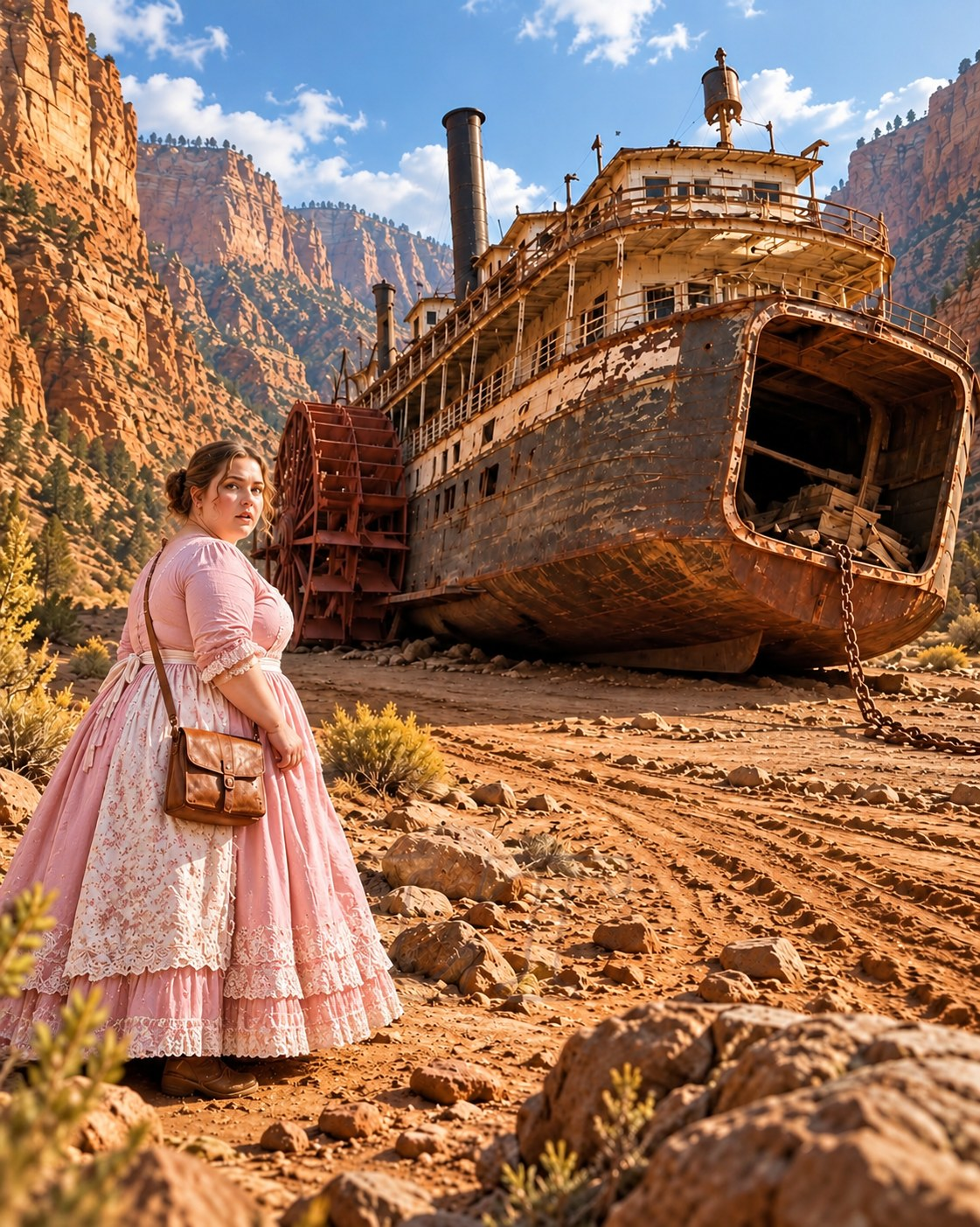
"Edwin Whitmore?"
I repeated the name because I wanted to be certain I had heard Mrs. Hargrove correctly.
She nodded.
"That's what the man asked about. He wanted to know whether you had arrived in town, where you were staying, and whether you had purchased the Silver Dawn."
I looked down at the warning letter in my hand.
Someone had written it carefully.
The message was short, but the handwriting was deliberate.
STOP EXAMINING THE CAPTAIN'S CABIN. SOME SECRETS WERE NEVER MEANT TO BE FOUND.
I folded the paper.
"When did this man come?"
"About an hour ago."
"Did he say why he was looking for me?"
"No. He asked a few questions, paid for a drink, and left."
"What did he look like?"
Mrs. Hargrove thought for a moment.
"Middle-aged. Expensive coat. Clean boots. Not someone who looked like he belonged around here."
I felt something tighten in my stomach.
"Did he mention my uncle?"
"No. But he seemed interested when I told him you had bought the ship."
I walked toward the window.
The street was almost empty.
A wagon stood outside the bakery, and a man was closing the shutters of the general store.
Nothing looked unusual.
Still, I could not shake the feeling that someone was watching me.
"Did he leave an address?"
Mrs. Hargrove shook her head.
"Only a name."
"What name?"
She hesitated.
"Richard Whitmore."
I turned.
Richard.
My uncle's cousin.
The man who had taken my position at the general store.
For a moment, I could not speak.
Why would Richard be interested in the Silver Dawn?
He had no connection to Dry Creek Hollow.
He had no reason to care about an abandoned steamship.
Unless there was something I did not know.
"Are you certain?"
Mrs. Hargrove nodded.
"Quite certain."
I returned to the table and placed the warning beside my notebook.
Richard had barely spoken to me during the dismissal meeting.
He had seemed more interested in his new position than in the person he was replacing.
I could not imagine why he would travel all this way merely to ask questions about me.
And yet, there was something else bothering me.
The warning had specifically mentioned the captain's cabin.
Not the ship.
Not the machinery.
Not the ownership papers.
The captain's cabin.
Whoever had written it knew exactly where I had been working.
I looked at Mrs. Hargrove.
"Did you tell anyone about the cabin?"
"No."
"Did you tell anyone I found a hidden compartment in the desk?"
Her eyes widened.
"You found something?"
I immediately regretted saying too much.
"Nothing important. Just an unusual piece of furniture."
She studied me.
"Clara, I don't like this."
"Neither do I."
"Perhaps you should go to the sheriff."
I shook my head.
"And tell him what? That someone left me a warning because I own a ship?"
"At least someone would know."
I considered it.
But I had no proof that Richard had done anything wrong.
He might have been asking questions for an entirely different reason.
I did not want to accuse someone without evidence.
That was one of the principles I had followed throughout my working life.
Records mattered.
Facts mattered.
Assumptions could ruin a perfectly good decision.
"I'll be careful," I said.
Mrs. Hargrove did not look convinced.
"Promise me you won't go back to that ship tonight."
I looked at the folded warning.
Then I glanced toward the window.
"I won't."
It was a promise I intended to keep.
At least until morning.
I spent the next hour reviewing my notes.
The four brass rings.
The small pine bird engraving.
The concealed desk panel.
The old maintenance records.
And the sentence written on the warning.
Someone had gone to considerable trouble to make sure I understood that the captain's cabin was not an ordinary room.
I opened my father's compass.
The needle moved slightly before settling.
I remembered something he used to say.
Whenever I became frustrated with a difficult problem, he would tell me to stop looking at the part that refused to move and examine everything surrounding it.
Perhaps the answer was not in the lock itself.
Perhaps it was in the ship.
I placed the compass beside my notebook and began comparing my sketches.
The pine bird appeared in two places.
Once on the lower metal strip beside the cabin door.
And once in a pattern resembling one of the symbols on the lock.
I drew them side by side.
The markings were almost identical.
Then I noticed a small difference.
The bird beside the door had three tiny lines beneath its wings.
The symbol on the lock had four.
I stared at the drawings.
Why would someone deliberately change such a small detail?
I wrote a question beneath the sketches.
What is the fourth mark?
There was no answer.
I closed the notebook.
Outside, the evening grew darker.
A few minutes later, I heard someone walking along the corridor.
The footsteps stopped outside my door.
I looked up.
A shadow appeared beneath the narrow gap.
Then came a quiet knock.
"Clara?"
It was Mrs. Hargrove.
I opened the door.
She was holding a small envelope.
"This was left at the front desk."
I looked at the handwriting.
It was the same as the warning letter.
My name was written across the front.
I opened it.
Inside was a single sheet.
There were only six words.
Your uncle knows what Everett left.
I read the sentence several times.
Then I looked at Mrs. Hargrove.
"Did the same man bring this?"
She nodded.
"He left it with the boy who delivers the bread."
"When?"
"Just now."
I folded the paper.
The situation had changed.
Until that moment, I had believed the warning was an attempt to frighten me away from an abandoned room.
Now someone was connecting Edwin to Captain Everett.
I returned to the table.
My uncle had never mentioned the Silver Dawn.
He had never mentioned Dry Creek Hollow.
And as far as I knew, he had never met Captain Everett.
Yet the message suggested that he knew something about the ship's hidden contents.
I thought about the general store.
The old supply records.
The shipping contracts.
The business relationships Edwin had inherited from previous owners.
Could the Silver Dawn have been connected to one of those businesses?
It was possible.
Twenty years was a long time.
Companies disappeared.
Records were lost.
People died.
But commercial relationships sometimes survived long after the businesses that created them had vanished.
I needed information.
And I knew where to begin.
The following morning, I went to the courthouse.
Harold Beckett was sitting behind his desk, examining a stack of documents.
He looked up when I entered.
"Miss Whitmore."
"Good morning."
"Have you come to tell me the ship is falling apart?"
"Not exactly."
He put down his pen.
"What can I do for you?"
"I'd like to examine the historical ownership records for the Silver Dawn."
His expression became cautious.
"Why?"
"I'm trying to understand its history."
"That's a rather broad request."
"Then let's start with the former navigation company."
Harold leaned back.
"The Western Basin Navigation Company?"
"Yes."
He removed his spectacles.
"Those records are old. Some were transferred to the county archive after the bankruptcy."
"Could I see them?"
He hesitated.
"Possibly. What exactly are you looking for?"
"Shipping contracts, ownership transfers, maintenance agreements, and any documents relating to Captain Everett."
Harold studied me.
"Have you discovered something?"
I thought about the warning.
"Not yet."
He stood.
"Come with me."
We walked through a narrow hallway into a storage room.
Several shelves contained ledgers and boxes of old paperwork.
Harold searched through a cabinet before removing a large book.
"These are the surviving commercial records from the navigation company."
He placed it on a table.
The cover was cracked.
Dust fell from its edges when he opened it.
I began turning the pages.
Most contained ordinary business transactions.
Cargo descriptions.
Delivery dates.
Supplier names.
Payments.
I recognized several companies.
Some were no longer operating.
Others had merged with larger firms.
Then I noticed a familiar name.
Whitmore Mercantile.
I stopped.
The entry was dated twenty-one years earlier.
I read it carefully.
The company had supplied timber, iron fittings, and general equipment to the Western Basin Navigation Company.
I turned the page.
Another entry.
And another.
The transactions continued for several years.
I felt my pulse quicken.
My uncle's business had been connected to the Silver Dawn.
I looked at Harold.
"Was Whitmore Mercantile owned by Edwin?"
He shook his head.
"No. It belonged to his father before the business was transferred to Edwin."
I returned to the ledger.
The entries included several shipments marked for Captain Everett.
One described replacement fittings.
Another listed oak timber.
A third referred to specialized brass components.
Then I found something unusual.
A payment had been recorded but never completed.
The amount was substantial.
The note beside it read:
SPECIAL CONSTRUCTION WORK — CAPTAIN'S PRIVATE CABIN.
I stared at the words.
"Mr. Beckett."
He leaned closer.
"What is it?"
I pointed.
He adjusted his spectacles.
"That's interesting."
"Do you know what it means?"
"Not specifically."
I turned another page.
The next entry referred to a second shipment.
This time, the description was different.
CUSTOM-MADE MECHANICAL SECURITY SYSTEM.
My fingers went cold.
The lock.
It had been commissioned through a company connected to my family.
I read the entry again.
The supplier's name appeared at the bottom.
E. Whitmore.
My uncle.
I sat back.
For several seconds, I could not move.
Edwin had been involved with the captain's cabin.
Not indirectly.
Not through some distant business connection.
His name appeared on the paperwork.
"Mr. Beckett, may I copy this page?"
He nodded.
I carefully recorded the details.
Then I searched the following pages.
There were more entries.
Several payments had been made over a period of months.
One included a note stating that the final components were delivered personally.
The date was almost exactly twenty years earlier.
I looked at Harold.
"Who signed for the delivery?"
He turned the ledger.
The signature was faint.
But I could read it.
E. Whitmore.
I felt a strange mixture of anger and confusion.
My uncle had known about the captain's cabin.
He had known about the lock.
He might even have known what was inside.
And yet he had never mentioned any of it.
Why?
Harold closed the ledger.
"Miss Whitmore, I don't think these records were intended to be examined by someone purchasing the vessel today."
"Why not?"
"Because the company went bankrupt under complicated circumstances. There were outstanding payments, disputed property claims, and several private agreements."
"Private agreements with whom?"
He shrugged.
"I couldn't tell you."
I looked at the ledger.
"Are there any documents relating to Captain Everett's family?"
Harold considered the question.
"There might be."
He walked toward another cabinet.
After several minutes, he returned with a smaller box.
Inside were old letters and folded documents.
He placed them on the table.
I began examining them.
Most concerned ordinary business matters.
But one envelope caught my attention.
It was addressed to Edwin Whitmore.
The handwriting was elegant.
The paper was yellowed.
The date was September, twenty years earlier.
I opened it carefully.
The letter contained only a few paragraphs.
The writer thanked Edwin for completing a private order.
He also mentioned a promise involving the captain's family.
The final sentence was particularly strange.
The matter must remain between us until the day the Silver Dawn sees the morning water again.
I read it twice.
Then I looked at Harold.
"Who wrote this?"
He examined the signature.
"Captain Everett."
I sat completely still.
The letter was addressed to my uncle.
Captain Everett had personally written to Edwin.
And the contents suggested that they had made an agreement.
I copied the relevant details into my notebook.
Then I asked Harold whether he knew where the remaining correspondence might be kept.
He shook his head.
"Those are the only surviving letters in this box."
I looked at the date again.
September.
The same month in which I had discovered the ship's hidden compartment.
The same month the lock would eventually open.
I thanked Harold and left the courthouse.
Outside, the morning sun was bright.
But I barely noticed.
My mind was occupied by a different problem.
If Edwin knew about the cabin, why had he allowed me to purchase the vessel?
He had known I was leaving with almost nothing.
He had known I would struggle to survive.
And if the Silver Dawn contained something valuable, why had nobody claimed it?
Perhaps he believed the ship was impossible to access.
Perhaps the lock had remained a mystery.
Or perhaps there was another reason.
I decided I needed to speak to him.
But before I could return to the boardinghouse, I noticed someone standing across the street.
A man in a dark coat.
He was watching me.
The moment our eyes met, he turned and walked away.
I crossed the street.
"Excuse me!"
He continued walking.
I followed him past the courthouse and toward the general store.
He disappeared around the corner.
When I reached the intersection, the street was empty.
I stood there for several seconds.
Then I noticed a small object lying beside the wooden fence.
A brass button.
I picked it up.
Its surface carried a tiny engraved emblem.
A pine bird.
I turned it over.
On the back were two initials.
R.W.
Richard Whitmore.
I placed the button inside my satchel.
Now I had something more than a warning.
I had evidence that Richard had been near the courthouse.
And someone had been following me.
That afternoon, I returned to the Silver Dawn.
I wanted to examine the cabin again.
This time, I brought the old ledger copies, my notebook, my father's compass, and a small set of tools.
The upper deck was quiet.
The wind moved through the railings.
I walked directly to the captain's cabin.
The brass lock remained exactly as I had left it.
I placed my notebook beside the mechanism.
Then I compared the symbols with the bird engraving.
The three lines beneath the wings.
The four lines on the lock.
I looked at the central button.
It was slightly recessed.
Perhaps the missing mark represented the final position of the fourth ring.
I tried rotating the first three rings to their recorded positions.
One click.
Another.
Then a third.
The central button moved slightly.
I stopped.
I had made progress.
I examined the fourth ring.
Its symbols were more difficult to distinguish.
One resembled a star.
Another looked like a small branch.
The third appeared to be a curved line.
I turned the ring slowly.
Nothing.
I tried again.
A faint click.
Then another.
The mechanism shifted.
I pressed the central button.
It moved inward by a fraction.
But the door remained locked.
I stepped back.
My eyes moved toward the inscription.
WAIT FOR THE DAWN.
Perhaps the instruction referred to a specific time.
Perhaps the lock could only be operated at sunrise.
Or perhaps the word Dawn was part of a sequence.
I did not know.
I decided to inspect the doorframe again.
The small bird engraving remained visible near the lower hinge.
I crouched and examined the three lines beneath its wings.
They were not decorative.
Each line had a different depth.
I ran my fingertip over them.
The first was shallow.
The second was deeper.
The third was almost invisible.
I took out my father's compass.
Its metal edge caught against the lower strip.
Something clicked.
I froze.
I moved the compass slightly.
Another click.
Then I noticed a tiny opening beneath the bird engraving.
It was almost exactly the size of the compass's hinge pin.
I looked at the compass.
Then at the opening.
A thought entered my mind.
What if the compass was not merely a sentimental object?
What if it had once belonged to someone connected to the ship?
I examined its casing.
My father had never explained where he had obtained it.
He had simply told me to keep it safe.
I opened the lid fully.
The needle settled.
Then I noticed something I had never seen before.
Inside the brass casing, beneath the compass face, there was a tiny engraved symbol.
A pine bird.
I stared at it.
The same bird.
The same wings.
The same tiny branch.
My hands became cold.
For twenty years, I had carried the object without knowing its significance.
I turned it over.
A small inscription was engraved on the back.
The letters were worn, but still readable.
C.E. — FOR THE MORNING.
I whispered the initials.
"Captain Everett."
I looked at the locked cabin.
Then at the compass.
My father had possessed something connected to the Silver Dawn.
Something that might have been given to him by Captain Everett.
I had no idea how the compass had passed from the captain to my father.
But the connection could not be accidental.
I moved closer to the lock.
The late afternoon sun entered through the corridor windows.
It illuminated the brass rings.
I raised the compass toward the mechanism.
For one brief moment, the engraved bird on the casing aligned perfectly with the matching symbol on the lock.
A small metallic sound came from inside the door.
Click.
Then the central button moved.
I stared at it.
The lock had responded.
I placed the compass against the brass plate once more.
The mechanism shifted again.
A deep metallic sound echoed through the corridor.
Then, from somewhere inside the cabin, I heard a voice.
A man's voice.
Weak.
Distant.
And unmistakably coming from behind the locked door.
"Clara..."
I stopped breathing.
The voice spoke again.
"Don't open it..."






Comments 0