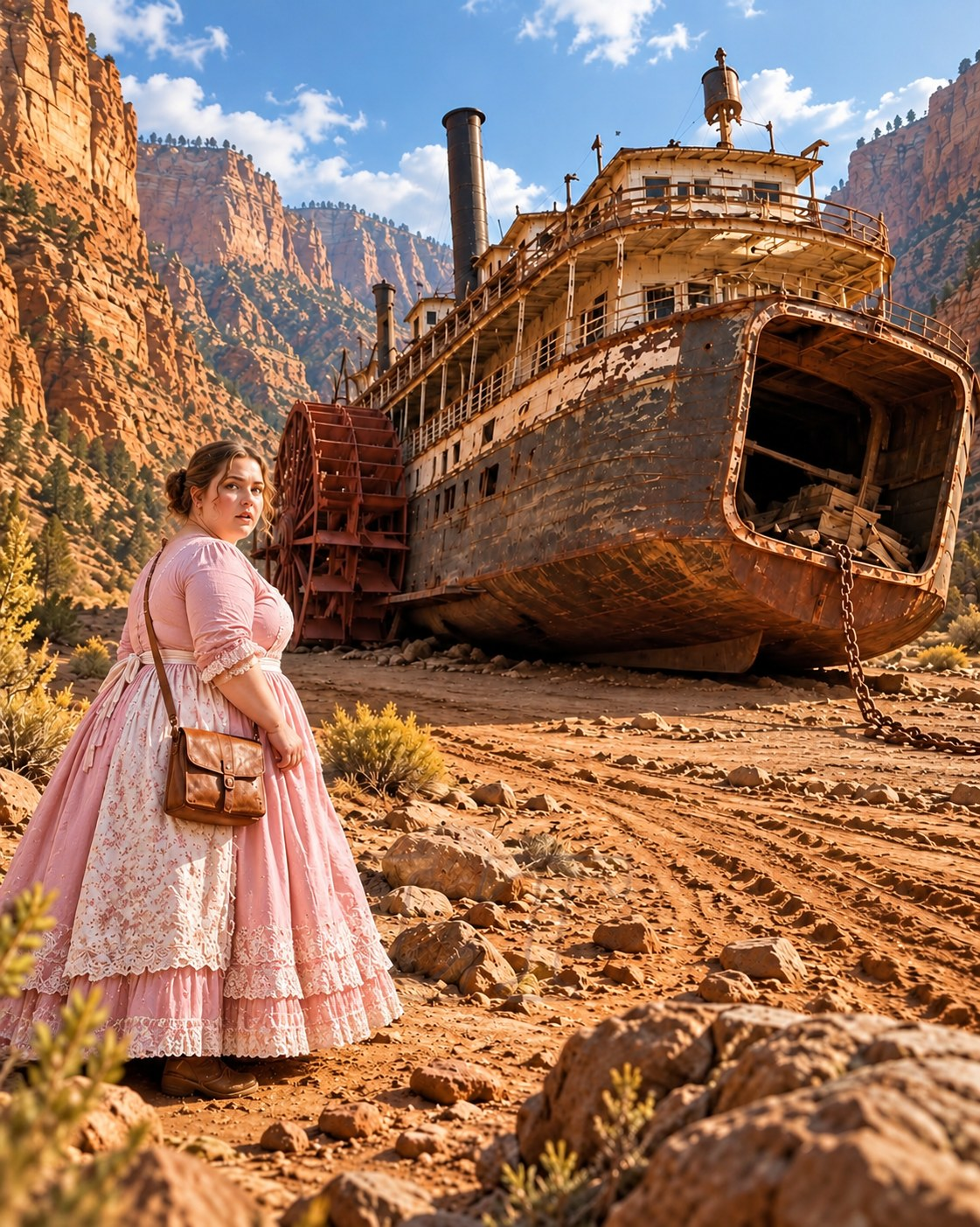
"That's your mother."
Nathaniel's words seemed to echo through the empty corridor.
I stared at the photograph.
The woman standing beside Captain Everett was holding a little girl's hand. Her dark hair was pinned behind her ears, and her expression was calm.
The little girl wore a pale dress.
She was holding a tiny wooden bird.
I looked at the woman again.
There was something familiar about her face.
The shape of her eyes.
The slight curve of her mouth.
Even the way she held her head.
I had seen those features before.
In an old photograph my father kept inside his bedroom drawer.
My mother.
Her name was Margaret Whitmore.
She had died when I was young, and my father had rarely spoken about her.
I had grown up believing she had lived an ordinary life before marrying him.
There had been no stories about riverboats, steamships, or mysterious captains.
Nothing about Dry Creek Hollow.
Nothing about the Silver Dawn.
I turned the photograph over again.
FOR THE ONE WHO RETURNS.
My hands began trembling.
"How can you be sure?" I asked.
Nathaniel pointed toward the woman.
"Look at her left hand."
I examined the photograph.
A small ring was visible on her finger.
It had a narrow oval stone surrounded by a delicate silver setting.
I recognized it immediately.
My father had kept that ring in a wooden box after my mother died.
I had seen it many times as a child.
He never allowed me to touch it.
I looked up at Nathaniel.
"Where did you see this photograph?"
"It was lying beneath the cabin door."
"That doesn't answer my question."
He shook his head.
"I've never seen this particular picture before."
I looked down again.
The photograph was old, but it had been carefully preserved.
There were no signs of water damage.
The corners were slightly worn, and the back carried the same faded handwriting found on several of the ship's documents.
I turned toward the locked cabin.
"Someone placed it here."
Nathaniel nodded.
"Recently."
"Who?"
"I don't know."
I looked at the open corridor windows.
A cold breeze passed through the ship.
For the first time, I felt that I was no longer simply investigating an abandoned vessel.
I was investigating my own family.
And someone seemed determined to stop me.
I slipped the photograph into my satchel.
Then I took out the compass.
The little pine bird engraved inside the casing looked exactly like the one in the photograph.
I studied the image again.
The little girl was holding a wooden bird with its wings spread.
The same design.
The same small branch carved across its body.
"Do you think the bird was important to my mother?" I asked.
Nathaniel nodded.
"Perhaps."
"Or perhaps it belonged to Captain Everett."
He looked toward the cabin.
"Either way, it connects them."
I examined the photograph once more.
Then I noticed something I had overlooked.
A small marking appeared near the bottom edge.
It looked like a date.
September 14.
There was no year.
I showed Nathaniel.
He leaned closer.
"That's interesting."
"Why?"
"Captain Everett's wife and daughter disappeared in September."
I felt a chill.
"How do you know?"
"My father mentioned it once. He said the captain received news about them during a September storm."
I stared at the photograph.
"Then why is my mother standing beside him?"
Nathaniel did not answer.
Neither of us had an explanation.
I wanted to ask more questions, but a sudden gust of wind shook the upper deck.
The corridor windows rattled.
Nathaniel glanced toward the sky.
"We should get off the ship."
"Why?"
"Storm's coming."
I looked outside.
Dark clouds were gathering beyond the sandstone cliffs.
The wind had shifted.
Dust moved across the basin in long, twisting lines.
We descended the stairs and reached the ground just as the first drops of rain began falling.
I secured my toolbox beneath my coat.
Nathaniel helped me carry the lantern.
The two of us hurried toward the road.
By the time we reached the edge of town, the rain had become heavier.
Dry Creek Hollow rarely received such sudden storms.
Water rushed along the dusty road, turning the ground into thick mud.
Lightning flashed behind the cliffs.
I looked toward the ship.
Its enormous silhouette stood alone in the basin.
The two smokestacks disappeared into the darkening sky.
I stopped walking.
Nathaniel turned.
"Clara?"
"I need to go back."
He stared at me.
"Absolutely not."
"I left my notebook aboard."
"We can get it tomorrow."
"The photograph, the compass, the documents—"
"You have the photograph and compass."
"My notebook contains the lock measurements."
Nathaniel shook his head.
"That can wait."
I looked toward the ship again.
Something about the approaching storm was bothering me.
The captain's cabin had remained sealed for twenty years.
The lock had responded to my father's compass.
The photograph had appeared outside the door.
And someone had left a warning.
I did not want to leave the ship unattended.
Nathaniel seemed to understand.
"Clara, listen to me. Whatever is inside that cabin has waited twenty years. It can wait another night."
I hesitated.
Then I nodded.
We continued toward town.
I spent the next hour in the boardinghouse drying my clothes and arranging my notes.
Mrs. Hargrove brought me a cup of hot tea.
She noticed the photograph on the table.
"Where did you get that?"
I looked up.
"From the ship."
She picked it up.
The moment she saw the woman, her face changed.
"Good Lord."
"You recognize her?"
Mrs. Hargrove slowly lowered herself into a chair.
"That's Margaret."
I felt my stomach tighten.
"You knew my mother?"
She nodded.
"Not well. But I remember her."
I stared at her.
"You never told me."
"You never told me she was your mother."
I looked at the photograph.
"What was she doing here?"
Mrs. Hargrove examined it carefully.
"She used to visit the settlement with a man named Thomas Bell."
"Why?"
"I don't know. She wasn't from around here, but she came several times."
"Was Captain Everett with her?"
Mrs. Hargrove shook her head.
"Not that I remember."
"Did she know him?"
"I think so."
She paused.
"Your mother was a quiet woman. Very private. People didn't ask too many questions."
I leaned forward.
"Do you remember when you last saw her?"
Mrs. Hargrove looked toward the window.
"September. A long time ago."
"Was it during a storm?"
Her expression became distant.
"Yes."
I waited.
"I remember because the rain was so heavy that the road near the old riverbank became impassable. Your mother came into the boardinghouse carrying a little wooden box."
My heart began beating faster.
"What was inside?"
"I never saw."
"Did she say anything?"
Mrs. Hargrove nodded slowly.
"She told Thomas Bell to keep something safe until the morning."
I looked at the photograph.
"Did he?"
"I believe so."
"Where is he now?"
Mrs. Hargrove lowered her eyes.
"Thomas died many years ago."
I felt disappointed.
Then she added something else.
"But his son might still have his old belongings."
"Who is his son?"
She looked at me.
"Benjamin Bell."
I wrote the name in my notebook.
"Where can I find him?"
"East side of town. Near the old water tower."
I stood.
"Thank you."
Mrs. Hargrove caught my hand.
"Clara, there's something else."
I looked at her.
"What?"
She lowered her voice.
"Your mother wasn't alone the last time I saw her."
"Who was with her?"
Mrs. Hargrove glanced toward the door.
"Edwin Whitmore."
I felt the room grow cold.
My uncle.
Again.
Every road seemed to lead back to him.
I wanted to ask more, but a sudden crash sounded outside.
The wind had knocked something against the boardinghouse shutters.
Mrs. Hargrove jumped.
I looked toward the window.
Rain covered the glass.
Lightning illuminated the street.
And beyond the rooftops, I could see the Silver Dawn.
Its upper windows were glowing.
I stood up immediately.
"That's impossible."
Mrs. Hargrove looked at me.
"What?"
"Someone is aboard the ship."
She followed my gaze.
The light disappeared.
Then another flash appeared near the upper deck.
Nathaniel had been right.
The ship was not empty.
I grabbed my coat.
Mrs. Hargrove stood.
"Where are you going?"
"Back to the ship."
"Clara, it's dangerous!"
"I won't be long."
I took my lantern and hurried outside.
The rain hit my face immediately.
The streets were almost deserted.
I crossed the road and headed toward the basin.
The mud made walking difficult.
The wind pushed against my coat.
Several times, I nearly lost my balance.
When I reached the ship, I found the lower entrance partly open.
I stopped.
It had been closed earlier.
I raised the lantern.
There were fresh footprints in the mud.
They led inside.
I looked around.
Nobody was visible.
I climbed aboard.
The wooden deck creaked beneath my boots.
The storm was getting worse.
Thunder rolled across the basin.
I moved toward the upper staircase.
My notebook was still beside the captain's cabin.
I intended to retrieve it and leave.
But when I reached the corridor, I saw something that made me stop.
The photograph was gone from the place where I had first found it.
I checked my satchel.
It was still there.
Someone had moved it.
I looked at the floor.
A narrow trail of wet footprints led toward the captain's cabin.
I followed them slowly.
The lock was different.
Several of the brass rings had been turned.
The central button was partially depressed.
I raised my lantern.
A thin line of water ran down the wooden door.
Then I heard a faint mechanical sound.
Click.
I stepped closer.
The mechanism moved again.
Click.
The door seemed to vibrate.
I looked toward the corridor.
"Who's there?"
No answer.
I reached for my compass.
Its needle trembled.
Then I noticed a small brass plate near the lower hinge.
It had not been there before.
Someone had opened a concealed section of the doorframe.
A narrow slot was visible.
And inside it was a small folded piece of paper.
I removed it.
The handwriting was unmistakable.
It was the same handwriting as the warning letters.
I unfolded the paper.
Only one sentence was written.
YOUR MOTHER DID NOT DIE WHERE YOUR FATHER TOLD YOU.
I stared at the words.
The storm shook the ship.
I read the sentence again.
My mother had died when I was young.
My father had always told me that she had become ill during the winter and passed away at home.
I remembered the funeral.
I remembered the black dress.
I remembered the quiet house.
But I had never questioned the details.
Why would someone write such a thing now?
I turned toward the locked cabin.
Then I noticed something else.
The brass lock had moved.
The four rings were aligned.
The central button was fully depressed.
A low metallic vibration traveled through the door.
I took out my father's compass.
The pine bird engraving seemed to catch the lantern light.
I placed it against the mechanism.
A sharp click sounded.
Then another.
The lock released.
I heard a deep mechanical movement inside the door.
The handle shifted.
For the first time in twenty years, the captain's cabin was no longer sealed.
I reached toward it.
Then I stopped.
A sudden voice came from behind me.
"Clara!"
I turned.
Nathaniel stood at the end of the corridor, soaked from the rain.
His face was pale.
He was holding an old envelope.
"Don't touch that door," he said.
I looked at the envelope.
"What is it?"
He approached slowly.
"My father left something for me before he died."
"What does that have to do with this?"
Nathaniel looked toward the brass lock.
"Everything."
He held out the envelope.
On its front were two words.
FOR CLARA.
I took it.
Inside was a photograph.
Not the one I had found earlier.
This one showed my mother standing beside my father.
And behind them was Captain Everett.
All three were smiling.
I turned the photograph over.
A date was written on the back.
September 14.
The year was twenty years earlier.
I looked at Nathaniel.
"Why would my father be here?"
He swallowed.
"Because he wasn't supposed to be on that ship."
I stared at him.
"What do you mean?"
Nathaniel stepped closer.
Then he pointed toward the cabin door.
"Because, Clara, your father was the last person Captain Everett allowed inside that room."
Before I could ask another question, a loud metallic bang erupted from inside the cabin.
The door began opening on its own.
And from the darkness beyond it, a man's voice whispered:
"Margaret..."






Comments 0