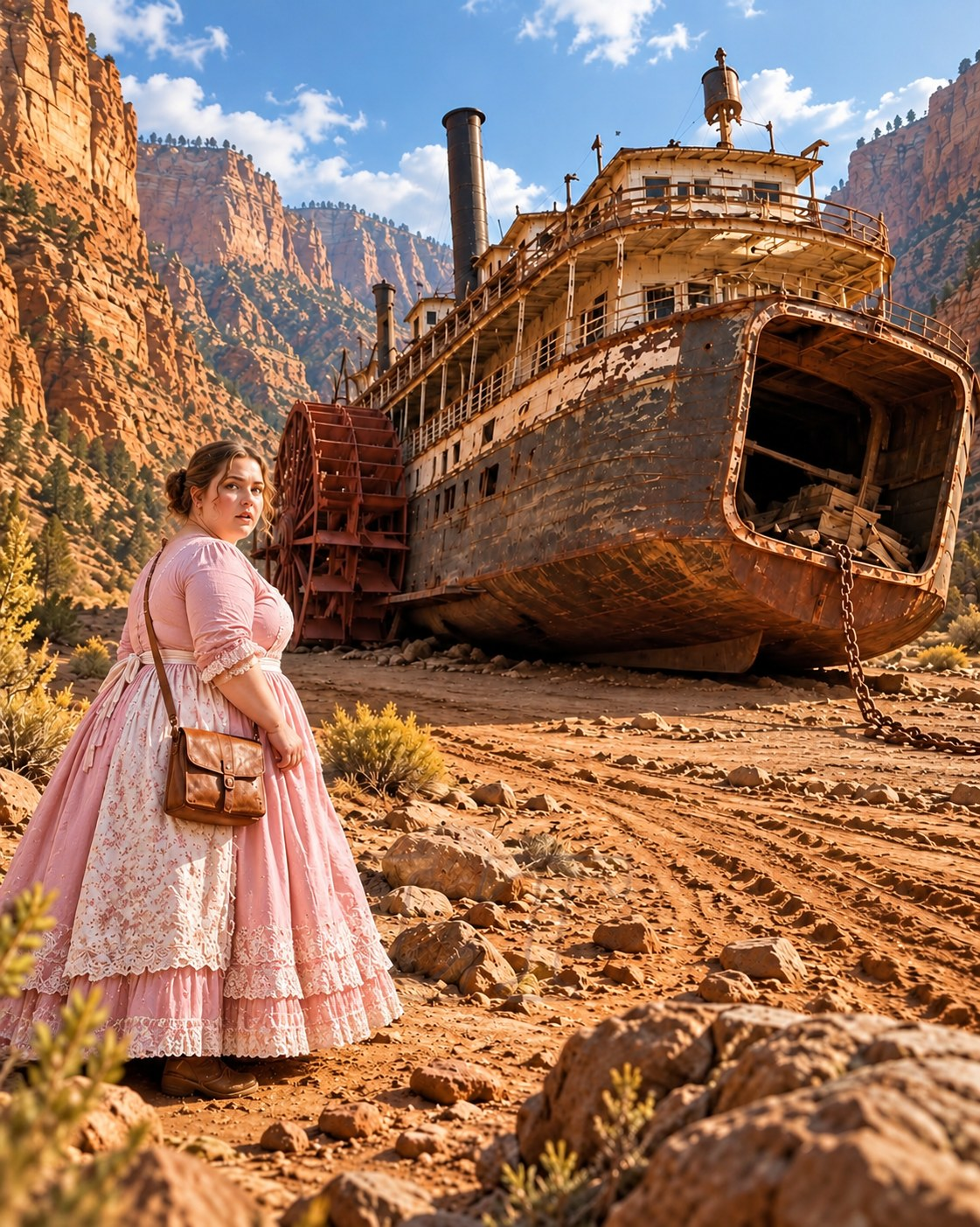
My uncle shoved an envelope across his desk and said:
"Take your eighty dollars and get out of my store."
I stared at the money.
Edwin Whitmore had just dismissed the woman who had saved his business.
The envelope had a small tear along its upper edge.
And inside it was exactly what he believed my eight years were worth.
I looked up at him.
He was already reaching for the next document.
I understood then.
This conversation was over for him.
But mine was only beginning.
My name was Clara Whitmore. I was thirty-eight years old, and until that Tuesday morning, I had believed that loyalty meant something.
For eight years, I had worked in my uncle's general store, a large establishment that supplied nearly every ranch, farm, and small business within twenty miles of our county.
When I first started, the store was barely surviving.
The shelves were poorly organized. Deliveries arrived late. Expired goods filled the back storage rooms. Nobody knew exactly how much inventory we had, and suppliers routinely charged us for items that never arrived.
My uncle blamed the economy.
He blamed the customers.
He blamed the railroad.
He blamed everyone except himself.
I had been twenty-nine when he offered me the position.
My father had recently passed away, and I had nowhere particular to go. Edwin told me that family should help family.
He said he needed someone he could trust.
I believed him.
The first six months were brutal.
I worked from sunrise until late evening, often sleeping in the small room behind the store because there was too much work to finish before morning.
I reorganized the inventory records.
I negotiated with suppliers.
I created a delivery schedule that reduced unnecessary transportation costs.
I personally inspected damaged shipments and challenged invoices that contained unexplained charges.
I even persuaded three major suppliers to extend better payment terms after showing them the store's improved purchasing records.
At first, Edwin barely noticed.
Then the numbers began changing.
The store's waste rate fell from eleven percent to less than two percent.
Missing inventory became rare.
Customers who had stopped shopping with us returned.
Our monthly profits improved.
Within three years, the business that had once struggled to pay its bills became one of the most dependable general stores in the region.
People began asking Edwin how he had managed such a remarkable turnaround.
He always smiled.
"Experience," he would say.
Sometimes he mentioned his business instincts.
He never mentioned me.
I did not mind.
At least, I told myself I did not.
I was never interested in public praise. I wanted a stable life, honest work, and the comfort of knowing that the years I had invested in the business were building something lasting.
My uncle knew that.
He also knew I had very little family left.
My father had left me a few personal belongings, including an old brass compass and a worn toolbox. Neither was particularly valuable, but they were the last things I had from him.
I kept the compass in my satchel.
The toolbox remained in the storage room behind the store.
I had not realized how important those two objects would become.
That Tuesday morning, Edwin called me into his office.
His voice had been unusually cheerful when he asked me to come.
I assumed he wanted to discuss the upcoming winter inventory.
Instead, I found him sitting behind his polished desk with another man beside him.
The man was younger than Edwin, perhaps in his early forties. He wore an expensive suit and carried a leather portfolio.
I recognized him immediately.
Richard Whitmore.
Edwin's cousin.
Richard had visited the store several times during the previous year. He knew almost nothing about its daily operations, but he was always interested in the profits.
I looked at the two men.
"Good morning," I said.
Edwin gestured toward the chair.
"Sit down, Clara."
I sat.
Richard examined me without greeting me.
My uncle folded his hands.
"I have some changes to announce."
I waited.
"Richard will be taking over the management of the store."
For a moment, I thought I had misunderstood.
"Taking over management?"
"That's right."
I glanced at Richard.
He opened his portfolio and removed several sheets of paper.
"Edwin and I have discussed the future," he said. "We believe the business needs a different direction."
I looked at my uncle.
"What about the supply contracts? The inventory system? The new delivery arrangements?"
Edwin waved his hand.
"Richard will handle those."
"He hasn't seen the updated supplier agreements."
"He'll learn."
"The winter shipments are already scheduled. If you change the delivery sequence now, we'll pay considerably more."
Richard gave a small laugh.
"I think I can manage a general store."
I turned back to Edwin.
"Is this temporary?"
My uncle leaned against his chair.
"No."
The room became very quiet.
I looked at the man who had once told me I was the only person he trusted to keep his business alive.
"Why?"
Edwin sighed as though I had asked him an unreasonable question.
"Richard needs the position."
I waited for an explanation.
None came.
"He has a family," Edwin continued. "He has responsibilities. This is an opportunity for him."
"And what about my responsibilities?"
His expression hardened.
"Clara, don't make this difficult."
I glanced at the papers on his desk.
There were no financial reports.
No discussion of performance.
No mention of the thousands of hours I had worked.
Just a few documents and an envelope.
Edwin pushed the envelope toward me.
"This covers your wages," he said. "Be gone by Friday."
I opened it.
Eighty dollars.
I counted the notes twice.
Not because I thought I had made a mistake.
Because I wanted to be certain that I understood the insult correctly.
Eight years.
Eight years of repairing a failing business.
Eight years of missed holidays.
Eight years of early mornings, late deliveries, damaged shipments, and sleepless nights.
Eighty dollars.
Richard shifted uncomfortably in his chair.
"Clara, I'm sure you understand this is just business."
I looked at him.
He avoided my eyes.
I turned back to Edwin.
"Does the store still have the inventory records I created?"
"Of course."
"The supplier contracts?"
"Yes."
"The purchasing schedules?"
"Yes, Clara. All of that is staying."
I nodded slowly.
"So the work stays."
Edwin frowned.
"What?"
"The systems I built. The supplier relationships. The inventory controls. Everything that made this business profitable."
He looked irritated.
"Nobody is saying you didn't work hard."
I placed the eighty dollars back into the envelope.
"Then I want you to know what that work was worth."
My voice was steady.
"Even if you don't."
For several seconds, nobody spoke.
I stood up.
Edwin looked almost relieved.
"Good. I appreciate you being reasonable."
I did not answer.
I walked out of his office.
The store looked exactly as it had that morning.
A farmer was examining a bag of feed near the entrance. Two women were discussing the price of flour. One of the delivery boys was carrying a crate toward the storage room.
Nobody knew what had happened.
I walked behind the counter.
My hands moved automatically as I collected my personal belongings.
A small notebook.
My father's compass.
A folded photograph.
And the old leather satchel I had carried for years.
I went into the storage room.
My father's toolbox stood beneath the workbench.
It was dented brass and dark wood, with a leather handle worn smooth from years of use.
I had brought it to the store because some of its tools were useful for repairing shelves and storage equipment.
I lifted it.
It was heavier than I remembered.
I placed it beside my satchel.
Then I looked around the room.
The shelves I had reorganized.
The delivery charts I had designed.
The boxes marked with the supplier codes I had developed.
Everything had once seemed like evidence of a future I was building.
Now it looked like a life I had been foolish enough to give away.
I left before anyone could see my expression change.
Outside, the afternoon sun was bright.
I walked several blocks before stopping beside a wooden fence.
For the first time that day, I allowed myself to breathe.
I was unemployed.
I had no home of my own.
My savings were almost gone.
And the eighty dollars in my satchel represented nearly everything I had.
I could have returned to Edwin's office.
I could have argued.
I could have demanded an explanation from the family that had treated me like an inconvenience.
But I knew what would happen.
He would tell me that business was business.
Richard would take my chair.
And the store would continue operating with the systems I had built.
I would leave with nothing but resentment.
I looked down at my father's compass.
Its brass casing was dented near the hinge.
The needle trembled slightly when I opened it.
My father had once told me that a compass did not make a journey easy.
It simply reminded you that being lost and being finished were two different things.
I closed it.
Then I went to collect the rest of my belongings.
By evening, I had packed everything I owned into two bags and the old toolbox.
There was no dramatic farewell.
No final argument.
Nobody came looking for me.
Edwin did not even send someone to check whether I had left the premises.
That night, I rented a small room above a bakery.
I placed my belongings beside the bed and counted my money.
Eighty dollars.
I had enough for a few meals and perhaps a short journey.
Not enough to begin a new life.
I lay awake for several hours, listening to the distant sounds of wagons passing through the street.
At some point, I remembered an old newspaper notice I had seen a few weeks earlier.
It mentioned a settlement called Dry Creek Hollow.
The article described a declining Western town that had once prospered through river transportation.
The river had dried up.
The shipping companies had abandoned the region.
Businesses had closed, and families had moved away.
The article had included a sentence that stayed in my mind.
There is still plenty of land available for anyone willing to take a chance.
I did not know why I remembered it.
Perhaps because I had spent eight years trying to save something that everyone else had already given up on.
The following morning, I packed my belongings again.
I bought a ticket on a westbound stagecoach.
It cost more than I wanted to spend, but I had made my decision.
If I stayed, Edwin would continue occupying my thoughts.
If I left, at least I would have somewhere else to look.
The stagecoach departed shortly after sunrise.
I sat near the window, my father's toolbox secured beneath my feet and my satchel resting on my lap.
The driver was a weathered man with a gray beard and a habit of complaining about everything.
When I mentioned Dry Creek Hollow, he glanced at me.
"You're going there?"
"Yes."
He shook his head.
"Not much left."
"Is there somewhere to stay?"
"Couple of buildings. Maybe a boardinghouse. Depends on whether the owner still bothers opening the door."
I looked through the window.
"Does anyone still live there?"
"Some. Mostly stubborn people."
He laughed.
"River dried up. People left. Nothing much there anymore."
I said nothing.
For the next several hours, the landscape changed.
The green fields disappeared.
The road became rougher.
The air grew drier.
Eventually, the stagecoach began climbing a long ridge.
The driver slowed the horses.
"Hold on," he muttered.
I looked up.
"What's wrong?"
He pointed toward the valley.
"Nothing. Just something I thought you'd want to see."
I leaned toward the window.
At first, I saw only the enormous basin below us.
Reddish cliffs surrounded the valley.
Dry shrubs covered the rocky ground.
The sunlight stretched across the empty landscape.
Then I noticed something near the center.
Something enormous.
Something that did not belong there.
I leaned closer to the glass.
My fingers tightened around my father's compass.
The driver looked at me.
"Well," he said quietly. "There's your new neighbor."
I could not speak.
Because sitting alone in the middle of that endless desert was a gigantic two-decked steamship.
And on its weathered bow, beneath layers of dust and rust, I could still make out its name.
THE SILVER DAWN.






Comments 0