I was holding my grandmother's letter when the telephone rang.
It was 7:15 on a cold December morning.
The kitchen smelled of coffee, and my production notebook was open beside a stack of unpaid farm invoices.
I picked up the receiver.
"Marin Reinhold?"
"Yes."
"This is Harold Peterson from the cooperative."
I looked at the photocopy lying on the table.
"Good morning, Harold."
"I understand you've been showing people an old agreement from 1953."
"I've shown it to my attorney."
There was a pause.
"That's precisely what concerns me."
I placed my coffee cup down.
"Why?"
"Because you're drawing conclusions from documents you don't fully understand."
I looked again at the handwritten sentence on the photocopy.
If they ever claim the culture belongs to them, show them what happened in 1956.
Then I heard Harold say something that made my fingers tighten around the receiver.
"Marin, I think it's time you stopped investigating your grandmother's old business with the cooperative."
I remained quiet.
He continued.
"Some things were settled a long time ago. There's no reason to reopen them."
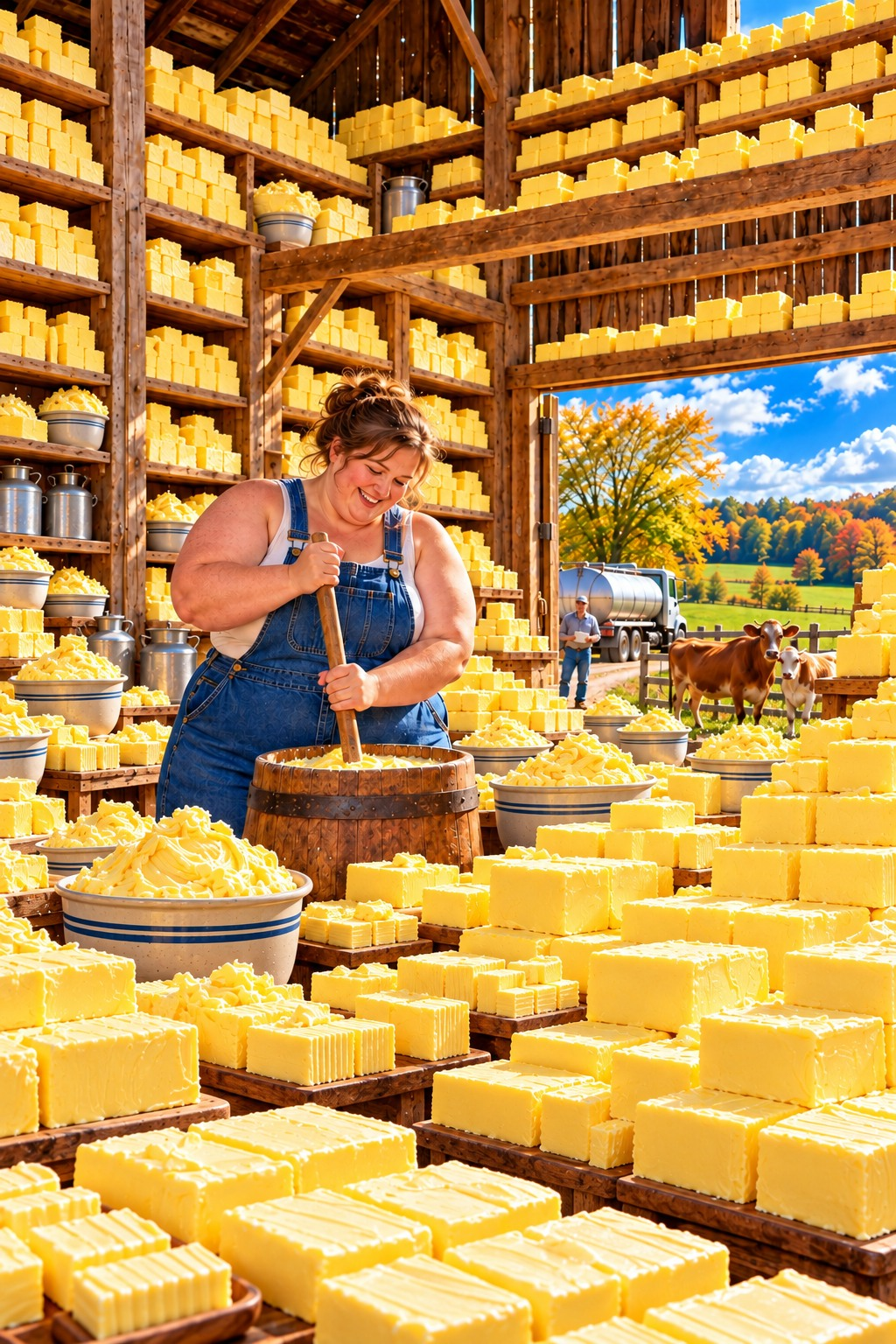
I glanced toward the barn, where hundreds of pounds of cultured butter were waiting for Christmas orders.
Then I answered calmly.
"Perhaps. But I haven't finished reading."
He hung up.
And I knew I had just found the reason he was worried.
Thomas Erickson arrived at the farm shortly before noon.
He parked beside the barn, carried his leather briefcase into the kitchen, and placed it on the table.
I gave him coffee.
Then I showed him the photocopy.
He read the handwritten sentence.
His expression changed.
"Where did you get this?"
"It came with the cooperative's latest letter."
"Did Harold send it?"
"Yes."
Erickson examined the page carefully.
"Interesting."
"That's what I've been thinking."
He took out a notebook.
"Did you find the original report?"
"No. Only this reference."
He leaned back.
"Then we need to establish what happened in 1956."
I told him about Gordon Niskanen's suggestion that Walter Kruger's daughter might know something.
He wrote down the name.
"Margaret Kruger?"
"Yes. She lives near Spring Valley."
"Have you contacted her?"
"Not yet."
He nodded.
"Do that. Meanwhile, I'll make a formal request for the cooperative's archived records."
I looked at the photocopy.
"Do you think the report proves the culture belongs to my grandmother?"
"Not by itself. But it may establish that the cooperative recognized her independent ownership."
He tapped the old agreement.
"And this document is important. It distinguishes ownership of the starter culture from ownership of the cream processed through it."
I thought about that.
"So they can reject my cream, but they cannot claim the culture?"
"That's the distinction we need to investigate."
He closed his notebook.
"Marin, I also want you to understand something. If your butter is becoming commercially successful, the cooperative may have reasons beyond money to challenge you."
"What reasons?"
"Competition. Reputation. Control over the market. Sometimes organizations become uncomfortable when a small producer proves that their assumptions aren't universal."
I looked toward the window.
Outside, the Jersey cows were standing near the fence.
"Then they should have thought about that before sending Curtis with a zero."
Erickson smiled faintly.
"Keep that rejection form safe."
I called Margaret Kruger that afternoon.
A woman answered after several rings.
"Hello?"
"Mrs. Kruger? My name is Marin Reinhold. My grandmother was Selma Reinhold."
There was a short silence.
Then the woman spoke again.
"Selma's granddaughter?"
"Yes."
"Oh, my goodness."
Her voice softened.
"I haven't heard that name in years."
I explained that I had found an old cooperative agreement from 1953 and that I was trying to locate a report concerning the cooperative's cultured cream program.
Margaret didn't interrupt.
When I finished, she asked one question.
"Did you find the letter?"
"What letter?"
"The one my father received after the program ended."
I sat down.
"No. I found a reference to a report."
Margaret sighed.
"My father kept a box of cooperative papers in his workshop. He never threw anything away."
"Do you still have it?"
"I might."
She paused.
"There's something else you should know. My father and your grandmother argued about that program before it ended."
I felt my stomach tighten.
"About what?"
"I don't know all the details. But I remember him saying that Selma refused to sign something."
"What?"
"I was only a child. I remember him being angry."
I reached for my notebook.
"Would you be willing to let me see the papers?"
Another pause.
Then Margaret said something unexpected.
"Yes. But I think you should come before the cooperative finds out I'm looking."
The following morning, I drove to Spring Valley.
I left Gordon Niskanen in charge of checking the barn and gave Walter Benson instructions about the afternoon delivery.
The roads were cold and damp.
My old pickup rattled whenever I went over a rough patch.
I carried the photocopy, my grandmother's letter, and a small notebook.
Margaret lived in a white farmhouse outside town.
Her father had died several years earlier, but the property still contained his workshop.
She met me at the front door.
She was in her late fifties, with gray hair cut short and a careful way of speaking.
"You look like Selma around the eyes," she said.
I wasn't sure what to say.
She invited me inside.
We sat at her kitchen table.
She asked about the farm, the cows, and whether the old separator was still working.
I told her everything.
When I mentioned the butter, she smiled.
"Your grandmother would have loved that."
Then her expression became serious.
"Come with me."
The workshop stood behind the house.
It was a narrow building with a wooden floor, old cabinets, and shelves filled with tools.
Margaret opened a cupboard.
Inside were several boxes.
She removed one marked COOPERATIVE RECORDS.
The cardboard had darkened with age.
Dust covered the lid.
She placed it on the workbench.
"My father kept everything."
I began sorting through the papers.
There were invoices, meeting notices, production figures, and correspondence.
Several documents mentioned the 1953 cultured cream program.
I found a list of participating farms.
Selma's name appeared near the top.
So did Walter Kruger's.
There were six other names.
I turned another page.
It contained production comparisons.
My grandmother's results were consistently better than the others.
The butter was described as having a distinctive flavor and a stable texture.
Then I found a handwritten note.
Reinhold culture produces exceptional consistency. Recommend further development.
I showed Margaret.
She nodded.
"That's my father's handwriting."
I continued searching.
At the bottom of the box was a sealed envelope.
The words on the front were written in black ink.
FINAL REPORT — CULTURED CREAM PROGRAM — MARCH 1956.
My hands became cold.
I looked at Margaret.
"May I open it?"
She studied the envelope.
Then she nodded.
"Please do."
I carefully removed the papers.
There were seven pages.
The first described the original program.
The second contained technical observations.
The third listed participating farms.
The fourth discussed the economic potential of cultured butter.
I turned to the fifth page.
And stopped.
It contained a proposal for the cooperative to acquire exclusive commercial rights to the Reinhold starter culture.
My grandmother's name was typed beside a proposed payment.
The amount was $500.
I read the paragraph again.
Then I looked at Margaret.
"Did your father know about this?"
She nodded slowly.
"He was on the committee."
I turned the page.
At the bottom was a handwritten response.
Offer declined. Culture remains family property.
Signed:
SELMA REINHOLD.
I sat down on an old wooden stool.
Five hundred dollars.
That was the amount the cooperative had offered my grandmother for something she had spent years developing.
I thought about the $4,230 she had left me after thirty-six years of careful work.
I thought about the old crock.
The composition notebook.
The hours she had spent feeding the culture every four days.
The cooperative had tried to buy it.
She had refused.
I turned to the final page.
There was a paragraph explaining why the committee had closed the program.
It wasn't because the culture had failed.
It was because the cooperative had been unable to secure the rights it wanted.
The committee had decided that independently maintained cultures would not be used in its commercial operations without a written agreement.
My grandmother had refused to sign.
The program had ended.
I looked at Margaret.
"Did your father ever talk about this?"
She nodded.
"He said your grandmother was the only person who wouldn't accept the offer."
"Why?"
"He thought she was making a mistake."
I looked back at the document.
"She knew what she had."
Margaret gave a small smile.
"Apparently."
Then she reached into the box.
"There was another letter."
She pulled out a folded sheet.
It was addressed to her father.
The date was April 1956.
I opened it.
The handwriting was different from the other documents.
The first sentence made me stop.
Walter, the board has decided that the Reinhold culture must not be used in any further cooperative trials.
I continued reading.
The letter mentioned the $500 offer.
It also referred to a second proposal.
This one was for a much larger amount.
The cooperative had offered to purchase the entire culture and the associated production method.
My grandmother had refused again.
At the bottom was a handwritten warning.
If the Reinholds ever develop a commercial product independently, the board may reconsider its position.
I read the sentence twice.
Then I folded the letter.
My grandmother had known that the cooperative might eventually come back.
She had simply continued doing her work.
I thanked Margaret.
Before I left, she made a copy of the documents for me.
She kept the originals.
I placed the copies inside my folder.
Then I asked her whether she remembered anything else.
She considered the question.
"There's one thing."
"What?"
"My father used to say the cooperative wasn't really interested in the culture."
I frowned.
"Then what did it want?"
Margaret looked toward the workshop door.
"Your grandmother's customers."
I stared at her.
"What customers?"
"The people who bought her butter. He said the cooperative wanted to know where she sold it and how much she could produce."
I thought about the original program.
The committee had been interested in the flavor.
The consistency.
The production methods.
But perhaps it had also been interested in the market.
I asked Margaret whether she knew where my grandmother had sold her butter.
She smiled.
"Mostly around Lanesboro. Some families in Preston. A few people in Rochester."
"Do you remember any names?"
She nodded.
Then she gave me one.
A name I had never heard before.
Eleanor Whitcomb.
Margaret said Eleanor had been one of Selma's most regular customers.
She had owned a small specialty food business in Rochester.
And she had purchased my grandmother's butter for years.
I wrote the name down.
It might be worth finding her.
When I returned to the farm, Gordon Niskanen was waiting beside the barn.
He looked toward my truck.
"Find anything?"
I held up the folder.
"More than I expected."
We went inside.
I showed him the final report.
He read the page about the $500 offer.
Then he shook his head.
"Five hundred dollars."
"That's what they offered."
"Your grandmother wouldn't have taken it."
"No."
He continued reading.
When he reached the handwritten warning, he looked at me.
"They knew this could happen."
I nodded.
"Apparently."
He handed the papers back.
"Well, now you know why they're interested."
I placed the documents on the table.
"They don't want the cream."
"What do they want?"
"They want the culture. Or at least control over what it produces."
Gordon looked toward the shelves.
"Then they're going to have a difficult time."
I smiled faintly.
The next few days were exhausting.
I had to complete orders, prepare the next production batches, and work on the processing room improvements.
Thomas Erickson reviewed the documents Margaret had provided.
He was particularly interested in the committee's original offer and my grandmother's written refusal.
He explained that the records strengthened my position concerning the culture.
But he also warned me that the cooperative might argue that the new butter operation was using knowledge developed through its old program.
"We need to establish exactly what your grandmother contributed and what the cooperative contributed," he said.
"She developed the culture before the program."
"Do we have proof?"
"Her notes."
"Good. Keep them safe."
I showed him the original composition notebook.
He examined the dated entries.
Some went back to 1953.
Others contained observations from later years.
He looked impressed.
"These records are extremely valuable."
I thought about my grandmother sitting at the kitchen table, writing temperatures while I played on the floor.
She had never told me she was creating evidence.
She had simply been keeping notes.
Meanwhile, Walter Benson began receiving larger orders.
He called one afternoon to tell me that a customer had purchased four pounds in one visit.
Another family had reserved butter for Christmas dinner.
The specialty shop in Rochester had asked whether I could provide a regular supply after the holidays.
I wrote everything down.
The sales figures were beginning to exceed my expectations.
But so were the expenses.
I needed more packaging.
I needed better storage.
I needed additional labor during the busiest weeks.
And I needed to complete the processing improvements before expanding production.
I spoke with Gordon Niskanen about hiring a local woman to help with wrapping and labeling.
He suggested his niece, Laura.
She had recently returned from Winona and was looking for part-time work.
I agreed to meet her.
She arrived the following afternoon.
She was twenty-six, careful, and surprisingly quick with numbers.
I showed her the labeling process.
She asked about the production dates and storage records.
I explained everything.
At the end of the afternoon, she looked at the shelves.
"Marin, I think you need a bigger room."
I laughed.
"That's what I've been telling myself."
She smiled.
Then she asked whether she could bring her mother to taste the butter.
I told her she could.
The following morning, she arrived with an order for three pounds.
That was the first time someone had purchased my butter because of Laura's recommendation.
It was also the beginning of something I hadn't planned.
Word was spreading beyond the people I already knew.
On December 10, Thomas Erickson called.
He sounded serious.
"Marin, the cooperative has responded to our request for the archived records."
"What did they say?"
"They claim the final report is incomplete and that the original committee files are not available for public release."
I frowned.
"But I have copies."
"Yes. Which is why their response is interesting."
"What does it mean?"
"It means they may be trying to limit what becomes part of the formal record."
I looked toward the photocopies on my table.
"Can they do that?"
"They can refuse to provide certain internal records unless there's a legal basis requiring disclosure. But we can challenge their position if necessary."
He paused.
"There's another development."
"What?"
"The cooperative has scheduled a special board meeting."
"About me?"
"Your operation is listed on the agenda."
I sat down.
"What are they planning?"
"I don't know."
He lowered his voice.
"But I received a copy of a proposed resolution."
"What resolution?"
"The board wants to establish an exclusive cooperative policy concerning the use of historical starter cultures by former participating farms."
I looked at the old agreement.
"Does that include my grandmother's culture?"
"It appears to."
I closed my eyes.
They had waited thirty-one years.
Now that my butter was selling, they wanted to change the rules.
That evening, I opened Selma's composition notebook.
I read the first page.
Then the second.
I looked at the dates.
The notes from 1953.
The entries from 1954.
The observations from 1955.
Everything was there.
My grandmother had documented the culture long before the cooperative had offered to buy it.
I turned toward the photograph on the windowsill.
"You knew they'd come back."
I placed the notebook down.
Then I checked the cooling room.
The latest batch was ready for the next stage.
I began preparing the churn.
I had twenty pounds due to Walter and another order for Edward Miller.
The butter couldn't wait for a board meeting.
It couldn't wait for a legal dispute.
It needed attention.
I washed the equipment.
I checked the temperature.
I examined the cream.
Then I started churning.
For nearly an hour, the wooden handle moved beneath my hands.
The cream thickened.
The texture changed.
The butter formed.
I worked carefully until the batch was finished.
When I lifted the first golden block from the mold, I felt the same quiet satisfaction I had felt with the very first one.
This was what my grandmother had left me.
Not a fortune.
Not a modern dairy.
Not a business plan.
A skill.
And the ability to turn something other people had rejected into something worth keeping.
The next morning, I received a telephone call from Walter Benson.
"Marin, have you heard?"
"Heard what?"
"Someone from the cooperative came into my store."
I stopped wrapping butter.
"Who?"
"Harold Peterson."
My stomach tightened.
"What did he want?"
"He asked how much of your butter I was selling."
I placed the wrapping paper down.
"What did you tell him?"
"The truth. I told him people were buying it."
Walter paused.
"Then he asked whether I'd consider replacing it with a cooperative specialty butter."
I felt my face grow warm.
"What did you say?"
"I told him my customers were asking for yours."
I closed my eyes.
"Thank you, Walter."
He continued.
"There's something else. Harold asked whether I knew the woman who had introduced your butter to Rochester."
I frowned.
"Eleanor Whitcomb?"
"That's the name he mentioned."
I looked toward Margaret's notes.
"Did he say why?"
"No. But he seemed particularly interested in finding her."
The telephone receiver felt heavy in my hand.
Eleanor Whitcomb.
The customer who had bought my grandmother's butter for years.
The woman who might know how Selma had originally sold it.
And the person the cooperative apparently wanted to find.
I thanked Walter and hung up.
Then I called Thomas Erickson.
He listened carefully.
"Don't contact Harold yet," he said.
"Why?"
"Because I want to understand why he's looking for Eleanor Whitcomb."
I looked at the old report.
"Do you think she knows something?"
"I think we should find out."
I opened my notebook and wrote her name again.
Then I reached for the telephone to call Margaret Kruger.
But before I could dial, another call came through.
I recognized the number.
It was the cooperative office.
I answered.
"Marin Reinhold."
A woman's voice spoke quietly.
"Mrs. Reinhold, my name is Helen Barrett. We met at your farm."
"Yes."
"I need to tell you something before the board meeting."
I sat down.
"What is it?"
She lowered her voice.
"Harold Peterson has found a document that changes the entire history of your grandmother's agreement."
I tightened my grip on the receiver.
"What document?"
There was a long silence.
Then Helen said:
"It's the original 1956 report, Marin. And your grandmother's name isn't the only signature on it."






Comments 0