"Marin, my father is in the hospital, and yesterday someone came asking him to sign a document transferring the sample to the cooperative."
Dorothy Kruger's words made the kitchen feel suddenly cold.
I looked at Thomas Erickson.
He was already reaching for his coat.
"Where is your father?" I asked.
"At the hospital in Decorah. He's been there since yesterday afternoon."
"Is he conscious?"
"Yes. He's weak, but he can speak."
"Has he signed anything?"
"No. I refused to let the visitor give him the papers."
I closed my eyes briefly.
"Who came?"
Dorothy hesitated.
"Richard Hale."
Thomas stopped moving.
I looked at him.
The cooperative had already tried to claim the cream, challenge the culture, and enforce an agreement that had never been properly authorized.
Now Richard had traveled to Iowa to obtain a sample that belonged to my grandmother.
"Please don't let anyone near your father with another document," I said.
"I won't."
"I'll come tomorrow morning."
After ending the call, I turned toward Thomas.
"We're going to Iowa."
He nodded.
"And before we leave, I'm contacting Martin Ellison. I want his statement and the original minutes secured with our attorney."
I looked toward the photograph of Selma on the kitchen shelf.
For thirty-one years, she had protected that culture.
I wasn't going to let someone take the final piece of her work while I stood by.
We arrived at the hospital shortly after ten the following morning.
Dorothy was waiting outside her father's room.
She was in her early sixties, with gray hair and tired eyes.
When she saw me, she approached immediately.
"You look like your grandmother."
I smiled faintly.
"Everyone keeps telling me that."
She took my hands.
"My father has talked about Selma for years. He always said he owed her an apology."
I followed her into the room.
Walter Kruger was lying in bed beside the window.
He looked much older than I had imagined.
His hair was almost completely white.
His hands were thin.
But when I introduced myself, he smiled.
"Selma's granddaughter."
"Yes, Mr. Kruger."
He reached for my hand.
"Your grandmother was a remarkable woman."
I sat beside him.
"I've heard that."
He laughed softly.
"Then you've heard correctly."
Dorothy brought a chair for Thomas.
Walter looked at the folder in my hands.
"You found the minutes."
"We did."
He closed his eyes.
"Good."
I waited.
Then he spoke again.
"Then I suppose it's time you knew everything."
Walter explained that the cooperative had originally taken three culture samples during the 1956 trials.
One came from Selma.
Another came from a farm near Lanesboro.
The third came from a small producer outside Spring Valley.
The cooperative intended to use the samples to develop a commercial cultured butter.
But the samples had been collected under an agreement that allowed them to be examined for research purposes only.
They were not supposed to become cooperative property.
When Selma refused to sell her culture, Arthur Voss became angry.
He wanted to preserve the commercial opportunity.
According to Walter, the board discussed keeping the samples even after the program ended.
My grandmother objected.
She demanded that the samples be returned.
The cooperative agreed to return them.
But the records were deliberately incomplete.
"Why?" I asked.
Walter looked at the ceiling.
"Because Arthur wanted to keep one sample."
"Which one?"
"Selma's."
I felt my heartbeat quicken.
"Did you take it?"
He nodded.
"Yes."
"Why?"
"Because I knew what they were planning."
He turned toward me.
"I had made a terrible mistake by supporting them. Your grandmother had trusted me, and I had allowed myself to be used against her."
His voice became weaker.
"I couldn't undo what had happened. But I could return something."
I looked at Dorothy.
She nodded.
"That's why the sample stayed with our family."
Walter explained that he had kept the original sample in a sealed glass container.
It had been stored in a controlled environment for decades.
He had never opened it.
He had never sold it.
He had never transferred ownership.
He had simply kept it.
I asked why he hadn't returned it to Selma.
His expression changed.
"Because I was ashamed."
He looked down at his hands.
"I wrote to her several times. I never sent the letters."
I felt something tighten in my chest.
"She knew you had been pressured."
"She knew. But I didn't know how to face her."
He paused.
"After your grandmother died, I wanted to give the sample to you. But I couldn't find the right moment."
I looked at him.
"Why now?"
"Because the cooperative came looking."
He swallowed.
"Richard Hale told me the board had a legal claim. He wanted me to sign a transfer document. I refused."
"Did he threaten you?"
Walter nodded.
"He said the cooperative could take legal action against my family."
Dorothy spoke quietly.
"He frightened my father."
Walter shook his head.
"I wasn't frightened of him. I was frightened that I'd make the same mistake twice."
He looked at me.
"Marin, I want you to have the sample."
I couldn't speak immediately.
Then I took his hand.
"Thank you."
Dorothy retrieved the sample that afternoon.
It was stored in a small wooden case.
Inside was a sealed glass container.
A handwritten label was attached.
SELMA REINHOLD — ORIGINAL CULTURE — 1956.
I stared at it.
The handwriting was Walter's.
I looked at him.
"Is this the original?"
He nodded.
"It was taken from your grandmother's crock during the cooperative trials."
I examined the container.
The culture had been preserved using the methods available at the time.
Thomas photographed the case, the label, and the surrounding documentation.
He also asked Dorothy to prepare a written statement confirming the history of the sample.
Walter agreed.
Before we left, he asked me to sit beside him again.
"Marin."
"Yes?"
"I know your grandmother continued making butter after the cooperative agreement. I know she taught you. And I know what she would say if she were here."
I smiled.
"What?"
He looked at the sample.
"She would tell you to feed it properly and stop wasting time talking."
I laughed.
For the first time in days, the tension inside me eased.
We returned to Preston with the sample.
Thomas immediately arranged for an independent laboratory to examine it.
The purpose was not to commercialize the original sample immediately.
It was to establish its identity, document its condition, and preserve it properly.
The laboratory confirmed that the material was consistent with the historical records.
It also recommended that the sample remain preserved until a qualified specialist could evaluate whether a safe, viable culture could be recovered.
I was relieved.
The original sample would not be used casually.
It would be protected.
Meanwhile, my own family culture remained alive in the crock.
That was what mattered most.
The cooperative responded three days later.
Harold Peterson issued a statement claiming that Walter's sample belonged to the cooperative because it had been collected during the 1956 trials.
Thomas sent a formal response.
He included the original agreement.
The committee minutes.
Edward Peterson's objection.
Martin Ellison's statement.
Walter Kruger's testimony.
And the documents establishing that the samples were intended for research purposes only.
The cooperative's claim became increasingly difficult to defend.
The next development came from an unexpected direction.
George Lund, one of the board members who had questioned Harold during the earlier hearing, requested a private meeting.
Thomas advised me to attend with him.
We met in a small conference room.
George arrived carrying a folder.
He looked uncomfortable.
"Mrs. Reinhold, I want to apologize."
I studied him.
"For what?"
"For the way the cooperative handled your situation."
He opened the folder.
Inside was a copy of a board memorandum from October 1987.
It concerned the 412 gallons of rejected cream.
I read it carefully.
The document showed that Harold had requested a review of the cream's potential commercial value shortly after learning that I was producing cultured butter.
There was also a handwritten instruction.
Determine whether the Reinhold operation can be stopped under the historical restriction.
I looked up.
"This was written before you demanded payment for the cream."
George nodded.
"Yes."
"So the demand wasn't really about the cream."
He hesitated.
"The board was concerned about the commercial implications of your operation."
I closed the folder.
"Then why did you tell me the cream was worthless?"
George looked down.
"Because that was the grading decision."
"And why did you try to charge me for it afterward?"
He didn't answer.
Thomas spoke calmly.
"Mr. Lund, the documents indicate that the cooperative's position was not based on an ordinary cream purchase or disposal dispute."
George nodded.
"I understand."
He removed another document.
"This is the board's proposed resolution."
I examined it.
The cooperative intended to withdraw its claim against the 412 gallons.
It also proposed recognizing that the Reinhold family had independently maintained the culture.
I read the final paragraph.
It stated that the cooperative would no longer seek to prevent the sale of cultured butter produced by my farm.
I looked at George.
"Has the board approved this?"
"Not yet."
"Will it?"
He nodded.
"I believe it will."
The final board meeting took place in January 1988.
Thomas accompanied me.
Martin Ellison provided his signed statement.
Walter Kruger's testimony was included in the record.
The cooperative's attorney reviewed the original minutes.
The altered report was examined.
The board members were shown the letters from Arthur Voss.
They were also shown the 1987 memorandum concerning my farm.
For the first time, the entire history was visible in one place.
Harold Peterson tried to defend the cooperative's actions.
He argued that the board had been attempting to protect the interests of its members.
He said the historical agreement had been interpreted in good faith.
But the documents were difficult to explain.
George Lund finally addressed the room.
"The cooperative cannot claim that Mrs. Reinhold's grandmother's culture belongs to us while relying on records that contradict that position."
Nobody interrupted.
He continued.
"We rejected her cream. We gave her no payment. We then attempted to claim an interest in what she produced from it. Whatever our historical intentions may have been, that is not a position this cooperative should defend."
The room remained silent.
Harold looked down.
The board voted.
The resolution passed.
The cooperative formally withdrew its claim to the 412 gallons of cream.
It acknowledged that the Reinhold family culture had never been transferred to its ownership.
It also withdrew its challenge to my commercial production.
The disputed restriction was declared unenforceable by the cooperative.
The board agreed to correct its historical records.
And it issued a written acknowledgment of Selma Reinhold's contribution to the 1953 cultured cream trials.
When the meeting ended, George approached me.
"Your grandmother deserved better."
I looked at him.
"Yes. She did."
He shook my hand.
"I'm sorry."
I accepted his apology.
But I also knew that an apology could not give my grandmother back the years she had spent protecting something that should never have been questioned.
At least the truth was finally written down.
The legal dispute was resolved the following month.
Thomas received the final settlement documents.
The cooperative agreed to cover the reasonable legal costs associated with the dispute and formally relinquished any claim against my butter operation.
The matter concerning the original culture sample was also resolved.
Walter Kruger signed a declaration confirming that the sample had been retained for safekeeping and had never been transferred to the cooperative.
He gave it to me without payment.
I arranged for its continued preservation.
My grandmother's original crock remained in the root cellar.
The culture she had maintained was still alive.
And the sample from 1956 was now protected by records that established its history.
For the first time, I no longer worried that someone would arrive at my farm demanding that I surrender it.
The business continued growing.
Not overnight.
Not without difficulty.
There were inspections.
There were additional expenses.
There were days when the separator needed repair and days when the butter didn't turn out exactly as I wanted.
But the processing room was completed.
The necessary approvals were obtained.
Laura became my first regular employee.
Gordon Niskanen helped me install additional storage shelves.
Walter Benson continued selling the butter at his grocery store.
Edward Miller placed regular orders for his Rochester customers.
By the spring of 1988, I had customers in several Minnesota towns.
Some came directly to the farm.
Others ordered through local stores.
I never tried to become a large commercial dairy.
I didn't want to produce thousands of pounds simply to prove something to the cooperative.
I wanted to make excellent butter.
That was enough.
One afternoon in April, I received a letter from Dorothy Kruger.
Her father had passed away peacefully.
She wrote that he had asked her to send me a final message.
It was written in his own hand.
Marin,
I am sorry I waited so long to return what belonged to your family. Your grandmother was right about the culture, and she was right about the cooperative. I hope you will remember me not for the mistake I made, but for the small thing I finally did correctly.
Keep the butter good.
Walter.
I folded the letter.
Then I placed it beside Selma's photograph.
I didn't feel angry.
I felt grateful that he had finally found the courage to tell the truth.
In October 1988, almost one year after Curtis Vold had delivered the rejected cream, I organized a small celebration at the farm.
I invited Walter Benson.
Edward Miller.
Gordon Niskanen.
Laura.
Thomas Erickson.
Helen Barrett.
Margaret Kruger.
Martin Ellison's daughter, Patricia, also came.
We arranged tables inside the newly finished processing room.
There was fresh bread.
Apples.
Coffee.
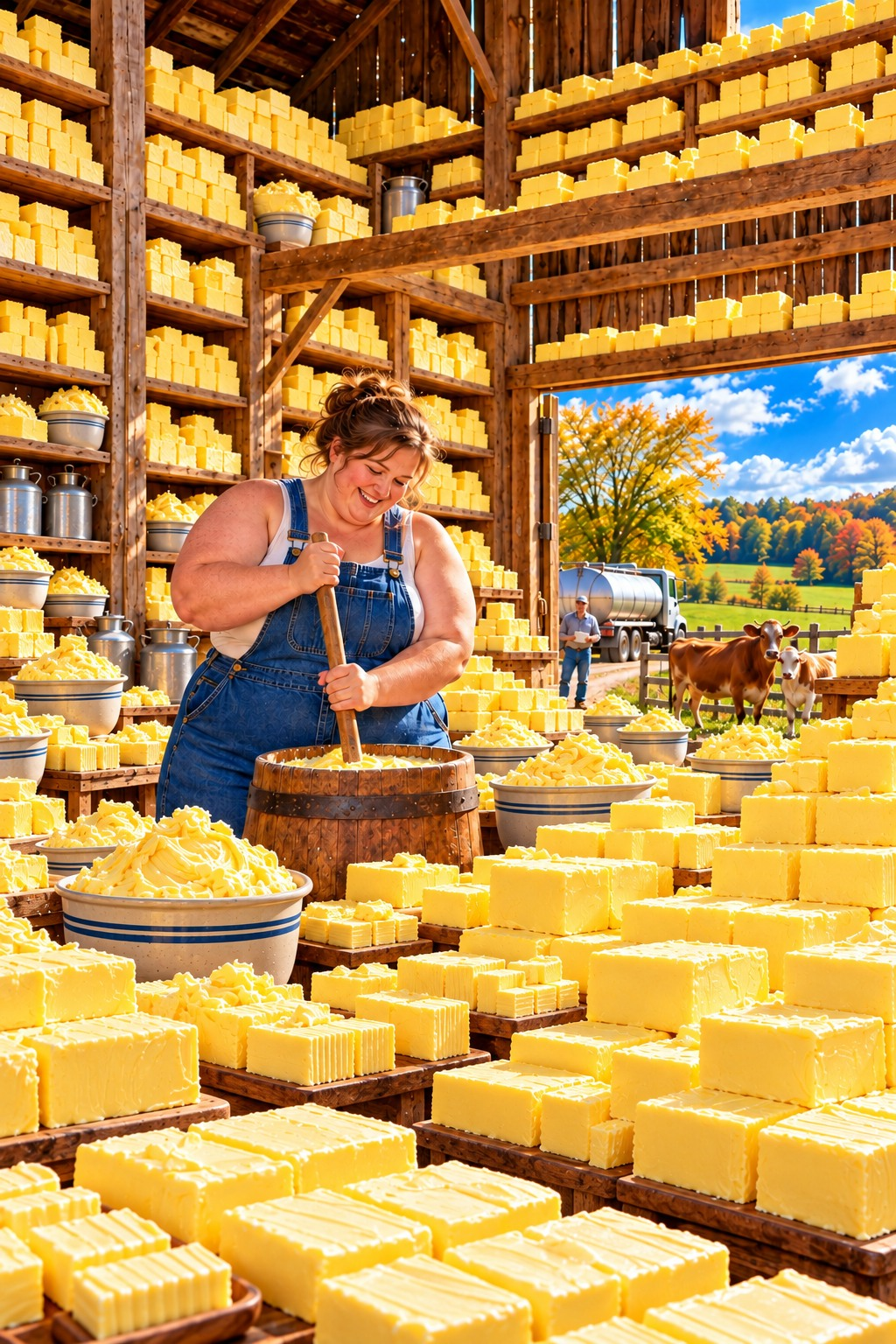
And several blocks of cultured butter.
I had prepared the original family recipe.
The butter was pale gold.
Its flavor was rich and slightly tangy.
Everyone took a piece.
Gordon spread some on bread.
He tasted it.
Then he looked at me.
"Your grandmother would approve."
I smiled.
"That's what I was hoping."
Helen stood beside the shelves.
She examined the production records.
"You've built something wonderful here."
I looked around.
The equipment was clean.
The shelves were organized.
The butter was properly labeled.
Laura was laughing with Patricia near the doorway.
Thomas was speaking with Edward.
Gordon was helping Walter move another table.
It wasn't a large operation.
But it was mine.
And it was working.
Later that afternoon, I went down to the root cellar.
The small crock sat on its familiar shelf.
I removed the lid.
The culture was healthy.
I checked it carefully.
Then I added fresh cream according to Selma's instructions.
I recorded the date in my notebook.
Beside the entry, I wrote:
October 15, 1988. Culture maintained. Original method preserved.
I paused.
Then I added another sentence.
The butter is now being sold under the Reinhold family name.
I closed the notebook.
For a moment, I remembered October 14, 1987.
The truck.
The rejected cream.
Curtis Vold handing me a form with a zero where the payment should have been.
At the time, I had believed I was being handed a problem.
The cooperative believed it was getting rid of something worthless.
But the cream had not been worthless.
It had been misunderstood.
And the culture my grandmother had protected had transformed it into something people wanted.
I carried the notebook upstairs.
That winter, the Reinhold Farm butter sold out before Christmas.
Walter Benson called to say customers had begun reserving their orders weeks in advance.
Edward Miller requested another shipment for Rochester.
Several families returned year after year.
We never promised more than we could produce.
We never changed the culture to increase output.
And we never forgot that the butter began with a woman who had spent decades maintaining something she believed was worth protecting.
The cooperative eventually removed the disputed restriction from its historical records.
A corrected report acknowledged Selma's contribution to the original trials.
The board also established a small program to help independent dairy producers develop specialty products without surrendering ownership of their family methods or cultures.
Helen Barrett helped administer it.
She later told me that the cooperative had finally begun to understand that small farms were not necessarily failed versions of large farms.
They could build something different.
Something valuable.
Something worth preserving.
On Christmas Eve, I closed the barn later than usual.
The cows were fed.
The separator was cleaned.
The cooling room was steady.
The final orders had been collected.
I returned to the kitchen and found a small package on the table.
It was from Thomas.
Inside was a framed copy of the original 1953 agreement.
He had arranged for it to be professionally preserved.
Below the document was a small brass plaque.
It read:
SELMA REINHOLD — CULTURED CREAM PIONEER, 1953.
I placed it beside her photograph.
Then I sat down.
For years, I had believed my grandmother had left me a modest farm, an old separator, a crock, and a notebook.
I now understood that she had left me something much larger.
She had left me the right to continue her work.
The right to build something without surrendering it.
And the knowledge that something other people rejected could still have extraordinary value.
I took one last look at the framed agreement.
Then I opened the drawer and removed the original rejection form.
The zero was still there.
I placed it beside the photograph.
I didn't feel bitter anymore.
I almost smiled.
Because the cooperative had been right about one thing.
The cream had been worthless to them.
They simply hadn't understood what it could become.
Outside, the winter wind moved across the ridge.
Inside the kitchen, the old composition notebook rested beside the new production ledger.
Two generations of careful work.
One family culture.
And a business that had finally found its place.
I turned off the kitchen light and went upstairs.
The next morning, I would feed the culture again.
Just as Selma had taught me.
And long after the people who had tried to claim it were gone, the butter would still carry her name.






Comments 0