"Your grandmother's name?"
I stared at the document Richard Hale had placed on my worktable.
For several seconds, I couldn't make sense of what I was seeing.
The paper was old.
Not merely a few years old, but yellowed around the edges, with faded typewriter lettering and a dark blue signature near the bottom.
SELMA REINHOLD.
My grandmother's handwriting.
I reached toward it.
Richard placed one hand on the paper.
"Before you read this, I think you should understand why the cooperative has reopened the matter of the rejected cream."
I looked at him.
"You came here claiming I owe you money for something you refused to buy. I believe I understand enough."
Gordon Scogan stood behind him, unusually quiet.
Richard removed his hand.
"Perhaps. But the board believes there are circumstances you haven't considered."
I pulled the document closer.
And when I read the first paragraph, I realized that the cooperative's interest in my butter had begun long before Curtis Vold drove his truck onto my farm.
The document was dated September 1953.
It was a cooperative agreement concerning small-scale dairy processing and the handling of cultured cream.
My grandmother's name appeared three times.
The first occurrence was on a list of participating farm families.
The second was beside a handwritten note concerning traditional butter-making methods.
The third was at the bottom of a statement.
I read the sentence twice.
Any culture maintained independently by the participating farm family shall remain the property of that family and shall not become the property of the cooperative through the purchase, rejection, or collection of cream.
I looked up.
"What is this?"
Richard folded his arms.
"An old agreement."
"I can see that."
"It was part of a program the cooperative operated during the early fifties."
"What program?"
He glanced at Gordon.
Gordon finally spoke.
"The cooperative was trying to improve the quality of cream coming from smaller farms. Some of the older producers had their own methods of fermentation and butter preparation."
I looked back at the paper.
"And my grandmother?"
"She was one of the people who participated."
I felt a strange sensation in my chest.
My grandmother had never mentioned an agreement with the cooperative.
She had spoken freely about her culture, her methods, and the things she had learned from her mother.
But she had never told me that the cooperative had once asked her for help.
I looked at Richard.
"Why is this document being shown to me now?"
He took a breath.
"Because the board wants to establish whether your current operation is connected to the original program."
I almost laughed.
"My grandmother died two years ago. The culture is still on my farm. What exactly do you believe the cooperative owns?"
Richard didn't answer.
Instead, he opened his briefcase and removed another folder.
The second document was much newer.
It contained a financial assessment of the 412 gallons of cream.
The cooperative had calculated a commercial value based on the amount of usable fat in the original shipment.
The number at the bottom was substantial.
I read it.
Then I read it again.
"You're claiming I owe you this amount?"
Richard nodded.
"The board believes the cream may have retained commercial value."
I looked toward Gordon.
"Didn't your fieldman tell me it was unsuitable for commercial intake?"
Gordon shifted his weight.
"That was the cooperative's grading decision."
"Then why are you calculating its commercial value now?"
Richard intervened.
"The situation has become more complicated."
"No. It has become more expensive."
He frowned.
I pointed to the rejection form.
"This is what Curtis gave me. Zero dollars. The creamery removed the cream without charging me. Nobody told me I was receiving a temporary loan of cream. Nobody told me I would owe the cooperative money if I found a use for it."
Richard opened his mouth.
I continued.
"And nobody told me the cooperative could decide something was worthless on Monday and valuable on Friday."
Gordon looked down.
Richard gathered the papers.
"I understand your frustration."
"Do you?"
"Yes."
"Then explain the amount."
He paused.
"The board is concerned that the cream was not properly disposed of."
I stared at him.
"It wasn't supposed to be disposed of. It was supposed to be taken away."
He closed his briefcase.
"We'll continue this discussion at the office."
I picked up the old agreement.
"This stays with me."
He hesitated.
Then he nodded.
"Make a copy. We'll need the original returned."
I placed it carefully inside my folder.
For the first time, I felt that the meeting was no longer about my butter.
It was about something my grandmother had done thirty-four years earlier.
And I intended to find out what.
After Richard and Gordon left, I sat at the worktable for nearly an hour.
The barn was quiet.
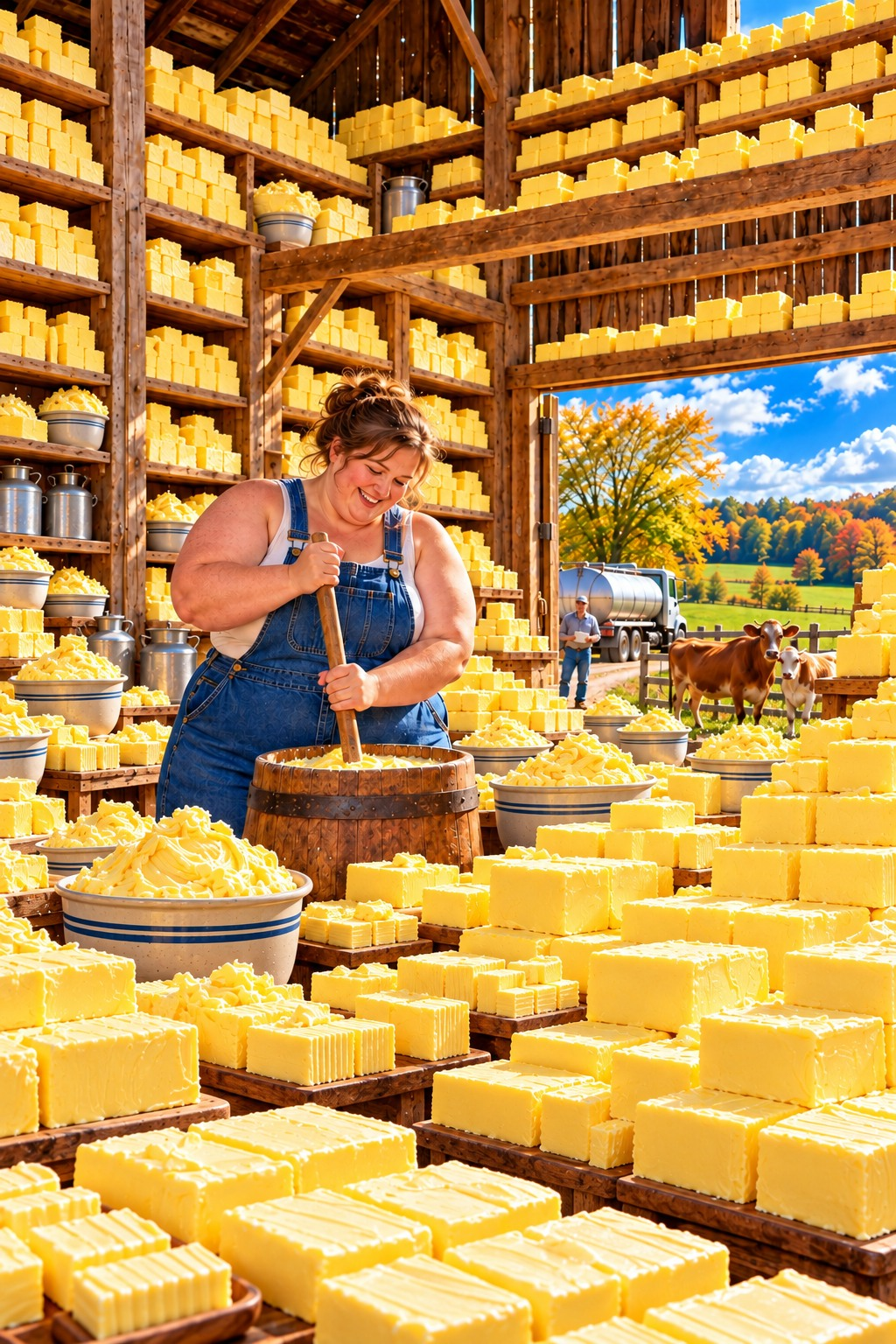
The wooden churn stood beside the shelves.
Rows of golden butter filled the cooling area.
I could still smell the cream.
I took the old agreement from my folder and read it again.
My grandmother had signed it on September 18, 1953.
There were several handwritten additions.
One of them mentioned a culture sample maintained by the Reinhold family.
Another stated that the cooperative could not claim ownership of independently maintained starter cultures.
I wondered whether Selma had known that the document still existed.
Perhaps she had.
Perhaps she had deliberately left it among her papers.
But why hadn't she mentioned it?
I went to the house and opened the cabinet where I kept her belongings.
There were old photographs, letters, farm receipts, and several small envelopes.
I searched through them.
Nothing.
Then I remembered the wooden box beneath the stairs.
Selma had kept old family documents inside it.
I pulled it into the kitchen and opened the lid.
Inside were tax receipts, veterinary records, property papers, and old photographs.
I searched through everything.
At the bottom, I found a brown envelope.
It was addressed to Selma.
The handwriting belonged to someone I didn't recognize.
The postmark was from Preston.
And the date was October 1953.
I carefully opened it.
Inside was a short letter.
Dear Mrs. Reinhold,
Thank you for your assistance with the cooperative's cultured cream trials. Your observations have been valuable to our committee. We appreciate your willingness to share your experience, although we understand that your family culture remains your private property.
The letter was signed by the cooperative's former chairman.
I sat down.
There was more.
A second page contained several handwritten notes about the program.
One sentence had been underlined.
The Reinhold culture produced the most consistent results among the participating farms.
I read it three times.
My grandmother had never told me.
She had simply continued making butter.
I placed the letter beside the agreement.
Then I looked toward her photograph.
"Why didn't you tell me?"
The photograph offered no answer.
The next morning, I visited Gordon Niskanen.
He was repairing a gate when I arrived.
He noticed the folder under my arm.
"Something wrong?"
"I need to ask you about my grandmother."
He put down his hammer.
"That usually means something interesting."
I showed him the agreement.
He read it carefully.
Then he looked at the old letter.
His expression changed.
"I remember hearing about this."
"You do?"
"Not the paperwork. But your grandmother once mentioned that the cooperative had asked her to help with a butter project."
I stared at him.
"Why didn't she tell me?"
Gordon shrugged.
"Maybe she didn't think it mattered."
He read the letter again.
"She was proud of that culture, you know."
"I know."
"She didn't care much about recognition."
He handed the paper back.
"She cared about making something good."
I folded the letter.
"Richard Hale says the cooperative may have a claim against the cream."
Gordon's expression hardened.
"That's nonsense."
"That's what I thought."
"Do you have the original rejection form?"
"Yes."
"Keep it."
He looked toward the road.
"And don't go to another meeting without someone who understands the paperwork."
I nodded.
"I was thinking about finding a lawyer."
"Good."
He picked up his hammer again.
Then he stopped.
"Marin?"
"Yes?"
"There's something else you should know."
I waited.
"Your grandmother wasn't the only person who worked with that culture in 1953."
I looked at him.
"What do you mean?"
He hesitated.
"There was another farmer. A man named Walter Kruger. He was on the cooperative committee."
"Did he have the culture?"
"I don't know. But he was involved in the trials."
"Is he still alive?"
Gordon shook his head.
"He died years ago."
I thought about that.
"Do you know whether he left any records?"
Gordon considered the question.
"His daughter might."
He gave me her name.
Margaret Kruger.
She lived outside Spring Valley.
I wrote it down.
Then I returned to the farm.
My first call was to a local attorney named Thomas Erickson.
He practiced agricultural and property law in Preston.
I explained the situation without exaggeration.
He listened.
When I finished, he asked me to bring every document I had.
I agreed.
The following afternoon, I sat across from him in a small office above a hardware store.
He examined the rejection form.
Then the financial demand.
Then the 1953 agreement.
He spent nearly twenty minutes reading without speaking.
Finally, he looked at me.
"Who gave you this original?"
"Richard Hale."
"Does he have a copy?"
"He asked me to return the original after making one."
Erickson nodded.
"Don't return it yet."
"Why?"
"Because I want to examine the document and determine exactly what it establishes."
He turned toward the rejection form.
"Did you sign this?"
"Yes."
"Did you receive payment?"
"No."
"Did you sign any other document transferring ownership?"
"No."
"Did the driver tell you that the cream was being removed as a favor?"
"Yes."
He wrote something down.
Then he examined the cooperative's demand.
"Their position appears to be that the cream retained commercial value and should not have been used without their approval."
"But they rejected it."
"That is important. We need to establish what their actual procedures were, what the form meant, and whether they had any ownership interest after collection."
He paused.
"Don't assume the old agreement automatically settles the entire dispute. It may be relevant to the culture, but the ownership of the cream and the ownership of the culture are separate questions."
I appreciated his honesty.
"What should I do?"
"Keep making records. Preserve your correspondence. Don't destroy anything. And don't sign any new document from the cooperative until I've reviewed it."
I nodded.
He placed the old agreement in a protective folder.
"One more thing, Marin."
"Yes?"
"If your product is becoming commercially successful, you need to take the regulatory side seriously. A good recipe won't protect you from a sanitation problem or a labeling violation."
"I understand."
"Good. Then we have two matters to handle. The cooperative dispute and your processing operation."
For the first time, I felt I had someone helping me understand the situation.
Not someone telling me what I couldn't do.
Someone showing me what I needed to do next.
Meanwhile, the orders continued.
Walter Benson called on Thursday.
He wanted another thirty pounds.
Edward Miller wanted his sixty pounds confirmed.
Two families from Lanesboro had asked whether I could prepare smaller holiday packages.
I began working longer hours.
The farm was no longer quiet.
There were telephone calls, delivery schedules, and lists of customers.
The old barn seemed smaller every day.
I needed more shelving.
I needed additional containers.
I needed a better washing arrangement.
And I needed to find a way to process the larger quantities without compromising quality.
Gordon Niskanen helped me measure the unused eastern room.
We discussed installing a separate work area.
He knew a carpenter who might be able to help.
I calculated the costs.
It would be difficult.
But it was possible.
One evening, while we were reviewing measurements, Gordon looked toward the shelves.
"How much butter do you have ready?"
"Forty-six pounds."
"How much is already promised?"
"Thirty-eight."
He whistled.
"You're getting close."
"Close to what?"
"Running out."
I laughed.
"That's a good problem."
"It can become a bad one if you promise more than you can make."
I looked at the production notebook.
"I won't."
He nodded.
"Your grandmother would have said the same thing."
On November 30, I received a letter from the agricultural extension office.
It outlined the steps required to bring my processing area into compliance with the applicable requirements.
There were several inspections to arrange.
There were sanitation improvements to complete.
There were records I needed to maintain.
I read the letter carefully.
Then I made a list.
The first item was improving the water supply.
The second was installing additional washable surfaces.
The third was establishing a separate area for finished product.
The fourth was arranging the appropriate inspection before expanding sales.
I didn't know how much everything would cost.
But I knew I couldn't continue pretending that a successful product was enough.
The business needed proper foundations.
I took my grandmother's savings ledger from the cabinet.
The balance had changed.
I had spent money on equipment, packaging, and improvements.
I wrote down the remaining amount.
Then I calculated what the next several weeks might bring.
If the Christmas orders were completed, I could pay for most of the planned work.
I placed the ledger beside my production notebook.
For the first time, the numbers were moving in the right direction.
On December 3, Edward Miller called from Rochester.
He wanted to increase his order.
"How much more?" I asked.
"Another forty pounds."
I stopped writing.
"Forty?"
"Yes. The first people who tasted it have been asking for more."
I looked toward the shelves.
"Edward, I need to be certain I can produce it properly."
"I understand. I don't want anything rushed."
He explained that he wanted to advertise the butter as a special holiday product.
He also asked whether I could provide a short description of its history.
I thought about Selma.
I thought about the crock.
I thought about the old composition notebook.
I told him I would write something.
After we hung up, I sat at the table.
I began with one sentence.
The Reinhold family cultured butter begins with a living starter maintained by my grandmother since 1953.
I stopped.
Then I continued.
Every batch is prepared slowly, using the same careful observations she taught me.
I didn't mention the creamery.
I didn't mention the rejection.
That wasn't what the customer needed to know.
They needed to know what they were buying.
I finished the description and placed it inside the folder.
Then I returned to the barn.
The following afternoon, Gordon Scogan arrived again.
This time, he wasn't alone.
A woman in a dark blue coat stepped out of his truck.
She introduced herself as Helen Barrett, the cooperative's quality-control supervisor.
I had never met her.
She was in her late forties, with short blond hair and a serious expression.
She carried a small leather case.
"Mrs. Reinhold, I'd like to look at your processing area."
I nodded.
"Do you have identification?"
She showed me her cooperative badge.
"Thank you. What exactly are you inspecting?"
"Your current production arrangements."
"Do you have an appointment?"
Gordon looked irritated.
"Marin, we're trying to make this easier."
I turned toward Helen.
"Is this an official inspection?"
She paused.
"Not a regulatory inspection. The cooperative wants to understand what you're doing."
"Then I can show you the equipment, but I need to know what authority you're acting under."
Helen looked at Gordon.
He didn't answer.
Finally, she closed her case.
"I'm here voluntarily on behalf of the cooperative."
"Then you're welcome to look at the general processing area. My production records and private family documents will remain with me."
She considered that.
"That's reasonable."
I showed her the cooling room.
I showed her the separator.
I showed her the churn and the finished butter.
She examined the shelves.
She asked about temperatures.
She asked about sanitation.
She asked how I maintained the culture.
I answered the questions I could.
When she reached the wooden table, she picked up a finished block.
She examined the label.
Then she looked at me.
"How long have you been making this?"
"Since October."
"Using the culture from your grandmother?"
"Yes."
She turned the package over.
Then she asked something I hadn't expected.
"Have you ever considered selling the starter culture itself?"
I shook my head.
"No."
"Why not?"
"Because it isn't something I want to sell."
She studied me.
"Interesting."
I didn't ask what she meant.
She put the butter down.
Then she turned toward Gordon.
"We should discuss this with Harold."
Gordon looked at her.
"Why?"
Helen glanced toward the shelves.
"Because I don't think he understands what we're dealing with."
That evening, I received a telephone call from Thomas Erickson.
He had reviewed the old agreement.
"Marin, I've found something."
I sat down.
"What?"
"The cooperative's demand refers to the cream as a recoverable commercial asset. But the original agreement distinguishes between ordinary cream collection and independently maintained cultures."
"Does that help?"
"It may. I've also found a reference to the 1953 trial program in an old cooperative record."
I reached for a pen.
"What does it say?"
"Your grandmother's farm was listed as one of the participating producers. More importantly, the record indicates that the cooperative stopped the program in 1956."
I frowned.
"Why?"
"That's what I'm trying to establish."
He paused.
"There's a second reference."
"What?"
"The record mentions a final report prepared by the committee chairman."
"Do you have it?"
"No. But I know where it may be."
"Where?"
"Possibly in the cooperative's archived files."
I felt a knot form in my stomach.
"Would they give it to you?"
"Not necessarily. But we can request it."
I looked toward the photograph of Selma.
"What do you think it contains?"
"I don't know yet."
He lowered his voice.
"But I think the cooperative's current claim may have more to do with that old program than the 412 gallons of cream."
I sat very still.
For weeks, I had believed the cooperative was simply angry because I had turned rejected cream into a product customers wanted.
Now I wondered whether the butter had reminded someone of something they preferred to keep buried.
The next morning, I went to the mailbox.
There were two envelopes.
One was from Walter Benson.
The other was from the cooperative.
I opened Walter's first.
It contained a handwritten order for another twenty pounds.
At the bottom, he had added:
Customers are asking whether you'll have enough for Christmas. They're beginning to reserve it in advance.
I smiled.
Then I opened the cooperative envelope.
Inside was a formal letter signed by Harold Peterson.
It requested that I attend another meeting.
The subject line was different this time.
REVIEW OF HISTORICAL CULTURE AGREEMENT AND REINHOLD FARM PRODUCTION RIGHTS.
I read it twice.
There was a handwritten note at the bottom.
Please bring the original 1953 document.
I put the letter in my folder.
Then I noticed something else.
A second sheet had been included.
It was a photocopy of an old cooperative record.
The paper was badly faded.
Several lines were difficult to read.
But one name was perfectly clear.
SELMA REINHOLD.
Beside it was a handwritten notation dated March 1956.
I leaned closer.
The notation was short.
Only nine words.
Do not distribute this report without board authorization.
And beneath it was the signature of the cooperative's former chairman.
I turned the page over.
There was another handwritten sentence.
This one was in my grandmother's handwriting.
"If they ever claim the culture belongs to them, show them what happened in 1956."
I stopped breathing.
My grandmother had known this day might come.
And suddenly, the old envelope beneath her stairs seemed much more important than I had ever imagined.
Because inside the photocopy was a reference to a second document.
A document the cooperative had never given me.
And according to the final handwritten line, it was still in the possession of the man who had approved the original rejection of my 412 gallons.
Harold Peterson.






Comments 0