I read the sentence again.
We have reason to believe you are using cooperative-owned cream.
For several minutes, I stood in the kitchen without moving.
The cream had been rejected.
The cooperative had sent a truck to remove it.
Curtis had handed me a form with a zero in the payment column.
And now, after I had managed to produce my first block of cultured butter, someone was suggesting that the cream belonged to them.
I placed the letter on the table.
Then I walked to the telephone.
There was only one person I wanted to speak with.
Gordon Niskanen.
Gordon arrived twenty minutes later.
He read the letter twice, then placed it beside the rejection form.
"Who signed this?"
"Harold Peterson."
"The manager?"
I nodded.
Gordon leaned back.
"That's interesting."
"What does it mean?"
"It means somebody at the cooperative is nervous."
"About butter?"
"About something they don't understand."
He looked toward the barn.
"Did they pay you for the cream?"
"No."
"Did they offer to buy it back?"
"No."
"Did Curtis tell you it was being removed as rejected material?"
"Yes."
Gordon tapped the rejection form.
"Then keep every piece of paper."
I looked at him.
"Why?"
"Because people sometimes remember things differently when money becomes involved."
His words stayed with me.
I took a folder from the kitchen cabinet and placed both documents inside.
Then I wrote the date on the front.
October 24, 1987.
It was the first folder I had ever created for my butter business.
At the time, I didn't even have a business.
But I had learned something from my grandmother.
Good records were worth keeping, especially when someone else wanted to rewrite the story.
The next morning, I called Harold Peterson.
He answered after the third ring.
"Cooperative office."
"This is Marin Reinhold."
There was a pause.
"Yes, Marin."
"I received your letter."
"Good. I wanted to make sure it reached you."
"You said the cooperative believes I'm using its cream."
He sighed.
"That's not exactly what I said."
I looked at the letter.
"It is exactly what you wrote."
He was silent.
Then he explained that the cooperative needed to protect its reputation and ensure that rejected material was not being misrepresented as approved commercial product.
I listened.
When he finished, I asked one question.
"Does the cooperative claim ownership of the cream?"
Another pause.
"No. That's not what this is about."
"Then what is it about?"
"We simply want to ensure that you understand the responsibility involved."
"I understand."
"Are you planning to sell the butter?"
"Eventually."
"Then you need to be careful."
"I intend to be."
He sounded frustrated.
"Marin, this isn't personal."
I looked through the kitchen window toward the barn.
"Neither is making butter."
I thanked him for calling.
Then I hung up.
I spent the next several days doing something I had never expected to do.
I began researching the business of butter.
Not the process of making it.
I already understood that.
I needed to understand customers.
I needed to understand packaging, prices, transportation, storage, and the regulations governing dairy products.
I visited the Preston library and asked the librarian for agricultural publications.
She brought me a stack of magazines.
I read articles about small food businesses, specialty products, and direct farm sales.
Most of the examples came from larger operations.
Some came from farms in Wisconsin.
A few described small producers who sold cheese, preserves, and baked goods directly to customers.
I copied the names of several organizations.
Then I made a list of questions.
The first was simple.
Would anyone pay more for cultured butter?
The second was harder.
How much more?
My first attempt at pricing came from a conversation with Evelyn Niskanen.
She was sitting at my kitchen table when I placed a small block of butter in front of her.
It weighed one pound.
The wrapping was plain parchment paper.
I had written the date on a small label.
Evelyn examined it.
"How much would you charge?"
"I haven't decided."
"How much does ordinary butter cost?"
I told her.
She nodded.
"And yours?"
"I don't know."
She cut a small piece and tasted it.
Her eyes changed.
Not dramatically.
Just enough.
"Marin, this tastes like Selma's."
I sat down.
"That's what I was hoping."
She spread a little on a piece of bread.
Then she tasted it again.
"You can't charge ordinary butter prices for this."
"Why not?"
"Because it isn't ordinary."
I smiled.
"That's what my grandmother used to say."
Evelyn put the bread down.
"Then listen to her."
By the end of October, I had produced several small batches.
Each one was consistent.
The culture remained healthy.
The flavor was developing exactly as Selma had described.
I continued recording every measurement.
I also began making small improvements to the processing area.
Gordon Niskanen helped me install additional shelves.
We repaired a section of the floor.
I purchased new containers and cleaned the equipment thoroughly.
I separated the processing space from the area where ordinary farm work took place.
The changes were modest.
But they made the room feel different.
It no longer looked like a corner of an old dairy barn.
It looked like a place where something valuable was being made.
One afternoon, while Gordon was fastening a shelf, he noticed the growing collection of butter molds.
"How many have you made?"
"Forty-three."
"Forty-three pounds?"
I nodded.
He looked toward the table.
"That's more butter than most families use in a year."
"I know."
"Have you sold any?"
"Not yet."
He lowered his hammer.
"Then you'd better find somebody who wants it."
I looked at the rows of finished butter.
That was the problem.
Making it had never been the difficult part.
Finding people willing to pay for it would be another matter entirely.
On November 2, I took four blocks into Preston.
I visited a small grocery store owned by a man named Walter Benson.
Walter had known my grandmother.
He had purchased her butter occasionally during the 1960s, before she stopped selling regularly.
When I entered, he was arranging canned vegetables.
"Marin Reinhold."
"Hello, Walter."
He smiled.
"How's that old farm?"
"Still standing."
"Good. Your grandmother would have approved."
I placed one block of butter on the counter.
He looked at it.
"What's this?"
"Something I'd like you to try."
He removed the wrapping.
Then he cut a small piece.
He tasted it.
His expression changed.
He cut another piece.
"Where did you get this?"
"I made it."
He looked at me.
"You made this?"
"Yes."
"With your grandmother's recipe?"
"Her culture. Her method. My work."
Walter examined the butter again.
Then he leaned against the counter.
"How much can you make?"
"That's what I'm trying to find out."
He laughed.
"That's not an answer."
"It's an honest one."
He tasted another piece.
Then he asked how much I intended to charge.
I gave him the number I had been considering.
He frowned.
"That's expensive."
"I know."
"People around here buy ordinary butter."
"I know that too."
He looked at the block.
Then he wrapped it again.
"Leave this with me."
I hesitated.
"To sell?"
"To taste. To think. Maybe to show my wife."
I smiled.
"All right."
He placed it behind the counter.
I left the other three blocks in my basket.
It wasn't a sale.
But it was the first time someone outside my family had considered the possibility of selling my butter.
Two days later, Walter called.
He wanted me to bring another six pounds.
His wife had tasted the butter.
So had two employees.
One customer had asked whether it was available for purchase.
Walter wanted to try a small display near the specialty cheese section.
I nearly dropped the telephone.
"How much do you want?"
"Six pounds to start."
"Six?"
"That's what I said."
I wrote the quantity in my notebook.
Then I asked about the price.
We negotiated for several minutes.
He wanted a lower wholesale cost.
I wanted enough to cover the ingredients, packaging, and labor.
Eventually, we agreed on a small introductory order.
I wrote the amount down.
It wasn't a fortune.
It wasn't even enough to change the farm's financial situation.
But it was the first money anyone had offered me for the butter.
When I hung up, I stood in the kitchen and looked at my grandmother's photograph.
"Six pounds," I whispered.
I could almost hear her response.
Then make six good pounds.
The following Saturday, I delivered the order.
Walter had cleared a small space in his refrigerator.
He placed the butter in a neat row.
I watched him attach the price labels.
For the first time, my grandmother's recipe was sitting on a commercial shelf.
The packaging was plain.
There was no fancy logo.
No advertising.
Just the name I had chosen:
REINHOLD FARM CULTURED BUTTER
Underneath, I had added a smaller line.
Made using a family culture maintained since 1953.
Walter looked at the label.
"That's a nice touch."
"Thank you."
He placed the final package in the display.
I stood there for several seconds.
Then I returned to the farm.
I received my first call that evening.
It was Walter.
He sounded amused.
"Marin?"
"Yes?"
"I've got a question."
"What's wrong?"
"Nothing's wrong."
He paused.
"Do you have any more butter?"
I looked toward the kitchen table.
There were twelve finished blocks waiting to be wrapped.
"Why?"
"Because six pounds disappeared."
I stared at the telephone.
"All of it?"
"Every pound."
I sat down.
Walter laughed.
"One woman bought two pounds. Another bought one. A man came back after lunch and bought the rest."
I couldn't think of anything to say.
"Can you bring more on Monday?"
"How much?"
"Let's start with twelve pounds."
I wrote it down.
Twelve.
Then I wrote the date.
November 7, 1987.
When I finished, I looked at the first order in my notebook.
Six pounds.
Now twelve.
It was happening.
Not quickly.
Not dramatically.
But it was happening.
The next Monday, I delivered twelve pounds.
By Wednesday, Walter had called again.
He wanted another twenty.
I began working longer hours.
The churn became part of my daily routine.
I woke early, checked the culture, prepared the cream, and worked through each batch carefully.
The old separator ran steadily.
The wooden churn moved beneath my hands.
The butter was shaped, washed, worked, weighed, wrapped, and labeled.
Every block was checked.
Every order was recorded.
I did not cut corners.
I could not afford to.
My grandmother had spent thirty-six years building the quality I was now selling.
I wasn't going to damage it by becoming impatient.
Then, on November 12, Gordon Scogan arrived.
He stepped into the barn carrying his clipboard.
He looked toward the shelves.
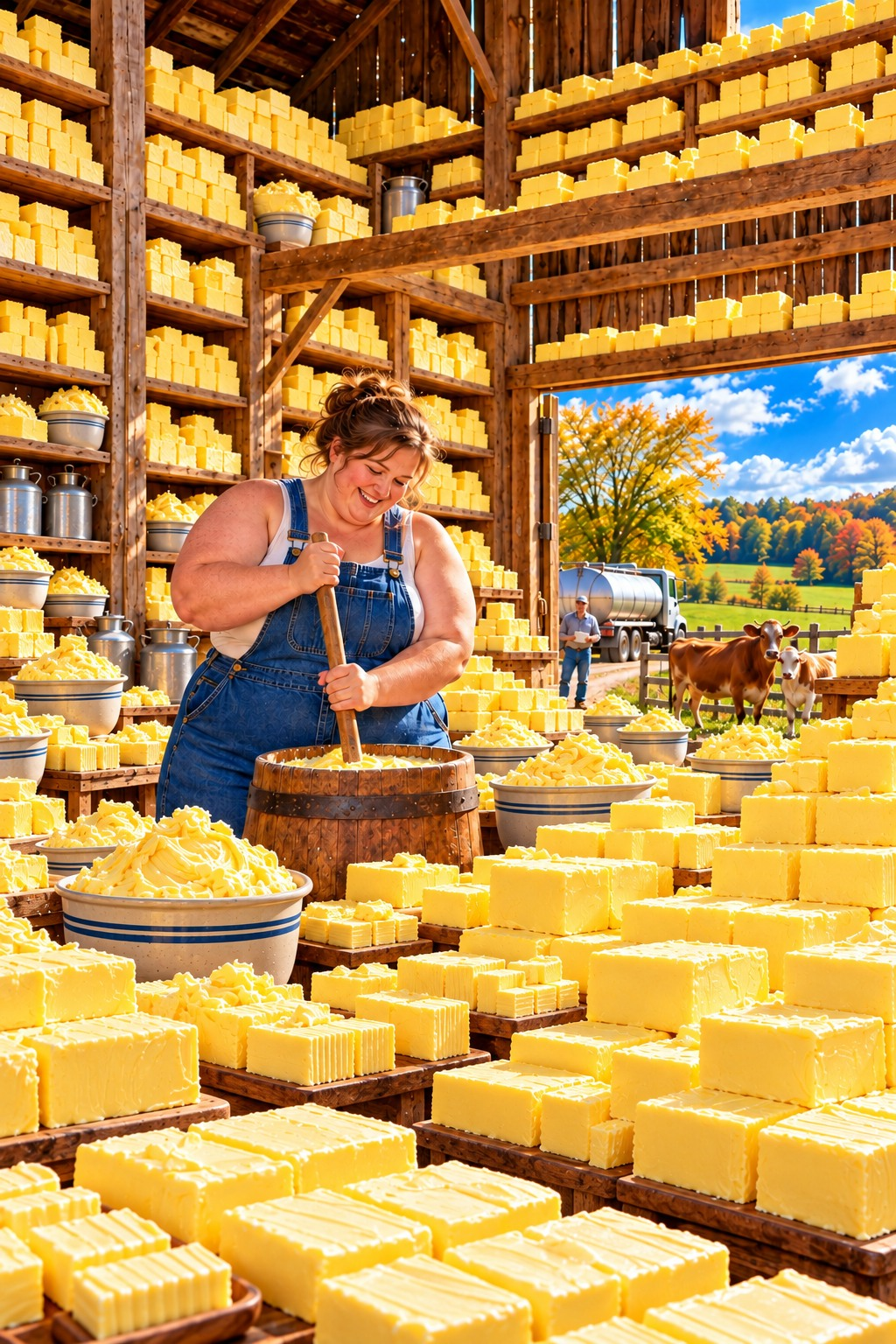
There were now dozens of butter blocks arranged in orderly rows.
He stopped.
"What is all this?"
I continued wrapping a block.
"Butter."
"I can see that."
"Then you know what it is."
He approached the table.
He picked up one package.
His eyes moved across the label.
"You're selling this?"
"Yes."
"To whom?"
"Local customers."
He looked toward the shelves again.
"How much have you sold?"
I gave him an honest answer.
He wrote something on his clipboard.
Then he looked at me.
"Marin, I need you to understand something."
I waited.
"The cooperative is aware of your activity."
"I assumed they would be."
"They have concerns about the origin of your product."
"The cream came from my farm."
"That cream was rejected under cooperative standards."
"Exactly."
He closed the clipboard.
"You're making a mistake if you think this is going to continue without consequences."
I placed the wrapped butter on the shelf.
Then I looked at him.
"Are you here to inspect my butter or threaten me?"
He stiffened.
"I'm here because I don't want you to get into trouble."
"Then tell me what I need to do to comply with the rules."
He didn't answer immediately.
Instead, he looked toward the cooling room.
"Harold Peterson wants to speak with you."
"About what?"
Gordon glanced at the butter.
"Your growing business."
I removed my apron.
"Then he can call me."
Gordon turned toward the door.
But before he left, he looked back at the shelves.
"You're moving faster than anyone expected."
I watched him go.
Then I returned to my work.
That evening, I found another envelope in the mailbox.
This one contained a request for a formal meeting at the cooperative office.
Harold Peterson had signed it personally.
The meeting was scheduled for the following Monday.
I placed the letter in my folder beside the rejection form.
Then I opened my grandmother's composition notebook.
On the final page of her original notes, there was a sentence I had never paid much attention to.
When people begin asking why your work is different, never forget how you made it.
I read it slowly.
Then I closed the notebook.
I had no idea what Harold intended to say.
But I knew one thing.
I would walk into that meeting with my records, my production notes, and the original rejection paperwork.
They had called the cream worthless.
Now they wanted to know how much butter it had become.
And on Monday morning, I was going to find out why.
The cooperative manager had already prepared a document bearing my name.






Comments 0