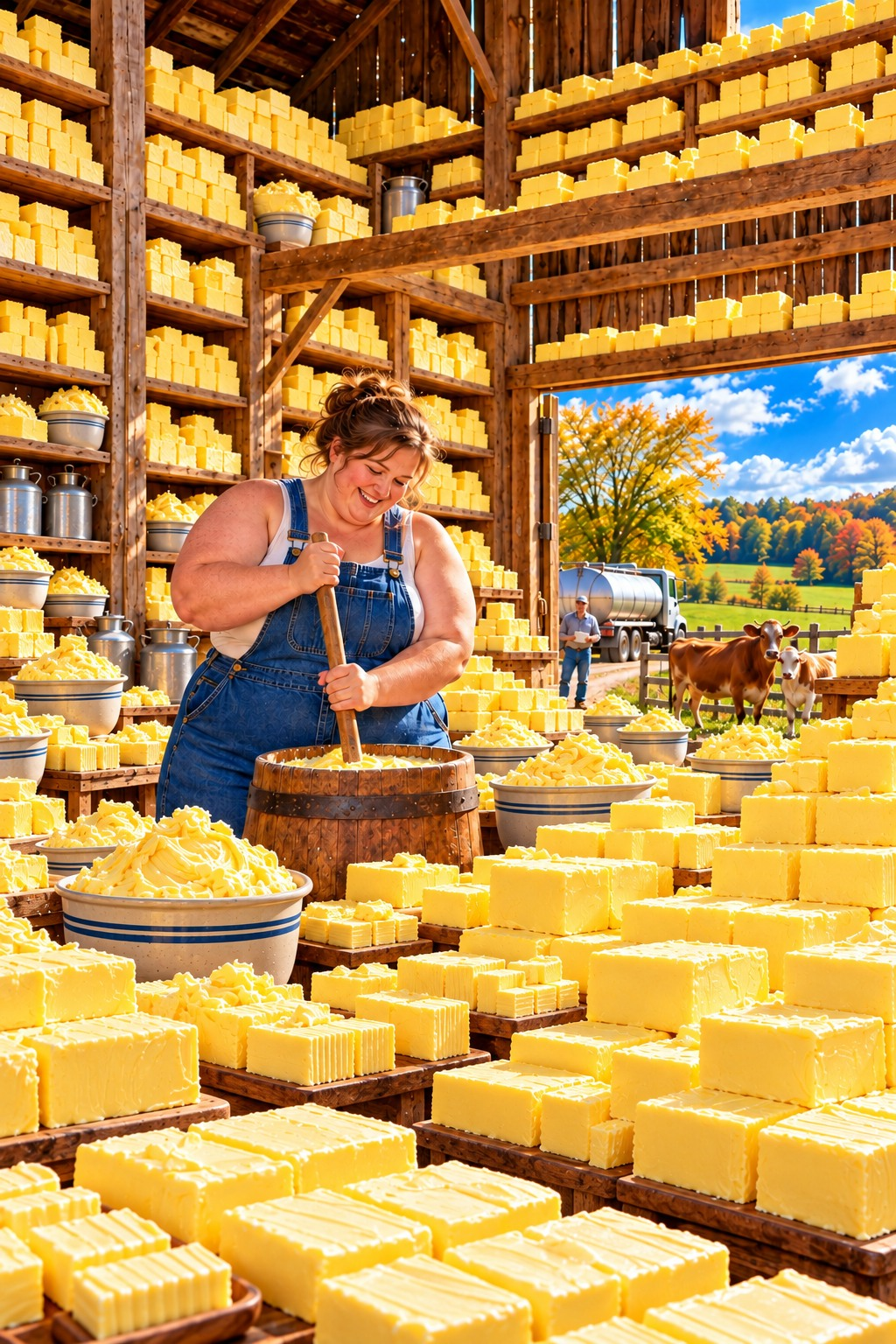
The creamery manager did not knock.
He stood in the doorway with a brown envelope tucked beneath his arm, looking past me toward the cooling room.
"Marin Reinhold?"
"Yes."
"My name is Harold Peterson. I'm the general manager at the cooperative."
I wiped my hands on my apron.
"I know who you are."
He glanced toward the cream tanks.
"I understand Curtis picked up the rejected shipment."
"He did."
"And Gordon tells me you've been experimenting with the remaining cream."
I looked at him.
"Gordon talks a lot."
Harold didn't smile.
"May I come in?"
I stepped aside.
He entered the barn carefully, avoiding a small puddle near the wooden worktable.
He was in his early sixties, with thinning gray hair, a dark brown overcoat, and polished shoes that seemed entirely unsuitable for a dairy barn.
He looked around.
His eyes settled on the old separator.
"That's quite an old machine."
"My grandmother bought it in 1948."
"Still using it?"
"Every week."
He nodded, though his expression suggested he considered that an unfortunate admission.
Then he opened the envelope.
"I wanted to discuss the rejected cream."
"There isn't much to discuss. You rejected it."
"That's correct. But I want to make sure you understand the cooperative's position."
I waited.
He placed a document on the table.
"The cream cannot enter our commercial supply chain. It doesn't meet our intake requirements, and we cannot accept responsibility for any product manufactured from material we've rejected."
"I haven't asked you to."
"Good. I wanted that understood."
He studied my face.
Then he noticed the composition notebook.
"What's that?"
"My grandmother's notes."
He picked it up without asking.
I watched him turn several pages.
There were temperature records, feeding intervals, and handwritten descriptions of the culture at different stages.
He looked puzzled.
"What's all this?"
"How to make cultured butter."
He closed the notebook.
"From that cream?"
"That's the plan."
Harold looked toward the cooling room again.
"Marin, I don't want to see you lose money chasing something that isn't commercially viable."
I thought about the zero on the rejection form.
Then I thought about the $4,230 in my grandmother's savings account.
"I'll take responsibility for my own work."
He placed the notebook down.
"Just remember that the cooperative has standards."
"So does my grandmother."
For several seconds, neither of us spoke.
Finally, Harold picked up his envelope.
"I hope you know what you're doing."
"So do I."
He left without another word.
I watched his sedan disappear down County Road 14.
Then I returned to the cooling room.
The thermometer still read 61 degrees.
The culture was still developing.
And I had no intention of stopping.
My grandmother's crock had always fascinated me.
It wasn't particularly beautiful.
It was an ordinary covered stoneware container with a small chip near the rim.
Selma had owned it for as long as I could remember.
She kept it on the second shelf of the root cellar, away from direct sunlight and away from the strongest temperature changes.
She never let anyone handle it carelessly.
When I was nine, I once tried to move it without asking.
She caught me before I had lifted it from the shelf.
"Where are you going with that?"
"I wanted to see inside."
"You can see inside when you're ready."
"When will that be?"
"When you understand that keeping something alive is different from owning it."
I hadn't understood.
I understood now.
The culture had survived because someone had cared for it every four days for decades.
It wasn't magic.
It was work.
It was attention.
It was the kind of work that rarely appeared on a balance sheet.
Selma had never charged anyone for teaching her methods.
She had never written a book.
She had never tried to patent anything.
She simply made excellent butter and shared it with people who appreciated it.
I sometimes wondered whether she had understood that her knowledge was worth more than the farm itself.
Perhaps she had.
Perhaps she had simply never needed anyone else to recognize it.
On the fourth morning, I noticed the smell had changed.
Not dramatically.
Just enough.
I opened the cooling room door and stood quietly for a moment.
The air carried a clean, rich acidity.
I checked the thermometer.
Sixty-one degrees.
I removed the cover and examined the surface.
It looked exactly as Selma's notebook described.
I took another sample.
The texture had become more uniform.
I tasted a tiny amount.
The flavor was sharp but pleasant.
I returned to the notebook.
There were three lines written in the margin.
Do not confuse strength with spoilage.
Do not rush the culture.
When it is ready, it will tell you.
I ran my finger beneath the last sentence.
Then I laughed softly.
My grandmother had written those words thirty years earlier.
They sounded like advice for something much larger than cream.
The first person to notice my work was my neighbor, Gordon Niskanen.
He was sixty-six and had lived on the next ridge for nearly forty years.
He had helped my grandfather repair fences, replace a water pump, and move equipment during the spring floods.
He had also attended my grandmother's funeral.
Unlike Gordon Scogan from the cooperative, Gordon Niskanen never carried a clipboard.
He carried a pocketknife.
He arrived one afternoon with a sack of apples and stopped beside the barn.
"Smells different in here."
I looked up from the cooling vessel.
"Does it?"
He sniffed again.
"Something's cooking."
"Not exactly."
He stepped closer.
I explained what I was attempting.
He listened without interrupting.
When I finished, he looked toward the old crock.
"Selma's culture?"
I nodded.
He rubbed his chin.
"She kept that thing alive longer than some people keep marriages."
I laughed.
"She'd have liked hearing that."
"She'd have told me to stop talking and wash my hands."
He looked toward the cream.
"How much did they leave you?"
"Four hundred twelve gallons."
His eyebrows rose.
"That's a lot of cream."
"Three hundred twenty-two gallons are usable."
"And the rest?"
"Too bitter. I separated it."
He nodded.
"Good."
I looked at him.
"You don't think I'm being foolish?"
He shrugged.
"I think you're doing something nobody else is doing. That isn't the same as being foolish."
He placed the apples on the table.
Then he noticed the rejection form tucked into my apron.
He read the zero.
His expression hardened.
"That's how they paid you?"
"That's how they paid me."
He folded the paper back along its original crease.
"Your grandmother would have hated that."
"She wouldn't have argued."
"No," he said. "She would have made something better."
The next two days were the longest of my life.
The cream continued to develop.
I monitored the temperature constantly.
I recorded every change.
I washed equipment between each inspection.
I checked the culture in the crock and fed it according to Selma's instructions.
The work was repetitive, but I didn't mind.
Repetition was familiar.
Uncertainty was not.
At night, I sometimes woke and wondered whether the culture had changed while I slept.
On one occasion, I went downstairs at two in the morning simply to check the thermometer.
It still read 61 degrees.
I stood in the doorway, listening to the quiet hum of the cooling equipment.
Then I noticed something.
The smell had become fuller.
More developed.
I took a sample.
The acidity was right.
The fat remained intact.
I checked the notebook.
I checked it again.
The results were encouraging.
I wrote a note.
Day six. Culture progressing cleanly.
Then I added something Selma had never written.
This is the largest batch I've ever attempted.
On the seventh day, I called the local agricultural extension office.
I didn't ask for permission.
I asked about the requirements for selling cultured butter directly to customers.
The woman who answered transferred me twice.
Eventually, I spoke with a man named Peter Larson.
He explained that there were regulations concerning dairy processing, sanitation, labeling, inspections, and approved facilities.
I wrote everything down.
Some of it was discouraging.
Some of it was manageable.
I asked whether a small farm could legally sell its own cultured butter if it met the applicable requirements.
He said it depended on the production process and the facility.
I thanked him.
Then I spent the afternoon reviewing the list.
The farm would need work.
There was no way around that.
But the equipment I already owned was a beginning.
I could improve the washing area.
I could install additional shelving.
I could separate the processing space from the ordinary barn work.
I could purchase better containers.
What I could not afford was a complete modern dairy facility.
That evening, I opened my grandmother's savings account ledger.
The balance was $4,230.
I wrote the number at the top of a clean page.
Then I began calculating.
For the first time, I wasn't calculating how long I could keep the farm alive.
I was calculating what it would cost to give it a future.
The following morning, a letter arrived from the cooperative.
It was addressed to me personally.
The letter explained that the rejected cream had been removed from the cooperative's responsibility and that any subsequent processing or sale would be entirely my responsibility.
I read it twice.
Then I placed it beside the rejection form.
Two documents.
One said they would pay me nothing.
The other made certain they would not be responsible for anything I produced.
I found myself smiling faintly.
They had given me exactly what I needed.
Freedom from their expectations.
On the ninth day, I opened the cooling room and examined the cream.
The surface had reached the stage I had been waiting for.
I took a sample.
The aroma was clean and developed.
The texture was rich.
I tasted it.
Then I stood completely still.
It was right.
Not finished.
Not yet.
But right.
I reached for the notebook.
Selma's instructions for the next stage were written across two pages.
The cream needed to be churned carefully.
The temperature would matter.
The washing process would matter.
The working of the butter would determine its final texture and keeping quality.
There was no room for impatience.
I looked toward the old wooden churn.
It had belonged to my grandmother too.
The wood was dark from decades of use.
The metal bands had been replaced once.
I ran my hand along its rim.
"Well," I whispered.
"Here we go."
I began preparing the equipment.
I didn't know how much butter the batch would produce.
I didn't know whether I could sell it.
I didn't know whether anyone would believe it came from cream the cooperative had rejected.
But I knew the culture was ready for the next stage.
And that was enough.
Just before noon, Gordon Niskanen returned.
This time, he brought his wife, Evelyn.
She stood near the doorway holding a small basket.
"I heard you've been making something special," she said.
I smiled.
"Not yet. I'm still working."
She looked toward the churn.
"Your grandmother used to give us butter every Christmas."
"I remember."
"She always said yours would be better than hers someday."
I stopped moving.
"She said that?"
Evelyn nodded.
"She did."
I looked down at my hands.
For a moment, I couldn't speak.
Then I returned to the work.
Gordon watched me prepare the first portion.
He noticed how carefully I checked the temperature.
"Your grandmother taught you all this?"
"Every bit of it."
He nodded.
"Then I suppose we're about to find out whether she was right."
I poured the cultured cream into the wooden churn.
The lid settled into place.
I positioned the handle.
Then I began.
The first movement was slow.
The second was easier.
The churn made a familiar wooden sound.
I had heard it as a child.
I had heard it when Selma worked alone.
Now I heard it beneath my own hands.
For several minutes, nothing seemed to happen.
Then the sound changed.
I stopped.
Gordon looked at me.
"What?"
I opened the lid.
Inside, the cream had begun to separate.
Small golden granules were forming.
Butter.
Real cultured butter.
I stared at it.
Evelyn stepped closer.
"Oh, Marin."
I didn't answer.
I was afraid that if I spoke, I might begin crying.
I took the wooden paddle and examined the texture.
The grains were forming properly.
The process was working.
I looked at the old notebook.
Then at the churn.
Then at the first golden pieces collecting in the cream.
My grandmother had been right.
And I had proof.
I continued working until the first batch was ready for washing and shaping.
The butter was rich and golden.
It had the aroma I remembered from Selma's kitchen.
I pressed it carefully into a small wooden mold.
Then I turned it onto the worktable.
The first block was imperfect.
One corner was slightly uneven.
The surface needed more finishing.
But it held together.
I placed it on a clean wooden board.
Gordon leaned forward.
"That's butter?"
I nodded.
He examined it.
"From the cream they threw away?"
"From the cream they rejected."
He shook his head slowly.
Evelyn touched the edge of the mold.
"Your grandmother would have been proud."
I looked at the first block.
Then I looked toward the hundreds of gallons waiting in the cooling room.
One small block had become something more than food.
It was evidence.
Evidence that the cooperative's decision had not been the final word.
But there was still one problem.
I had produced the first batch.
I had no idea how many customers would want it.
And when I went to the kitchen that evening, I found an envelope pushed beneath the front door.
It carried the cooperative's return address.
Inside was a formal notice.
The manager wanted to inspect my processing arrangements before I attempted to sell any of the butter.
But beneath his signature was a handwritten sentence.
We have reason to believe you are using cooperative-owned cream.
I read it once.
Then again.
And suddenly, I understood that someone had begun asking questions about my 322 gallons.
The cooperative wasn't finished with me.






Comments 0