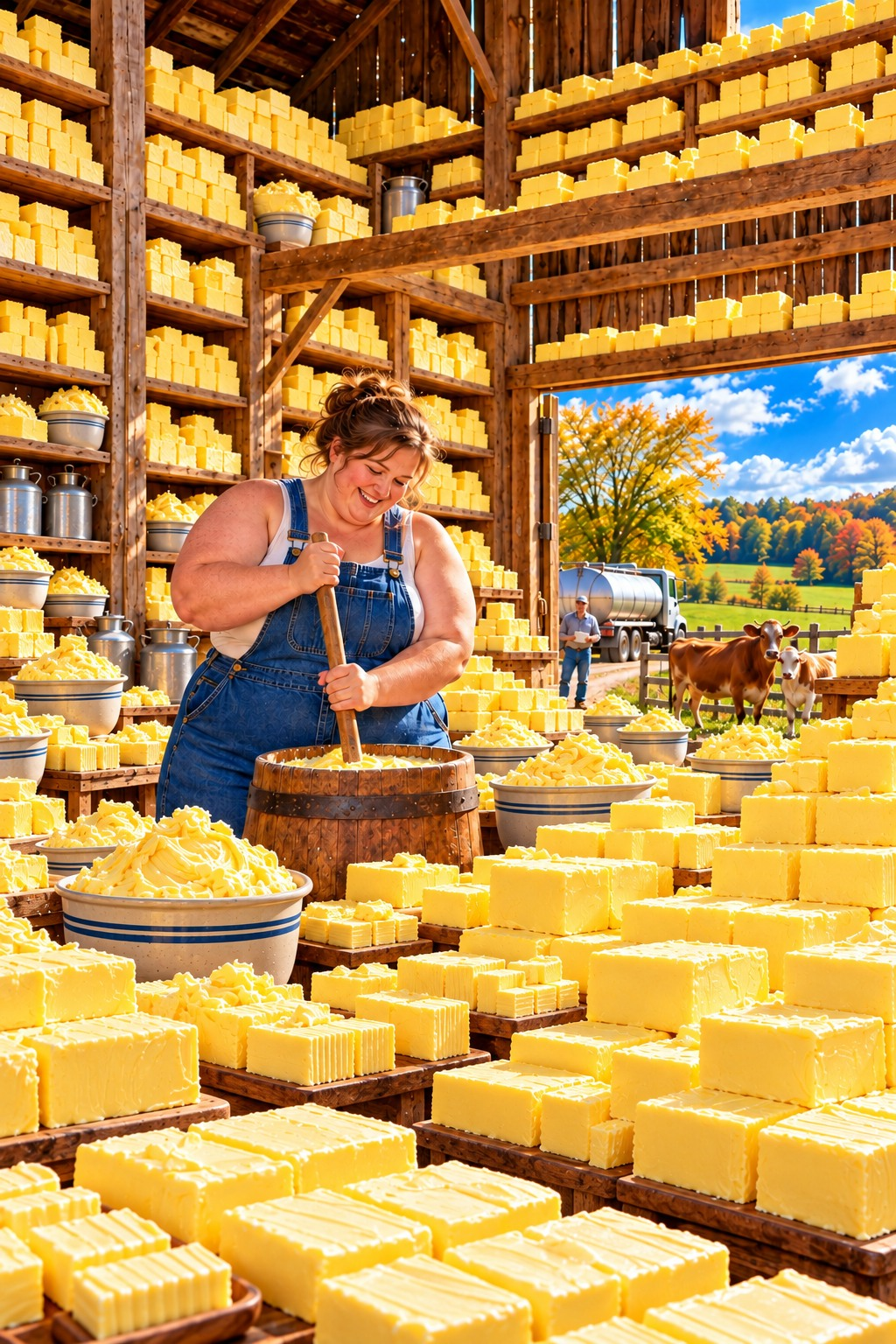
"Four hundred twelve gallons. Not one dollar, Marin. We're taking it away for free."
Curtis Vold held out the rejection form while I stood beside the cream tanks.
The payment column contained a single number.
Zero.
He had already turned toward his truck when he noticed the old composition notebook lying beside my grandmother's separator.
He picked it up.
On the first page, someone had written six words in faded blue ink.
Cream is not a commodity.
Curtis looked at me.
For the first time that morning, he stopped smiling.
I took the notebook from his hands.
He had no idea what those words meant.
And neither did the people who had sent him there.
My name is Marin Reinhold.
In October 1987, I was thirty-one years old, unmarried, and responsible for a small dairy farm outside Preston, Minnesota.
The farm had belonged to my family for decades.
It wasn't impressive by the standards of the larger operations in Fillmore County. We didn't have a modern milking parlor, a refrigerated bulk tank, or a fleet of shiny agricultural equipment. We had two Jersey cows, a young Guernsey calf, an aging cream separator, and a wooden barn that complained whenever the wind came hard across the ridge.
But everything we owned had a purpose.
The separator had belonged to my grandmother, Selma. She had purchased it new in 1948, when she was younger than I was now. She maintained it with an almost unreasonable level of attention.
Every bearing was cleaned.
Every fitting was inspected.
Every moving part received exactly the amount of oil she believed it needed.
When I was little, I used to watch her take the machine apart and put it back together.
She never rushed.
"Machines remember how you treat them," she once told me.
I had laughed.
She hadn't.
My grandmother had been like that. She rarely wasted words, and she never repeated a lesson unless she believed the first attempt had failed.
She had taught me how to milk cows, how to recognize healthy cream, how to make butter, and how to keep a bacterial starter culture alive through seasons when the weather seemed determined to kill everything in the cellar.
Most importantly, she had taught me to pay attention.
Not to what people said something was worth.
To what it could become.
That lesson was about to become the most important thing I had ever learned.
But first, I had to survive the humiliation of that October morning.
The truck arrived shortly after nine.
I recognized the engine before I saw it.
Curtis Vold had been driving the Fillmore County Cooperative Creamery collection route for eleven years. His truck was a white tanker with the cooperative's name painted in blue lettering on the side.
He knew every farm on his route.
He knew which farmers paid their bills early, which ones argued about grading standards, and which ones had begun selling cattle because they could no longer afford to feed them.
He also knew my farm.
He had visited often enough to recognize the barn's crooked north door.
When he climbed down from the cab, he was carrying a clipboard.
That was never a good sign.
"Morning, Marin."
"Morning, Curtis."
He looked toward the three cream tanks.
"That's the whole shipment?"
"That's what you asked me to hold."
He checked his paperwork.
I watched him compare the numbers.
Then he gave a small sigh.
"Well, we've got a problem."
I didn't answer immediately.
He stepped closer and lowered his voice, adopting the professional tone he used when delivering bad news.
"The cream has turned."
"I know."
"Not acceptable for intake."
"I understand."
He glanced at me.
"You understand what that means?"
I nodded.
The cream had soured beyond the cooperative's grading standard. It would not be accepted as ordinary commercial cream, and the cooperative would not issue payment.
The truck had been sent to remove it.
Curtis turned the clipboard around.
"Sign here."
I looked at the form.
The quantity was listed as 412 gallons.
The payment figure was zero.
There was a small printed explanation underneath.
Rejected product removed at producer's request.
I read it twice.
Then I looked at Curtis.
"At my request?"
He shrugged.
"That's the form we use."
"But I didn't request that the cream be rejected."
He gave me a tired smile.
"Marin, you know how this works. The cream has to meet the standard. It doesn't. We're not going to pay for it."
"I didn't ask you to."
He seemed surprised by that answer.
I picked up the pen.
He watched me sign.
"Honestly, you're lucky we're taking it away without charging you for disposal."
I put the pen down.
"Thank you for making the trip."
Curtis smiled as if he had won an argument.
He hadn't.
He simply didn't know there had been another argument available.
The creamery had been telling me my farm was failing for two years.
The fieldman, Gordon Scogan, had made that assessment his personal mission.
Gordon was a neatly dressed man with a clipboard, a county extension certificate from 1979, and a white half-ton truck carrying the cooperative's logo.
He was not cruel.
That would have been easier to understand.
He genuinely believed that modern dairy farming required larger herds, improved cooling systems, better equipment, and enough production to justify the expense.
By those measurements, my farm was in trouble.
Two Jersey cows could not compete with a neighboring operation that milked forty animals.
My grandmother's separator could not match the speed of modern equipment.
And my lack of a bulk tank made my operation look outdated before Gordon had even stepped inside the barn.
He had explained all of this to me several times.
"Three cows aren't a business, Marin," he had said during one visit. "They're a hobby with expenses."
I remembered standing beside the separator while he inspected the equipment.
"These cows pay their way."
"Not according to the numbers."
"Your numbers?"
"Our cooperative's numbers."
He had tapped his clipboard.
"You're going to have to make a decision eventually. Upgrade or get out."
I had asked him what he believed my grandmother would have done.
He had looked uncomfortable.
"I can't speak for your grandmother."
"Neither can your clipboard."
He hadn't appreciated that.
But Gordon wasn't entirely wrong.
My farm was small.
My income was inconsistent.
Feed prices were rising, and the money from the previous year had barely covered repairs, veterinary expenses, and the taxes.
I had inherited the property after Selma died in March 1985.
Along with the farm, she had left me $4,230 in savings.
That was not enough money to modernize a dairy operation.
It was barely enough to keep an old one breathing.
The cooperative had a different idea of what survival looked like.
My grandmother had taught me another.
After Curtis finished unloading the rejected cream, I watched his truck pull away.
The engine faded beyond the pasture.
I remained beside the holding vessel.
Four hundred twelve gallons.
I repeated the number silently.
It sounded enormous.
It was enormous.
And according to the cooperative, it was worthless.
I pulled the folded rejection form from my apron and examined it again.
For a moment, I felt the weight of everything that had happened since Selma died.
The quiet house.
The empty chair beside the kitchen window.
The root cellar that still smelled faintly of apples and cold earth.
The small crock on the second shelf.
I hadn't touched the culture that morning.
Not yet.
I had been too busy dealing with the creamery's delivery.
Now I walked toward the cellar door.
The stairs creaked beneath my boots.
At the bottom, I reached for the shelf.
The crock was exactly where my grandmother had left it.
It was small, covered, and unremarkable.
Someone unfamiliar with its contents might have mistaken it for an old container of sour cream.
But inside was something Selma had maintained since 1953.
A living bacterial starter culture.
She had fed it every four days with fresh cream from the morning separator run.
She had protected it through freezing winters and humid summers.
She had adjusted its care when the cellar warmed.
She had adjusted it again when the temperature dropped.
And she had written everything down.
I lifted the crock carefully.
For a moment, I remembered her hands guiding mine when I was nine years old.
"Don't fight the cream," she had said.
I could still hear her voice.
"Listen to it."
Selma had come to the Ridge Farm in 1951.
She was twenty-two years old when she married my grandfather, Arvid Reinhold.
He understood cattle.
He understood pasture.
He understood machinery.
But cream was another matter.
My grandmother had grown up in Lanesboro, where her mother made butter and soft cheese from a small Jersey herd.
She had learned the work before she was old enough to understand that other people considered it work.
To her, it was simply part of life.
When she arrived at the farm, she brought that knowledge with her.
She spent thirty-six years developing her methods.
She never called herself a scientist.
She didn't use impressive words.
She used a crock, a thermometer, a clean spoon, and an extraordinary memory.
She also used patience.
Her culture produced crème fraîche and cultured butter with a flavor that I had never found anywhere else.
It was rich without being heavy.
Tangy without tasting spoiled.
The butter held together beautifully and had a color that reminded me of late summer sunlight.
My grandmother had shown me how to make it when I was nine.
She showed me again at fourteen.
When I was twenty-six, she made me repeat every step while she watched from a chair.
Her hands had started shaking by then.
She could still recognize the correct smell from across the room.
"Remember this," she told me.
I nodded.
"Not the temperature alone. Not the clock alone. You must understand what is happening."
She pointed toward the cream.
"Something living is working here."
I watched the surface.
"What if it goes wrong?"
"Then you learn why."
"What if it doesn't?"
She smiled faintly.
"Then you have butter."
I carried the crock back upstairs.
The rejected cream was still waiting.
I had not yet decided what to do with it.
I knew that souring could mean different things.
Some cream developed a clean lactic acidity that could be useful for cultured products.
Other cream developed bitterness or undesirable flavors that no amount of patience could repair.
My grandmother had been extremely particular about the distinction.
She used the word forward for cream that had developed in the right direction.
It was a strange word to anyone unfamiliar with her vocabulary.
But I understood it.
I set the crock on the wooden table.
Then I retrieved three clean sampling containers.
I would not risk the culture until I knew what I was working with.
The first sample came from the largest tank.
I brought it to my nose.
The smell was sharp, but clean.
I tasted a tiny amount.
The acidity was present, yet the fat remained rich.
I wrote a note in my composition book.
Tank One: clean souring. Forward.
The second sample was similar.
The third was different.
A faint bitterness lingered after the first taste.
I tried another small sample.
The bitterness remained.
My grandmother had warned me about that.
Not every rejected batch could be rescued.
I looked toward the hog pen outside the barn.
The third portion would go there.
Approximately ninety gallons.
I felt a little sick at the thought of losing so much cream, but I knew better than to gamble with the entire batch.
The remaining quantity was approximately 322 gallons.
I returned to the two acceptable samples.
I checked their texture again.
Then I checked the temperature of the cooling room.
The thermometer read 61 degrees Fahrenheit.
I opened Selma's notebook.
I knew the page I needed.
It took only a few seconds to find it.
There, in her careful handwriting, was the instruction.
For a long culture, maintain 61 degrees. Do not hurry it.
I read the line twice.
Then I looked toward the cream.
The cooperative had already decided what it was.
I was about to find out what it could become.
I began separating the questionable cream from the rest.
The work was slow.
I used the old equipment because it was what I had, and because I trusted it.
The separator had been cleaned that morning.
The containers were ready.
The starter culture remained covered until the moment I needed it.
I worked methodically.
Every movement had a purpose.
By the time I finished, the third portion had been removed and the remaining cream had been prepared.
I opened the crock.
The culture smelled familiar.
A clean, pleasant acidity.
I checked it carefully before using it.
Then I inoculated the selected cream.
I stirred slowly.
The surface moved in gentle circles.
I watched until the mixture looked uniform.
Then I covered the vessel.
The cooling room was already set to 61 degrees.
I checked the thermometer once more.
Everything was where it needed to be.
I wrote the date in my new composition book.
October 15, 1987.
I added the quantity.
322 gallons.
Then I wrote the culture temperature.
61 degrees Fahrenheit.
I paused before writing the final line.
Proceeding according to Selma's long-culture method.
My grandmother's name looked different on the page.
Not because I had forgotten her.
Because I had finally reached a moment when I understood how much she had left me.
That afternoon, Gordon Scogan arrived.
I heard his truck before I saw it.
The white half-ton stopped outside the barn.
He climbed down with his clipboard tucked beneath one arm.
"Marin."
"Gordon."
He glanced toward the cream tanks.
"Vold told me about the pickup."
I continued wiping the wooden table.
"Then you know the situation."
"Four hundred twelve gallons is a serious loss."
"I know."
He stepped inside.
"Have you considered selling the cows?"
I looked at him.
"No."
"Because I really think you need to look at the bigger picture."
"I am."
He glanced toward the cooling room.
"What are you doing with the remaining cream?"
"Working."
"Working on what?"
"Butter."
He stared at me.
Then he laughed once.
Not loudly.
Not cruelly.
Just enough to tell me he thought I had said something unreasonable.
"Marin, that cream was rejected."
"I know."
"You're not going to turn rejected cream into a commercial product."
I wiped my hands on the apron.
"Why not?"
"Because there's a reason it was rejected."
"Yes."
He seemed to be waiting for me to admit defeat.
I didn't.
He tapped the clipboard.
"Look, I'm not trying to discourage you. I'm trying to keep you from throwing good money after bad."
"I appreciate that."
"You need to be realistic."
"I am."
He looked toward the old separator.
Then toward the covered cream vessel.
Finally, his eyes returned to me.
"Your grandmother was a good woman, Marin. But things have changed."
I felt something tighten in my chest.
"She knew what she was doing."
"Nobody is questioning that."
"You just did."
Gordon sighed.
"I'll come back next month. We can discuss your operation again."
He turned toward the door.
Before leaving, he glanced at the wooden table.
"Just don't expect the cooperative to buy something it has already rejected."
I watched him climb into his truck.
Then I returned to the cooling room.
The cream was covered.
The temperature was steady.
And my grandmother's notebook was open beside it.
That evening, I ate alone at the kitchen table.
I had soup, bread, and a small piece of cheese.
I could hear the cows shifting in the barn.
The house was quiet.
On the windowsill sat a photograph of Selma taken in 1962.
She was standing beside the old separator, wearing a pale blouse and an apron.
Her expression was serious.
Her hands rested on the machine.
I picked up the photograph.
"You'd have liked this," I whispered.
I placed it back.
Then I opened my composition book.
There was still more work to do.
The culture would need to be monitored.
The temperature had to remain stable.
The smell and surface would need to be checked at regular intervals.
I knew the process.
But I had never attempted it with anything close to 322 gallons.
That was the difference.
My grandmother had worked with small batches.
I was working with enough cream to fill a large farm truck.
If it failed, I would lose days of work.
If it succeeded, I would still have to figure out how to sell it.
The cooperative would not help me.
The local grocery stores had established suppliers.
And I had no commercial reputation.
I turned to the next page.
Then I wrote a question.
What happens when a small farm produces more butter than the local market expects?
I stared at it.
I didn't have an answer.
Not yet.
Two days passed.
The cream remained at temperature.
I checked it in the morning and again in the afternoon.
The smell developed gradually.
It was not unpleasant.
It was not bitter.
The surface began to change.
I recorded every observation.
On the third day, I noticed something that made me stop writing.
The cream had reached the stage Selma described as the beginning of a proper long culture.
I took another sample.
I smelled it.
I tasted a tiny amount.
Then I looked at the notebook.
The description matched.
I felt my heartbeat quicken.
Not because I knew the batch would succeed.
Because, for the first time, I had evidence that it might.
I closed the notebook.
Then I walked toward the barn door.
Outside, the afternoon light fell across the pasture.
The Jersey cows stood near the fence.
The Guernsey calf was nosing through the grass.
Everything looked ordinary.
But inside the cooling room, something extraordinary was happening.
I returned to the cream vessel.
I placed my hand on the lid.
"All right," I whispered.
"Let's see what you become."
Then I heard a vehicle approaching.
It wasn't Curtis's tanker.
It wasn't Gordon's white half-ton.
It was a dark sedan.
It stopped beside the barn.
A man stepped out, looked toward the cooling room, and walked straight toward my door.
He was carrying a creamery envelope.
And when he called my name, I recognized the voice immediately.
It belonged to the man who had signed the rejection decision.
The manager of the Fillmore County Cooperative Creamery was standing outside my barn.






Comments 0