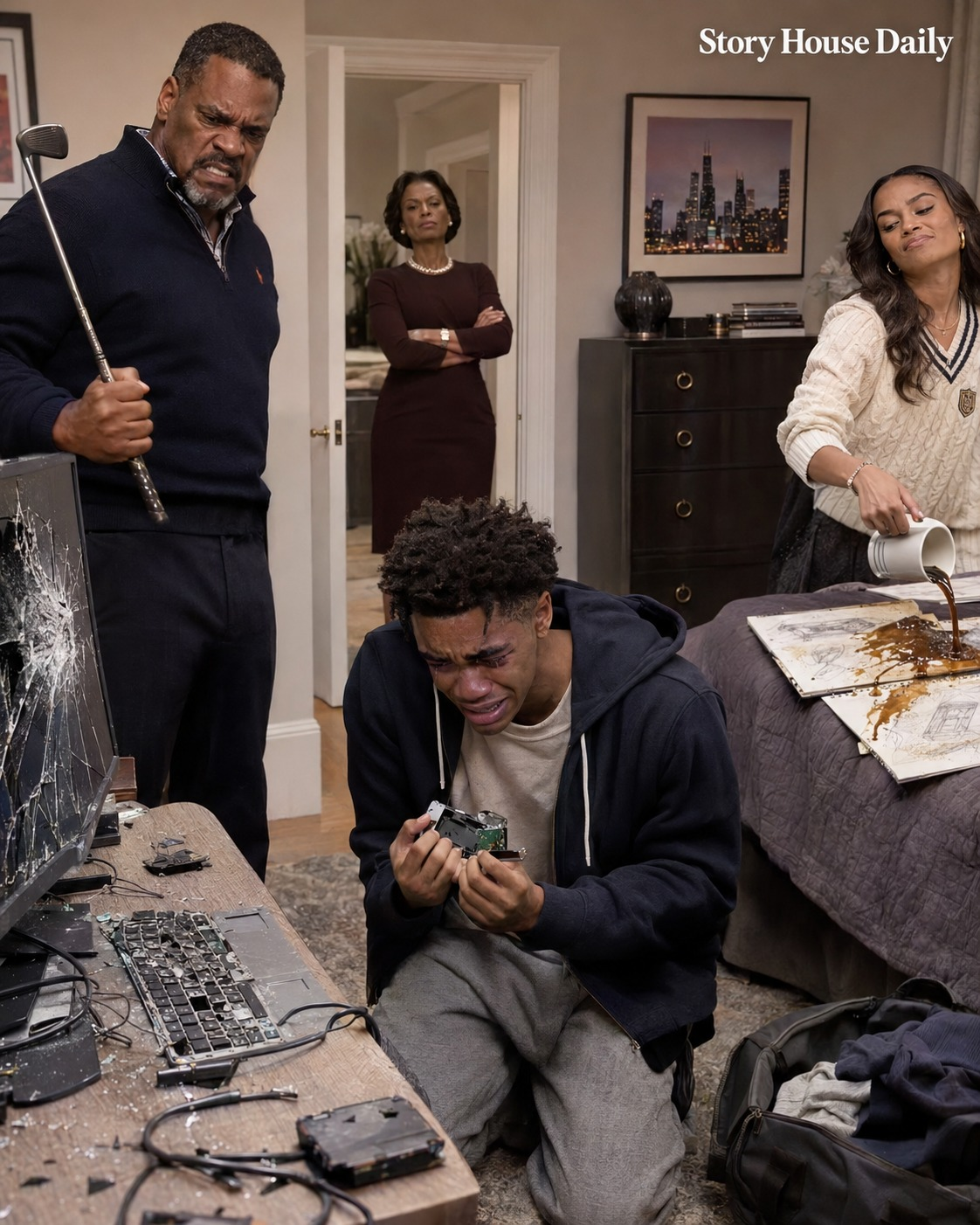
"THAT'S MY NAME. BUT I NEVER CREATED THAT COMPANY!"
I pointed at the registration document on Harper's laptop.
She leaned closer to the screen.
The company was called Hayes Digital Systems LLC.
Its original founder was listed as Desmond Winston Hayes.
Me.
The filing date was three months before my father destroyed my computer.
And the registered business address was my childhood home.
For several seconds, I couldn't breathe.
Harper scrolled down.
"Desmond, did you ever sign paperwork to start a company?"
"No."
"Not even something your father gave you?"
I shook my head.
"I would remember starting a company."
She looked at the document again.
"Then somebody used your identity."
I stared at the screen.
My father had spent years telling me that software design was a childish hobby.
He had laughed at my projects.
Destroyed my equipment.
Thrown me out when I refused to abandon my dream.
And now I was looking at evidence that someone had created a software company in my name while I was still living under his roof.
"Why would he do this?" I whispered.
Harper didn't answer.
She opened another page.
The company registration showed that the original organizer was an outside filing service. The public record didn't identify who had instructed that service to submit the documents.
There was also an amendment.
Filed four weeks after my father kicked me out.
The amendment removed my name as a managing member.
The new manager was Reginald Hayes.
My father.
I sat back.
"He took it."
Harper looked at me.
"We don't know exactly what happened yet."
"He put my name on a company, then removed it."
"That's what the filings show."
"Without telling me."
She nodded.
"Apparently."
I rubbed my forehead.
"Why?"
Harper opened the attached list of intellectual property.
The ElderCare medication application appeared near the bottom.
Beside it was a description of its interface, reminder system, and visual scheduling features.
My features.
My ideas.
My grandfather's inspiration.
Then I noticed a line beneath the description.
Commercial licensing rights assigned to Hayes Digital Systems LLC.
My stomach tightened.
"They're claiming they own it."
Harper's expression became serious.
"Yes."
I stared at her.
"Can they do that?"
"Not just because they wrote it down. But we need an attorney to review the documents."
I laughed bitterly.
"An attorney."
I looked around our tiny office.
Two used desks.
A cheap printer.
A secondhand coffee maker.
My battered laptop.
"We can barely afford this place."
Harper closed the document.
"Then we'll find someone who can help."
I looked at her.
"Why are you still doing this?"
She frowned.
"Doing what?"
"Helping me."
She seemed genuinely confused.
"Because we're partners."
I swallowed.
"My father could make this difficult for you."
"He already has."
"You could walk away."
Harper studied me.
Then she said something I would remember for years.
"Desmond, your father has spent so much time convincing you that you're a burden, you don't recognize loyalty when somebody offers it."
I looked down.
She continued.
"I'm not staying because I feel sorry for you. I'm staying because you're talented, hardworking, and exactly the kind of person I want to build a company with."
My throat tightened.
"And because," she added, "I don't particularly enjoy watching bullies win."
For the first time that evening, I smiled.
The following morning, we contacted a small business attorney named Naomi Carter.
Her office was on the third floor of an older building downtown.
The waiting room contained two chairs, a bookshelf, and a coffee machine that looked older than I was.
Naomi was in her early forties, with close-cropped natural hair and sharp, observant eyes.
She greeted us without ceremony.
"Tell me what happened."
I explained everything.
My father's expectations.
The destroyed computer.
The false confidentiality agreement.
Victoria's witness signature.
The company registered in my name.
And the legal notice claiming ownership of my designs.
Naomi listened carefully.
She took notes.
Asked specific questions.
Then requested copies of every document.
When I finished, she leaned back.
"All right."
I held my breath.
"How bad is it?"
She looked at me.
"Potentially serious. But not hopeless."
I exhaled.
She pointed toward the registration.
"First, a company filing isn't proof that you authorized the company to be formed."
Harper nodded.
"That's what we thought."
"Second, intellectual property ownership depends on the actual circumstances. Who created the work, whether there were valid agreements, and what rights were transferred."
I leaned forward.
"So my father can't just claim everything I designed?"
"Not automatically."
I felt some of the pressure leave my chest.
Naomi continued.
"But we need evidence. Original files. Emails. Drafts. Anything showing when you created the work and what you agreed to."
I thought about the smashed hard drive.
The coffee-soaked sketchbooks.
The ruined computer.
My father had destroyed nearly everything.
Then I remembered the old USB drive.
"Actually," I said, "there might be something."
Naomi looked up.
"What?"
"A backup drive."
"Does it work?"
"Not yet."
She nodded.
"Get it examined. Don't experiment with it yourself. Preserve the device and document what happens."
Harper wrote that down.
Naomi then turned to the confidentiality agreement.
"This signature needs closer examination."
I pointed at Victoria's name.
"My sister supposedly witnessed it."
"Have you asked her?"
"No."
"Why?"
I hesitated.
"Because she helped my father destroy my work."
Naomi studied me.
Then nodded.
"Understood."
She placed the document aside.
"For now, don't contact your family about these allegations. Let me review the records first."
I looked at her.
"Can we afford you?"
She smiled faintly.
"I was waiting for that question."
I felt my face grow warm.
She continued.
"I offer reduced-fee consultations for early-stage businesses. We can start with a limited engagement focused on document review and preserving your rights."
Harper leaned forward.
"That would help enormously."
Naomi nodded.
"Then let's start there."
As we stood to leave, she looked at me.
"Mr. Hayes?"
"Yes?"
"One more thing."
I stopped.
"Don't confuse your father's confidence with legal certainty."
I stared at her.
She continued.
"People who are used to getting their way sometimes forget that evidence matters."
We returned to Apex's office with a plan.
Harper taped a sheet of paper to the wall.
At the top, she wrote:
BUILD THE COMPANY. PROTECT THE WORK.
Beneath it, she drew two columns.
The first contained our business priorities.
Finish Northstar's remaining implementation work.
Find another client.
Improve our portfolio.
Create a reliable development process.
The second contained the legal issues.
Preserve the disputed documents.
Recover the USB drive.
Collect original design emails.
Let Naomi handle communications with Hayes Commercial Holdings.
I looked at the wall.
"That seems like a lot."
Harper smiled.
"It is."
"How are we supposed to do all of it?"
"One thing at a time."
I laughed.
"That's your brilliant strategy?"
"Pretty much."
She handed me a marker.
"Now stop complaining and help me organize this mess."
For the next several weeks, that wall became our headquarters.
Every completed task received a check mark.
Every new problem became another line.
We didn't have investors.
We didn't have employees.
We didn't have expensive equipment.
We had two laptops, a handful of clients, and a growing collection of unpaid bills.
But we were building something.
And nobody could take that feeling away from me.
Our second client was a small bakery chain.
Harper found the owner through a former coworker.
The business had four locations and a terrible online ordering system.
Customers complained that orders disappeared.
Employees struggled to track pickups.
The owner, a woman named Denise Walker, had almost given up on digital ordering entirely.
She met us at one of her bakeries.
I recognized the smell immediately.
Fresh bread.
Coffee.
Butter.
It reminded me of the apartment building where Harper lived.
Denise sat across from us with a notebook.
"I'm going to be honest," she said. "I've already paid two companies to fix this."
Harper nodded.
"What went wrong?"
"They made it prettier. They didn't make it work."
I smiled.
"Then we should start by watching how your employees use it."
Denise looked surprised.
"You want to watch them?"
"Yes."
"Why?"
"Because they're the people who have to live with the system every day."
She studied me.
Then smiled.
"All right. Come tomorrow morning."
We spent six hours observing the bakery's busiest shift.
I watched employees take orders.
Handle phone calls.
Pack pastries.
Search for missing receipts.
And apologize to frustrated customers.
By lunchtime, I understood the problem.
The system had been designed around the customer's checkout process.
But it ignored the employees preparing the orders.
There was no clear priority list.
No simple way to mark items unavailable.
No reliable alert when a pickup time changed.
I drew a new workflow on a sheet of paper.
Denise stared at it.
"That's it?"
I hesitated.
"That's the basic idea."
She pointed at the sketch.
"You're telling me my employees could see every order on one screen?"
"Yes."
"And mark it ready without opening five different pages?"
"Exactly."
She looked at Harper.
"How soon can you build it?"
Harper smiled.
"Let's talk about the schedule."
Three weeks later, we delivered the first version.
Denise called me the following morning.
I answered nervously.
"Is something wrong?"
"Wrong?"
She laughed.
"Desmond, my employees are fighting over who gets to use the new screen."
I grinned.
"That's good, right?"
"It's wonderful."
Then her voice softened.
"You listened to us."
I looked at the laptop in front of me.
"Of course."
"No," she said. "You don't understand. The other companies listened to what I wanted. You listened to what my employees needed."
I swallowed.
"Thank you."
She continued.
"I'm recommending you to every business owner I know."
After the call, I turned toward Harper.
She was watching me.
"What?" I asked.
She smiled.
"That's how companies grow."
The next few months were the hardest and most exciting of my life.
We worked long hours.
Sometimes twelve.
Sometimes fourteen.
We argued over deadlines.
We worried about invoices.
We celebrated tiny victories.
A new client inquiry.
A positive review.
A feature that finally worked.
A payment arriving before rent was due.
We also made mistakes.
One afternoon, an update to the bakery's ordering system caused duplicate notifications.
Denise called immediately.
"Desmond, my employees are getting two alerts for every order."
My stomach dropped.
"I'm on it."
Harper and I spent four hours finding the problem.
It was a small error in the notification logic.
Simple to fix once we located it.
But I felt terrible.
I called Denise afterward.
"I'm sorry."
She sighed.
"Is it fixed?"
"Yes."
"Will it happen again?"
"We've added tests to catch this kind of issue."
She paused.
"Good."
I waited.
Then she said, "Desmond, I don't expect perfection. I expect honesty."
I looked at the screen.
"Understood."
After the call, Harper leaned back.
"See?"
I frowned.
"See what?"
"You made a mistake. You fixed it. Nobody destroyed your computer."
I stared at her.
Then I laughed.
It was such a ridiculous comparison.
And such a painful one.
Because she was right.
At Apex, mistakes were problems to solve.
At home, mistakes had been excuses for punishment.
Six months after I left my parents' house, I moved into my own apartment.
It was small.
One bedroom.
A narrow kitchen.
A bathroom with a faucet that dripped.
The building was older, and the walls were thin.
But the lease had my name on it.
The rent came from money I earned.
And nobody could tell me to leave because they disliked my career.
I carried my belongings inside in three trips.
My duffel bag.
My laptop.
A few boxes of clothes and notebooks.
That was almost everything I owned.
I placed the laptop on a small desk beside the window.
Then I stood in the middle of the room.
I didn't know what to do.
For months, every day had been about surviving.
Finding food.
Finding warmth.
Finding somewhere safe to sleep.
Now I had a home.
A real one.
I sat on the floor.
And cried.
Not because I was sad.
Because I finally understood how much fear I'd been carrying.
A week later, Harper arrived at the office holding a small padded envelope.
She placed it on my desk.
"Guess what."
I looked up.
"What?"
"Remember your broken USB drive?"
I stood immediately.
"The technician?"
She nodded.
"He called this morning."
My heart started pounding.
"Did he fix it?"
"Not exactly."
She opened the envelope.
Inside was a small replacement USB device.
"He recovered a portion of the data and copied it onto this."
I stared at it.
"How much?"
"Enough to make you very happy, I think."
My hands trembled as I took it.
I inserted it into my laptop.
A folder appeared.
Then another.
Then dozens more.
Old design files.
Sketches.
Early application prototypes.
Screenshots.
Notes.
I opened the first folder.
My medication-management application appeared.
An early version.
Incomplete.
But recognizable.
I stared at the screen.
There it was.
The dashboard.
The reminder system.
The calendar.
The simple navigation I'd designed for my grandfather.
I covered my mouth.
Harper stood beside me.
"Desmond?"
I shook my head.
"I thought it was gone."
She smiled.
"Not all of it."
I opened another folder.
There were dated files from three years earlier.
Original sketches.
Development notes.
Screenshots showing the application's progress.
Evidence.
Proof that I had created the work long before my father's company claimed ownership.
I looked at Harper.
"We need to send this to Naomi."
She nodded.
"Already thought of that."
I laughed.
For the first time, I felt like we might actually be able to fight back.
Naomi examined the recovered files two days later.
She was careful not to promise too much.
But her expression changed as she reviewed the dates and development history.
"This is useful."
I leaned forward.
"How useful?"
"It helps establish a timeline of your work."
She opened another file.
"These drafts also appear consistent with the design concepts described in the disputed documents."
Harper nodded.
"So they support Desmond's claim?"
"They may. We'll need to preserve the recovery records and verify the metadata."
I looked at Naomi.
"Can we stop my father from claiming everything?"
She folded her hands.
"We have a stronger position than we did before."
I exhaled.
Then she added, "But there's something I need to tell you."
My stomach tightened.
"What?"
"I contacted the filing service that registered Hayes Digital Systems."
I sat upright.
"And?"
"They confirmed that the formation documents were submitted through an authorized business account."
"Whose account?"
She hesitated.
"The account was associated with Hayes Commercial Holdings."
I closed my eyes.
My father's company.
Again.
Naomi continued.
"They haven't yet provided the underlying authorization documents. I've requested them."
I looked at her.
"Does that mean my father filed it?"
"Not necessarily. But it strengthens the reason to investigate."
Harper leaned forward.
"And the false confidentiality agreement?"
Naomi's expression hardened.
"We're examining that separately."
I nodded.
She looked directly at me.
"Desmond, I want you to understand something."
"Okay."
"This may take time."
"How much time?"
"Months. Possibly longer."
I stared at the table.
Months.
I had spent so long trying to escape my father's control.
And now his name was attached to documents that could threaten everything I was building.
Naomi continued.
"But you don't have to stop working while we investigate. We'll address any specific legal restrictions if they arise."
I looked up.
"So Apex can continue?"
"Based on what I've reviewed, yes. Keep your projects independent, maintain records, and don't use disputed materials in new client work."
I nodded.
"Understood."
By the end of our first year, Apex Innovations had six regular clients.
We hired a part-time developer.
Then a freelance designer.
We replaced our secondhand office chairs.
Bought a proper printer.
And finally upgraded my battered laptop.
I kept the old one.
I couldn't bring myself to throw it away.
It sat on a shelf above my desk.
Scratched.
Dented.
Slow.
But still working.
Whenever I looked at it, I remembered the pawnshop.
The two hundred dollars.
The freezing car.
The nights washing dishes.
And the moment Harper first asked whether I'd designed the interface on my screen.
One Friday afternoon, she stood beside the whiteboard.
"We need a bigger office."
I looked up.
"Already?"
She pointed at the crowded room.
"Our developer is sitting beside the printer."
I glanced over.
He was.
"And our designer is working from a folding table."
I smiled.
"That's true."
Harper crossed her arms.
"Desmond, we're growing."
I leaned back.
The word felt strange.
Growing.
Not surviving.
Not hiding.
Growing.
I looked at the whiteboard.
The first sheet of paper was still taped in the corner.
BUILD THE COMPANY. PROTECT THE WORK.
Most of the tasks beneath it had been checked off.
But the legal dispute remained unresolved.
I thought about my father.
I wondered whether he knew how well we were doing.
Then I decided I didn't care.
At least, I tried to.
That evening, I received a phone call from Mr. Coleman.
I smiled when I saw his name.
"Hey, Mr. Coleman."
"Desmond! How's the software empire?"
I laughed.
"Still pretty small."
"Small empires count."
I leaned back in my chair.
"How's the diner?"
"Same old chaos."
I could hear dishes clattering in the background.
Then his voice became more serious.
"Listen, son. Something happened today."
My smile faded.
"What?"
"Your father came by."
I sat upright.
"Why?"
"Asked about you."
My stomach tightened.
"What did you tell him?"
"That you're doing fine."
I closed my eyes.
Mr. Coleman continued.
"He didn't like that."
I could imagine my father's expression.
The tight jaw.
The cold eyes.
The way he spoke when someone refused to agree with him.
"What did he say?"
Mr. Coleman hesitated.
"He asked whether you were still working with that woman."
"Harper?"
"That's the one."
I frowned.
"Why would he ask about her?"
"I don't know."
Then Mr. Coleman lowered his voice.
"But he said something that bothered me."
I gripped the phone.
"What?"
"He said you were building a company on something that belonged to him."
My stomach turned.
I looked toward the whiteboard.
The legal dispute.
The recovered files.
The company registration.
"He doesn't own Apex," I said.
"I know that."
"He doesn't own my work."
"I believe you."
I swallowed.
"What else did he say?"
Mr. Coleman was silent for a moment.
Then he replied, "He said you'd find out soon enough."
The call ended a few minutes later.
I sat alone in the office.
The lights were dim.
Everyone else had gone home.
I opened my laptop.
Checked our client records.
Reviewed the project folders.
Everything appeared normal.
Then I noticed an email notification.
It was from a company I'd never heard of.
Subject: CONFIDENTIAL ACQUISITION INQUIRY — APEX INNOVATIONS.
I frowned.
An acquisition inquiry?
We were barely a year old.
I opened the message.
A private investment group wanted to discuss purchasing a controlling interest in Apex.
The proposed amount was substantial.
Far more than our annual revenue.
I read the email twice.
Then I called Harper.
She answered immediately.
"Desmond?"
"You're not going to believe this."
"What happened?"
"Someone wants to buy Apex."
She laughed.
"Very funny."
"I'm serious."
I forwarded the email.
A moment later, she went quiet.
"Desmond..."
"Yeah?"
"This is real."
My heart began pounding.
"Why would someone offer that much?"
"I don't know."
She paused.
"But look at the investment group's name."
I scrolled down.
The company was called Meridian Capital Partners.
I didn't recognize it.
Harper continued.
"Now look at the contact person."
I read the signature.
Julian Mercer.
My father's attorney.
My blood went cold.
Harper whispered, "Desmond, I think your father is trying to buy your company."
I stared at the screen.
Then another email arrived.
Same sender.
Different subject.
REVISED OFFER — RESPONSE REQUIRED WITHIN 48 HOURS.
I opened it.
The new amount was even higher.
But the final paragraph contained a condition.
Apex Innovations would be required to transfer all existing and future software intellectual property to a holding company.
I looked at Harper's name on the partnership agreement beside my laptop.
Then at the offer.
My father wasn't trying to help me.
He was trying to own what I had built.
Again.
I forwarded everything to Naomi.
Then I typed a short reply.
We are not interested in selling.
Before I could send it, Harper called back.
"Desmond, don't respond yet."
I stopped.
"Why?"
"Because I just searched Meridian Capital Partners."
My stomach tightened.
"And?"
She was breathing quickly.
"Desmond, there's something very strange about the ownership structure."
I leaned closer to the phone.
"What do you mean?"
"The investment group isn't owned directly by your father's company."
I frowned.
"Then who owns it?"
Harper hesitated.
"That's what I was trying to figure out."
I heard her typing.
Then she went completely silent.
"Harper?"
No answer.
"Harper, what is it?"
Her voice came back as a whisper.
"Desmond, the controlling shareholder is listed under a family trust."
I sat upright.
"What family trust?"
She didn't answer immediately.
Then she said, "The Winston Hayes Family Trust."
My grandfather.
I stared at the phone.
My grandfather had been dead for six years.
Harper continued.
"And Desmond..."
I could hear the fear in her voice.
"Your name is listed in the trust records."
My heart stopped.
"What?"
"Not as a beneficiary."
I gripped the desk.
"Then as what?"
She swallowed.
"As the person authorized to approve certain transfers."
I stared at the screen.
My father had been using my name.
My designs.
My signature.
And now, somehow, my grandfather's trust was involved.
I opened the attachment Harper had sent.
There was a scanned authorization page.
At the bottom was a signature.
My signature.
Again.
But this time, beside it was a date from six years earlier.
A date I remembered perfectly.
The day my grandfather died.
I stared at the document.
Then I noticed a handwritten note in the margin.
Four words.
For Desmond. When ready.
My hands began trembling.
Before I could call Harper back, my phone vibrated.
A new message appeared.
Unknown number.
Your grandfather left you something your father never wanted you to see.
I stared at the screen.
Then a second message arrived.
Come to the old Hayes property tomorrow morning. Bring the silver pen.
I frowned.
The silver pen?
I hadn't seen my grandfather's silver pen in years.
Then I remembered something.
A small wooden box he'd given me shortly before he died.
I'd left it in my childhood bedroom.
Inside the house my parents had forbidden me to enter.
I looked at the message again.
Before I could respond, a third notification appeared.
This time, it was a photograph.
My old bedroom.
The broken computer was gone.
The sketchbooks had disappeared.
But on the desk sat a small wooden box.
Its lid was open.
And inside was my grandfather's silver pen.
Beneath the photograph was one final sentence.
Your father is opening the box tonight. If he finds what's hidden inside, you'll never see it again.
I stood so quickly my chair crashed backward.
Then the office door opened.
Harper stepped inside, her face pale.
She held a sealed envelope.
"Desmond," she whispered, "Naomi just called. She found the original trust document."
I stared at her.
Harper placed the envelope on my desk.
Across the front, in my grandfather's handwriting, were five words.
TO MY GRANDSON, DESMOND HAYES.
And beneath them, written in red ink, was a warning.
DO NOT LET REGINALD OPEN THIS.






Comments 0