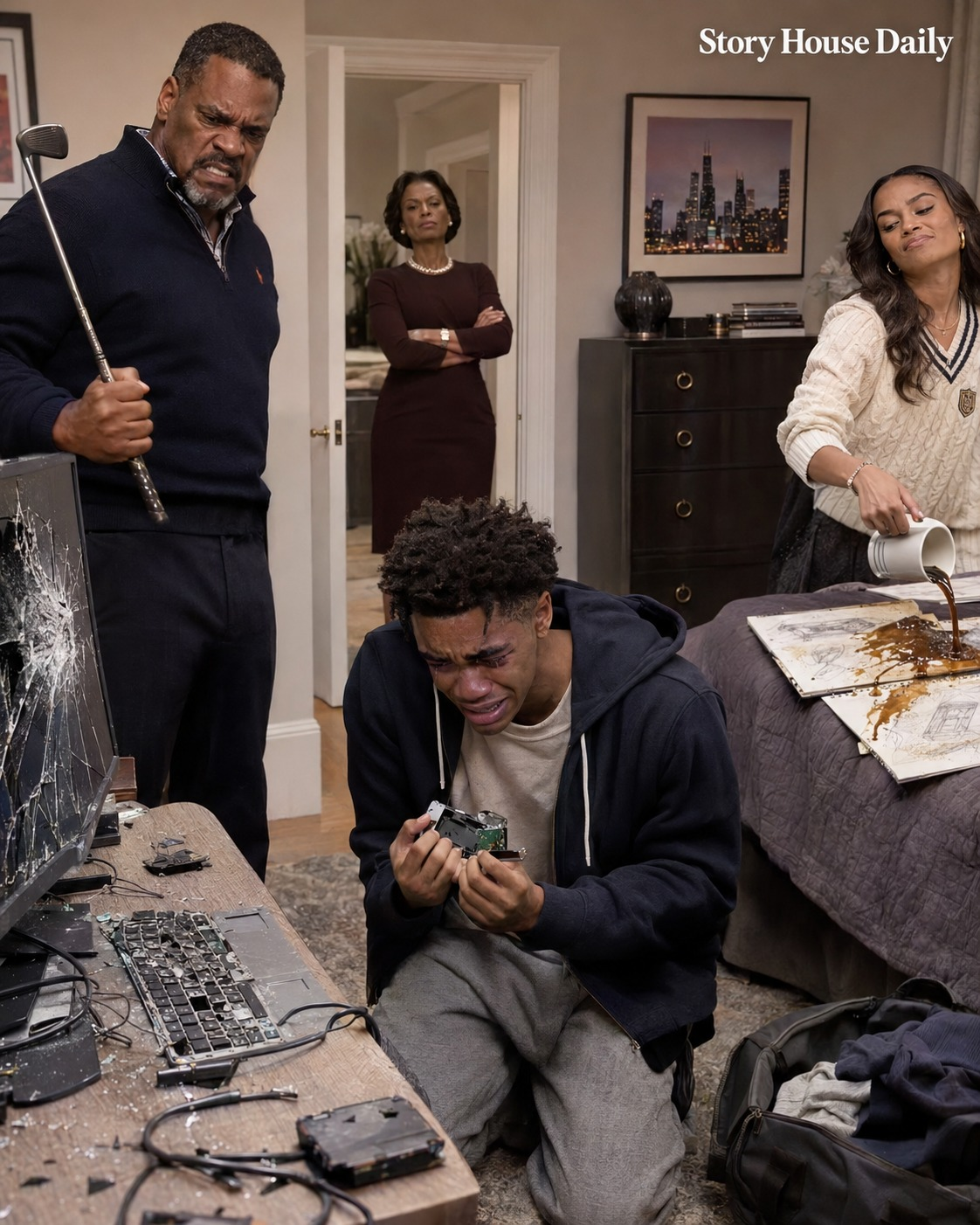
"YOUR FATHER CALLED HERE BEFORE YOU ARRIVED."
Mr. Coleman stood outside the diner, holding a white envelope with my name written across the front.
I stared at him.
"What?"
He glanced toward the street, then back at me.
"Reginald Hayes. That's your father, isn't it?"
My stomach dropped.
For a moment, I couldn't speak.
I had been homeless for barely two days. I'd slept in my car, lost my first paying design job, and spent almost every dollar I had trying to survive.
And somehow, my father had found me.
"How do you know him?" I asked.
Mr. Coleman didn't answer immediately.
He looked to be in his early sixties, with thick gray hair, broad shoulders, and the tired expression of someone who had spent most of his life working while other people slept.
"Come inside," he said. "It's freezing out here."
I didn't move.
"Did he tell you not to hire me?"
Mr. Coleman looked surprised.
Then his expression softened.
"Son, come inside. I'll explain."
I followed him through the glass door.
The diner smelled of bacon grease, coffee, and dish soap.
A waitress was wiping down the counter. Somewhere in the kitchen, metal pans clattered against one another.
It was the kind of place my father would never have entered unless he owned the building.
Mr. Coleman led me to an empty booth near the back.
He placed the envelope on the table.
"Sit down."
I remained standing.
"Please. Just tell me what he said."
Mr. Coleman sighed.
"Your father and I went to high school together."
I blinked.
"What?"
"We grew up in the same neighborhood. Before he became the great Reginald Hayes, he was just Reggie."
I had never heard anyone call my father Reggie.
It sounded almost impossible.
Mr. Coleman sat across from me.
"We weren't close friends, but we knew each other. Played basketball together. Got into a little trouble together."
He gave a humorless smile.
"Then life took us in different directions."
I looked at the envelope.
"Why did he call you?"
"Because he still remembers I run this place."
My throat tightened.
"And?"
Mr. Coleman leaned back.
"He said you might come looking for work. Said you'd had some kind of disagreement at home."
I stared at him.
"He called it a disagreement?"
"That's what he said."
My hands curled into fists beneath the table.
"He destroyed my computer."
Mr. Coleman watched me carefully.
"He smashed my monitor with a golf club. He broke my external hard drive. My sister poured coffee over three years of drawings."
I heard my voice shaking.
"Then my mother told me I wasn't her son anymore."
The older man said nothing.
I looked away.
"I'm sorry. You probably don't want to hear all that."
"Actually," he said quietly, "I think I needed to."
I looked back.
He tapped the envelope.
"Your father told me you were refusing to grow up. That you'd been wasting your time on some computer hobby."
I laughed bitterly.
"Of course he did."
"He also told me something else."
I waited.
Mr. Coleman's expression hardened.
"He said if you came here asking for a job, I should send you home."
My chest tightened.
"Why?"
"Because he thought a few nights without money would teach you a lesson."
I stared at the table.
Even after everything, my father wasn't finished.
He wasn't satisfied with throwing me out.
He wanted to make sure I couldn't survive without him.
Mr. Coleman pushed the envelope toward me.
"He dropped this off yesterday evening."
I looked at it.
"What is it?"
"Open it."
I hesitated.
Then I picked it up.
The envelope was expensive, thick, and cream-colored.
My name was written in my father's familiar handwriting.
I tore it open.
Inside was a cashier's check for five thousand dollars.
For a moment, I forgot how to breathe.
Five thousand dollars.
Enough for a cheap apartment deposit.
Enough for food.
Enough to buy another computer.
Enough to stop sleeping in my car.
Then I noticed the folded sheet of paper behind it.
I opened it.
There were only two sentences.
Desmond, this money is available when you are ready to apologize, return home, and agree to follow the career plan we discussed.
Mr. Coleman has been instructed to release it only after you confirm your decision.
I read the note again.
Then again.
My father hadn't sent help.
He had sent a leash.
Mr. Coleman watched my face.
"Now you understand why I didn't hand it over immediately."
I placed the check on the table.
"He thinks I'll take it."
"He thinks you're desperate."
I looked at my hands.
They were cracked from the cold.
My stomach was empty.
My car barely had enough gasoline to reach another parking lot.
Desperate wasn't a strong enough word.
But something about that check made me feel worse than the hunger.
My father wanted me to come crawling home.
He wanted to be able to say he'd been right.
I pushed the envelope back.
"Tell him no."
Mr. Coleman raised his eyebrows.
"You're sure?"
"No."
I swallowed.
"I'm not sure of anything right now."
He waited.
"But I'm not taking that money."
For several seconds, he studied me.
Then he folded the check and returned it to the envelope.
"All right."
I looked toward the kitchen.
"Does that mean I can't apply for the job?"
Mr. Coleman leaned forward.
"Son, I didn't say that."
I stared at him.
He continued.
"Your father doesn't own this diner."
A small smile appeared beneath his gray mustache.
"And he sure as hell doesn't decide who works in my kitchen."
I started that night.
Mr. Coleman handed me a black apron, a pair of rubber gloves, and a schedule written on a yellow sheet of paper.
Ten at night until six in the morning.
Five nights a week.
The pay was modest.
The work was exhausting.
But every shift came with one free meal.
When he told me that, I almost thanked him twice.
"You ever washed dishes professionally?" he asked.
"No, sir."
"Ever worked in a restaurant?"
"No."
He looked at my hands.
"Well, you're about to learn."
The kitchen was hotter than I expected.
Steam rose from industrial sinks.
Metal trays arrived covered in grease.
Plates stacked up faster than I could wash them.
The dishwasher machine roared like an engine.
Within the first hour, my shirt was soaked.
Within the second, my back began to ache.
By midnight, I had broken a glass, dropped a tray, and burned my wrist against a hot pan.
The cook, a heavyset man named Luis, shook his head.
"College boy, huh?"
I looked up.
"Is it that obvious?"
He laughed.
"You hold a plate like it's a computer."
Despite everything, I smiled.
"Guess I've got a lot to learn."
"Don't worry. By Friday, you'll hate plates as much as the rest of us."
He handed me another stack.
"Welcome to the kitchen."
I worked until my shoulders felt as though they were made of stone.
At three in the morning, Mr. Coleman brought me a plate of scrambled eggs, toast, and potatoes.
"Take ten minutes."
I stared at the food.
"All of this?"
He frowned.
"Unless you want me to eat it."
I sat on a plastic crate near the back entrance.
And I ate.
Every bite tasted better than anything I'd eaten at my parents' expensive dining table.
Not because the food was extraordinary.
Because I hadn't realized how hungry I was.
Mr. Coleman came outside while I was finishing.
He leaned against the wall.
"Where are you staying?"
I hesitated.
"With a friend."
He looked at me.
I looked down.
He didn't challenge the lie.
Instead, he said, "There's a public library about fifteen minutes from here. Opens early most days. Warm place to sit."
I nodded.
"Thanks."
"And Desmond?"
"Yes?"
"Don't be ashamed of honest work."
I looked up.
He continued.
"Your father may own buildings. That doesn't make him better than the people who clean them."
I remembered those words.
Especially during the nights when I wanted to quit.
The first week nearly broke me.
I slept in my car during the day.
Worked at the diner at night.
Used public bathrooms to wash my face.
Changed clothes in the back seat.
Some mornings, I drove to the library and waited for it to open so I could sit somewhere warm.
Other mornings, I was too exhausted to move.
I learned which parking lots had security patrols.
Which gas stations allowed customers to use the restroom without buying anything.
Which public buildings had outlets where I could charge my phone.
I also learned that homelessness didn't always look the way I'd imagined.
Sometimes it looked like a young man wearing clean clothes, carrying a backpack, and pretending he had somewhere to go.
Sometimes it looked like sitting in a parked car, waiting for the sun to rise.
Sometimes it looked like smiling at strangers while quietly calculating whether you could afford a bottle of water.
The hardest part wasn't the physical discomfort.
It was the loneliness.
Every night, after my shift, I checked my phone.
No calls from my mother.
No messages from my father.
Nothing from Victoria.
The silence became its own kind of punishment.
I knew they were waiting.
Waiting for me to surrender.
Waiting for me to admit that I couldn't survive without them.
One morning, I opened Victoria's social media page.
She had posted a photograph from a family dinner.
My parents sat beside her at a restaurant downtown.
They were smiling.
My mother held a glass of wine.
My father had his arm around Victoria's shoulders.
The caption read:
Family is everything.
I stared at those three words.
Then I closed the application.
I never checked her page again.
By the second week, the weather had turned colder.
One morning, I woke up with frost covering the inside of my windshield.
My fingers were so stiff I could barely turn the ignition key.
The engine struggled.
Clicked.
Then stopped.
I tried again.
Nothing.
"Come on," I whispered.
I turned the key a third time.
The engine finally caught.
I sat there trembling with relief.
If my car died, I didn't know what I would do.
It wasn't just transportation.
It was my bedroom.
My closet.
My shelter.
Everything I owned was inside it.
That afternoon, I visited a discount store and bought a cheap blanket.
I almost bought a second one.
Then I remembered I needed gasoline.
I put it back.
That night, while washing dishes, I caught myself staring at the kitchen's old computer near the office.
Mr. Coleman used it for inventory and payroll.
The monitor was scratched.
The keyboard had several missing letters.
But it worked.
I missed working on a computer more than I missed sleeping in a real bed.
That surprised me.
I thought hunger and exhaustion would erase my interest in design.
Instead, the ideas kept coming.
While scrubbing pans, I imagined cleaner navigation menus.
While stacking plates, I thought about color combinations.
During breaks, I drew interface layouts on the backs of discarded receipts.
I couldn't stop.
Even when I wanted to.
One night, Luis found me sketching on a napkin.
"What's that?"
"An app idea."
He looked over my shoulder.
"Looks complicated."
"It's actually supposed to make things simpler."
He grinned.
"Then you're doing it backward."
I laughed.
He pointed at the drawing.
"You still doing that computer stuff?"
"Trying to."
"Good."
I looked at him.
"Good?"
"Yeah. You should have something you're working toward."
He returned to the stove.
"Otherwise, this place starts feeling like the whole world."
I folded the napkin carefully and slipped it into my pocket.
Three weeks after leaving home, I received my first full paycheck.
I stood outside the diner staring at the amount.
It wasn't much.
After deductions, it was less than my father sometimes spent on a business lunch.
But it was mine.
Nobody had given it to me because of my last name.
Nobody expected an apology in exchange.
I had earned every dollar.
I bought gasoline.
A few groceries.
A second blanket.
Then I took fifty dollars in cash and folded it into the lining of my duffel bag.
I made myself a promise.
Every Friday, I would save another fifty.
No matter how difficult the week became.
I was going to buy another laptop.
Not a beautiful one.
Not an expensive one.
Just something that worked.
Something my father couldn't touch.
The following weeks blurred together.
Work.
Sleep.
Cold.
Hunger.
Repeat.
There were days when I felt almost normal.
And days when I sat in the driver's seat wondering whether I had made the worst decision of my life.
One particularly cold morning, I found a missed call from an unknown number.
I called back immediately.
A woman answered.
"Hayes residence."
My heart stopped.
It was our family's housekeeper.
Mrs. Bennett.
She had worked for my parents since I was a child.
"Mrs. Bennett?"
"Desmond?"
Her voice changed.
"Oh, sweetheart."
I closed my eyes.
Hearing someone from home speak to me with kindness almost undid me.
"How are you?" she asked.
"I'm okay."
She was silent.
Then she said, "Don't lie to me, baby."
I looked at the frost on my windshield.
"I'm managing."
She sighed.
"I heard what happened."
I swallowed.
"Did Mom tell you?"
"Your sister did."
Of course.
Mrs. Bennett lowered her voice.
"I wanted to call sooner, but your father made it clear nobody in the household was supposed to contact you."
My chest tightened.
"He said that?"
"Yes."
I stared at the steering wheel.
"He told everyone you needed to learn responsibility."
I laughed without humor.
"By sleeping in my car?"
She went silent.
Then she whispered, "You're sleeping in your car?"
I immediately regretted saying it.
"Mrs. Bennett, please don't tell them."
"Oh, Desmond."
"Please."
She took a shaky breath.
"I won't."
I heard movement in the background.
Then she spoke quickly.
"Listen to me. Your grandfather loved you. Don't ever forget that."
I frowned.
"Why are you saying that?"
"Because he saw something in you your father never understood."
I looked down at the old USB drive resting in the cup holder.
Mrs. Bennett continued.
"And there are things about your grandfather's affairs that—"
A door opened on her end.
She stopped speaking.
Then I heard my mother's voice in the distance.
"Who are you talking to?"
Mrs. Bennett whispered, "I have to go."
"Wait. What things?"
"Take care of yourself, sweetheart."
The call ended.
I stared at the screen.
For several minutes, I tried calling back.
No answer.
I wanted to know what she meant.
But I couldn't afford to lose my job or spend the day chasing a mystery.
I put the phone away.
Still, her words stayed with me.
There are things about your grandfather's affairs...
I didn't understand them.
Not then.
By the end of the second month, I had saved two hundred dollars.
The bills were folded carefully inside my duffel bag.
I counted them twice.
Then a third time.
Two hundred dollars.
It was the most important money I had ever held.
I knew exactly what I wanted to buy.
A laptop.
I searched local pawnshops online.
Most computers were too expensive.
Some were missing chargers.
Others had cracked screens or dead batteries.
Then I found one.
An older laptop listed for two hundred dollars.
The description said it had cosmetic damage and a weak battery.
But it powered on.
It had enough memory to run basic design software.
And it was available at a pawnshop less than twenty minutes away.
I called immediately.
"Is the laptop still there?"
The clerk checked.
"Yeah."
"Does it work?"
"Works when it's plugged in."
"Can you hold it for me?"
"First come, first served."
I looked at the clock.
My next shift started in six hours.
I grabbed my coat and hurried to the car.
The engine started on the second try.
I drove carefully, watching the fuel gauge.
When I reached the pawnshop, I nearly ran inside.
The laptop sat behind a glass counter.
Its casing was scratched.
One corner was dented.
The screen had a faint discoloration near the bottom.
To anyone else, it probably looked like junk.
To me, it looked like a second chance.
The clerk plugged it in.
The screen lit up.
I held my breath.
It booted.
Slowly.
Painfully slowly.
But it booted.
"Two hundred," the clerk said.
I reached into my pocket.
Then stopped.
Two hundred dollars was everything I'd saved.
If I bought the laptop, I would have almost nothing left.
No emergency money.
No backup.
No cushion if my car broke down.
I looked at the machine.
Then at the bills in my hand.
I thought about my father.
This world doesn't pay for doodles, Desmond. It pays for results.
I placed the money on the counter.
"I'll take it."
That afternoon, I carried the laptop into a small coffee shop called The Grind.
It was a narrow place with mismatched chairs, exposed brick walls, and a long counter near the windows.
The coffee was cheaper than most places downtown.
More importantly, there were electrical outlets beside several tables.
I bought the smallest coffee on the menu.
Then I sat in a corner.
I plugged in the laptop.
Pressed the power button.
And waited.
The machine hummed.
The screen flickered.
Then the desktop appeared.
I stared at it.
For the first time in two months, I had a computer of my own.
I opened a blank design program.
My fingers rested on the keyboard.
I didn't know where to begin.
There were so many ideas in my head.
So many things I wanted to rebuild.
I started with the medication-management application.
The one my grandfather would have loved.
I sketched a simple dashboard.
Added a medication calendar.
Created a reminder button.
Adjusted the spacing.
Changed the colors.
Deleted half of it.
Started again.
Hours passed.
The coffee shop grew quieter.
Employees changed shifts.
I barely noticed.
For the first time since leaving home, I wasn't thinking about where I would sleep.
I wasn't thinking about my father's anger.
I wasn't thinking about Victoria's laughter.
I was designing.
And for a few precious hours, that was enough.
Near closing time, I heard someone speak behind me.
"Excuse me."
I turned.
A woman stood beside my table.
She looked a few years older than me, with an alert expression and a laptop tucked beneath one arm.
She pointed toward my screen.
"Did you build that interface?"
I hesitated.
"Yeah."
She leaned closer.
"From scratch?"
"Mostly."
She studied the design.
Then she looked at me.
"That's interesting."
I wasn't sure what to say.
She continued.
"The navigation structure is unusually clean. And the way you've organized the medication schedule..."
She stopped.
Her expression changed.
"Wait."
I looked at her.
"What?"
She placed her laptop on the table.
Opened it.
Then turned the screen toward me.
A complicated software interface filled the display.
There were dozens of menus.
Inventory tables.
Shipping information.
Order tracking screens.
She pointed at the design I'd been working on.
Then at her own.
"My name is Harper."
I nodded.
"Desmond."
She pulled out the chair opposite me.
"Desmond, I've been watching you work in this corner for weeks."
I blinked.
She continued.
"I'm a software developer. And I think you might be exactly the person I've been looking for."
My heart began to race.
"Looking for?"
She nodded.
"I have a contract. A real one. But there's a problem with the interface."
She turned her laptop toward me again.
"The client wants something my current team can't deliver."
I stared at the screen.
Then she opened a folder.
Inside was a document labeled:
SUPPLY-CHAIN PLATFORM — CLIENT CONTRACT
I looked at the amount listed on the first page.
My breath caught.
Harper watched my reaction.
Then she leaned forward.
"Before I tell you what I'm offering, there's something you need to understand."
She tapped the contract.
"The client is paying ten thousand dollars."
I stared at her.
She lowered her voice.
"And if you can solve this design problem, I'm willing to split it with you."
I couldn't move.
Five thousand dollars.
For design work.
The exact amount my father had tried to use to buy my obedience.
But this money would be different.
I would have to earn it.
I looked at the interface again.
Then at Harper.
She smiled slightly.
"There's just one thing."
She opened another file.
The screen filled with a complicated diagram.
Her smile disappeared.
"The last designer quit yesterday."
I frowned.
"Why?"
She turned the laptop fully toward me.
"Because he found something in the client's requirements that nobody else noticed."
I leaned closer.
At the bottom of the document was a section highlighted in red.
Harper pointed to it.
Then she said, "Desmond, if this clause means what I think it means, the entire project could collapse before we even begin."
I read the first sentence.
Then the second.
And when I reached the name printed at the bottom of the page, my hands went completely still.
It was a name I recognized.
A name I had heard in my father's office more times than I could count.
Harper noticed my expression.
"Desmond?"
I didn't answer.
She leaned forward.
"Do you know this person?"
I looked up at her.
Before I could speak, the coffee shop door opened.
A man in an expensive black coat stepped inside.
He scanned the room.
Then his eyes landed on our table.
Harper went pale.
She closed her laptop.
Too late.
The man had already seen us.
He walked straight toward me, reached into his coat, and placed a business card on the table.
I looked down.
The name printed across it made my blood run cold.
Then he said, "Desmond Hayes. Your father told me I'd find you here."






Comments 0