The first document inside the folder was a copy of a partnership agreement.
My name appeared at the top.
Harper's name appeared beneath it.
But there was a third name.
Reginald Hayes.
I stared at the page, trying to understand what I was seeing.
"Harper, what is this?"
She stood across my desk, her hands trembling.
"Desmond, please let me explain."
I looked down again.
The document was dated eighteen months earlier.
That was before Apex Innovations existed.
Before our first contract.
Before the tiny office above the dry cleaner.
Before I had even met Harper.
And beneath the heading, someone had written:
Proposed Technology Development and Commercial Partnership.
I turned the page.
There were clauses describing software development, intellectual property ownership, revenue distribution, and management authority.
My eyes stopped at one paragraph.
It stated that certain technology concepts originally developed by me could be licensed through a company controlled by Reginald Hayes.
I read it twice.
Then I looked at Harper.
"You knew about this?"
She nodded slowly.
"Yes."
"How long?"
Her eyes filled with tears.
"Since before we started Apex."
I pushed the document away.
For a moment, I couldn't speak.
The office suddenly felt smaller.
The million-dollar contract sat on my desk.
The employees I'd hired were working just outside my door.
Our company logo was printed on the glass entrance.
Everything I had built seemed to be standing on top of something I hadn't known existed.
I looked at Harper.
"Tell me everything."
She pulled out the chair opposite me.
Then she sat down.
And began.
"Eighteen months before I met you," she said, "I was working as an independent software consultant."
I nodded.
I remembered she'd mentioned that.
"One of my clients was a small technology investment firm. They were evaluating a project involving commercial property management software."
My stomach tightened.
"Hayes Digital Systems?"
"Yes."
I leaned back.
She continued.
"I didn't know it belonged to your family at first. The project was presented through a separate consulting company. They wanted an interface designer to review an existing prototype."
I stared at her.
"What prototype?"
"An early version of a property management dashboard."
My throat tightened.
The dashboard I'd designed when I was twenty-one.
The one my father had dismissed as childish.
Harper nodded as if she'd read my thoughts.
"I recognized some of the design elements immediately."
"Why?"
"Because they were unusually thoughtful. The layout was different from anything I'd seen. The navigation was designed around how actual property managers worked, not how executives thought they worked."
I looked down.
She continued.
"I asked who had created it. The project manager told me it was developed internally by a young designer."
"Did he give you my name?"
"No."
I stared at her.
"Then how did you find out?"
She hesitated.
"Your father."
I felt my jaw tighten.
"What did he say?"
"He told me the original designer was his son. He described you as someone with potential who had abandoned the project."
I laughed bitterly.
"Of course he did."
Harper looked down.
"He also said you had agreed to transfer the designs to the family company."
I stood.
"I never agreed to that."
"I know that now."
"Harper, I never signed anything."
She nodded.
"I believe you."
I walked toward the window.
Outside, traffic moved through the West Loop.
People hurried along the sidewalk.
The world continued.
But inside my office, I felt like I was discovering another version of my life.
One in which my father had been making decisions about my work while pretending it didn't matter.
I turned back.
"What did you sign?"
Harper opened the folder.
She pulled out another document.
"A preliminary consulting agreement."
I took it.
The agreement described her role in reviewing and improving the software.
There was a confidentiality clause.
A payment schedule.
And a section involving ownership rights.
My eyes moved down the page.
Then stopped.
"What's this?"
Harper looked at the paragraph.
"That clause."
"It says the client retains ownership of all derivative work."
She nodded.
"Yes."
I looked up.
"And you signed it?"
"Yes."
My voice became quieter.
"Harper, you knew those designs were mine."
"I didn't know the full story."
"But you knew they were created by me."
She closed her eyes.
"I knew your father said they were."
I stared at her.
"That's not an answer."
She looked at me.
"You're right."
For several seconds, she said nothing.
Then she continued.
"When I first met you at The Grind, I recognized your design style. I remembered the old prototype. But I didn't immediately connect you to the project."
I frowned.
"Why not?"
"Because your name hadn't appeared in the consulting materials. Everything was presented under Hayes Digital Systems."
I remembered that day.
Harper leaning over my cracked laptop.
Her saying the UI logic was brilliant.
Her offering to split the first project fifty-fifty.
I'd thought it was the beginning of something completely new.
Now I wondered whether my past had followed me into that coffee shop before I even knew it.
"Why didn't you tell me when you recognized the designs?"
Harper looked devastated.
"I should have."
"Why didn't you?"
"Because I was afraid."
I laughed without humor.
"Of what?"
She swallowed.
"Losing the project. Losing the opportunity. And losing you as a partner."
I stared at her.
She continued.
"By then, I'd already seen how good you were. I knew what you could build. But I also knew your father was involved in the original project, and I didn't understand the legal structure."
I looked down at the agreement.
"You could have told me."
"I know."
"You could have asked me."
"I know."
"Instead, you signed something that might give my father ownership of my work."
Her eyes filled.
"Desmond, I didn't sign away your original designs. I signed a consulting agreement for work commissioned by the company. I thought the original rights had already been handled."
I sat down slowly.
The distinction mattered.
But it didn't erase the secrecy.
"Did you receive money from them?"
Harper nodded.
"Yes."
"How much?"
"Four thousand dollars."
I stared at her.
Four thousand.
The amount was small compared with what we'd built.
But it represented something much bigger.
"Did you know where the money came from?"
"From the consulting firm."
"Owned by my father?"
"I found that out later."
I rubbed my forehead.
I wanted to believe her.
I wanted the woman who had helped me survive to be exactly who I thought she was.
But trust was suddenly a complicated thing.
And I didn't know how much of it remained.
The office door opened.
Jordan stepped inside carrying a laptop.
He stopped when he saw our faces.
"Everything okay?"
Neither of us answered immediately.
Harper wiped her eyes.
"We need a few minutes."
Jordan looked at me.
I nodded.
He slowly backed out.
"Sure."
The door closed.
I turned toward Harper.
"Does anyone else know?"
She shook her head.
"Not about the original agreement."
"Naomi?"
"She knows now."
I looked at the folder.
"Does my father know you signed it?"
"Yes."
"Does he know we're partners?"
"Yes."
I closed my eyes.
Then another thought occurred to me.
"Harper, why did he call me today?"
She looked up.
"Because of Continental."
"No. Why did he mention you signing something before you met me?"
She hesitated.
"Because he wanted you to doubt me."
I stared at her.
She continued.
"He knows how much you trust me. He knows I helped you build Apex. If he can convince you that I betrayed you, he can break the partnership without having to fight the company directly."
I looked at the folder.
That was possible.
My father had always been good at finding weaknesses.
But there was another possibility.
Harper had made a mistake.
And my father was using that mistake to manipulate both of us.
I needed to know which parts were true.
"Give me the entire agreement," I said.
She handed it over.
"I'll send you everything."
"Every email. Every payment record. Every document."
"Yes."
"And no more secrets."
She nodded.
"None."
I looked at her.
"I need time."
"I understand."
She stood.
Then paused beside the door.
"Desmond?"
I looked up.
"I never wanted to hurt you."
I didn't answer.
She walked out.
And for the first time since we founded Apex, I watched my business partner leave my office without knowing whether she would come back.
I called Naomi immediately.
She arrived forty minutes later.
I gave her the folder.
She read every page.
Then reviewed the consulting agreement Harper had signed.
Her expression remained neutral.
When she finished, she looked at me.
"Did Harper explain the circumstances?"
"Yes."
"And do you believe her?"
I hesitated.
"I don't know."
Naomi nodded.
"That's understandable."
She separated the documents into two piles.
"Let's distinguish between what we know and what we're assuming."
I leaned forward.
"Okay."
"First, Harper signed a consulting agreement with a company connected to your father's business."
"Correct."
"Second, that agreement contains an intellectual property clause."
"Yes."
"Third, we don't yet know whether the original company possessed valid rights to your designs."
I looked at her.
"So the agreement might not give them ownership?"
"Correct. A contract cannot necessarily transfer rights that the contracting party never possessed."
I exhaled.
She continued.
"However, the document creates a potential dispute, especially if your father claims Harper's subsequent work was derived from material owned by Hayes Digital Systems."
I rubbed my forehead.
"Can he stop Apex from operating?"
"Not simply by sending a letter. But he can create expensive legal problems if he believes he has a credible claim."
I stared at the papers.
"Then what do we do?"
Naomi closed the folder.
"We preserve everything. We establish the development timeline. We identify the original author of each component. And we examine how the original company was formed."
I nodded.
She continued.
"I also want to investigate the four-thousand-dollar payment."
"Why?"
"Because the payment may help establish what Harper was actually hired to do."
I frowned.
Naomi explained.
"If she was paid to review a prototype, that's different from being paid to acquire your ownership rights."
I nodded slowly.
"Can you investigate it?"
"Yes."
She gathered the documents.
"But I need one more thing."
"What?"
"Your original development files. Especially the recovered USB data."
I nodded.
"I have them."
"Good. Don't modify the originals. We'll make forensic copies."
She stood.
Then looked at me carefully.
"Desmond, one more question."
"Yes?"
"Has your father ever had access to your personal identification documents?"
I thought about my childhood home.
The filing cabinets in his study.
The financial paperwork my parents handled.
My old school records.
My bank statements.
I hesitated.
"Probably."
Naomi's expression changed slightly.
"Then we should examine the company registration more closely."
That afternoon, Harper returned to the office.
She didn't come into my room.
Instead, she stood near the reception desk.
I walked out.
She held a small box.
"What's that?" I asked.
"Everything I have related to the old project."
She placed it on the counter.
"Emails. Receipts. Notes. Original agreements."
I looked at her.
"Why bring it here?"
"Because Naomi asked for the records."
I nodded.
She hesitated.
"I also wanted to show you something."
She opened the box.
Inside was a small notebook.
The cover was worn.
Several pages had been marked with sticky notes.
Harper opened it to a page near the middle.
There were sketches of an interface.
My interface.
I recognized the design immediately.
The medication dashboard.
The large reminder buttons.
The color-coded schedule.
My hands went cold.
"Where did you get this?"
Harper pointed to a handwritten note.
"Your father gave me a copy during the consulting project."
I stared.
"He gave you my original sketches?"
"Yes."
"Why?"
"He wanted me to understand the design logic."
I turned the page.
There were more sketches.
Some were mine.
Others had annotations in a different handwriting.
My father's.
Beside one diagram, he had written:
Potential commercial application. Expand for assisted living facilities.
I stared at the words.
My father had understood.
He had understood exactly what I was trying to build.
He hadn't dismissed the project because he thought it was worthless.
He had seen commercial potential.
He had simply wanted to control it.
I looked at Harper.
"Did he tell you about the healthcare concept?"
"Yes."
"What did he say?"
"That it was an internal research project."
I laughed bitterly.
"Internal research."
I turned another page.
There was a note in the margin.
Original designer: Desmond Hayes.
My name.
Written in my father's handwriting.
Beneath it was another sentence.
Do not approach him directly until ownership is secured.
I stopped breathing.
Harper looked at the page.
Then at me.
"Desmond..."
I read it again.
Do not approach him directly until ownership is secured.
My father hadn't been planning to encourage me.
He had been planning to secure my work before I could understand its value.
I closed the notebook.
"Thank you for bringing this."
Harper nodded.
"There's something else."
I looked up.
She reached into the box and removed a folded email printout.
"I found this last night."
I took it.
The email was dated six weeks before the night my father destroyed my computer.
It was addressed to Julian Mercer.
The sender was Reginald Hayes.
I read the message.
The designer is becoming difficult to manage. He has started discussing outside opportunities. We need to finalize the ownership documents before he develops anything further.
My hands tightened around the paper.
Then I noticed the next line.
Victoria has agreed to witness the required paperwork.
I looked at Harper.
She nodded.
"That's why I thought you needed to see it."
I swallowed.
My sister hadn't just witnessed a document.
She had apparently agreed to help my father secure the rights to my work.
I felt anger rising.
But beneath it was something worse.
A memory.
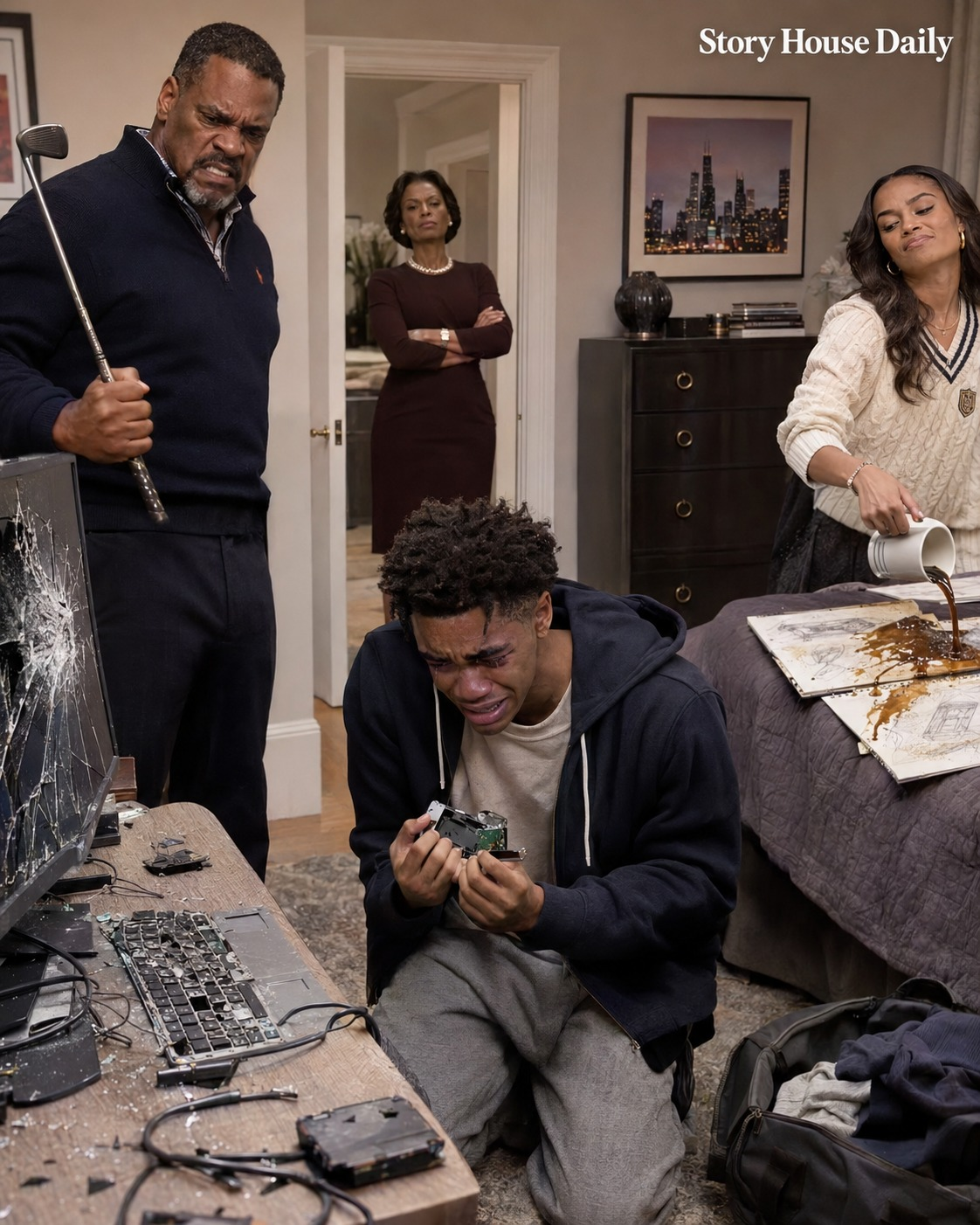
Victoria standing in my bedroom.
Pouring coffee over my sketchbooks.
Laughing as the ink spread.
At the time, I'd believed she was simply enjoying my humiliation.
Now I wondered whether she had been destroying evidence.
Naomi reviewed the email the following morning.
She was more interested in it than I expected.
"Where did you obtain this?"
"Harper's old project records."
"Do you have the original electronic version?"
Harper nodded.
"I can provide it."
"Good. Preserve the metadata."
Naomi examined the printed copy again.
"This could be significant."
I leaned forward.
"Because it shows he knew about my designs?"
"More specifically, it suggests he was considering ownership arrangements before you were informed."
I looked at the line about Victoria.
"Can we use this against him?"
"We can use it as evidence supporting further investigation. But I want to be careful about making conclusions before we authenticate the message."
I nodded.
Naomi closed the folder.
"I also received a response from the filing service."
My stomach tightened.
"What did they say?"
"They located the original registration instructions for Hayes Digital Systems."
She removed another document.
"Your father submitted the application through an account associated with his business."
I stared.
"And my signature?"
Naomi looked at me.
"That's the interesting part."
She turned the page.
The registration instructions included an authorization form.
At the bottom was a signature.
My signature.
Or a very convincing copy of it.
But Naomi pointed to a small box beside the signature.
"Look at this."
I leaned closer.
The box was labeled:
IDENTITY VERIFICATION COMPLETED IN PERSON.
I frowned.
"I never went to a filing office."
Naomi nodded.
"That's why I requested the verification record."
She opened another page.
There was a timestamp.
A location.
And the name of the person who had presented the identification.
I read it.
Then read it again.
My mother.
Margaret Hayes.
I sat back.
"She did it?"
"According to the filing service's preliminary record, she presented identification documents during the registration process."
I stared at the table.
My mother.
The woman who had stood in my bedroom doorway while my father destroyed my equipment.
The woman who had told me I brought everything upon myself.
The woman who had watched me leave with twenty dollars.
She had helped register a company using my name.
Naomi continued.
"We need the complete verification file before drawing conclusions."
I barely heard her.
I remembered my mother's face that night.
Cold.
Unmoved.
As though watching her son lose everything was an inconvenience she wanted finished quickly.
Now I wondered how long she had known.
How long had both my parents been planning to take my work?
That evening, Harper and I sat alone in the office.
The others had gone home.
Neither of us had spoken much throughout the day.
Finally, she broke the silence.
"Do you think we can still work together?"
I looked at her.
"I don't know."
She nodded.
"I understand."
I studied her face.
"Harper, why did you keep that old agreement from me?"
She looked down.
"Because I thought I could fix it before it ever affected you."
"How?"
"I was trying to get the original project released from the consulting company's control."
I frowned.
"What do you mean?"
She opened her laptop.
Then showed me an email chain.
It contained several messages between her and Julian Mercer.
The earliest was dated shortly after I'd left home.
Harper had asked for clarification about the intellectual property clause.
Julian had replied that the matter was being reviewed.
She had followed up several times.
Then, three months later, he had sent a short response.
The original developer has relinquished all rights.
I stared.
"Did you believe him?"
"At the time, yes."
"Why?"
"Because he was the attorney handling the project, and the agreement said the company owned the work."
I leaned back.
"Did you know I'd never signed anything?"
She nodded.
"Not until I met you and heard what happened."
I stared at her.
"Then why didn't you tell me?"
She closed her laptop.
"Because I was afraid you'd think I had helped your father steal your work."
I looked away.
She was right.
I probably would have.
But the secrecy had made everything worse.
"I need you to understand something," I said.
"Okay."
"I trusted you more than anyone."
Her eyes filled.
"I know."
"You were the first person who made me believe I could build something after my family destroyed everything."
"I know."
"And now I'm finding out you were connected to the same people who did it."
She looked down.
"I am sorry."
I believed she was sorry.
But I still didn't know whether that was enough.
After a long silence, I spoke.
"We're going to let Naomi investigate everything."
Harper nodded.
"And we're going to keep the company running."
She looked up.
"Together?"
I hesitated.
"Until we know the truth."
She accepted that.
It wasn't forgiveness.
But it was a beginning.
Two days later, a package arrived at the office.
There was no return address.
The receptionist brought it directly to my desk.
I examined the label.
My name.
My office address.
No sender.
I called Naomi.
She advised me not to open anything suspicious without documenting it.
I photographed the package.
Then recorded the delivery time.
Harper stood beside me.
"Do you think it's from your father?"
"I don't know."
I carefully opened the outer envelope.
Inside was a small cardboard box.
And inside that box was an old photograph.
I picked it up.
It showed Grandfather Winston sitting at his desk.
He was holding the silver pen.
Beside him stood a much younger version of my father.
Both men were looking toward the camera.
I turned the photograph over.
There was handwriting on the back.
The truth was never in the pen.
I frowned.
"What does that mean?"
Harper took the photograph.
Then examined it closely.
"Look at the desk."
I turned it around.
The photograph showed a small wooden box beside my grandfather's right hand.
The same box that had appeared in the photograph from my childhood bedroom.
But there was something else.
A small metal key was visible beneath the pen.
I looked at Harper.
"The box has a lock."
She nodded.
"Maybe the key is hidden somewhere."
I stared at the photograph.
Then remembered the wooden box in my childhood bedroom.
The one I'd been told to leave behind.
The one someone had photographed only days earlier.
I reached for my phone.
There was a new message.
Unknown number.
Stop asking questions about the trust.
I stared at it.
Then another message arrived.
Your mother is willing to meet you.
My heart jumped.
I read it again.
My mother?
Harper leaned closer.
"What does it say?"
I showed her.
She looked concerned.
"Do you want to go?"
I thought about the last time I'd seen my mother.
The front door.
The deadbolt.
Her voice telling me never to return.
I thought about the false registration.
The identification documents.
The five million dollars.
And the letter my grandfather had left for me.
"Yes," I said.
Harper frowned.
"Desmond, be careful."
"I know."
"Don't go alone."
I nodded.
"I won't."
The meeting was arranged for the following afternoon at a small café near Lincoln Park.
I arrived twenty minutes early.
Harper came with me, sitting at a separate table near the window.
Naomi had advised me to keep the conversation calm and avoid signing anything.
My mother arrived at three fifteen.
She looked older.
Her hair was shorter.
There were faint lines around her eyes.
She wore a cream-colored coat and carried a leather handbag.
For a moment, I saw the woman who used to make pancakes on Sunday mornings.
Then she looked at me.
And the memory disappeared.
"Desmond."
"Mother."
She sat down.
Her eyes moved around the café.
Then toward Harper.
"Is she staying?"
"Yes."
My mother sighed.
"I was hoping we could talk privately."
"We can talk here."
She studied me.
Then opened her handbag.
She removed a folded document.
"I suppose you've been asking questions about your grandfather's estate."
I didn't touch it.
"Yes."
"Your father has been handling complicated financial matters for years."
"That doesn't answer my question."
She looked irritated.
"Desmond, this family has responsibilities."
I stared at her.
"What responsibilities?"
"Your grandfather's business. His investments. The properties he left behind."
"And the company registered in my name?"
Her expression changed.
Only slightly.
But I noticed.
"What company?"
I leaned forward.
"Hayes Digital Systems."
She looked down.
Then back at me.
"Your father was trying to protect the family."
I almost laughed.
"By using my identity?"
"That's not how it happened."
"Then tell me how it happened."
She pressed her lips together.
For several seconds, she said nothing.
Then she whispered, "You were too young to understand what your grandfather was planning."
I stared at her.
"How old was I?"
She looked away.
"Desmond..."
"How old was I?"
She closed her eyes.
"Eighteen."
I nodded slowly.
"Old enough to be used."
Her face tightened.
"Don't speak to me like that."
I leaned back.
"Then don't expect me to pretend nothing happened."
She looked at Harper.
Then lowered her voice.
"Your father never wanted to hurt you."
I stared at her.
"He destroyed my computer."
"He was angry."
"He destroyed three years of work."
"He believed you were throwing your future away."
"He threw me out."
My mother looked down.
For the first time, I saw something resembling shame.
But it disappeared quickly.
"We were trying to teach you responsibility."
I shook my head.
"No. You were trying to control me."
She reached into her handbag again.
This time she removed a smaller envelope.
"Your father wants to make things right."
I didn't touch it.
"He wants you to sign an agreement."
"Of course he does."
She slid the envelope toward me.
"He'll release certain claims against Apex if you agree to transfer your grandfather's trust interests into a family-managed account."
I stared at her.
There it was.
The real reason for the meeting.
My father wanted the trust.
And he wanted my company.
I looked at her.
"Does he know I've seen the registration records?"
She froze.
"Who told you about those?"
I said nothing.
My mother slowly folded her hands.
Then she spoke in a voice I barely recognized.
"Desmond, you need to understand something. Your grandfather didn't leave you five million dollars simply because he loved you."
I stared at her.
"What does that mean?"
She leaned forward.
"There's a condition attached to the inheritance."
My heart began pounding.
"What condition?"
She looked toward the café window.
Then back at me.
"Your grandfather wanted you to take control of the family business."
I frowned.
"That doesn't make sense."
"It does if you know what he planned."
I leaned closer.
"What did he plan?"
She swallowed.
Then whispered something that made my blood run cold.
"Your father was never supposed to inherit control of Hayes Commercial Holdings."
I stared at her.
"What?"
She looked directly into my eyes.
"Your grandfather intended to give you the controlling interest."
For several seconds, I couldn't speak.
My mother continued.
"Your father discovered it before the will was finalized. That's why everything became so complicated."
I felt the room tilt.
"Then why did Grandfather leave me the money?"
"Because he knew your father might try to take it."
I stared at her.
"And the company?"
She nodded slowly.
"That was supposed to be yours too."
I sat back.
My father had told me I wasn't capable of building a future.
But my grandfather had apparently intended to give me control of an entire business empire.
My mother reached for the envelope.
"Sign the agreement, Desmond. Let your father handle everything. You can keep Apex. You can keep your little company. Nobody has to get hurt."
I looked at the paper.
Then at her.
"Why are you helping him?"
She hesitated.
And for the first time, her eyes filled with tears.
"Because if you don't sign, your father says he'll expose what happened the night your grandfather died."
I went completely still.
Harper turned toward us.
"What happened that night?"
My mother looked at her.
Then back at me.
Her voice dropped to a whisper.
"Desmond, your grandfather didn't die believing your father would inherit the company."
I swallowed.
"What are you saying?"
She reached into her handbag.
Pulled out a second document.
And placed it on the table.
It was a medical authorization form.
My grandfather's name appeared at the top.
My father's signature appeared at the bottom.
And beside the signature was a date.
The day Grandfather Winston died.
I stared at it.
Then my mother leaned closer and whispered:
"Your father wasn't supposed to be in that hospital room when the final decision was made."
She reached for my hand.
And just as I pulled away, she said the words I had never expected to hear.
"Desmond, I think your father may have had something to do with your grandfather's final hours."






Comments 0