At 8:47 the following morning, I stood outside Victor Lang's office with Naomi beside me and the original loan agreement inside a sealed document folder.
I hadn't slept.
Neither had Harper.
For the first time in five years, my company was facing a threat that could destroy everything we had built.
But the photograph Victor had sent the previous night had changed something.
My grandfather had known about the loan.
He had known my father was borrowing money from Victor.
And he had left a promise that might finally explain why.
Victor's assistant opened the door.
"Mr. Lang is ready to see you."
I looked at Naomi.
She nodded.
We entered.
Victor sat behind an enormous walnut desk. He was in his late sixties, with silver hair, a dark suit, and the kind of expression that suggested he rarely needed to repeat himself.
He gestured toward the chairs.
"Mr. Hayes. Ms. Carter. Please sit."
I remained standing.
"I want to know why my company is being threatened."
Victor studied me.
"Because your father borrowed money he couldn't repay."
"Then take it up with him."
"I tried."
He opened a drawer and removed a thick folder.
"Your father borrowed nearly four million dollars from me six years ago. He claimed the money would stabilize several commercial properties and prevent the company from defaulting on its obligations."
I frowned.
"Why would he need that much money?"
"Because he'd already been moving company funds into speculative investments. Several of those investments failed."
I looked at Naomi.
She was taking notes.
Victor continued.
"Your grandfather discovered the financial problems. He demanded that Reginald disclose everything to the shareholders."
"And my father refused."
Victor nodded.
"He believed he could recover the losses before anyone noticed."
I looked at the folder.
"Where do I come into this?"
Victor opened it.
"Your father offered me something as security."
I stared.
"What?"
"His controlling interest in Hayes Commercial Holdings."
I felt my stomach tighten.
"But he didn't own the controlling interest."
"Exactly."
Victor looked directly at me.
"Your grandfather had already transferred those rights into your trust. Reginald knew that. He also knew I would never have accepted the arrangement if he had told me the truth."
Naomi leaned forward.
"Are you saying the collateral agreement was invalid?"
Victor nodded.
"Once the ownership records were examined, yes. But there was another document."
He removed a photograph.
It showed my grandfather sitting across from him.
Between them was the original agreement.
My grandfather had signed it as a witness.
I stared.
"Why would he sign anything connected to this loan?"
Victor's expression softened.
"Because he wanted to protect you."
Victor explained that my grandfather had discovered the loan before the company faced its worst financial crisis.
He had personally contacted Victor and asked him not to pursue the family business.
In exchange, Winston had offered to help arrange an independent repayment plan.
But he had imposed one condition.
Reginald could not use my name, my inheritance, or my future company as security.
Victor agreed.
My grandfather documented the arrangement.
He also created a separate provision stating that if Reginald attempted to use my identity to secure additional financing, Victor would be required to disclose the original agreement and provide all relevant records to the trust administrator.
I stared at the document.
"Then why did you send me the loan agreement with my signature?"
Victor looked uncomfortable.
"Because your father submitted a separate agreement to my office last week."
Naomi interrupted.
"Did you verify its authenticity?"
"No. I received it through Julian Mercer. It appeared to contain Desmond's signature and the required supporting documents."
"But you knew the original agreement prohibited such an arrangement."
Victor nodded.
"That's why I contacted him."
I leaned forward.
"You threatened to take my company."
Victor didn't look away.
"Yes. And that was wrong."
His admission surprised me.
He continued.
"I was angry. Reginald had deceived me, and when I received the second agreement, I believed he had finally arranged a legitimate repayment mechanism."
Naomi placed the original documents on the desk.
"Mr. Lang, this agreement contains a forged signature."
Victor examined it.
Then he looked at the supporting pages.
His expression changed.
"Where did you get these?"
"From the financial records preserved by Thomas Whitaker."
Victor slowly removed his glasses.
"Then Julian has been lying to me as well."
Naomi nodded.
"Based on the documents we have, that's a reasonable concern."
Victor sat silently.
Finally, he reached for the telephone.
"Cancel the transfer instruction. Immediately."
He spoke to his assistant.
Then he looked at me.
"Desmond, I will cooperate with the investigation. I will also release the company from any claim arising from this fraudulent agreement."
I exhaled.
For the first time in days, I felt my shoulders relax.
But I still had one question.
"Why did Grandfather make you promise to give me the original agreement?"
Victor looked at the photograph.
Then answered quietly.
"Because he knew your father would eventually make the same mistake twice."
By noon, Naomi had received written confirmation that Victor's attempted claim against Apex Innovations had been withdrawn.
The disputed loan agreement was being preserved for forensic examination.
The bank also confirmed that the remaining $1.6 million in my grandfather's account would remain protected while the unauthorized transfers were investigated.
But the biggest development came from Thomas.
He had located an additional set of financial records.
These records showed that Julian Mercer had established several shell companies using documents supplied by Reginald.
The companies had received money from my grandfather's account, then transferred portions of it into property investments and private debt payments.
One of those companies had purchased the building occupied by Apex.
Another had received money that was later deposited into an account registered under Victoria's name.
The evidence connected the financial transactions.
Naomi immediately forwarded everything to the appropriate investigators.
By late afternoon, Julian's office had confirmed that he would no longer represent my father in the estate dispute.
He was also facing an investigation into his handling of the disputed documents.
I didn't celebrate.
Too many people had been hurt.
But I finally understood how the pieces fit together.
My father had spent years moving money, forging signatures, and manipulating people because he believed that controlling the paperwork meant controlling the truth.
He had forgotten something important.
Documents could be examined.
Signatures could be verified.
And people who had once been afraid could eventually speak.
Three days later, my father requested a meeting.
Naomi advised me not to attend alone.
I agreed.
We met in her conference room.
Reginald arrived wearing the same expensive suit he had worn at Victoria's graduation party.
But he looked different.
His hair was untidy.
His eyes were tired.
He sat opposite me.
For several seconds, he said nothing.
Then he spoke.
"We need to find a way to resolve this."
I looked at him.
"What do you mean?"
"The company. The estate. Everything."
"You mean the money you took?"
His jaw tightened.
"I made decisions under difficult circumstances."
"You used my name."
"I was trying to save the business."
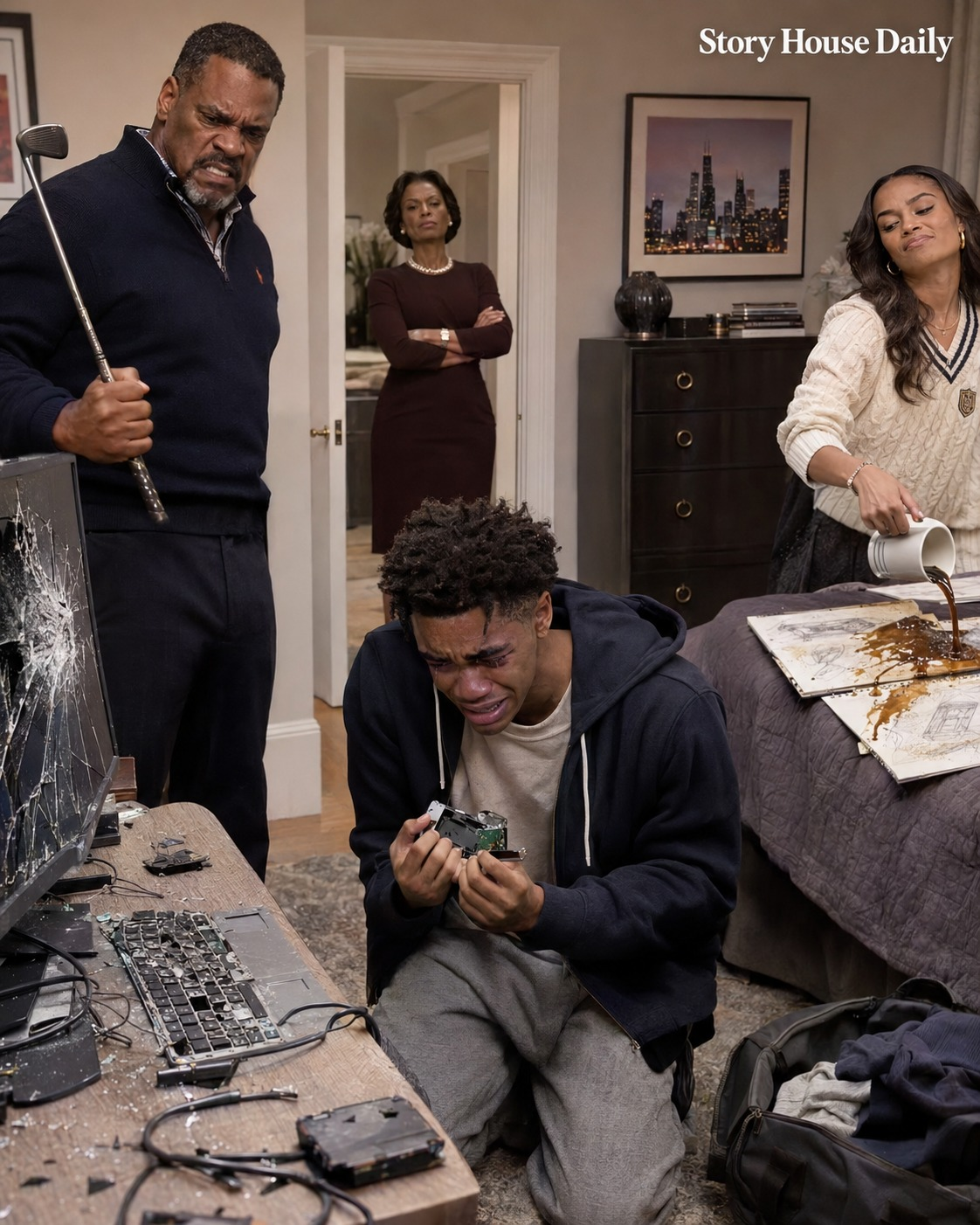
"You destroyed my equipment."
He looked away.
"You were making a mistake."
I leaned forward.
"You threw me out of your house."
He exhaled.
"I thought you'd come back."
That sentence made me laugh.
Not because it was funny.
Because it revealed how little he understood.
"You thought I'd come crawling back?"
"I thought you'd realize how difficult the world was."
I shook my head.
"I did realize. I slept in a car. I washed dishes. I worked until my hands hurt. I rebuilt everything you destroyed."
My father stared at me.
"And you know what?"
I paused.
"Nobody who helped me ever demanded that I become someone else first."
For the first time, he seemed unable to respond.
Then he lowered his voice.
"I am still your father."
I looked directly at him.
"That doesn't make what you did acceptable."
He stared at the table.
After a long silence, he said, "What do you want?"
I had thought about that question for years.
I could have demanded apologies.
I could have demanded that he publicly admit everything.
I could have demanded that he acknowledge the years he had stolen from me.
But I wanted something more important.
"The truth," I said. "All of it. Every document. Every transaction. Every person you involved."
He nodded slowly.
"And after that?"
"After that, the investigators and the courts decide what happens."
His face tightened.
"You would do that to your own father?"
I stood.
"You did it to your own son."
Then I left.
The investigation continued for several months.
Forensic accountants traced the unauthorized transfers.
The handwriting examination confirmed that the disputed signatures on the financial documents had not been written by me.
The bank records established that my father had used the administrative power of attorney to move money without my authorization.
My mother's statement was independently reviewed.
She cooperated fully and provided additional correspondence showing that my father had repeatedly instructed her to sign documents without explaining their contents.
Thomas supplied the original transaction ledger.
Evelyn's records and Helen's preserved testimony were also authenticated.
Together, the evidence established that Grandfather Winston's final estate instructions had been validly executed.
The later amendment presented by Julian was determined to be fraudulent.
The trust administrator formally recognized my rights.
The attempted loan against Apex was voided.
The money remaining in my protected account was secured.
The investigation also uncovered the financial arrangements involving the company that owned Apex's office building.
After negotiations, the property was transferred to an independent holding structure at a fair market valuation.
I decided not to keep the building as a source of leverage against my father.
Instead, Apex purchased its office space through a transparent transaction financed independently.
I wanted our headquarters to belong to the people who had built the company.
Not to the man who had once tried to destroy it.
Reginald eventually faced civil claims and financial penalties connected to the unauthorized transactions and fraudulent documents.
His position in Hayes Commercial Holdings was suspended during the proceedings.
When the evidence became public, several long-standing business partners withdrew.
He lost the influence he had spent decades building.
Julian faced separate legal and professional consequences for his role in the forged documentation.
Victor cooperated with the investigation and withdrew every claim against Apex.
He later sent me a handwritten apology.
I accepted it.
But I didn't become his friend.
Not every relationship needed to be repaired.
Some simply needed to end without further damage.
Victoria's future changed too.
She met with the university's dean and explained her involvement in the original estate documents.
She acknowledged that she had signed paperwork without understanding its contents and had remained silent when our grandfather asked for help.
She also cooperated with the investigation into the account opened using her identity.
The university reviewed her circumstances and determined that she had not knowingly participated in the financial scheme.
Her medical degree remained valid.
But she made another decision.
She postponed her hospital appointment for several months and began volunteering at a community health center.
When I asked why, she said she wanted to become a better doctor before beginning her career.
One afternoon, she visited my office.
She stood near the door, holding two coffees.
"Can I come in?"
I smiled faintly.
"Of course."
She placed one cup on my desk.
For a moment, we simply looked at each other.
Then she said, "I know I can't ask you to forget what happened."
I nodded.
"You can't."
"I also know I can't repair five years with a few apologies."
"No."
She looked down.
"But I'd like to try."
I studied her face.
The confident girl who had once laughed at my sketches was gone.
In her place stood someone who finally understood that being favored wasn't the same as being loved.
"I'd like that too," I said.
She smiled through tears.
We started slowly.
Lunch once a week.
Occasional phone calls.
Conversations that sometimes became uncomfortable.
But for the first time, we were honest with each other.
It wasn't the childhood relationship I had wanted.
It was something different.
Something we were building ourselves.
My relationship with my mother took longer.
She visited my penthouse one Sunday afternoon.
She brought an old photograph of Grandfather Winston.
It showed him sitting in his study, wearing his favorite brown cardigan.
I placed it on the table.
"I remember that day."
My mother nodded.
"He was waiting for you to come downstairs. He wanted to see the drawings you'd made."
I smiled.
"I remember showing him the first version of my healthcare application."
"He was so proud."
She paused.
"Your father wasn't."
I looked at her.
"Why didn't you defend me?"
Her eyes filled.
"Because I was afraid of losing the life I knew."
I said nothing.
She continued.
"I convinced myself that keeping the family together was more important than standing up to him."
I looked at the photograph.
"But you lost the family anyway."
She nodded.
"Yes."
For a long moment, we sat quietly.
Then she reached for my hand.
"I'm sorry, Desmond."
This time, I didn't pull away.
I didn't tell her everything was forgiven.
It wasn't.
But I allowed her to hold my hand.
We agreed to begin again, with honesty and boundaries.
And that was enough for that day.
Six months later, Apex Innovations celebrated its fifth anniversary in its new headquarters.
The office was larger than our first rented space above the dry cleaner.
Floor-to-ceiling windows overlooked the Chicago River.
The reception area displayed the company's original logo.
Harper had insisted that we preserve a framed photograph of our first office.
It was tiny.
The walls were uneven.
The furniture didn't match.
But it reminded us of where everything began.
Forty employees had grown into nearly seventy.
Our healthcare software had been adopted by several regional hospital networks.
The major financial company that had once questioned our stability renewed its contract.
And the university hospital network signed a new long-term agreement.
The company was thriving.
But the greatest achievement wasn't the revenue.
It was the culture we had built.
Nobody was humiliated for asking questions.
Nobody was forced to hide their ambitions.
And every employee knew that their ideas would be judged by their value, not by their family background or social status.
Harper stood beside me during the anniversary celebration.
She raised her glass.
"To the kid who bought a broken laptop from a pawnshop."
I laughed.
"To the woman who told me my work was brilliant when I couldn't believe it myself."
She smiled.
"To Apex."
Everyone raised their glasses.
"To Apex!"
One week later, I visited my grandfather's grave.
I brought a small bouquet of white roses.
The sky was clear.
I stood quietly for a while, thinking about the man who had believed in me before I had learned to believe in myself.
I placed the flowers beside his name.
Then I took a folded letter from my jacket.
It was the final page of the letter he had written to me.
I had kept it in my desk for months.
The last sentence read:
Never allow someone else's fear to become the limit of your future.
I smiled.
"You were right, Grandpa."
I looked toward the city in the distance.
"I built it."
For a moment, I imagined him sitting beside me, asking about my latest project.
I could almost hear his voice.
He would probably ask whether the buttons were the right color.
Then he'd tell me to make the whole thing better.
I laughed quietly.
And for the first time in years, the memories of that house no longer hurt as much.
That evening, I hosted dinner at my penthouse.
Harper arrived first.
Victoria came next, carrying dessert.
My mother brought an old recipe book.
Thomas and Samuel joined us later.
Even Victor sent a congratulatory note, though I had decided to keep our relationship professional.
The table was full.
The conversation was warm.
Nobody discussed money.
Nobody discussed ownership.
Nobody discussed who had been more successful.
We talked about ordinary things.
Harper told a ridiculous story about our first client.
Victoria complained about hospital paperwork.
Thomas described a fishing trip he was planning.
And my mother laughed at something Samuel said.
I looked around the table.
For years, I had believed that losing my family meant losing the people who shared my blood.
Now I understood that family was also built through loyalty, honesty, and the decision to stand beside someone when doing so was difficult.
I had lost five years.
I couldn't get them back.
But I had gained something I never expected.
A life that belonged entirely to me.
Later, after everyone had left, Harper stood beside me near the windows.
"Are you happy?"
I looked at the city lights.
Then at her.
"Yes."
She smiled.
"Good."
I took her hand.
My father had once told me that nobody would pay for my designs.
My sister had laughed at my dreams.
My mother had watched me walk out of our home with twenty dollars.
But I had built a company.
I had protected my grandfather's legacy.
I had recovered the truth.
And I had found people who believed in me without asking me to become someone else.
I no longer needed my father's approval.
I no longer needed the house where I had grown up.
And I no longer measured my worth by the people who had once refused to see it.
I turned off the lights.
The city continued glowing beyond the windows.
For the first time in my life, I wasn't trying to prove anything to anyone.
I was simply living the future I had chosen.
And that was the greatest inheritance my grandfather could ever have given me.






Comments 0