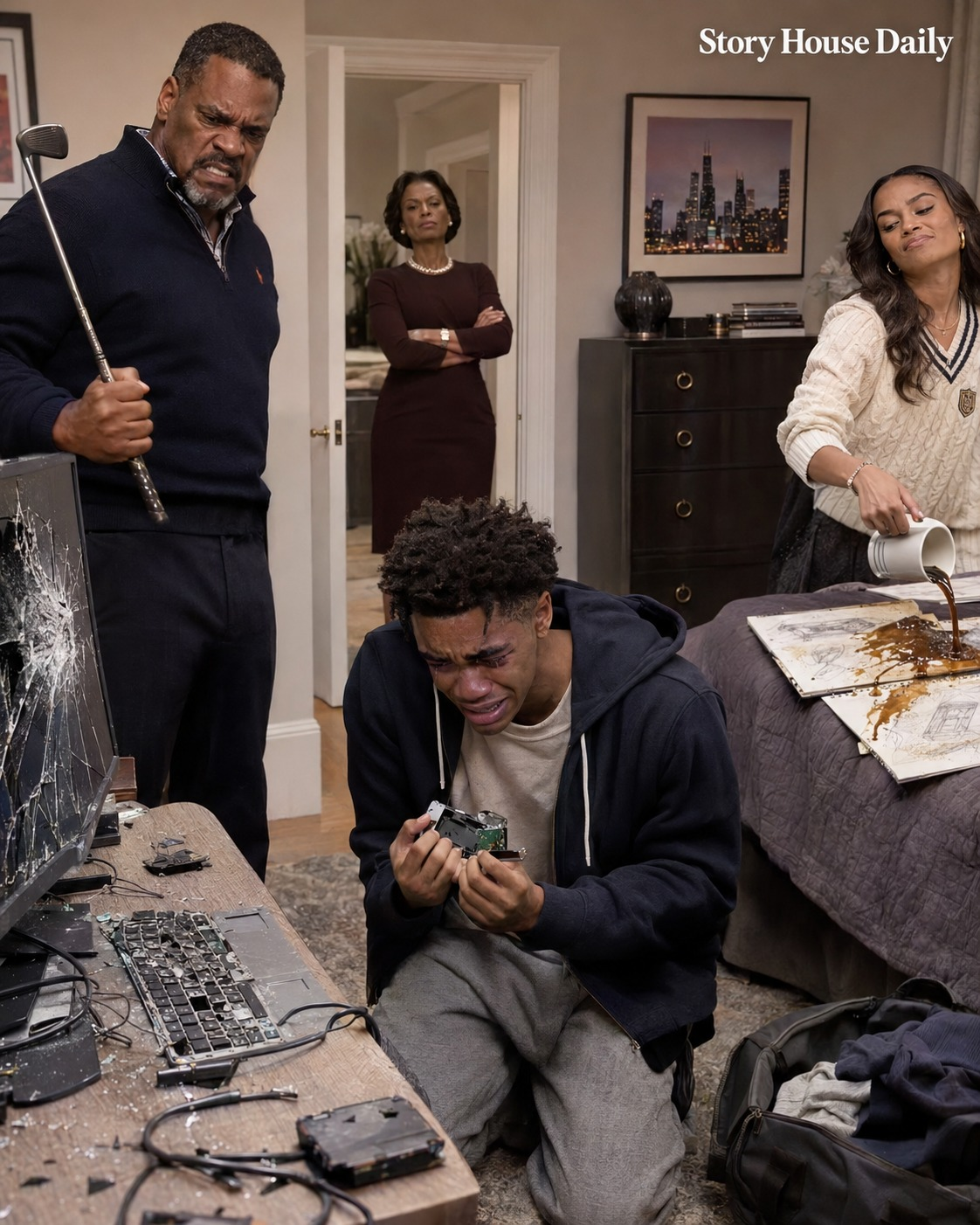
"STOP! PLEASE! THAT'S THREE YEARS OF MY LIFE!"
I lunged toward my computer as my father raised his golf club again.
Reginald Hayes stood over my desk, holding the shattered external hard drive in his other hand.
A small green light was still blinking on its damaged casing.
Then he looked at me.
And I realized he wasn't trying to teach me a lesson.
He was trying to erase me.
The second swing came before I could reach him.
Metal struck plastic with a sound I would remember for the rest of my life.
My monitor collapsed backward. A jagged crack spread across the screen, turning the interface I had spent the entire evening designing into a broken reflection of my bedroom ceiling.
Pieces of black plastic scattered across the desk.
One struck my cheek.
I barely felt it.
"Dad, stop!"
My voice sounded strange to my own ears. Too high. Too desperate.
He ignored me.
My father, Reginald Hayes, was fifty-seven years old and had built a successful commercial real estate business in Chicago. He was the kind of man who could walk into a room full of wealthy strangers and leave with three new clients.
People respected him.
Some feared him.
And almost everyone believed he was an exceptional father.
They had never seen him like this.
He wore an expensive dark olive sweater over a pale blue shirt, the kind of outfit he considered casual. His beige trousers were perfectly pressed. His brown leather shoes probably cost more than my entire computer setup.
The golf club in his hand was a seven-iron from a set he kept in the garage.
He had brought it upstairs specifically for this.
"Do you have any idea what you've done?" he demanded.
I stared at the broken monitor.
"Dad, I can explain."
"Explain?"
He laughed once.
There was nothing funny about it.
"You missed your real estate examination. An examination I arranged for you. An examination that would have put you one step closer to joining my company."
"I know."
"You know?"
His voice rose.
"And instead of showing up, you sat in this room playing with pictures on a computer?"
I swallowed.
"I was working for a client."
He stared at me.
"A client."
"Yes."
"A real client?"
"Yes, Dad."
He leaned closer.
"How much?"
I hesitated.
That hesitation was a mistake.
"Five hundred dollars," I admitted.
For a moment, he said nothing.
Then he started laughing.
Not because he was amused.
Because he was disgusted.
"Five hundred dollars."
He repeated the number as though it were something filthy.
"My son threw away a professional opportunity for five hundred dollars."
"It wasn't just about the money."
"Of course it wasn't. Because you don't understand money."
I looked toward my desk.
The broken monitor had gone completely black.
Behind it sat the small external drive containing nearly three years of projects, unfinished applications, design files, and hundreds of hours of work.
I had built those projects in the evenings.
On weekends.
During holidays.
Sometimes I stayed awake until three in the morning because an idea wouldn't leave me alone.
I had taught myself interface design through free tutorials, library books, and countless failed experiments.
My favorite project was a medication-management application for elderly patients.
It wasn't perfect.
But it worked.
A user could enter prescriptions, schedule reminders, and create a simple visual calendar.
I had spent more than two hundred hours developing its prototype.
My grandfather would have loved it.
That thought hurt almost as much as the destruction in front of me.
Grandfather Winston had been the only person in my family who treated my drawings like they mattered.
When I was twelve, he bought me my first proper sketchbook.
When I was sixteen, he gave me money for design software.
He died when I was eighteen.
And with him went the only person in our family who ever asked what I wanted to become.
My father believed my future had already been decided.
I would finish school.
Join his brokerage firm.
Learn commercial real estate.
Eventually take over the business.
It didn't matter that I hated the idea.
It didn't matter that I had no interest in selling office buildings or negotiating commercial leases.
I was his son.
And in his mind, that meant my life belonged to him.
"Dad," I said carefully, "the startup liked my work. They offered to pay me. This could become something."
He looked at me as though I had insulted him.
"Something?"
"A career."
His expression hardened.
"A career?"
He lifted the golf club.
I instinctively stepped forward.
"Please don't—"
The club struck the external hard drive.
The casing split.
Something inside snapped.
I heard myself make a sound I had never made before.
It wasn't quite a scream.
It wasn't quite a sob.
It was the sound of watching something irreplaceable disappear.
I grabbed the drive before he could hit it again.
A sharp edge cut into my finger.
Blood appeared on my thumb.
I didn't care.
"Dad, please. My files are on here."
He pointed the club toward the floor.
"Good. Maybe now you'll stop wasting your life."
I looked up at him.
For the first time that evening, I couldn't think of anything to say.
Because he wasn't angry about a missed examination anymore.
He was pleased that my work was gone.
Behind him, someone laughed softly.
My younger sister, Victoria, stood beside my bed.
She was twenty-one, three years younger than me, and already the center of our family's universe.
Victoria was studying medicine.
She was brilliant, ambitious, and perfectly aware that our parents considered her the successful child.
She had never needed to ask for their approval.
It was simply there.
Waiting for her.
Her trophies had filled the mantelpiece when we were children.
Her academic certificates hung in the hallway.
Every family dinner became a discussion about her future medical career.
And every accomplishment I mentioned was compared to something she had done better.
That evening, Victoria wore a lavender sweater and a burgundy skirt.
She held a white coffee mug in one hand.
Her long honey-blonde hair fell neatly over her shoulders.
She looked at the wreckage on my desk.
Then at me.
"Wow," she said. "All that work for five hundred dollars."
"Victoria, stay out of this."
She raised her eyebrows.
"Excuse me?"
"Please."
She took a slow sip of coffee.
"You really think those little colored buttons were going to make you rich?"
I looked away.
There was no point arguing.
She walked toward the bed.
My sketchbooks lay open across the dark quilt.
I had been working on a series of application layouts before my father arrived.
There were hand-drawn screens, navigation diagrams, color studies, and notes written in the margins.
Some pages were covered in tiny corrections.
Others contained designs I had spent weeks refining.
Victoria stopped beside them.
She glanced at our father.
Then she looked directly at me.
"Maybe you need to learn what real work looks like."
She tilted her mug.
Black coffee poured across the open pages.
For a second, I couldn't move.
The liquid spread through the paper.
Dark stains swallowed pencil lines.
Ink bled into the margins.
A drawing I had spent three evenings perfecting disappeared beneath a spreading brown puddle.
"Victoria!"
I rushed toward the bed.
Too late.
I lifted the top sketchbook.
Coffee ran from its pages onto the floor.
My sister stepped back, careful not to stain her socks.
"Oops."
She smiled.
A small smile.
Almost casual.
That made it worse.
I stared at her.
"Why would you do that?"
She shrugged.
"Maybe now you'll get a real job."
I wanted to shout.
I wanted to demand an explanation.
Instead, I stood there holding the ruined sketchbook, watching dark drops fall from its corners.
Then I noticed my mother.
Margaret Hayes stood in the open doorway.
She had been there the entire time.
Her dark auburn hair was perfectly styled.
She wore a midnight-blue dress and pearl earrings.
Her arms were folded across her chest.
I looked at her.
"Mom."
She said nothing.
"Mom, did you see what they did?"
Her eyes moved from the broken computer to the stained bedspread.
Then back to me.
"Desmond, your father is trying to protect your future."
I stared at her.
"Protect my future?"
"You've been given opportunities most young men would do anything to have."
"My computer is destroyed."
"You should have thought about that before disrespecting your father."
I looked at the coffee-soaked pages.
"Victoria ruined my work."
My mother sighed.
"Don't start blaming your sister."
Something inside me went very quiet.
I had spent years trying to explain myself to these people.
Years believing that if I found the right words, they might understand.
But standing in that bedroom, I finally recognized something I had been refusing to see.
They understood perfectly well that they were hurting me.
They simply believed they had the right.
My father placed the golf club against the desk.
"Enough."
His voice was lower now.
More controlled.
That frightened me more than the shouting.
He adjusted his sleeves.
Then he looked at me the way he looked at employees who had disappointed him.
"Here's what's going to happen."
I didn't answer.
"You're going to apologize for embarrassing this family."
I stared at him.
"You're going to contact the examination office and arrange another date."
He paused.
"And you're going to forget this ridiculous design nonsense."
I looked down at the ruined sketchbook in my hands.
"What if I don't?"
My father went still.
Victoria stopped smiling.
My mother straightened in the doorway.
"What did you say?" my father asked.
I raised my head.
"What if I don't want to join your company?"
He took one step closer.
"Then you don't belong in my house."
I felt the words settle over the room.
I had always known he could be cruel.
But some part of me had believed there was a line he wouldn't cross.
I was his son.
Surely that meant something.
He pointed toward the bedroom door.
"You can apologize and accept the future I've provided for you."
His voice became colder.
"Or you can pack your things and leave."
I looked at my mother.
She didn't object.
I looked at Victoria.
She folded her arms and waited.
Then I looked back at my father.
For a moment, I saw myself as a little boy standing beside him at a business dinner.
I remembered how proud I had been when he introduced me to his colleagues.
"This is my son, Desmond. One day he'll run the company."
I had smiled because he was smiling.
I hadn't known I was agreeing to a life I didn't want.
Now, at twenty-four, I understood the price of that smile.
My father waited.
He expected me to apologize.
I could see it.
He expected tears.
Promises.
Submission.
He had destroyed the things I loved because he believed that without them, I would have nowhere else to turn.
And he was almost right.
I had less than fifty dollars in my checking account.
My old sedan was parked outside.
I had no apartment.
No stable job.
No relatives willing to challenge my father.
I had no idea where I would sleep.
But I knew one thing.
If I stayed, the next thing he destroyed would be whatever remained of my belief in myself.
I placed the wet sketchbook on the bed.
My hands were shaking.
I took a slow breath.
Then another.
My father narrowed his eyes.
"Well?"
I looked directly at him.
"Then I guess I'm packing a bag."
For the first time that night, he looked surprised.
Only for a second.
Then his expression hardened.
"Fine."
He stepped aside.
"Let's see how long you last."
Victoria gave a short laugh.
My mother looked toward the hallway.
Nobody tried to stop me.
I walked to the closet and pulled out an old black duffel bag.
I packed three pairs of jeans.
Four shirts.
A winter coat.
Socks.
Underwear.
A toothbrush.
My hands moved almost automatically.
I couldn't afford to think about what was happening.
Not yet.
If I stopped, I might fall apart.
Behind me, my father watched.
"You'll be back within a week," he said.
I folded my last shirt.
"You'll come crawling through that door when you realize nobody pays grown men to draw pictures."
I zipped the bag.
Victoria leaned against the bedpost.
"Maybe he'll get a job designing cartoons."
Neither parent corrected her.
I lifted the duffel bag onto my shoulder.
It felt painfully light.
Twenty-four years of living in that house.
And everything I could take with me fit into one bag.
I was about to leave when something near the desk caught my eye.
A small USB drive lay beneath the broken keyboard.
Its metal connector was bent.
The plastic casing was cracked.
I recognized it immediately.
It was an old backup drive containing several unfinished designs from years earlier.
I had forgotten it was there.
I crouched and picked it up.
My father watched me.
"Still collecting your garbage?"
I closed my fingers around the drive.
"No."
I slipped it into my pocket.
Then I walked toward the door.
My mother moved aside to let me pass.
I stopped beside her.
For one foolish second, I hoped she might touch my arm.
Tell me to wait.
Say we could talk tomorrow.
Instead, she looked at the duffel bag.
"Don't embarrass us by calling your father's business associates for money."
I nodded.
"Okay."
"And don't expect your sister to fix the mess you've made."
"Okay."
She studied my face.
I think my calmness bothered her.
But she said nothing else.
I walked down the stairs.
Past the family photographs.
Past Victoria's framed awards.
Past the dining room where my father had dismissed my first healthcare application prototype.
At the front door, I reached for my car keys.
Then I heard my mother's voice behind me.
"Desmond."
I turned.
She stood at the bottom of the staircase.
My father appeared behind her.
Victoria stood a few steps above them.
All three watched me.
For a heartbeat, I thought something had changed.
Then my mother spoke.
"Don't ever show your face at this house again."
Her voice was steady.
"We have no son."
I stared at her.
The words hurt more than the broken computer.
More than the ruined sketches.
More than anything my father had said.
I wanted to ask how a mother could say that to her own child.
But I already knew the answer.
She had just done it.
I opened the front door.
Stepped outside.
And pulled it closed behind me.
The deadbolt clicked.
I stood on the porch with my duffel bag.
My entire life had changed in less than an hour.
I walked toward my car.
A ten-year-old sedan with worn seats and a heater that barely worked.
I threw the bag onto the passenger seat.
Then I sat behind the wheel.
For several minutes, I couldn't start the engine.
My hands were trembling again.
I looked at the house.
Every window was illuminated.
I could see movement upstairs.
Life was continuing without me.
I reached into my wallet.
Twenty dollars.
That was everything I had in cash.
I opened my phone.
No missed calls.
No messages.
I started the engine.
As I pulled away from the curb, my phone vibrated.
For one desperate second, I thought it might be my mother.
Maybe she had changed her mind.
Maybe she wanted me to come back.
I glanced at the screen.
It was a notification from the small startup that had offered me five hundred dollars for my design work.
The message contained a single sentence.
"Desmond, we need to talk about your project immediately."
I pulled over.
My heart started pounding.
Then a second message appeared.
And this one began with three words I wasn't prepared to read...






Comments 0