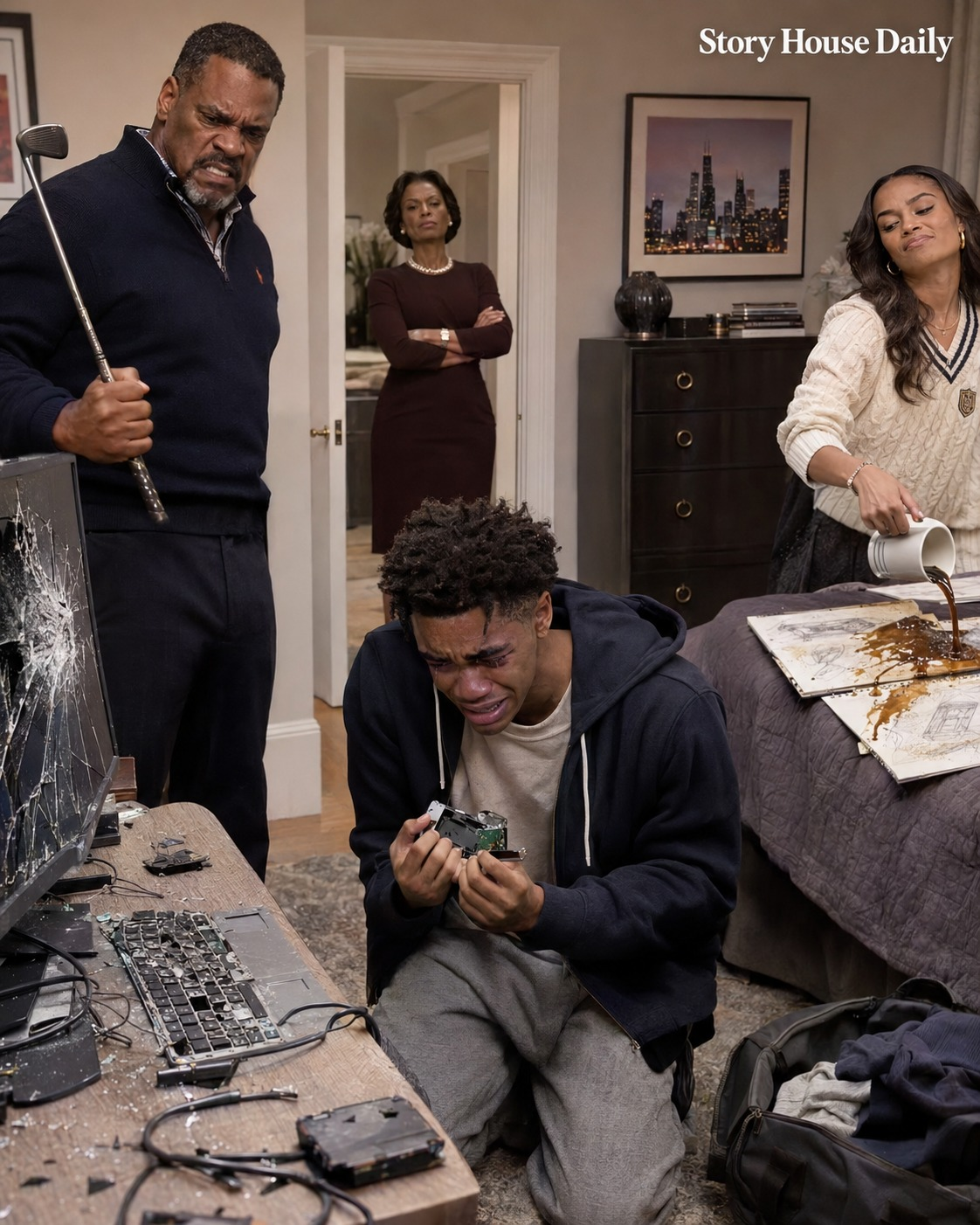
"WE HAVE AN IMPORTANT UPDATE."
Those were the first words in the second message from the startup.
I sat behind the wheel of my old sedan, less than three blocks from the house where my parents had just disowned me.
My duffel bag was on the passenger seat. My computer was destroyed. My mother had told me I was no longer her son.
And now the only company that had ever offered to pay me for my designs wanted to talk.
I opened the message.
Desmond, we need the completed landing page by Friday. Our investor presentation has been moved up. Please confirm that you can deliver.
I read it three times.
Friday.
That was only three days away.
Three days to deliver a project whose files had just been destroyed by my own father.
I stared at the screen until the words blurred.
Then my phone rang.
The caller ID showed a number I recognized.
Ethan Brooks.
The founder of the small technology startup that had hired me.
I almost let it go to voicemail.
What was I supposed to say?
Sorry, Ethan. My father smashed my computer with a golf club because he thinks designing websites is a waste of time.
It sounded ridiculous even inside my own head.
The phone kept ringing.
I answered.
"Hey, Ethan."
"Desmond! Thank God. I was worried you weren't going to respond."
I closed my eyes.
"Sorry. It's been a difficult night."
"Everything okay?"
I looked at the duffel bag.
Then at the dark road ahead.
"Not exactly."
He paused.
"Listen, I hate to put pressure on you, but our investors moved the presentation forward. We really need that landing page."
"I understand."
"Can you still deliver?"
I gripped the steering wheel.
My first instinct was to lie.
To tell him everything was fine.
To promise that I would finish the work.
But I had just lost nearly every tool I needed.
"Ethan, something happened to my equipment."
"What kind of something?"
"It's damaged."
"How damaged?"
I swallowed.
"Completely."
Silence.
Then he said, "Oh, man."
"I'm sorry."
"Did you back everything up?"
I thought about the bent USB drive in my pocket.
Some old designs might still be on it.
But the current project?
That had been stored on my computer and external drive.
"Not the latest version."
Ethan exhaled.
"Desmond, I really liked your work. That's why I hired you."
"I know."
"But if we don't have the page by Friday, we're going to have to find somebody else."
My stomach tightened.
"Please give me a little time."
"How much?"
"Until tomorrow."
Another pause.
"Okay. Call me tomorrow afternoon."
"Thank you."
"Desmond?"
"Yeah?"
"I hope whatever happened gets better."
The call ended.
I lowered the phone.
For a few seconds, I sat completely still.
Then I laughed.
It was a terrible sound.
My father had told me nobody would ever pay for my designs.
Now somebody wanted to pay me, and I couldn't deliver because my father had destroyed the equipment I needed.
I rested my forehead against the steering wheel.
"Come on, Desmond," I whispered.
But I had no idea what I was supposed to do next.
I drove for nearly an hour without a destination.
At first, I stayed near the wealthy Chicago suburb where I had grown up.
The streets were familiar.
Beautiful houses stood behind trimmed hedges and decorative gates.
Driveways held expensive cars.
Warm light glowed through tall windows.
I passed the park where my grandfather used to take me on Sunday afternoons.
I passed the grocery store where my mother shopped.
I passed the restaurant where Victoria celebrated getting accepted into medical school.
Every familiar place seemed to belong to a life that had ended.
Eventually, I pulled into a gas station.
My fuel gauge was close to empty.
I checked my wallet again.
Twenty dollars.
That was it.
My checking account held less than thirty dollars, but a pending payment meant I couldn't safely spend most of it.
I stood beside the gas pump, staring at the prices.
I had never thought about gasoline this way before.
At home, I drove whenever I wanted.
If the tank was empty, I filled it.
If I needed groceries, I bought them.
If my car needed repairs, I asked my father for help.
I hated admitting that.
But it was true.
I had grown up surrounded by money without ever understanding how quickly life could become frightening when it disappeared.
I put ten dollars of gas into the tank.
Then I went inside and bought a bottle of water and the cheapest sandwich I could find.
When I returned to the car, I counted my remaining cash.
A little over six dollars.
I stared at the bills.
Six dollars.
My father had spent more than that on the coffee he drank during his morning commute.
I sat in the driver's seat and unwrapped the sandwich.
I wasn't hungry.
My stomach felt too tight.
But I ate anyway.
Halfway through, my phone lit up.
For one ridiculous moment, hope rushed through me.
Maybe my mother had called.
Maybe she had realized what she'd said.
Maybe my father had cooled down.
The notification was from Victoria.
My heart jumped.
I opened it.
Dad says you left your room a mess. You should be embarrassed.
I stared at the message.
Then another appeared.
Also, Mom said not to come back tomorrow pretending you're sorry. Nobody's falling for it.
I felt my jaw tighten.
I typed a response.
You destroyed my sketchbooks.
I deleted it.
I typed another.
Why do you hate me so much?
I deleted that too.
Finally, I locked the screen.
There was nothing I could say that would make her care.
A minute later, she sent a photograph.
It showed my bedroom.
My destroyed computer was still on the desk.
The coffee-soaked sketchbooks were piled near the trash can.
Beneath the photograph, Victoria had written:
Guess Dad finally cleaned out the junk.
I turned the phone facedown.
For the first time since leaving the house, I started crying.
Not loudly.
Not dramatically.
I just sat there with half a sandwich in my hand while tears ran down my face.
I cried because I had lost my work.
I cried because I had nowhere to sleep.
But mostly, I cried because my sister had taken a photograph of the worst moment of my life and treated it like a joke.
By midnight, I had made three phone calls.
The first was to a friend from college.
Marcus.
We hadn't spoken in months, but he had always been decent to me.
He answered on the fourth ring.
"Desmond? What's up, man?"
"Hey. Sorry it's late."
"No problem. Everything good?"
I looked through the windshield.
"Actually, I need a favor."
"What kind?"
"Could I sleep on your couch tonight?"
There was a pause.
"Tonight?"
"Yeah."
"Man, I'm sorry. My girlfriend's family is staying with us. The whole apartment's packed."
"That's okay."
"What's going on?"
I hesitated.
"Family problems."
"Bad?"
"Pretty bad."
He sighed.
"I wish I could help."
"I know."
After we hung up, I called another acquaintance.
No answer.
Then a third.
Straight to voicemail.
I stared at my contact list.
There were dozens of names.
Classmates.
Former coworkers.
People I had met at family events.
But I couldn't think of anyone I could call without feeling like I was asking for something they hadn't agreed to give.
That realization was humiliating.
I had spent twenty-four years believing I had a comfortable life.
Yet when everything collapsed, I didn't know where to go.
I considered calling one of my father's business associates.
Then I remembered my mother's warning.
Don't embarrass us by calling your father's business associates for money.
I put the phone away.
I wasn't going to give them another reason to call me a failure.
Not tonight.
Around one in the morning, I found a strip mall on the edge of the South Side.
Most of the businesses were closed.
A laundromat stood at one end.
A discount store occupied the middle.
At the far corner was a small restaurant with a faded red sign.
I parked near the back, away from the brightest lights.
Then I turned off the engine.
The silence felt enormous.
I leaned the driver's seat backward.
It barely moved.
My car was old, and the mechanism had been broken for years.
I tried stretching my legs across the passenger side.
The duffel bag got in the way.
I pushed it onto the floor.
Then I pulled my winter coat from the bag and used it as a blanket.
The temperature was dropping.
I could see my breath faintly against the windshield.
I checked the door locks.
All four were secured.
Then I checked them again.
I had never slept in a car before.
I didn't know what I was supposed to do.
Should I leave the engine running?
No. I couldn't waste gasoline, and sleeping with an idling car could be dangerous.
Should I move somewhere else?
I didn't know where else to go.
I watched a security vehicle drive slowly through the parking lot.
My heart started racing.
For a moment, I thought the driver would stop beside me.
But the vehicle continued past.
I waited until its taillights disappeared.
Then I pulled my coat tighter.
The seat belt buckle pressed against my hip.
My knees ached.
Every time a car passed on the road, I opened my eyes.
I thought about my bedroom.
The bed.
The clean sheets.
The heater.
The bathroom down the hall.
Things I had never appreciated because I had never imagined losing them.
Then I thought about my father.
I could still see him holding the golf club.
I could still hear the sound of the monitor breaking.
And I could still hear my mother saying those four words.
We have no son.
I rolled onto my side.
There wasn't enough room.
I turned back.
Somewhere around three in the morning, exhaustion finally overcame fear.
I fell asleep.
A sharp knock woke me.
I jerked upright.
A man stood outside my driver's window.
He wore a dark jacket and carried a flashlight.
For one terrifying second, I thought someone was trying to break into the car.
Then I saw the security badge.
"Hey, buddy."
I lowered the window slightly.
"Yes, sir?"
"You can't sleep here."
My throat was dry.
"I'm sorry."
"Parking lot's private property."
"I understand."
He looked at my coat.
Then at the duffel bag.
His expression changed slightly.
"You got somewhere to go?"
I hesitated.
"Not really."
He studied me for a moment.
"How old are you?"
"Twenty-four."
He sighed.
"Look, I don't want trouble. But management doesn't allow overnight parking."
"I'll leave."
He nodded.
"There's a twenty-four-hour diner a few miles east. Sometimes they let people sit inside if they buy coffee."
"Thank you."
He stepped back.
I started the engine.
The dashboard clock read 4:17 a.m.
I had slept less than three hours.
My neck hurt.
My hands were numb.
And I had nowhere to go except another parking lot.
As I pulled away, I noticed the security guard watching me.
He didn't look angry.
He looked tired.
I wondered how many people like me he'd found sleeping in cars.
The diner was called Millie's.
It sat between a tire shop and a small convenience store.
The windows were fogged from the heat inside.
A neon OPEN sign flickered above the entrance.
I parked near the curb and walked in.
The smell of coffee and fried potatoes hit me immediately.
For a second, I almost cried again.
Not because anything was wrong.
Because it was warm.
A waitress with tired eyes and silver-streaked hair looked up from behind the counter.
"Morning, honey."
"Morning."
"Just you?"
"Yes, ma'am."
She pointed toward an empty booth.
"Sit wherever you like."
I chose a booth near the window.
A few truck drivers sat at the counter.
An older man read a newspaper.
Someone in the kitchen was washing dishes.
I opened the menu.
Everything seemed expensive.
Not objectively.
Just compared to the money in my wallet.
The waitress returned.
"What can I get you?"
"Coffee, please."
"Anything to eat?"
I shook my head.
"Just coffee."
She studied me.
Then she glanced at my duffel bag.
"You traveling?"
"Something like that."
She didn't push.
"Coffee's coming right up."
I sat there for almost two hours.
I drank slowly.
I watched people come and go.
And I tried to think.
I needed money.
Immediately.
Not next month.
Not after graduation.
Now.
I couldn't afford to spend days searching for the perfect design job.
I needed something that would pay me enough to eat and eventually buy another computer.
I opened my phone and searched for overnight jobs.
Warehouse work.
Cleaning services.
Stocking shelves.
Dishwashing.
Most listings required online applications.
Some wanted experience.
Others promised to call back within a week.
A week felt impossibly far away.
I started filling out applications anyway.
By seven in the morning, I had submitted six.
My coffee had gone cold.
The waitress returned with the bill.
I reached into my wallet.
She watched me count the money.
Then she said, "You know what? Coffee's on me."
I looked up.
"What?"
She took the bill.
"Don't worry about it."
"No, I can pay."
"I know you can."
She smiled gently.
"Just let somebody do something nice for you."
I stared at her.
For a moment, I couldn't speak.
My own mother had thrown me out.
My sister had mocked me.
My father had destroyed everything I worked for.
And this woman, who didn't even know my last name, was offering me a cup of coffee.
"Thank you," I whispered.
She nodded.
"Take care of yourself, honey."
I left the diner with my six dollars still in my wallet.
Outside, the morning air felt bitterly cold.
But for the first time since leaving home, I felt something other than fear.
Not hope exactly.
Just the possibility that the entire world might not be as cruel as the people who raised me.
I spent the rest of the morning looking for work.
I walked into restaurants.
I asked managers if they needed help.
I filled out paper applications.
At one place, the manager barely looked at me.
At another, I was told to apply online.
A third restaurant said they weren't hiring.
By noon, my feet hurt.
My phone battery was almost dead.
And I still hadn't found a job.
I stopped outside a public library.
The building opened at one.
I waited on a bench until the doors unlocked.
Inside, I found a computer station and plugged in my phone.
Then I took the bent USB drive from my pocket.
I stared at it.
The casing was cracked.
The metal connector was crooked.
I didn't know whether it would work.
But it was the only piece of my old work I still possessed.
I approached the librarian.
"Excuse me. Do you have computers with USB ports?"
She nodded.
"Yes. You can use one with a guest pass."
"Thank you."
A few minutes later, I sat in front of a public computer.
I inserted the drive carefully.
Nothing happened.
My stomach dropped.
I removed it.
Tried again.
Still nothing.
I leaned back.
Of course.
Of course it was broken.
I looked at the screen.
Then at the drive.
I wanted to throw it across the room.
Instead, I placed it gently beside the keyboard.
I remembered my grandfather sitting beside me when I was a teenager.
He had watched me struggle with a drawing for nearly an hour.
Finally, I'd crumpled the paper.
"I can't do it," I'd complained.
Grandfather Winston had picked up the paper and smoothed it out.
"Desmond, do you know the difference between a mistake and a failure?"
I'd shaken my head.
"A mistake is something that didn't work. A failure is when you decide not to try again."
At the time, I thought he was talking about drawing.
Now I understood he had been talking about life.
I opened a blank document.
If I couldn't recover the startup project, I would rebuild it.
I remembered the layout.
The navigation.
The color palette.
The call-to-action buttons.
I had spent enough hours staring at that design to reproduce most of it from memory.
I began sketching the structure using the computer's basic tools.
It was slow.
Frustrating.
And nowhere near the software I was used to.
But it was something.
For nearly three hours, I worked without stopping.
Then I checked the time.
Ethan was expecting my call.
I stepped outside the library and dialed his number.
He answered immediately.
"Desmond?"
"Hey, Ethan."
"Any good news?"
I looked through the glass doors at the library computers.
"I'm rebuilding the page."
"Rebuilding?"
"From scratch."
He went quiet.
"Man, that's rough."
"I know."
"Can you finish by Friday?"
I wanted to say yes.
I wanted to sound confident.
But I couldn't promise something I wasn't sure I could deliver.
"I'm going to try."
Ethan sighed.
"Desmond, I appreciate the effort. I really do. But our investors need something polished."
"I understand."
"And I can't risk the presentation."
My chest tightened.
"So you're replacing me?"
"I'm sorry."
I looked down at the sidewalk.
He continued.
"If things were different, I'd give you more time."
I nodded, even though he couldn't see me.
"Okay."
"You're talented, Desmond. Don't take this personally."
I almost laughed.
Everything about the last twenty-four hours had been personal.
"Thanks for the opportunity," I said.
After the call ended, I stood outside the library for a long time.
The five-hundred-dollar job was gone.
My first real client.
My first proof that I could make money doing what I loved.
Gone.
I wanted to call my father.
Not to apologize.
To tell him what he'd done.
To make him understand that his anger had cost me something real.
But I knew what he would say.
Good. Now come home and do what I told you.
I put the phone in my pocket.
I wasn't going home.
That evening, I returned to the same strip mall.
I didn't have enough gasoline to keep driving around.
I parked farther from the stores, where the security patrol might not notice me immediately.
I ate a packet of crackers I'd bought from a vending machine.
Then I sat in the dark.
My phone showed no messages from my parents.
No missed calls.
No apologies.
I checked anyway.
Again and again.
At ten, I tried sleeping.
At midnight, I gave up.
The cold had settled into the car.
I pulled on an extra shirt and wrapped my winter coat around my shoulders.
My stomach growled.
I tried ignoring it.
Then I heard a car door slam nearby.
I opened my eyes.
Two men were standing beside a pickup truck several spaces away.
One looked toward my car.
I lowered myself in the seat.
They talked for a moment.
Then one started walking in my direction.
My heart began pounding.
I reached for the door lock.
It was already secured.
The man stopped a few feet away.
He looked through the windshield.
Then he raised one hand.
"Hey."
I didn't move.
"Hey, man. You okay in there?"
I hesitated.
"Yeah."
He looked at the fogged windows.
"You sleeping out here?"
I said nothing.
He glanced toward the pickup.
Then back at me.
"Listen, I'm not trying to bother you."
He reached into his jacket.
My entire body went rigid.
But he didn't pull out a weapon.
He pulled out a folded piece of paper.
"I work nights at a diner down the road," he said. "We're short on dishwashers."
I stared at him.
He held the paper closer to the window.
"Manager's been looking for somebody who can work overnight."
I lowered the window an inch.
"Overnight?"
"Ten to six."
My pulse quickened.
"Are they hiring right now?"
"That's what the sign says."
He nodded toward the paper.
"Here. I wrote down the address."
I reached through the gap and took it.
"Thank you."
"No problem."
He started walking away.
Then he stopped.
"Oh, and one more thing."
I looked up.
He turned back toward my car.
"If you're serious about the job, get there before the morning manager leaves. Ask for Mr. Coleman."
I unfolded the paper.
There was an address.
A phone number.
And a name written in thick black ink.
I looked up to thank him again.
But he was already getting into the pickup.
The engine started.
The truck pulled away.
I sat there holding the paper.
For the first time in two days, I had an actual lead.
A real job.
Something that might keep me from starving.
I read the address twice.
Then I noticed a second line written beneath the phone number.
The handwriting was smaller.
Almost hidden by the fold.
I brought the paper closer to the dashboard light.
There were only six words.
Ask him about the free meals.
I stared at the note.
A job that paid money.
And food.
It sounded almost too good to be true.
I checked the time.
5:42 a.m.
The morning manager might still be there.
I started the engine.
The fuel warning light came on immediately.
I looked at the gauge.
Almost empty.
I had just enough gas to reach the diner.
Maybe.
I pulled out of the parking lot and followed the directions.
The streets were nearly deserted.
My heater blew cold air.
Every traffic light felt painfully long.
When I finally turned onto the correct block, I saw the diner.
A narrow brick building with a faded blue awning.
A handwritten HELP WANTED sign hung in the front window.
I felt my heart lift.
I parked across the street.
Turned off the engine.
And hurried toward the entrance.
Through the glass, I could see a man behind the counter speaking angrily into a telephone.
He was broad-shouldered, with gray hair and a white apron.
I assumed he was Mr. Coleman.
I reached for the door.
Then I heard him shout something that made me stop.
"I told you, I don't care who his father is!"
My hand froze on the handle.
The man turned toward the window.
His eyes landed directly on me.
He lowered the telephone.
Then he said a name I hadn't expected anyone here to know.
"Desmond Hayes?"
I stood motionless.
He reached beneath the counter and pulled out a folded envelope.
My full name was written across the front.
And underneath it was the name of the man who had thrown me out of his house.
Reginald Hayes.
The diner door suddenly opened.
Mr. Coleman stepped outside, holding the envelope.
He looked at me for a long moment.
Then he said, "Son, before I give you this, there's something you need to know about your father..."






Comments 0