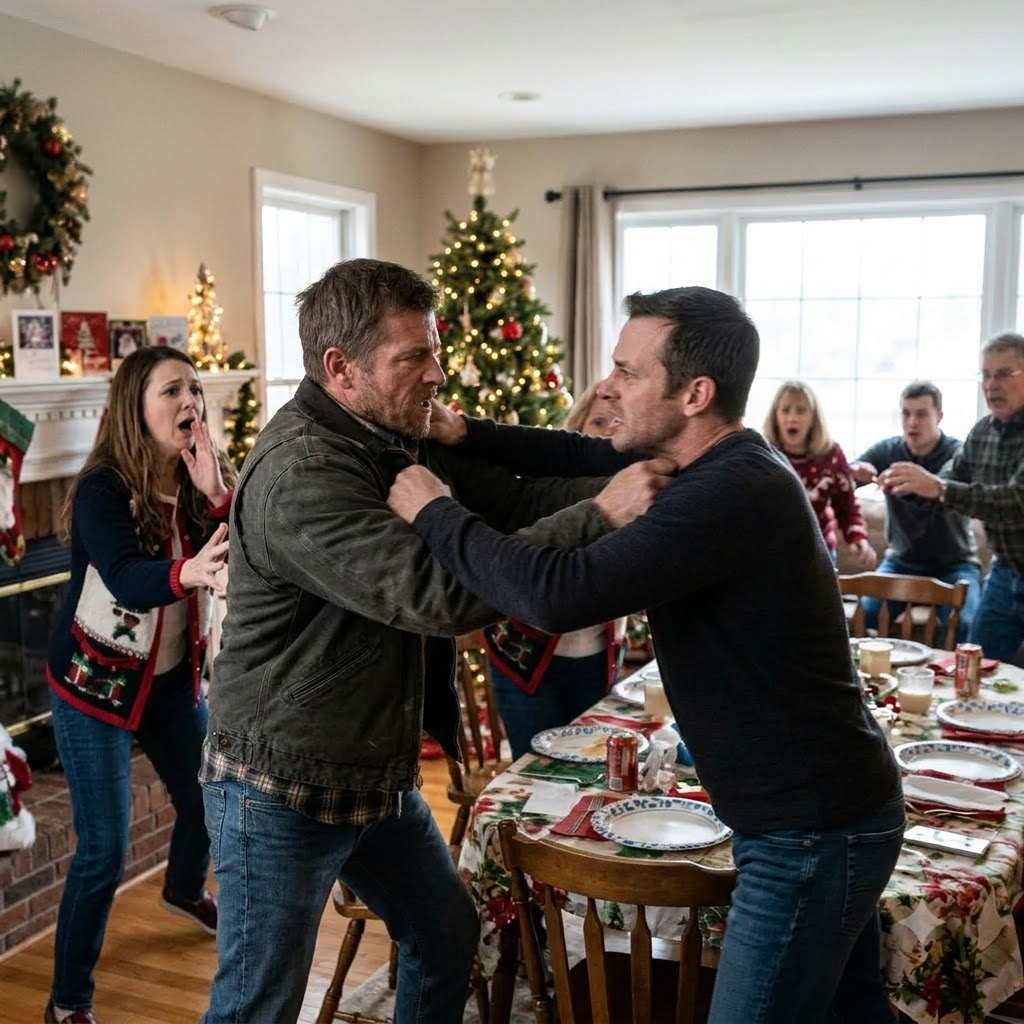
"Don't open it, Carol!" Travis shouted.
My mother stood on the porch with my father's old cardboard box in her arms.
I was halfway up the driveway.
Travis was moving toward her.
And in her trembling hand was an envelope that had been waiting nine years for someone to read it.
My name was written across the front.
Below it were four words.
OPEN IF SOMETHING HAPPENS.
I knew my father's handwriting.
I'd spent my childhood watching him write repair estimates at the kitchen table. His letters leaned slightly to the right, and he always pressed too hard with his pen.
Those words were his.
But I had no idea why my mother had kept them hidden.
"Mom," I said, "give me the envelope."
She looked at Travis.
That was the moment something inside me changed.
Not when Travis mocked my business.
Not when my mother demanded that I guarantee his $160,000 loan.
Not even when I discovered paperwork bearing a signature I hadn't written.
It happened when my sixty-eight-year-old mother looked at her son-in-law for permission to hand me something my dead father had left for me.
"Carol," Travis said, "we talked about this."
I stopped walking.
"What exactly did you talk about?"
He ignored me.
"Put the box away."
My mother tightened her grip.
"Travis, I think Michael should see it."
His face hardened.
"You're making a mistake."
I stepped onto the porch.
"Back away from her."
Travis turned.
"Stay out of this."
I stared at him.
"It's my father's letter."
"You don't know what it is."
"Neither do you, apparently."
He opened his mouth.
Then closed it.
My mother looked between us.
"Please," she whispered. "Not another fight."
I held out my hand.
"Mom, you don't have to explain anything right now. Just give me the envelope."
She hesitated.
Then she placed it in my palm.
Travis took one step forward.
I turned toward him.
"Don't."
He stopped.
I didn't raise my voice.
I didn't need to.
For several seconds, nobody moved.
Then Travis laughed.
It was the same laugh I'd heard at Christmas dinner.
Short.
Dismissive.
Designed to make somebody else feel foolish.
"Unbelievable," he said. "You're going to turn a dead man's paperwork into another excuse to attack me."
I looked at him.
"You've been here five minutes, and you're already telling everyone what they're allowed to do."
His smile disappeared.
"Watch yourself."
I slipped the envelope inside my coat.
"No, Travis. You watch yourself."
He stared at me.
Then he looked toward my mother.
"Carol, if you give him access to those records, you can forget about saving this house."
My mother made a small frightened sound.
I turned toward her.
"Mom, is that what he's been telling you?"
She lowered her eyes.
Travis answered for her.
"I'm trying to keep this family from losing everything."
I looked back at him.
"By asking me to guarantee a loan?"
"By doing whatever it takes."
"Even if it involves documents I never signed?"
His jaw tightened.
"You keep making accusations you can't prove."
I nodded.
"Then you should be glad I hired an attorney."
For the first time, Travis had no immediate response.
I stepped off the porch.
Behind me, Mom called my name.
I turned.
She was standing beneath the Christmas wreath, holding the empty cardboard box.
"Michael," she said quietly, "your father loved you."
I felt my throat tighten.
"I know."
She looked at the envelope inside my coat.
"He wanted you to have a good life."
I waited.
Then she whispered, "I thought I was protecting everyone."
I looked at her for a long moment.
"From what?"
Her eyes moved toward Travis.
He was watching her.
She shook her head.
"I can't."
I wanted to ask again.
I wanted to demand every answer she'd withheld.
But I knew I wouldn't get the truth while Travis stood beside her.
So I walked toward my truck.
And this time, I didn't look back.
I didn't open the envelope in the driveway.
I didn't open it at the first stop sign.
I didn't even open it when I parked outside Daniel Mercer's office twenty minutes later.
I waited until I was sitting across from my attorney.
Daniel looked at the envelope.
"Where did you get this?"
"My mother."
"Was it sealed when she gave it to you?"
"Yes."
"Do you recognize the handwriting?"
"Absolutely."
He nodded.
"All right. Let's document its condition before you open it."
We photographed both sides.
The paper was yellowed.
One corner had been bent.
The adhesive along the flap looked old, but the seal appeared intact.
Dad had written my name in black ink.
Underneath it were those four words.
OPEN IF SOMETHING HAPPENS.
I ran my thumb along the edge.
Daniel waited.
Finally, I broke the seal.
Inside were three folded sheets of paper.
And a small photograph.
I removed the photograph first.
It showed Dad standing beside my original Jeep.
I was next to him, wearing an old work jacket and holding a snow shovel.
We were both laughing.
I remembered the day.
The Jeep's plow mount had broken during my first winter in business.
Dad had come over to help me fix it.
Afterward, Mom had taken a picture.
She'd complained that we were tracking grease into the kitchen.
Dad had laughed and told her that grease was cheaper than diamonds.
I smiled despite myself.
Then I unfolded the letter.
The first line nearly broke me.
Michael,
If you're reading this, there's a good chance I'm not around to explain something myself.
I stopped.
Daniel looked away, giving me privacy.
I swallowed and continued.
I know you don't like asking for help. I know you think you have to carry everything on your own. You got that from me, and I'm sorry for the hard parts of it.
I stared at the page.
My father had never been a man who spoke easily about feelings.
He showed love by fixing things.
By arriving when somebody needed him.
By making sure the car started before anyone left for work.
Seeing those words in his handwriting felt like hearing his voice again.
I continued reading.
I've watched you build something from almost nothing. That old Jeep might not look like much, but I've seen how hard you work. Don't let anybody convince you that honest work is beneath you.
I closed my eyes.
For eleven winters, I'd carried those words without knowing he'd written them down.
When I opened my eyes, the letters blurred.
I wiped my face and kept reading.
I've put copies of important financial records in the blue metal box in the basement workshop. Some concern the money I set aside for you and Emily. I want you both to understand what belongs to you and what doesn't.
My heart began beating faster.
The blue metal box.
I remembered it.
Dad had kept drill bits, spare keys, and old receipts inside.
After he died, I'd assumed Mom had cleared it out.
I looked at Daniel.
He leaned forward.
"Keep reading."
I turned the page.
If anyone ever tells you that you owe money because you're family, ask to see the agreement. If anyone tells you that you received money you don't remember receiving, ask to see the bank record. A signature is important, but so is the truth behind it.
I stopped.
For a moment, I couldn't breathe.
Dad had written those words years before Travis's loan application.
Years before my name appeared on a document I hadn't signed.
Years before Daniel discovered an estate record claiming I'd received $42,000.
I looked at the date at the bottom of the page.
It was written six months before Dad died.
Daniel held out his hand.
"May I?"
I passed him the letter.
He read it carefully.
Then he looked at me.
"Michael, this doesn't prove what happened to the estate money."
"I know."
"But it tells us where your father believed supporting records were kept."
I nodded.
"The blue box."
"Exactly."
I looked at the remaining page.
There was a short note.
The most important thing I can leave you isn't money. It's the ability to stand on your own feet. Don't sell that just because somebody calls you selfish.
I pressed my lips together.
Then I read the final sentence.
And if the world ever makes you doubt the value of your work, remember that keeping somebody safe is worth more than impressing a room full of people.
I lowered the paper.
For a long time, neither of us spoke.
Then Daniel said quietly, "Your father knew you pretty well."
I laughed once.
It came out broken.
"Yeah."
I looked at the photograph.
Dad's hand rested on the Jeep.
My younger self was grinning beside him.
I wished I could go back to that day.
Not to change anything.
Just to stand beside him for another five minutes.
Daniel made copies of the letter.
He asked me to preserve the original.
Then we discussed the blue metal box.
"Do you know whether it's still in your mother's basement?" he asked.
"No."
"Could she have moved it?"
"Absolutely."
"Could Travis have accessed it?"
I thought about the folder Mom had given him.
The old financing agreement.
The copied signature.
"I don't know."
Daniel nodded.
"Then we need to proceed carefully."
I looked at him.
"What about the $42,000 estate distribution?"
He opened another folder.
"I've obtained a copy of the record we discussed."
He placed a document in front of me.
It contained my full legal name.
A date.
An amount.
And a signature.
$42,000.
I stared at it.
The signature looked like mine.
But I hadn't signed it.
"I never received this money."
Daniel nodded.
"I understand."
"Where did it go?"
"That's what we need to establish."
I looked at the date.
It was from the year after Dad died.
At that time, I was struggling to keep my second truck running.
I remembered working weekends at a repair shop because I couldn't afford a replacement transmission.
I remembered skipping meals to make equipment payments.
I remembered lying awake wondering whether the business would survive another winter.
Forty-two thousand dollars would have changed everything.
Not because it would have made me rich.
Because it would have given me breathing room.
A chance to buy reliable equipment.
A reserve for emergencies.
A way to stop living one breakdown away from disaster.
And according to this document, I'd already received it.
I stared at the signature.
"Daniel, I was borrowing money to keep the business alive that year."
He said nothing.
"I would remember receiving forty-two thousand dollars."
"I believe you."
I looked up.
"Then somebody needs to explain where it went."
He closed the folder.
"We'll follow the records."
I nodded.
Then I thought about Mom.
Her house.
The default notice.
The way she'd looked at Travis before giving me Dad's envelope.
I felt anger.
But beneath it was something worse.
Grief.
Because I was beginning to wonder whether my mother had spent years making decisions about my life without ever believing I deserved to know.
I left Daniel's office just before noon.
The weather forecast had changed.
A strong winter system was moving toward our area.
The first wave was expected by evening.
Heavy snowfall overnight.
High winds.
Possible drifting along exposed roads.
I checked the company dispatch app.
Marcus had already scheduled crews.
The hospital route was marked as high priority.
Several commercial customers had requested additional coverage.
I called him.
"How's the storm plan?"
"Ready. Dave's checking Unit Three. Luis is loading salt. I've got the hospital crew on standby."
"Good."
"You sound tired."
"Long morning."
"Family?"
"Yeah."
He didn't ask for details.
Instead, he said, "Come by the yard when you can. I want to show you something on Unit Nine."
I drove straight there.
The yard was busy.
Employees were checking plow blades, filling fuel tanks, and loading salt.
The garage doors were open.
The smell of diesel and hydraulic fluid filled the air.
It was the kind of place my mother never wanted to visit.
Too noisy.
Too dirty.
Too ordinary.
But when I walked through the gate, I felt something I hadn't felt at her house in years.
I belonged.
Marcus was standing beside Unit Nine.
He pointed toward the front axle.
"Found some wear on the steering linkage."
I crouched to inspect it.
"How bad?"
"Not terrible. But I don't want it getting worse during a long shift."
"Replace it."
"Already ordered the part."
I smiled.
"Then why are you showing me?"
"Because I know you like seeing the problem before we fix it."
He was right.
I stood.
Marcus studied me.
"Everything okay?"
I hesitated.
Then I told him about Dad's letter.
Not every detail.
Just enough.
He listened quietly.
When I finished, he looked toward the office.
"Your dad was a good man."
"Yeah."
"He was proud of you."
I looked at him.
Marcus nodded.
"He told me once."
I frowned.
"When?"
"Years ago. Before he got sick."
I waited.
"We were fixing the spreader on Unit Two. He came by with sandwiches."
I remembered that day.
Dad had brought food because he knew we'd been working since dawn.
Marcus continued.
"He asked how the business was doing. I told him you worked harder than anybody I'd ever met."
I looked down.
"He said, 'Michael doesn't know when to quit. That's his problem and his gift.'"
I laughed softly.
"Sounds like him."
Marcus smiled.
"Then he said something else."
"What?"
"He said, 'One day, people are going to understand what my boy built.'"
I couldn't speak.
Marcus looked away.
"Thought you should know."
For a moment, I stood there listening to the sounds of the garage.
A wrench dropped onto concrete.
An engine started.
Someone laughed near the salt shed.
Ordinary sounds.
The sounds of work.
The sounds of people preparing to keep their promises.
And I realized something.
Dad had seen the business long before it became successful.
He'd seen the potential when everyone else saw a rusted Jeep.
He'd seen the man I was becoming when Mom still saw a son who hadn't chosen a respectable career.
I wished he were there.
I wished he could see the nine trucks.
The employees.
The hospital contract.
The company we'd built.
But he wasn't.
So I did what he'd taught me to do.
I went to work.
By seven that evening, the storm had arrived.
Snow fell in thick sheets.
Wind pushed it across the highway.
Our dispatch board filled with calls.
The hospital requested early treatment of the emergency approach.
A nursing facility needed its ambulance access cleared.
Two medical offices reported dangerous ice near their entrances.
Marcus coordinated the crews.
I took Unit Nine.
The replacement steering component had been installed and checked.
The truck was ready.
So was I.
I pulled out of the yard as the first serious gusts hit.
For the next several hours, I barely thought about the letter.
There wasn't time.
I cleared the hospital approach.
Then the ambulance turnaround.
Then the service lane.
I checked the steep entrance twice because drifting snow was building faster than expected.
At nine, Marcus called.
"Mike, Dave's stuck behind an accident on the north route."
"Can he get around?"
"Not yet."
"Send Luis to cover the medical offices. I'll stay at the hospital."
"Copy."
At ten, the hospital security supervisor called.
"We've got a transfer coming from a smaller facility. They need the emergency lane clear."
"It is."
"How long can you keep it that way?"
"As long as it takes."
I made another pass.
Then another.
The wind howled against the truck.
Snow struck the windshield so hard that the wipers struggled to keep up.
At eleven, I stopped long enough to check the plow blade.
Ice had built up around the mounting points.
I knocked it loose.
My fingers were stiff.
My back ached.
I hadn't eaten since breakfast.
But the road was open.
And that was what mattered.
Around midnight, my phone rang.
Mom.
I let it go to voicemail.
Then she called again.
I answered through the truck's hands-free system.
"Mom, I'm working."
"Michael, we need to talk."
"Not now."
"It's important."
I looked at the emergency entrance.
A hospital worker was spreading salt near the doors.
"Is anyone hurt?"
"No."
"Is Emily safe?"
"Yes."
"Then it can wait."
She sighed.
"You always put work before family."
I gripped the steering wheel.
"Mom, I'm keeping the hospital entrance open."
"And I'm trying to keep my home."
I closed my eyes briefly.
"Then speak to your lender and get independent legal advice."
"Travis says there's still a way."
I stared through the windshield.
"What way?"
"He says if you reconsider the guarantee, we can fix everything."
I felt anger rise.
Not because she was asking again.
Because she'd learned nothing.
"Mom, no."
"Michael—"
"No."
She began crying.
"Do you understand what could happen to me?"
"Yes."
"Then how can you be so cold?"
I looked toward the hospital doors.
A nurse was helping an elderly man into a wheelchair.
The wind nearly pulled the blanket from his shoulders.
I watched another employee hurry over to help.
"Mom," I said quietly, "I'm not refusing to help you understand your options. I'm refusing to sign a debt I didn't agree to."
She sniffled.
"Travis says you're trying to ruin him."
I shook my head.
"Travis needs to stop making promises he can't keep."
Her voice hardened.
"You're just like your father."
For a moment, I couldn't speak.
Then she added, "Stubborn. Always thinking you know best."
I looked down at the photograph of Dad tucked into the visor.
I'd brought it with me after leaving Daniel's office.
"Maybe," I said.
She was silent.
Then I continued.
"But Dad never asked me to sign something I didn't understand."
I ended the call.
And went back to work.
At 1:30 in the morning, Marcus called over the radio.
"Mike, we've got a problem."
I straightened.
"What?"
"County dispatch says a section of the west access road is blocked. Ambulance traffic may have to reroute."
"How bad?"
"Heavy drifting. One county plow is down."
I checked the map.
The west access road connected several smaller communities to the hospital.
If it closed completely, ambulances would need to take a much longer route.
"Can we get a truck there?"
"Not without pulling somebody off another critical site."
I thought for a moment.
"Send Dave to the hospital approach. I'll take the west road."
"Mike, you've been out for hours."
"So have you."
"That's not the point."
"I know."
There was a pause.
Then Marcus said, "Be careful."
I turned the truck toward the west side.
The road was worse than expected.
Snow had drifted across both lanes.
Visibility was poor.
The wind pushed against the truck hard enough to make the steering wheel fight back.
I lowered the plow.
The blade caught the first ridge.
The truck slowed.
I adjusted the angle.
Pushed forward.
Backed up.
Made another pass.
It was slow work.
Dangerous work.
The kind of work nobody noticed unless it wasn't done.
At two-thirty, I had cleared enough space for emergency vehicles to pass.
At three, I widened the route.
At four, I checked the intersections.
At five, I returned to the hospital.
The storm was still raging.
But the roads were open.
Eleven hours had passed since I'd left the yard.
Eleven hours of driving.
Plowing.
Checking equipment.
Answering calls.
Making decisions.
And keeping critical access routes usable.
I parked near the emergency entrance.
For a moment, I sat in silence.
My hands ached.
My eyes burned.
My shoulders felt like concrete.
Then I saw an ambulance approaching.
Its lights flashed through the snow.
I moved the truck aside.
The ambulance passed.
The driver raised one hand in thanks.
I raised mine.
Then I watched it disappear beneath the hospital entrance.
I thought about Travis.
Plowing snow is for kids.
I looked at the cleared road.
Then at the hospital.
And for the first time, his words didn't hurt.
They simply sounded foolish.
At six-thirty, the storm began to weaken.
Marcus arrived with fresh coffee.
He handed me a cup through the truck window.
"Eleven hours," he said.
I looked at him.
"What?"
"You've been out eleven hours."
I took the coffee.
"Feels longer."
He smiled.
"Hospital security called. They said you kept the west access road open all night."
"Team effort."
"Always is."
He leaned against the door.
"Go home, Mike."
"After one more pass."
He shook his head.
"You're impossible."
I smiled.
"Been hearing that a lot lately."
He laughed.
Then his radio crackled.
A dispatcher reported that the emergency route was clear.
Marcus looked at me.
"Good work."
I nodded.
He walked away.
I sat for a moment, holding the coffee.
Then I reached up and took Dad's photograph from the visor.
I looked at his face.
At the old Jeep.
At the man who'd believed in me before anyone else did.
"Hope I did okay, Dad," I whispered.
Then I put the photograph away.
And made one final pass.
When I returned to the yard, the office lights were already on.
I parked Unit Nine and climbed down.
My legs felt unsteady.
I was halfway toward the garage when I noticed a car parked near the entrance.
A silver sedan.
I recognized it.
Daniel's.
He was standing beside the office door.
And he wasn't alone.
A woman in a dark coat stood beside him, holding a leather folder.
Daniel saw me and walked forward.
"Michael."
I frowned.
"What are you doing here?"
He glanced at the woman.
"We need to speak with you."
I looked at the folder in her hands.
"About what?"
Daniel hesitated.
Then said, "Your father's estate."
I felt my stomach tighten.
The woman stepped forward.
"My name is Margaret Ellis. I was involved in reviewing some of the estate records after your father died."
I stared at her.
I didn't recognize the name.
She looked nervous.
Very nervous.
Daniel continued.
"Margaret contacted me after reviewing the documents you found."
I looked between them.
"What did she find?"
Margaret opened her folder.
Inside were several old bank records.
A copy of an estate distribution statement.
And a document bearing my signature.
The same signature I'd told Daniel wasn't mine.
Margaret looked at me.
"Mr. Michael, I need to ask you something."
I waited.
"Did you ever authorize your mother to receive money on your behalf?"
"No."
She swallowed.
"Did you ever sign a document transferring your inheritance to her?"
"No."
Her face changed.
She looked toward Daniel.
Then back at me.
"I was afraid you'd say that."
I stared at the papers.
"Why?"
She took a breath.
"Because the records show that the $42,000 was transferred into an account that wasn't yours."
My heart began pounding.
"Whose account?"
Margaret hesitated.
Then said, "Your mother's."
I closed my eyes.
For a moment, I couldn't speak.
Then I opened them.
"Does that mean she took the money?"
Daniel raised a hand.
"Not necessarily. We need to establish who authorized the transfer and what happened afterward."
I nodded.
But my chest felt tight.
Margaret looked down at the folder.
"There's something else."
I stared at her.
"What?"
She removed another page.
"This account received additional transfers over the following years."
I frowned.
"From where?"
She hesitated.
Then said, "That's what concerns me."
She placed the page on the hood of my truck.
I leaned forward.
The document contained several transaction dates.
Most were unfamiliar.
But one stood out.
A transfer made just three months earlier.
The amount was $18,000.
And the description included the name of a business.
Travis's construction company.
I stared at the page.
"Why would Travis's company be connected to Dad's estate money?"
Margaret looked at Daniel.
Then back at me.
"I don't know."
I studied the transactions.
There were more.
Smaller amounts.
Different dates.
Different descriptions.
Some went back years.
I looked up.
"How long has this been happening?"
Margaret swallowed.
"Longer than I expected."
Daniel stepped closer.
"Michael, we need to review the full account history before making accusations."
I nodded.
Then Margaret said something that made both of us turn toward her.
"There's one transaction I haven't been able to explain."
She opened the folder again.
A folded sheet slipped from between the pages.
She picked it up.
Her face went pale.
Daniel noticed.
"Margaret?"
She stared at the paper.
Then at me.
"I thought this was just a copy."
I frowned.
"A copy of what?"
She didn't answer.
Instead, she unfolded the sheet.
Across the top was the name of my snow removal company.
Below it was an authorization form.
And at the bottom was a signature.
My signature.
Or something that looked exactly like it.
I stared at the date.
It was from the previous month.
I hadn't signed any authorization form that month.
Margaret's hands began to shake.
"Mr. Michael," she whispered, "I think someone has been using your business information to support more than one financial application."
I looked at Daniel.
He was already reaching for his phone.
Then the office landline began ringing.
Marcus had gone inside to answer it.
A few seconds later, he appeared in the doorway.
His face was white.
"Mike!"
I turned.
"What?"
He held the receiver away from his ear.
"It's St. Mary's."
I frowned.
"What's wrong?"
Marcus swallowed.
"They said an ambulance is on its way to your mother's house."
I stood completely still.
Then he added:
"And the person who called 911 told dispatch there was a locked room in the basement."






Comments 0