I stared at Emily's message while the cold December wind pushed against my coat.
And Mom already knows.
Those four words bothered me more than anything Travis had said at dinner.
I read the message again.
Then I called my sister.
Straight to voicemail.
I tried a second time.
Nothing.
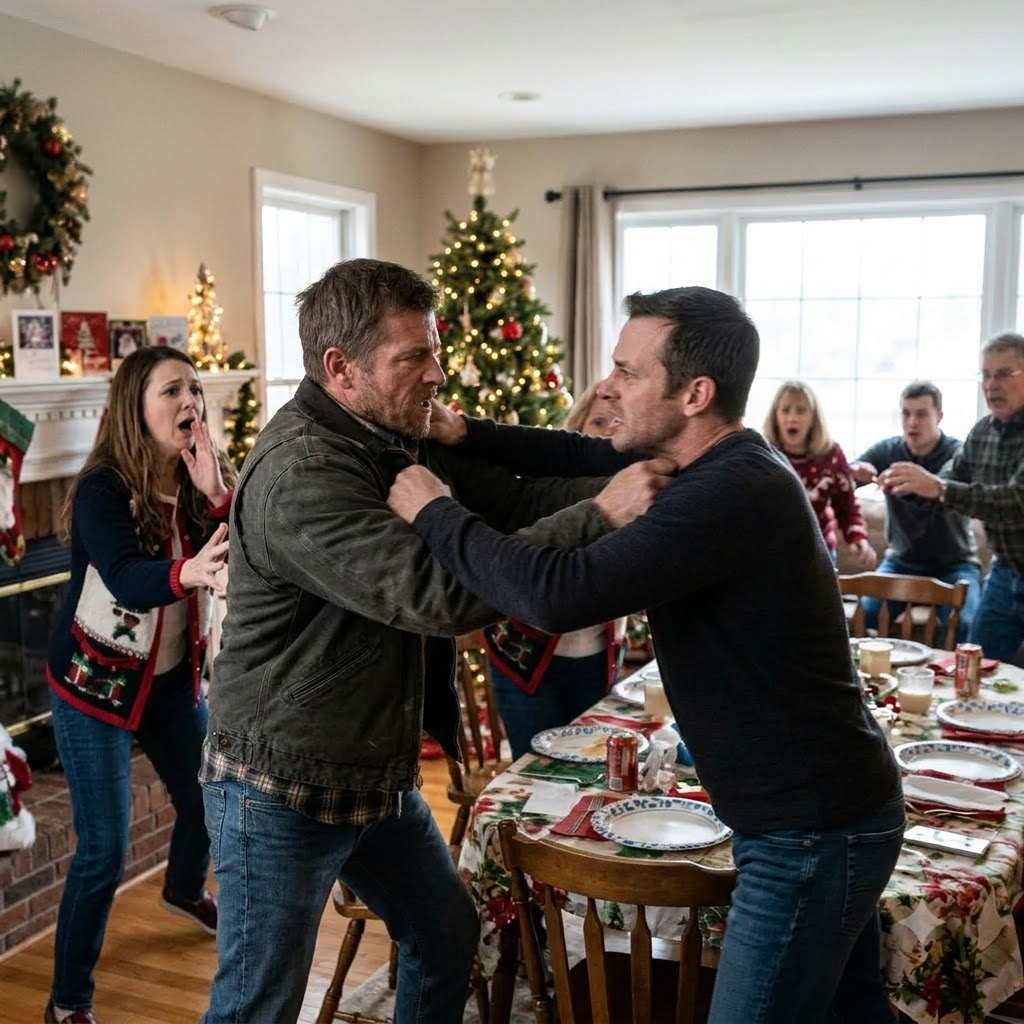
Through the front window, I could see my family gathered around the Christmas table. Travis was standing beside my mother, talking with his hands. She was nodding.
Emily wasn't sitting with them anymore.
I typed a message.
What does Mom know?
The three little dots appeared.
Disappeared.
Appeared again.
Then nothing.
I waited another thirty seconds before slipping my phone into my pocket.
I wanted answers.
But somewhere across town, an ambulance needed a clear road to the emergency entrance at St. Mary's Regional Hospital.
And unlike my family, the people waiting for that ambulance didn't have the luxury of turning a serious problem into a personal argument.
I climbed into my pickup, started the engine, and pulled away.
My mother's Christmas lights disappeared in the rearview mirror.
I didn't know it then, but that was the last time I'd see her house decorated for Christmas for a very long time.
The first truck I ever owned wasn't really a truck.
It was a Jeep.
A rusted, temperamental, twenty-year-old Jeep with a heater that worked only when it felt like it and a driver's-side door that needed a hard shove to close.
I bought it for $1,800.
At the time, that was almost everything I had.
I was thirty-two, working maintenance jobs and picking up whatever mechanical work I could find. I wasn't married. I didn't own a house. I rented a small apartment above a garage and kept my tools in the back of the Jeep because I couldn't afford a proper storage unit.
My mother called it embarrassing.
"You're a grown man, Michael," she told me when I brought it home. "When are you going to get a real career?"
I remember looking at the Jeep.
The faded paint.
The rust around the wheel wells.
The snowplow mount I'd purchased secondhand from a landscaping company.
"I think this might be the start of one."
She laughed.
Not cruelly, at least not that day.
But she laughed.
"Sweetheart, people don't build careers shoveling snow."
I didn't argue.
I'd learned early that arguing with my mother rarely changed her mind.
Instead, I went to work.
That first winter, I had seven residential driveways and one small commercial parking lot.
I charged less than I should have because I was desperate for customers.
I drove through the night, drinking gas-station coffee and listening to weather reports.
When the Jeep broke down, I fixed it.
When customers complained, I listened.
When snow stopped falling, I cleaned equipment, passed out business cards, and looked for maintenance work.
I didn't make much money.
But I made enough to keep going.
And that mattered.
My father understood.
He was a mechanic who believed that most problems could be solved with patience, preparation, and the right wrench.
One night, after my Jeep's alternator failed, I called him from a parking lot.
It was nearly midnight.
He arrived twenty minutes later carrying a toolbox and two cups of coffee.
He didn't lecture me.
He didn't ask why I hadn't bought something more reliable.
He just opened the hood.
We worked under the weak light of a gas-station sign until the engine started again.
When I thanked him, he shrugged.
"Just remember this feeling when somebody else needs help."
I never forgot that.
A few years later, when I hired my first employee, I made sure he had a reliable truck and proper winter gear before I bought anything nice for myself.
When I hired Marcus, I promised him that if he worked hard and treated customers honestly, he'd always know where he stood with me.
Marcus became more than an employee.
He became the person I trusted to run operations when I couldn't be everywhere at once.
And when my father died, Marcus was one of the men who helped carry his casket.
My mother never understood why that mattered.
To her, Marcus was somebody who drove a snowplow.
To me, he was somebody who had stood beside me when life got ugly.
There was a difference.
By the time I reached the company yard that Christmas Eve, snow was falling hard enough to blur the streetlights.
Our property sat behind an industrial supply warehouse on the edge of town.
It wasn't impressive.
A fenced lot.
A two-bay maintenance garage.
A small office with a coffee machine that made terrible coffee.
And nine trucks.
Nine trucks that had taken eleven winters to build.
Every one of them represented a decision I'd made when quitting would have been easier.
Unit One was a used Ford I'd bought after the Jeep finally became too expensive to keep running.
Unit Two nearly bankrupted me.
Unit Three was the first truck I purchased with money the business had actually saved.
Units Four and Five came after I won contracts with several medical offices and commercial properties.
The rest arrived slowly.
One winter at a time.
One contract at a time.
One repaired transmission, one insurance payment, and one sleepless night at a time.
I never woke up one morning suddenly successful.
There wasn't a magical investment.
There wasn't an inheritance.
Nobody handed me a check and told me to follow my dreams.
I built the company by learning how much everything cost.
Fuel.
Salt.
Equipment repairs.
Insurance.
Payroll.
Taxes.
Replacement blades.
Hydraulic fluid.
Tires.
The thousands of little expenses people never think about when they see a truck pushing snow across a parking lot.
Travis saw nine trucks.
He didn't see nine insurance policies.
Nine maintenance schedules.
Nine sets of registration fees.
Nine vehicles that could break down at the worst possible moment.
He didn't see the payroll I had to cover even when customers paid late.
And he certainly didn't see the nights I sat alone in the office wondering whether I could afford another employee.
He saw snow.
And decided it was child's work.
I parked beside Unit Nine.
Marcus was waiting near the garage.
He was forty-six, broad-shouldered, with a beard that always seemed to have grease in it.
He took one look at my clothes and frowned.
"You're dressed for Christmas dinner."
"I was at Christmas dinner."
He glanced at his watch.
"Didn't last long."
"Family discussion."
"That sounds dangerous."
"Financial discussion."
He winced.
"Worse."
Despite everything, I almost smiled.
Marcus handed me a radio.
"Hospital security called twice. The wind's pushing snow across the emergency approach faster than their maintenance crew can clear it."
"Ambulances?"
"One incoming. Another possible transfer later."
"What about the north route?"
"Dave's holding it. Luis is covering the outpatient lot. I'm going to work the main entrance."
I nodded.
"I'll take the emergency approach."
Marcus studied me for a moment.
"You okay?"
"Fine."
"That's not what I asked."
I pulled on my work gloves.
"My brother-in-law thinks this isn't a real business."
Marcus stared at me.
Then he looked toward the row of trucks.
Then back at me.
"Does he think those are Christmas decorations?"
I laughed.
It came out unexpectedly.
The first genuine laugh I'd had all evening.
"He wants me to co-sign a loan."
"How much?"
"One hundred sixty thousand."
Marcus stopped smiling.
"You're kidding."
"No."
"For what?"
"Construction equipment."
"Does he have contracts?"
"Not signed ones."
Marcus shook his head.
"Please tell me you didn't agree."
"I didn't."
"Good."
He turned toward the garage, then stopped.
"Mike?"
"Yeah?"
"Remember when we had to borrow money for the replacement spreader?"
I nodded.
It had been four years earlier.
A major piece of equipment failed during a storm, and replacing it immediately would have emptied our operating reserve.
I'd spent three days reviewing options before accepting a short-term equipment loan.
"Remember how many times you checked those numbers?" Marcus asked.
"About fifty."
"More like a hundred."
He pointed toward the trucks.
"You didn't build this place by signing things because somebody got emotional at Christmas dinner."
I looked at the yard.
Snow was collecting on the hoods.
The amber warning lights reflected off the wet pavement.
Somewhere inside the garage, a compressor started.
"Apparently, that's selfish."
Marcus snorted.
"Then selfish is keeping twenty people employed and ambulances moving."
I didn't answer.
Because hearing somebody say it out loud felt strangely uncomfortable.
I wasn't used to people defending what I'd built.
I was used to defending it myself.
We reached St. Mary's a little after eight.
The hospital sat on a rise above the main road, with a curved emergency entrance that became dangerous when wind pushed snow across the pavement.
I'd learned every trouble spot around that property.
The steep approach.
The narrow service lane.
The drainage area that froze first.
The loading entrance where drifting snow could block deliveries.
I'd learned them because hospitals didn't get to close when weather turned bad.
People still had heart attacks.
Babies still arrived early.
Cars still crashed.
And ambulances still needed somewhere to go.
The first time I contracted with St. Mary's, the facilities manager had asked me a simple question.
"Can you guarantee we'll stay accessible?"
I told him the truth.
"I can't guarantee the weather. But I can guarantee we'll be here working."
That answer got me the contract.
Keeping my word kept it.
I lowered the plow and started clearing the emergency approach.
Snow scraped against the blade.
The engine strained.
The truck shook as the plow caught a heavy ridge near the curb.
I adjusted the angle and pushed through.
For the next hour, I barely thought about Christmas.
There was too much to do.
Marcus called over the radio.
"Mike, security says the ambulance is five minutes out."
"Approach is open."
"Copy."
I made another pass.
Then another.
I cleared the turnaround, pushed accumulated snow away from the entrance, and checked the lane for ice.
A hospital security officer came outside and waved.
I lowered my window.
"How's it looking?"
"Good," I said. "Keep vehicles out of the outer lane until we finish salting."
He nodded.
"Appreciate you being here."
"No problem."
As he walked away, I thought about Travis.
Grown men build something.
I looked at the emergency entrance.
At the doors opening and closing.
At the nurses moving between vehicles.
At the ambulance approaching through the falling snow.
I wondered what Travis thought counted as building something.
A house?
A garage?
A commercial property?
Those things mattered.
Of course they did.
I'd never believed construction wasn't real work.
But I'd spent years building something too.
A business.
A team.
A reputation.
A service people depended on when conditions became dangerous.
And unlike Travis, I didn't need to make somebody else's work seem worthless to feel proud of my own.
The ambulance arrived at 8:47.
Its tires rolled across the cleared pavement.
Two paramedics jumped out.
Hospital staff came through the emergency doors.
A patient was moved inside.
I watched from the truck.
Then I returned to work.
Because another ambulance might be coming.
And the snow wasn't stopping.
Around ten, my phone rang.
Mom.
I let it go to voicemail.
Five minutes later, she called again.
I ignored it.
At 10:18, a text arrived.
You ruined Christmas for everyone.
I read it while waiting for a salt truck to finish a pass.
Then another message appeared.
Travis was deeply hurt by what you said.
I stared at the screen.
Deeply hurt.
The man who'd mocked my livelihood in front of the entire family was deeply hurt because I refused to guarantee his debt.
I set the phone down.
A minute later, it rang again.
This time, I answered.
"Mom, I'm working."
"You could at least have the decency to apologize."
I looked through the windshield.
Snow was blowing sideways across the hospital parking lot.
"Not tonight."
"Do you have any idea how embarrassed Travis was?"
"Do you have any idea where I am?"
"Don't change the subject."
"I'm at St. Mary's."
She sighed.
"Of course you are."
"The emergency entrance needs to stay open."
"Michael, you always hide behind work when something gets uncomfortable."
I closed my eyes briefly.
There were so many things I could have said.
I could have reminded her that my work paid my bills.
That it paid my employees.
That it supported families.
That it kept critical roads accessible.
But I knew none of those explanations would matter.
She wasn't calling to understand me.
She was calling to make me surrender.
"Mom," I said, "I'm not signing the loan."
Silence.
Then her voice turned cold.
"You don't even know what you're refusing."
"I know exactly what I'm refusing."
"Travis has a real opportunity."
"Then he needs a real business plan."
"He has one."
"Then he should be able to show it to a lender."
"You're being cruel."
"No. I'm being responsible."
She inhaled sharply.
"Your sister could lose everything if this doesn't work out."
I went still.
"What does that mean?"
There was a pause.
"Nothing."
"Mom."
"I mean Emily is counting on her husband to succeed."
"That's not what you said."
"Michael, don't start."
I remembered Emily's text.
There's something about that loan Travis hasn't told you.
I gripped the phone.
"Has Emily already put money into this?"
My mother didn't answer.
"Mom?"
"That's between Emily and her husband."
"How much?"
"I am not discussing their private finances with you."
I almost laughed.
She'd spent the evening demanding access to mine.
But suddenly, privacy mattered.
"Then stop asking me to guarantee them."
She made an angry sound.
"You've become a very hard man."
I looked toward the emergency entrance.
A nurse was helping an elderly patient out of a car.
The driver struggled to keep his footing on the pavement.
I watched a security officer hurry over to assist.
"No, Mom," I said quietly. "I've become a careful one."
She hung up.
I sat for a moment with the phone in my hand.
Then I opened Emily's messages.
Still no reply.
I typed:
Mom just said you could lose everything. What did she mean?
The message showed as delivered.
Nothing came back.
By midnight, the storm had become serious.
County crews were struggling to keep up.
Several smaller roads were nearly impassable.
Our radio traffic increased.
Dave needed help near a medical office.
Luis reported a mechanical issue with his spreader.
Marcus was coordinating trucks while trying to keep the hospital's main entrance clear.
I moved between the emergency approach and the ambulance turnaround, making pass after pass.
At 1:30, Unit Seven developed a hydraulic leak.
Marcus called.
"Mike, we've got a problem."
"How bad?"
"Pressure's dropping. Blade won't hold its angle."
"Bring it to the service entrance. I'll meet you."
We worked in the cold with portable lights shining across the engine compartment.
The hydraulic fitting had loosened.
Nothing catastrophic.
But enough to take a truck out of service if we ignored it.
I held the light while Marcus worked.
His gloves were soaked.
Snow collected on his shoulders.
After twenty minutes, we had the fitting secured and the fluid topped off.
Marcus climbed into the cab.
"Tell me again how this is a kid's job."
I shook my head.
"Don't start."
He grinned.
"Just saying. My kids would've quit two hours ago."
Then he drove away.
I stood beside the truck for a moment.
The wind cut through my jacket.
My boots were wet.
My back ached.
And I thought about how easily people dismissed work they didn't understand.
Most of the time, nobody noticed when we did our jobs correctly.
They noticed when we failed.
When a parking lot wasn't cleared.
When a road became impassable.
When somebody slipped.
When a delivery couldn't arrive.
Success in our business often meant nothing happened.
No accidents.
No delays.
No blocked entrances.
No emergencies made worse because the snow had won.
It wasn't glamorous.
But it mattered.
And I was proud of it.
At three in the morning, I finally had a few minutes to sit in the truck and drink coffee.
It had gone cold hours earlier.
I drank it anyway.
My phone showed several missed calls.
Two from Mom.
One from an unfamiliar number.
And one from Emily.
I immediately called her back.
No answer.
I tried again.
Voicemail.
I left a message.
"Em, it's me. I saw your texts. Call me when you can. I don't care about the argument. I just want to know you're okay."
I ended the call.
Then I stared at the unfamiliar number.
I considered calling it.
But before I could, Marcus came over the radio.
"Mike, hospital dispatch says another ambulance is inbound. Possible cardiac emergency. They're coming from the west side."
I put the phone down.
"Copy. I'll clear the approach."
The ambulance arrived twelve minutes later.
Its lights flashed against the snowbanks.
I pulled my truck aside as it passed.
A paramedic opened the rear doors.
Another jumped down carrying equipment.
They moved quickly.
I couldn't see the patient clearly.
I didn't need to.
The urgency was enough.
After the ambulance disappeared into the emergency bay, I made another pass through the entrance.
Then another.
The snow kept coming.
So did we.
By dawn, the storm had weakened.
The sky was turning pale gray.
The hospital entrance was open.
The ambulance lanes were clear.
The main parking areas were accessible.
Our crews were exhausted.
But we'd done what we promised.
I parked near the service entrance and stepped out to stretch my back.
My knees protested.
My hands felt stiff.
I hadn't slept.
I hadn't eaten since the few bites of dinner I'd managed before the argument.
And I smelled like diesel fuel and cold coffee.
A paramedic approached from the emergency entrance.
He was probably in his early thirties.
Dark circles sat beneath his eyes.
He looked as tired as I felt.
"Hey," he called.
I turned.
"Morning."
"You're with the plow company?"
"Yeah."
He walked over and offered his hand.
I shook it.
"I just wanted to say thanks."
"No problem."
He shook his head.
"No, seriously. We brought in three critical patients overnight. That entrance stayed clear the whole time."
I looked toward the hospital.
"That's what we're here for."
He held my gaze.
"People got here safely tonight because of your team."
For a moment, I couldn't speak.
Not because it was the first time somebody had thanked me.
It wasn't.
But because I'd spent Christmas Eve listening to people who supposedly loved me explain why my work didn't count.
And here was a stranger who'd spent the night trying to save lives, telling me that it did.
I nodded.
"Appreciate that."
He smiled tiredly.
"Merry Christmas."
"Merry Christmas."
He walked back toward the hospital.
I watched him go.
Then I stood beside my truck for another minute.
The engine idled.
Snow drifted gently from the roof of the emergency entrance.
Somewhere inside the building, people were waking up to a Christmas morning they might not have seen without the work of doctors, nurses, paramedics, dispatchers, maintenance crews, and countless others.
I was one small part of that.
And it was enough.
I didn't need Travis's approval.
I didn't need my mother's permission.
I didn't need a construction company to prove I was a grown man.
I needed to keep my promises.
That was all.
When I returned to the company yard, Marcus was waiting with two paper cups of fresh coffee.
He handed me one.
"Hospital called."
"Problem?"
"No. Compliment."
I took a sip.
"That's a nice change."
"They want us back next season."
I looked at him.
"We already have a multiyear agreement."
"Yeah, but the facilities director wanted to make sure you knew how much they appreciated the overnight coverage."
I nodded.
Marcus leaned against the truck.
"You should go home and sleep."
"After I check the maintenance logs."
He gave me a look.
"Mike."
"What?"
"You're the owner. You're allowed to rest."
"Somebody should tell my mother."
He laughed.
Then his expression softened.
"Seriously. Don't let those people get in your head."
I stared at the trucks.
Their plows were coated in ice.
Their tires were dirty.
Salt residue covered the lower panels.
They weren't beautiful.
But they were mine.
And every one of them had earned its place in that yard.
"I spent years thinking if I just worked hard enough, they'd eventually respect it," I admitted.
Marcus didn't interrupt.
"I thought maybe when I bought the third truck. Or when we got the hospital contract. Or when we hired more people."
I shook my head.
"Nine trucks later, I'm still the guy who pushes snow."
Marcus took a slow sip of coffee.
"Mike, some people don't want to respect what you built."
I looked at him.
"Why not?"
"Because then they'd have to admit they were wrong about you."
I didn't answer.
He pushed away from the truck.
"Go home."
This time, I listened.
My house was quiet when I arrived.
I lived in a modest three-bedroom home about fifteen minutes from the yard.
Nothing fancy.
A comfortable living room.
A kitchen I'd renovated myself.
A garage with enough tools to make most mechanics jealous.
And a small framed photograph of my father standing beside that original Jeep.
I'd kept the picture even after the Jeep was gone.
It reminded me where everything started.
I hung my coat, took off my boots, and walked into the kitchen.
There was a plate of leftover food in the refrigerator.
I heated it and ate standing at the counter.
Then I checked my phone.
No reply from Emily.
I opened our message thread.
Her words were still there.
There's something about that loan Travis hasn't told you.
And Mom already knows.
I thought about calling again.
Instead, I typed:
I'm home. I'm safe. Please call me when you're ready. Whatever's happening, you can tell me.
I set the phone down.
For the first time since leaving my mother's house, I let myself think seriously about the loan.
One hundred sixty thousand dollars.
That wasn't a small business favor.
That was a financial obligation large enough to damage everything I'd spent years building.
If Travis defaulted, I could be required to repay the debt.
If the lender pursued me, my personal savings could be at risk.
Depending on the agreement, other assets could become involved.
And even if I eventually recovered some of the money, the process could take years.
I'd seen good businesses damaged by bad guarantees.
I knew contractors who'd signed equipment loans based on future jobs that never materialized.
I knew a landscaper who lost his house after guaranteeing his partner's debt.
And I knew how easily family relationships could become poisonous when money was involved.
But something about Travis's request bothered me beyond the amount.
The urgency.
The fact that my information was already on the paperwork.
The way Mom insisted I sign before asking questions.
And Emily's frightened expression.
I remembered the moment Travis told her to sit down.
She had obeyed immediately.
That wasn't like my sister.
Emily had always been stubborn.
As a teenager, she'd argue with Mom for hours over the smallest things.
She'd once refused to attend a family wedding because she hated the dress Mom bought her.
She wasn't naturally timid.
Yet at Christmas dinner, she'd looked afraid to speak.
I stared at my phone.
Then I opened the contact information for Travis.
I hadn't called him in months.
We weren't close.
We never had been.
He was charming when he wanted something.
Friendly in public.
Always talking about his next big opportunity.
But he had a habit of describing plans as accomplishments.
A potential client became a major account.
A meeting with a lender became approved financing.
A conversation about buying equipment became the launch of a successful construction company.
I'd noticed it before.
I simply hadn't thought it was my responsibility to correct him.
Until he wanted my signature.
I put the phone down.
I wasn't going to call Travis.
Not yet.
I needed facts.
And I needed to hear from Emily.
I slept for four hours.
When I woke, Christmas afternoon sunlight was coming through the bedroom window.
My phone had twelve notifications.
Most were holiday greetings.
One was from Marcus.
Crew's home. All trucks accounted for. Get some rest.
I smiled.
Then I saw a message from Mom.
I hope you're happy. Emily cried after you left.
I read it twice.
My first instinct was guilt.
That old familiar feeling.
The one that made me want to fix everything.
Call Mom.
Apologize.
Smooth things over.
Make the discomfort disappear.
For years, I'd confused keeping the peace with doing the right thing.
But peace that required me to accept humiliation wasn't really peace.
It was compliance.
I set the phone aside.
Then I noticed a missed call from Emily.
It had come at 6:14 that morning.
While I was still driving home.
There was no voicemail.
I called her immediately.
She answered on the fourth ring.
"Michael?"
Her voice was barely above a whisper.
"Hey, Em."
"Are you alone?"
I sat up.
"Yeah. Why?"
A pause.
Then I heard movement on her end.
A door closing.
"Emily?"
"I'm sorry about last night."
"You don't need to apologize for Travis."
"I'm not apologizing for him."
Something in her voice made me stop.
"What are you apologizing for?"
She took a shaky breath.
"I knew they were going to ask you."
"I figured that out."
"No, Michael. I mean I knew before Christmas."
I waited.
"How long before?"
"Almost three weeks."
I stared at the wall.
Three weeks.
For three weeks, my family had been planning to ask me to guarantee a six-figure loan.
And nobody had bothered to call me.
"Why didn't you tell me?"
"Because Travis said you would overreact."
I closed my eyes.
"Of course he did."
"And Mom said it would be easier if we all talked in person."
"Easier for who?"
She didn't answer.
I softened my voice.
"Emily, what's going on?"
I heard her breathing.
Then she said something that made me sit completely still.
"Travis told me the bank already approved everything."
I frowned.
"That doesn't make sense."
"I know."
"If they approved it, why would they need me?"
"He said your signature was just a formality."
I rubbed my forehead.
"Emily, a guarantee isn't a formality."
"I know that now."
"Now?"
Her breathing changed.
I could hear her trying not to cry.
"Michael, I didn't understand what he was asking."
I stood.
"What did you sign?"
Silence.
"Emily."
"I thought it was just paperwork for the business."
My stomach tightened.
"What paperwork?"
"I don't know exactly."
"Did you read it?"
"Travis said the attorney had already reviewed everything."
I walked toward the kitchen.
"Did you sign anything connected to the loan?"
She hesitated.
"Yes."
I stopped walking.
"What did you sign?"
"I don't know."
"Emily, listen carefully. Did you sign a guarantee?"
"I don't think so."
"Did you put the house up as collateral?"
She began crying.
And suddenly, the conversation wasn't about Travis insulting me at Christmas dinner.
It wasn't even about my mother demanding money.
It was about my sister possibly risking her home without understanding what she'd agreed to.
"Emily," I said quietly, "I need you to find every document you signed."
"I can't."
"Why not?"
"Travis keeps them in his office."
"Then ask him for copies."
"He'll get angry."
I stared at the kitchen wall.
That sentence bothered me more than anything else she'd said.
"Emily, has he threatened you?"
"No."
"Has he hurt you?"
"No, Michael. Nothing like that."
"Then why are you afraid to ask about your own finances?"
She didn't answer.
I waited.
Finally, she whispered, "Because every time I ask questions, he tells me I'm ruining his chance to succeed."
I gripped the edge of the counter.
I wanted to drive straight to her house.
I wanted to confront Travis.
I wanted to demand every document he'd put in front of my sister.
But I knew anger wouldn't help her.
And I knew she needed to feel safe enough to keep talking.
"Listen to me," I said. "You haven't done anything wrong by asking questions."
She sniffled.
"Mom says I need to trust my husband."
"Trust doesn't mean signing things you don't understand."
"I know."
"Do you have access to your bank accounts?"
"Yes."
"Your mortgage statements?"
"Yes."
"Good. Don't sign anything else until you understand exactly what it is."
She was quiet for a moment.
Then she whispered, "Michael?"
"Yeah?"
"There's something else."
I felt my chest tighten.
"What?"
"Travis told Mom that if you refused to sign, he had another way to get the financing."
I frowned.
"What other way?"
"I don't know."
"Did he say who would guarantee it?"
"No."
"Did he mention another investor?"
"No."
I waited.
Emily lowered her voice.
"He said he already had everything he needed."
A cold feeling moved through me.
"Everything?"
"That's what he said."
I looked toward the framed photograph of my father beside the old Jeep.
Then I thought about the folder on my mother's table.
My name.
My address.
My business information.
All typed into a loan application I hadn't authorized.
"Emily," I said slowly, "did Travis ever ask you for any of my personal documents?"
She didn't answer immediately.
"Like what?"
"Tax returns. Bank statements. Copies of my driver's license. Anything with my signature."
I heard a sharp intake of breath.
Then silence.
"Emily?"
Her voice came back thin and frightened.
"Michael, last month Mom asked me to help her find some old family paperwork."
I didn't move.
"What kind of paperwork?"
"She said she needed copies of documents Dad had kept."
"Why?"
"I don't know."
"What documents, Emily?"
"I remember seeing some of your old business records."
My pulse quickened.
"Where?"
"In a box at Mom's house."
I stared at the phone.
Years earlier, when I first started the company, I'd used my parents' address for some paperwork because I didn't have a permanent business office.
I'd eventually updated everything.
But my father had kept copies of documents in his filing cabinet.
Insurance forms.
Old registration records.
Loan correspondence.
Even copies of signatures from equipment purchases he'd helped me review.
I had never thought much about those papers after he died.
They were old.
Outdated.
Mostly irrelevant.
At least, that's what I'd believed.
"Emily," I said, "did Travis see those documents?"
She started to answer.
Then stopped.
I heard a sound in the background.
A door opening.
Footsteps.
A man's voice.
"Emily? Who are you talking to?"
Travis.
My sister's breathing became shallow.
"Nobody," she said quickly.
I gripped the phone.
"Emily, don't hang up."
But her voice changed.
She sounded terrified.
"Michael, I have to go."
"Wait. Did Travis take any of those papers?"
Silence.
Then, barely audible, she whispered:
"He didn't just look at them."
I stood completely still.
"What do you mean?"
Her next words came so quietly I almost missed them.
"Mom gave him a folder with your name on it."
Then I heard Travis again.
Closer this time.
"Emily. Give me the phone."
There was a brief rustling sound.
A sharp breath.
And just before the call disconnected, I heard my brother-in-law say:
"Did you tell him about the signature?"






Comments 0