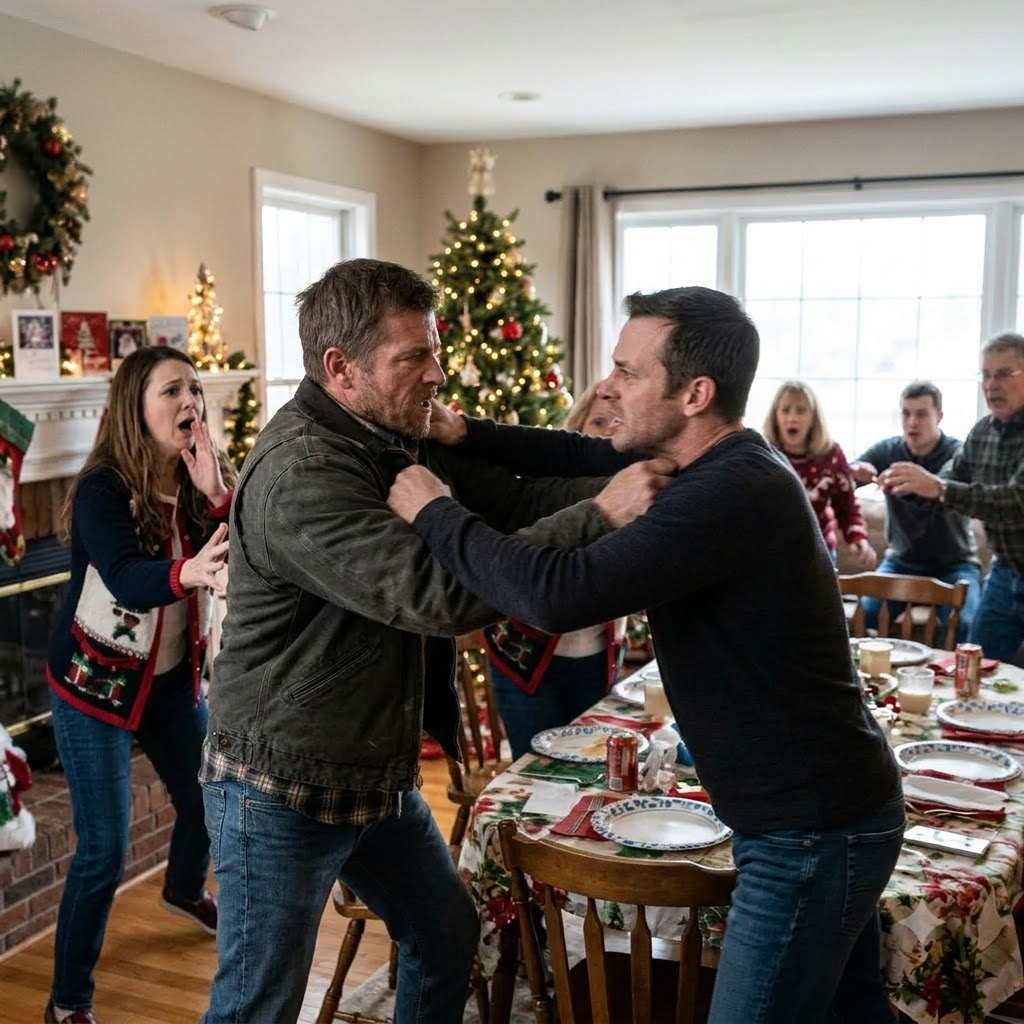
"Michael! Apologize to him right now!"
My mother slammed her hand against the Christmas dinner table so hard that a crystal glass tipped sideways.
I was standing across from my brother-in-law, Travis, when she shouted.
In his right hand was a glass of eggnog.
In my mother's left hand was a folder containing paperwork for a $160,000 business loan.
A yellow sticky note was attached to the front.
Two words were written on it.
Michael signs.
I hadn't agreed to anything.
And suddenly, I understood that nobody had invited me there to ask.
They had invited me there to collect my signature.
Ten minutes earlier, Travis had been laughing.
Not the kind of laughter that comes from hearing something funny.
The kind that comes from knowing you have an audience.
He stood beside my mother's dining table, holding his eggnog like he was giving a toast at a country club.
"Plowing snow is for kids," he announced. "Grown men build something."
He glanced around the room.
My sister, Emily, looked down at her plate.
My mother smiled.
And the relatives gathered around the Christmas table waited to see how I would react.
I was forty-three years old.
I owned nine snow removal trucks.
I'd spent eleven winters keeping the roads around St. Mary's Regional Hospital accessible during some of the worst storms Pennsylvania had seen.
I'd worked sixteen-hour shifts.
I'd slept in truck cabs.
I'd repaired hydraulic lines with fingers so cold I could barely move them.
I'd built a company from a rusted Jeep that most people would have sold for scrap.
But apparently, according to Travis, I was still a child playing in the snow.
I looked at him.
Then I looked at the folder my mother had pushed toward me.
"Then don't ask a kid to co-sign your loan."
Nobody laughed.
Travis's smile disappeared so quickly it was almost satisfying.
Almost.
But satisfaction wasn't what I felt.
I felt tired.
Not physically tired. I knew what physical exhaustion felt like. I'd worked through enough blizzards to recognize it.
This was something different.
I was tired of sitting at family tables where everything I'd accomplished became smaller the moment somebody else needed something from me.
My mother was the first to recover.
"Michael!"
She slapped the table.
"Apologize!"
I looked at her.
"For what?"
"For embarrassing Travis in front of everyone!"
I glanced toward my brother-in-law.
He had stopped holding his eggnog like a trophy.
Now he was gripping the glass.
"Mom," I said, "he just called my business a child's job."
"He was joking."
"Was he?"
"Don't be so sensitive."
There it was.
The sentence I'd heard in one form or another since childhood.
Don't be so sensitive.
Don't make a scene.
Don't take things personally.
Don't embarrass the family.
Funny how those rules always applied to me.
Never to the people insulting me.
Travis cleared his throat.
"Look, Mike, I wasn't trying to start anything."
I waited.
He shrugged.
"I'm just saying there's a difference between moving snow and building an actual company."
I stared at him.
"An actual company?"
"You know what I mean."
"No. Explain it."
Emily shifted uncomfortably in her chair.
"Michael, please."
But I kept looking at Travis.
He gestured with his glass.
"Construction creates things. Houses. Buildings. Something permanent. That's what I'm trying to do."
"And snow removal doesn't create anything?"
He rolled his eyes.
"Come on."
"Tell that to the paramedics who need an open emergency entrance at three in the morning."
My mother sighed loudly.
"Nobody is saying your work isn't useful."
"That's exactly what he's saying."
"Michael, you're making this difficult."
I looked down at the folder.
A bank logo was printed across the top.
Below it was a business financing application.
The requested amount was $160,000.
And there, beneath the section marked Additional Guarantor, was my name.
Not handwritten.
Typed.
Michael.
My full legal name.
My home address.
My business address.
I felt something cold settle in my stomach.
"Who filled this out?"
Nobody answered.
I picked up the first page.
"Mom?"
She folded her arms.
"Travis needed to get the paperwork started."
"With my information?"
"He needed to show the bank he had family support."
I turned toward Travis.
"You gave the bank my information before asking me?"
He lifted one shoulder.
"It wasn't a big deal. Nothing's final until you sign."
I studied his face.
He genuinely believed that explanation should settle everything.
I flipped through the pages.
The loan was intended for construction equipment.
An excavator.
A skid steer.
A trailer.
Additional operating capital.
I understood the basic idea.
Equipment could help a contractor take on larger jobs.
But equipment didn't create customers.
It didn't guarantee contracts.
And it certainly didn't pay monthly installments when a business had no work scheduled.
I knew that because I'd spent years learning the difference between owning equipment and running a profitable company.
The first winter I bought my second truck, I nearly went broke.
I had two vehicles, three commercial accounts, and a payment schedule that depended on snowfall.
Then February came with almost no snow.
The bills didn't care.
Insurance didn't care.
The bank didn't care.
I'd spent that month working nights repairing equipment for another contractor just to make payroll.
It was one of the most frightening periods of my life.
And one of the most valuable.
Because I learned that revenue wasn't the same thing as cash flow.
And ambition wasn't the same thing as a business plan.
I looked at Travis.
"How many signed contracts do you have?"
He frowned.
"What?"
"Construction contracts. Customers who have committed to paying you."
"I'm talking to several people."
"How many have signed?"
He glanced at Emily.
"That's not really the point."
"It is if I'm guaranteeing the loan."
My mother leaned forward.
"Michael, don't interrogate him."
"I'm asking a basic business question."
"He's your brother-in-law."
"That doesn't answer it."
Travis set his glass down.
"I have projects lined up."
"Signed?"
"Potential projects."
"So none."
His expression hardened.
"You don't understand construction."
"Then explain it."
"That's what I'm trying to do."
"How much do you have in savings?"
He looked offended.
"Excuse me?"
"How much of your own money are you putting into this?"
"That's personal."
"So is my credit."
My mother made a sharp noise.
"Enough!"
I turned toward her.
She was sixty-eight, and she had a particular expression she used whenever she expected a conversation to end.
Her chin lifted.
Her mouth tightened.
Her eyes narrowed just enough to make it clear that disagreement would be treated as disrespect.
I'd known that expression my entire life.
When I was twelve, it meant I had to give my sister the larger bedroom because she needed more space.
When I was seventeen, it meant I had to cancel a weekend job to help with a family event.
When I was twenty-six, it meant I was selfish for refusing to lend money I didn't have.
At forty-three, apparently, it meant I was expected to guarantee $160,000 because my brother-in-law had decided he wanted construction equipment.
"Your sister has a family to think about," Mom said.
I looked at Emily.
She sat quietly with both hands folded in her lap.
Her eyes were fixed on the tablecloth.
"Emily," I said, "do you know what co-signing means?"
She nodded without looking up.
"Of course."
"Then you know if Travis can't make the payments, the lender can come after me."
Travis scoffed.
"Nobody's coming after you."
"That's the entire reason they want a guarantor."
"The business is going to make money."
"Then why won't the bank approve it without me?"
Silence.
I watched him carefully.
For a second, I thought he might actually answer.
Instead, he laughed.
"See? This is what I'm talking about."
"What?"
"You think small."
I stared at him.
He spread his hands.
"You've spent your whole life worrying about what might go wrong. That's why you're still driving trucks around in the snow."
Something moved behind my ribs.
Not anger.
Recognition.
I'd heard this before.
Different words.
Different years.
Same message.
My work wasn't impressive enough.
My sacrifices weren't important enough.
My success wasn't respectable enough.
But my money?
That was apparently respectable.
My mother pushed the folder closer.
"Michael, you have a successful business. You own all those trucks. You can afford to help."
"That's not how guarantees work."
"You're being dramatic."
"No, Mom. I'm being careful."
She leaned back.
"Your father would have helped his family."
That one landed.
My father had been dead for nine years.
He'd been a mechanic.
A quiet man with permanently stained hands and a habit of fixing things long after other people would have thrown them away.
He was the person who'd taught me how to change brake lines.
How to listen to an engine.
How to keep working when something broke at the worst possible time.
He'd also been the first person to tell me that owning a business meant learning how to say no.
I remembered him standing beside my first Jeep, looking at its rusted fenders.
"That thing's ugly," he'd said.
I laughed.
"Thanks, Dad."
"But if it runs and somebody pays you to use it, you've got a start."
He'd tapped the hood.
"Just don't confuse being busy with making money."
I never forgot that.
And I wasn't going to let my mother use his memory to pressure me into ignoring everything he'd taught me.
"Dad would have asked to see the numbers," I said.
Her expression changed.
"Don't tell me what your father would have done."
"Then don't use him to make your argument."
Emily whispered my name.
I looked at her.
She seemed close to tears.
"Can we please just have Christmas dinner?"
I wanted to say yes.
I wanted to sit down.
Eat the turkey.
Talk about ordinary things.
Ask how everyone was doing.
Pretend, for one evening, that my family could enjoy being together without turning my financial situation into a group discussion.
But the folder was still on the table.
And my name was still printed on it.
"Emily," I said gently, "did you know they were going to ask me tonight?"
She didn't answer.
That was answer enough.
I looked around the room.
Nobody met my eyes.
The relatives who had been chatting comfortably twenty minutes earlier now seemed fascinated by their plates.
The Christmas tree lights blinked softly in the corner.
A holiday song played from a small speaker near the fireplace.
Somebody had left a serving spoon in the mashed potatoes.
Everything looked normal.
Everything felt wrong.
I picked up the folder.
My mother straightened.
"Good. Just sign where they've marked it."
I looked at her.
"I'm not signing."
Her smile vanished.
"What?"
"No."
Travis laughed sharply.
"You haven't even heard the full plan."
"I've heard enough to know I need financial statements, signed contracts, and a realistic repayment plan before I'd consider anything."
Mom shook her head.
"You always make everything complicated."
"That's what happens when someone asks you to risk $160,000."
"You're not risking anything. Travis will make the payments."
"Then the bank shouldn't need me."
Travis stepped closer.
"You're really going to do this?"
"Do what?"
"Stand there and act like you're better than me?"
I looked at him for a long moment.
"I haven't said I'm better than you."
"You think because you've got a few trucks—"
"Nine."
He blinked.
"What?"
"I have nine trucks."
He rolled his eyes.
"Fine. Nine snowplows. Congratulations."
I nodded.
"Thank you."
His face reddened.
"You're unbelievable."
I didn't respond.
Because there was nothing left to say.
The discussion had never been about whether I could help.
It was about whether I would obey.
I set the folder down.
Carefully.
Then I reached for my coat.
My mother stood.
"Where are you going?"
"Home."
"We haven't eaten dessert."
"I'm sure you'll manage."
"Michael."
I slipped one arm into my coat.
Her voice sharpened.
"If you walk out that door, don't expect another invitation next Christmas."
I stopped.
Not because I was frightened.
Because I wanted to make sure I'd heard her correctly.
I turned.
"You're telling me that if I don't guarantee Travis's loan, I'm not welcome here next year?"
"That's not what I said."
"It's exactly what you said."
She looked around the room, as though someone might rescue her from the words she'd just spoken.
Nobody did.
Travis folded his arms.
"Maybe it's time somebody taught you that family means something."
I looked at him.
"Family does mean something."
"Then prove it."
I picked up my keys.
"Not with a signature on a loan you can't qualify for."
His face darkened.
For a moment, I thought he might step toward me.
But he didn't.
Instead, he reached for his eggnog.
A strange little gesture.
As though having something in his hand made him feel important again.
I turned toward the door.
Emily rose halfway from her chair.
"Michael, wait."
I paused.
She looked at Travis.
Then at Mom.
Then back at me.
There was something in her expression I couldn't quite understand.
Fear, maybe.
Or guilt.
"Can I talk to you?" she whispered.
Before I could answer, Travis said, "Emily, sit down."
She froze.
I looked at him.
He stared back.
And suddenly, for the first time that evening, I wondered whether the loan was the only thing my sister was afraid of.
"Emily?" I said.
She opened her mouth.
Then closed it.
Mom stepped between us.
"Enough drama for one night."
I looked at my sister one last time.
She lowered her eyes.
I walked toward the front door.
Behind me, Travis muttered something about selfish people.
I ignored him.
My hand was already on the doorknob when my phone vibrated.
The screen lit up.
Marcus.
My operations supervisor.
He almost never called on Christmas Eve unless something was wrong.
I answered.
"What's happening?"
His voice came through fast.
"Mike, the storm's moving harder than forecast. We've got a problem near St. Mary's."
I straightened.
"What kind of problem?"
"The emergency entrance is drifting shut. County trucks are tied up on the highway, and dispatch says another ambulance is coming."
I looked back toward the dining room.
My mother was still standing beside the folder.
Travis was pouring himself more eggnog.
Emily was staring at me.
Marcus kept talking.
"I can send one of the north-route trucks, but it'll leave the hospital approach exposed."
I didn't hesitate.
"Keep the north truck where it is. I'll take Unit Nine."
"You sure? It's Christmas Eve."
"Marcus."
"Yeah?"
"People don't stop needing hospitals because it's Christmas."
I ended the call.
My mother frowned.
"Who was that?"
"Work."
She threw up her hands.
"Of course it was."
I opened the door.
Cold air hit my face.
Behind me, she called out, "Michael, we're not finished discussing this!"
I looked over my shoulder.
"Yes, Mom. We are."
Then I stepped outside.
I had no idea that the folder I'd left on her dining table would eventually become part of something much bigger than an argument.
I didn't know that Travis's business was already in worse condition than he'd admitted.
And I certainly didn't know that, one year later, my mother would walk into my office carrying a letter that could threaten everything I'd spent eleven winters building.
At that moment, all I knew was that the hospital needed another truck.
I crossed the driveway and reached for my vehicle.
Then my phone vibrated again.
This time, it wasn't Marcus.
It was a text from Emily.
Michael, please don't leave yet. There's something about that loan Travis hasn't told you.
Before I could type a response, another message appeared.
And Mom already knows.






Comments 0