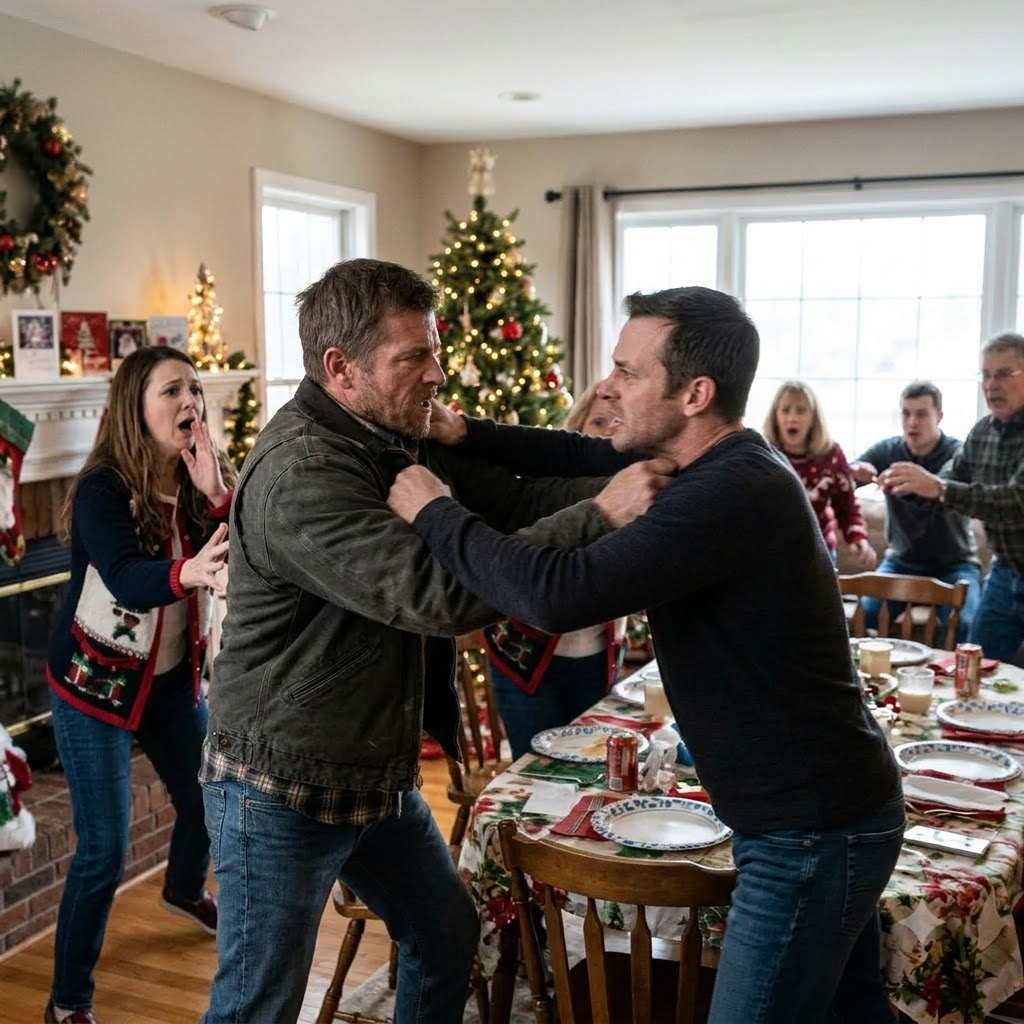
"Michael, put that letter down. Your father didn't write the second page."
Uncle Raymond stood in the conference room doorway, breathing hard.
Snow melted from his coat onto Daniel's carpet.
Nobody moved.
My mother had one hand pressed against her mouth. The two representatives from the financial institution sat perfectly still. Daniel remained beside me, his fingers resting on the edge of the letter.
I looked at Raymond.
"How do you know?"
He swallowed.
"Because I wrote it."
For a moment, the room seemed to tilt.
I looked down at the paper.
The first page was in Dad's handwriting. I recognized the slant of his letters, the way he pressed too hard on certain words, the little hook he put on the end of my name.
The second page looked similar.
But not identical.
Raymond stepped forward.
"I didn't forge your brother's signature," he said, looking at Mom. "I never said I did."
Mom started crying.
Daniel raised his hand.
"Raymond, before you say anything else, I need to understand why you're here."
Raymond looked toward the institution's attorney.
"They called me yesterday. Asked about the old North Ridge records."
"Did they ask you to attend this meeting?"
"No."
"Then how did you know we were here?"
Raymond hesitated.
"Carol told me."
I turned toward Mom.
She lowered her eyes.
Of course she had.
Even now, after everything, my mother had reached for the same people who'd helped bury the truth.
I looked at Raymond.
"Sit down."
He blinked.
"Michael—"
"Sit down, Raymond."
He pulled out a chair.
For years, he'd spoken to me like I was still the teenager who borrowed his socket wrench and forgot to return it.
That morning, he didn't argue.
Daniel looked at the institution's representatives.
"Given the nature of these statements, I suggest we pause any substantive questioning until everyone has appropriate counsel."
The attorney nodded.
Mom's lawyer leaned toward her.
Raymond looked around the room.
"I don't need a lawyer."
Daniel's expression didn't change.
"You should seriously consider getting one."
Raymond stared at the table.
Then nodded.
But before anyone could end the meeting, I pointed at the first page.
"Did Dad write this?"
Raymond looked at it.
"Yes."
"All of it?"
"The first page. Yes."
I looked at the second.
"And you wrote that?"
He nodded.
"Years later."
"Why?"
His eyes filled.
"Because your father asked me to keep a record."
I stared at him.
"Then why did you make it look like his handwriting?"
Raymond looked down.
"Because I thought you'd pay more attention if you believed it came from him."
I felt anger rise so quickly I had to grip the edge of the table.
"He's been dead nine years."
"I know."
"You used his handwriting."
"I know."
"You let me believe he was warning me from the grave."
Raymond's face crumpled.
"I'm sorry."
I looked at him.
"Don't apologize yet."
The room went silent.
"Tell me the truth first."
We didn't continue that conversation in front of the lender's representatives.
Daniel arranged for the meeting to end, preserved copies of the documents, and made sure everyone understood that the disputed papers would be handled through counsel and the investigators.
Raymond eventually agreed to speak with his own attorney.
Two days later, his attorney arranged a recorded interview with Investigator Price.
I wasn't present.
But over the following weeks, Daniel received enough verified information to explain what had happened.
Dad had discovered problems with North Ridge before he died.
Not a murder plot.
Not a secret fortune.
A business problem.
Raymond and Dad had formed North Ridge to acquire and lease equipment. At first, it was a modest arrangement. They purchased used machinery, rented it to contractors, and tried to earn enough to cover the financing.
Then one contractor failed to pay.
Another piece of equipment broke down.
North Ridge began falling behind.
Raymond brought in Robert Hensley, a financing consultant who promised to restructure the obligations.
Hensley requested old agreements, signatures, and account records.
Dad grew suspicious when he discovered that a document carrying my name had been included in a financing file.
I had signed a legitimate equipment agreement for my own truck.
Nothing more.
But somebody had copied that agreement into North Ridge's records and treated my signature as evidence of a broader business relationship.
Dad objected.
He wrote the first page of the letter.
He told Raymond to correct the records.
He insisted that my company had no obligation to cover North Ridge's debts.
And then he died.
Not because of North Ridge.
Not because somebody killed him.
His death had been a medical tragedy, exactly as we'd been told.
Raymond had invented the murder story because he was frightened that the investigators would uncover his own role in the financial mess.
That lie had sent me searching for a crime that never happened.
Meanwhile, the real misconduct was sitting in bank files and old folders.
When Daniel told me, I sat in his office for a long time.
"So Dad knew someone was using my name."
"Yes."
"But he didn't know how far it would go."
"That's what the records suggest."
I looked at the authenticated first page of Dad's letter.
"And Raymond added the second page later."
"Yes. He used old handwriting samples and included information he gathered from later account records."
I closed my eyes.
"Was the name on that transfer list real?"
Daniel nodded.
"The transfers were real. But the second page was not your father's work."
I took a breath.
"Whose name was it?"
Daniel looked at me.
"Carol's."
I stared at him.
Mom.
Again.
But this time I didn't feel surprise.
Only sadness.
The truth about the $42,000 inheritance was ugly.
And ordinary.
After Dad died, Mom had been frightened about money.
There were house repairs.
Medical bills.
Taxes.
Expenses she hadn't understood while Dad was alive.
Instead of asking for help, she took the estate distribution intended for me.
She signed my name to an acknowledgment.
The money entered an account she controlled.
At first, she used some of it for legitimate household expenses.
Then she began treating the account as a reserve.
When Raymond asked for help with North Ridge, she transferred money.
When Travis's construction business started struggling, she transferred more.
Over the years, the original $42,000 became tangled with other deposits and withdrawals.
The $18,000 transfer we'd discovered months earlier was one of the later movements from that account into Travis's company.
It wasn't a separate inheritance.
It wasn't a gift from Dad.
It was money Mom had never properly accounted for.
The bank records showed the transfers.
Mom's own statements explained why she'd made them.
And Raymond's records confirmed that he knew the money hadn't been distributed to me.
He hadn't taken the entire inheritance himself.
But he'd known enough to stop it.
He hadn't.
When Daniel explained that part, I stared at the window.
"She could have asked me."
"Yes."
"I would have helped her."
Daniel was quiet.
I shook my head.
"I was working sixteen-hour days back then. I didn't have much. But I would have helped."
"I believe you."
I looked at him.
"Instead, she stole from me."
Daniel didn't soften the word.
"She admitted taking funds that belonged to you and signing your name without authorization."
I nodded.
There were legal consequences to consider.
There were repayment arrangements to negotiate.
There were decisions about whether the estate needed to be reopened or corrected.
But the hardest part wasn't the money.
It was knowing that Mom had watched me struggle through those early winters while keeping something Dad had left me.
She'd called my business childish.
She'd told me to get a real job.
And she'd used money that could have helped me buy equipment, hire employees, and build the very company she mocked.
I thought about the old Jeep.
The freezing mornings.
The nights I slept in the office because I couldn't afford to stop working.
I thought about Dad.
Then I said, "I want the accounting corrected."
Daniel nodded.
"And I want repayment handled properly."
"Understood."
I looked at him.
"But I'm not going to pretend this was a misunderstanding."
He closed the folder.
"Neither should you."
The $147,600 demand took longer to resolve.
The institution had to review years of North Ridge records.
Its attorneys examined the original financing agreements.
The signature examiner compared my genuine equipment agreement with the disputed guaranty pages.
The technical findings were decisive.
The signature appearing on the newer documents had been reproduced from the old agreement.
The same defects appeared in both images.
The same broken ink line.
The same scanning marks.
The same tiny distortion near the final letter.
Those details didn't occur naturally when someone signed their name twice.
They occurred when an image was copied.
The document dated last Christmas Eve was especially damaging.
Its supposed notarization used a commission that had expired before the stated signing date.
The related electronic records showed that materials had been assembled and transmitted through accounts connected to Hensley's consulting work.
There was no credible evidence that I had personally executed the guaranty.
The purported certificate bearing Dad's signature three years after his death was also rejected as authentic proof of a new obligation.
Margaret's original draft had described Dad as a historical signatory.
Later versions changed that wording.
Hensley had directed revisions.
Raymond had supplied old documents.
Travis had provided business information and equipment schedules.
Mom had signed some papers and witnessed others.
Different people had played different roles.
But none of that gave anyone the right to sign for me.
One Thursday afternoon, Daniel called me to his office.
He had a letter waiting.
This time, the envelope was addressed correctly.
To me.
At my business.
I sat across from him.
"What's this?"
"The institution's formal determination."
I looked at the envelope.
My hands were steady.
That surprised me.
A year earlier, I'd been afraid to open almost any piece of financial mail.
Now I wanted to see exactly what it said.
I removed the letter.
Read the first paragraph.
Then the second.
Then I stopped.
The institution had withdrawn its claim that I was personally liable for the $147,600 balance.
It confirmed that the disputed guaranty documents would not be enforced against me.
It also confirmed that it was not asserting a security interest in my company's trucks or equipment based on those documents.
I read the words again.
Then looked at Daniel.
"It's over?"
He smiled slightly.
"This claim against you is resolved."
I stared at the page.
"Completely?"
"As to the institution's asserted personal liability and collateral claim described here, yes. We've also obtained the related release and correction confirmations."
I leaned back.
For a moment, I couldn't speak.
The number had lived in my head for months.
$147,600.
I'd seen it when I closed my eyes.
I'd thought about it while checking invoices.
While paying employees.
While watching the weather.
While driving past the hospital.
Now the institution was saying the debt wasn't mine.
I looked down at the letter.
Then laughed.
Just once.
A short, exhausted sound.
Daniel smiled.
"You can breathe, Michael."
I hadn't realized I'd been holding my breath.
The $160,000 loan application was resolved separately.
The lender completed its investigation into the proposed guaranty.
It confirmed that I had never become an authorized guarantor on the loan.
The application had relied on false or unsupported information, including outdated financial records and a telephone contact that had not been verified as mine.
The financing was not approved on the terms Travis had sought.
The lender corrected its records and provided written confirmation that I had no obligation under that application.
Rebecca Hale called me personally.
"I wanted you to hear it from me," she said.
I was standing in the garage when she called.
A mechanic was testing a plow motor behind me.
"Thank you."
"I'm sorry your information was used this way."
I looked toward the trucks.
"Me too."
She paused.
"Your refusal to sign was the right decision."
I smiled faintly.
"Didn't feel like it at Christmas."
"I imagine not."
I looked out at the snow-covered yard.
"No," I said. "It definitely didn't."
We ended the call.
I stood there for a moment.
Then Marcus walked over.
"Good news?"
I nodded.
"The $160,000 loan isn't mine."
He grinned.
"Wasn't yours yesterday either."
I laughed.
"Yeah."
He clapped me on the shoulder.
"But now you've got it in writing."
I nodded.
"Exactly."
The hospital investigation ended without finding that my company had diverted hospital payments.
The suspicious vendor authorization had been created using hospital branding and business information without proper approval.
The hospital's procurement records showed that the proposed arrangement had never been authorized through its required process.
No legitimate hospital payment had been redirected to Travis under that document.
But the false paperwork had been included in financing materials as evidence of expected revenue.
That was why investigators had come to my office with a warrant.
My company appeared in the records.
They needed to determine whether I had participated.
The GPS logs, dispatch records, invoices, bank statements, and employee communications established that our work was real and our billing was legitimate.
We had plowed the hospital's emergency access roads.
We had submitted accurate invoices.
We had received payment for services actually performed.
Nothing more.
When the hospital's facilities director called, I expected an awkward conversation.
Instead, he said, "Michael, I wanted to thank you."
I sat forward.
"For what?"
"For cooperating with the review. And for keeping our access roads open through all of this."
I looked toward the window.
Snow was falling.
"That's our job."
"I know," he said. "You do it well."
He paused.
"We'd like to discuss the next contract renewal."
I smiled.
"I'd be happy to."
The following month, St. Mary's renewed our snow and ice management agreement.
The new contract included expanded service coverage and clearer payment controls.
It was the largest hospital agreement we'd ever signed.
When I told Marcus, he stared at me.
Then he laughed.
"Nine trucks."
I smiled.
"Nine trucks."
"Remember when your uncle said nobody would ever take this business seriously?"
I nodded.
Marcus looked toward the yard.
"Well, somebody forgot to tell the hospital."
Travis's business didn't survive.
By the time the investigations were finished, the company had lost major customers, defaulted on several obligations, and stopped operating.
Equipment was returned or sold through the appropriate processes.
Creditors pursued legitimate claims against the responsible parties.
The records showed that Travis had used new advances to cover older debts, represented projected revenue as though it were more certain than it was, and submitted misleading information about equipment access and business arrangements.
Hensley's role was also examined.
Investigators traced payments for document preparation and identified altered certifications that had been used to support financing applications.
Eventually, criminal charges were filed against Travis and Hensley in connection with specific fraudulent submissions.
Raymond faced consequences for his own false statements and document-related conduct.
Margaret's concealed relationships and preparation of the earlier draft were examined too. Her cooperation and original files helped establish what had been changed after her work.
I didn't attend every hearing.
I didn't want my life to become a courtroom schedule.
But I followed the cases through Daniel.
Travis ultimately entered a guilty plea to charges arising from the false financing documents.
Hensley also accepted responsibility for his part in preparing and submitting altered records.
The court imposed sentences and restitution obligations according to the offenses established.
No one went to prison because they had mocked my snowplows.
No one was punished for running a business that failed.
The consequences came from what they did after the business began failing.
The lies.
The false signatures.
The misleading applications.
The money obtained through representations that weren't true.
When Daniel told me the outcomes, I sat quietly.
"How do you feel?" he asked.
I thought about it.
"Relieved."
He nodded.
"Anything else?"
I looked at Dad's photograph on my desk.
"Sad."
Daniel waited.
"I spent years thinking Travis was just arrogant. Then I spent a year wondering whether he'd destroy my business."
I shook my head.
"Now I know he destroyed his own."
Daniel closed the file.
"That's a difficult thing to watch."
I nodded.
"Yeah."
I didn't celebrate Travis's conviction.
But I didn't feel responsible for it either.
He'd made his choices.
I had finally stopped paying for them.
Emily rebuilt her life slowly.
She moved into a small apartment near her work.
She hired an attorney.
She reviewed every account and document bearing her name.
The investigation established that she'd authorized the $7,500 consulting payment through the joint account, believing Travis's explanation that it was a legitimate restructuring expense.
The electronic signature image on the authorization had been attached through a business document process Travis controlled.
There was no evidence that Emily had knowingly approved the forged guaranties or the false certificate involving Dad.
She cooperated fully.
Her marriage ended.
It hurt her.
I could see that.
There were days when she looked exhausted.
Days when she questioned every decision she'd made.
But she began making decisions for herself again.
She found a better job.
She started saving.
She stopped apologizing every time she asked a question.
One afternoon, she came to the yard carrying two coffees.
I was checking a salt spreader.
She handed me one.
"Peace offering."
I smiled.
"For what?"
She looked toward the trucks.
"For eleven years of acting like this was a hobby."
I laughed softly.
"You weren't the worst one."
She gave me a look.
"That's not a defense."
I nodded.
"Fair."
She stood beside me.
A plow truck rolled across the lot.
The driver waved.
Emily waved back.
Then she said, "I never understood how much work went into this."
I looked at her.
"Most people don't."
She nodded.
"Nine trucks. Employees. Contracts. Maintenance. Insurance. Weather reports. Payroll."
I smiled.
"Don't forget coffee."
She laughed.
"Right. Coffee."
We stood quietly for a moment.
Then she said, "Dad would have loved this."
I looked toward the garage.
"Yeah."
She touched my arm.
"He always knew."
I swallowed.
"Yeah," I said. "He did."
Mom's situation took longer.
The $38,400 default on her home-secured loan didn't disappear because the other documents were fraudulent.
She had borrowed that money.
She had signed the loan.
She had used it to help Travis.
The obligation was real.
But her attorney negotiated with the lender, reviewed the charges, and helped her establish a repayment plan.
The threatened foreclosure did not proceed.
Mom kept the house.
Not because I secretly paid the debt.
Not because another relative signed a new guarantee.
Because she finally faced the numbers and accepted a plan she could manage.
She sold some things she no longer needed.
Reduced expenses.
And stopped giving money to anyone who promised a miracle.
The $42,000 estate distribution was handled separately.
With counsel and a complete accounting, Mom acknowledged the amount owed to me.
The estate records were corrected.
We agreed to a documented repayment arrangement that recognized what she'd taken without forcing an immediate sale of the house.
I didn't forgive the debt.
I didn't pretend the signature was hers to use.
But I also didn't want revenge.
I wanted the truth recorded.
I wanted the money accounted for.
And I wanted the next generation of our family to understand that love didn't give anyone permission to take what belonged to somebody else.
Mom made the first payment herself.
She brought it to my office in an envelope.
I looked at it.
"Mom, you could have mailed this."
She nodded.
"I know."
She sat across from me.
The same chair she'd occupied the morning she brought the $147,600 letter.
Only this time, she didn't ask me to sign anything.
She didn't bring Travis's problems.
She didn't ask for money.
She just sat.
Then she said, "I owe you more than this."
I looked at the envelope.
"Yes."
Her eyes filled.
"I know."
I waited.
She took a breath.
"Michael, I was wrong about your business."
I looked up.
She continued.
"I used to think it was something you would grow out of."
I didn't answer.
"I thought you were wasting your potential."
She swallowed.
"Your father told me I was wrong."
My throat tightened.
"When?"
"All the time."
I stared at her.
She smiled sadly.
"He said you understood something most people didn't."
I looked down.
"What?"
"That honest work doesn't have to impress anybody."
For a moment, I couldn't speak.
Mom wiped her eyes.
"I should have listened."
I nodded slowly.
"Yes."
She looked at me.
"I'm sorry I didn't."
I believed she meant it.
That didn't erase what happened.
But it mattered.
For the first time, she wasn't asking me to make her feel better.
She was accepting what she'd done.
I put the envelope in my desk.
Then I said, "Thank you for saying that."
She nodded.
And we sat together without pretending everything was fixed.
Christmas came again.
A real Pennsylvania Christmas.
Cold air.
Gray skies.
Snow piled along the sidewalks.
Salt on every truck bumper.
By then, the business had grown to ten trucks.
We'd purchased the tenth after securing a new municipal contract.
It wasn't a flashy vehicle.
It was a reliable used truck with a solid frame, a good engine, and a plow that had plenty of winters left in it.
Marcus named it Lucky.
I told him that was a terrible name for a truck.
He said it was better than naming it after Travis.
I laughed so hard I nearly spilled my coffee.
We held our employee Christmas dinner in the garage.
Denise arranged the food.
Marcus brought his family.
The mechanics brought their kids.
The drivers told stories about storms that had grown worse with every retelling.
Someone hung lights around the office door.
Someone else put a Santa hat on the old Jeep.
My first Jeep.
The one I'd bought for $1,800.
The one Dad had helped me turn into a business.
I kept it in the back of the garage.
It didn't plow anymore.
But I couldn't bring myself to sell it.
That night, I stood beside it holding a paper plate of food.
Marcus walked over.
"Thinking about the old days?"
I smiled.
"Something like that."
He looked at the Jeep.
"Eleven winters."
I nodded.
"Eleven."
He shook his head.
"Hard to believe."
I looked around the garage.
Employees laughing.
Kids running between folding tables.
The sound of Christmas music from a cheap speaker.
Ten trucks outside.
A business that was healthy.
A hospital contract renewed.
No false guaranty hanging over my head.
No demand letter waiting to ruin the morning.
I smiled.
"Yeah."
Marcus raised his cup.
"To the kid with the snowplow."
I laughed.
"Don't start."
He grinned.
"To the kid who built a company."
I raised my cup.
"To the people who helped him."
We drank.
And for the first time in a long time, I felt completely at home in the life I'd chosen.
On Christmas Eve, Emily invited me to Mom's house.
I almost said no.
Not because I was angry.
Because I didn't know whether I wanted to return to that dining room.
The same table.
The same chairs.
The same walls.
The place where Travis had laughed and demanded my signature.
But Emily said something that changed my mind.
"Michael, we're not trying to recreate last Christmas."
I looked at her.
"Then what are we doing?"
She smiled.
"Making a better one."
So I went.
I arrived just after six.
Snow was falling lightly.
The porch light was on.
A wreath hung on the front door.
For a moment, I stood in the driveway.
I remembered the night I'd walked away.
Angry.
Humiliated.
Wondering whether my family would ever respect what I'd built.
Then the door opened.
Emily stood there.
She smiled.
"Merry Christmas."
I smiled back.
"Merry Christmas."
Inside, the house smelled like roast turkey and cinnamon.
Mom was in the kitchen.
She wore an old green sweater.
Her hair was pinned back.
When she saw me, she stopped.
"Michael."
"Hi, Mom."
She walked toward me.
Then hesitated.
I stepped forward and hugged her.
She held on tightly.
For a moment, neither of us spoke.
Then she whispered, "I'm glad you came."
I nodded.
"Me too."
Dinner was simple.
Just the three of us.
No Travis.
No Raymond.
No speeches about money.
No one asking me to guarantee anything.
We talked about Emily's new apartment.
About Mom's garden.
About the hospital contract.
About Marcus's terrible jokes.
We laughed.
Not constantly.
Not perfectly.
But honestly.
After dinner, Mom brought out a small wooden box.
I recognized it.
Dad had made it in his workshop years ago.
She placed it on the table.
"Michael, I want you to have this."
I looked at her.
"What is it?"
"Something your father kept."
I opened the lid.
Inside was a photograph.
Dad and me.
Standing beside the old Jeep.
The first winter.
My face was red from the cold.
Dad was smiling.
Behind the photograph was a folded piece of paper.
I opened it.
It was a note in Dad's handwriting.
Not a financial document.
Not a warning.
Not an authorization.
Just a note.
Mike,
You don't need a big office or a fancy title to be successful.
Build something useful.
Treat people fairly.
Pay your bills.
Keep your word.
And don't let anyone make you ashamed of honest work.
Love, Dad.
I stared at the words.
My throat tightened.
Mom watched me.
"He wrote that after you bought the Jeep."
I nodded.
"I remember that day."
She smiled sadly.
"He was so proud."
I looked at the photograph.
Then at her.
"Thank you."
She reached across the table.
This time, I took her hand.
Later that night, my phone rang.
Marcus.
I smiled.
"What's up?"
"Mike, sorry to interrupt Christmas."
I glanced toward the window.
Snow was falling harder.
"Hospital?"
"Yeah. Forecast changed. They're expecting heavier accumulation after midnight."
I stood.
"How bad?"
"Enough that we should move the first shift up."
I nodded.
"Okay. I'll be there in twenty."
Marcus hesitated.
"You don't have to come yourself."
I smiled.
"I know."
"Seriously. We've got it covered."
I looked toward Mom and Emily.
They were clearing the table.
I thought about last Christmas.
The insults.
The ultimatum.
The drive into the storm.
The hospital lights glowing through the snow.
Then I looked at Dad's note.
"I'll come by and check on everyone."
Marcus laughed.
"Figured you'd say that."
We ended the call.
Mom looked at me.
"Work?"
I nodded.
"Storm's picking up."
She glanced toward the window.
Then back at me.
A year earlier, she would have sighed.
She would have said something about ruining Christmas.
She would have reminded me that grown men should have better things to do than push snow.
Instead, she walked to the coat rack.
Took down my jacket.
And handed it to me.
"Be careful."
I smiled.
"I will."
Emily stepped forward.
"Wait."
I turned.
She picked up a small container from the kitchen counter.
"Leftovers."
I laughed.
"Seriously?"
She grinned.
"You're going to be hungry."
I took it.
"Thanks."
Mom opened the door.
Cold air swept into the hallway.
Snowflakes drifted past the porch light.
I stepped outside.
Then stopped.
I looked back.
Mom stood beside Emily.
Both were smiling.
No anger.
No demands.
No disappointment.
Just my family.
Mom said, "Michael?"
I turned.
"Yeah?"
She took a breath.
Then said the words I'd waited years to hear.
"I'm proud of you."
I stood still.
She continued.
"Not because of the trucks. Not because of the money. Because of the man you became."
My throat tightened.
I nodded.
"Thanks, Mom."
Then I walked into the snow.
At the yard, the trucks were warming up.
Diesel engines rumbled beneath the floodlights.
The air smelled like salt and cold exhaust.
Marcus stood near Truck Three with a clipboard.
He looked up as I approached.
"You're late."
I checked my watch.
"By two minutes."
He grinned.
"Standards, Mike."
I laughed.
We reviewed the routes.
The hospital first.
Then the municipal roads.
Then the commercial lots.
Every driver had a schedule.
Every truck had been inspected.
The weather radar showed a broad band of snow moving across the county.
I looked toward the hospital route.
"Emergency entrance?"
Marcus nodded.
"Priority one."
"Ambulance turnaround?"
"Covered."
"West access road?"
"Already assigned."
I smiled.
"Good."
Marcus looked at me.
"You okay?"
I nodded.
"Yeah."
He studied my face.
Then smiled.
"Really okay?"
I looked toward the trucks.
Ten of them.
Ready.
Waiting.
I thought about the $1,800 Jeep.
The years of repairs.
The payroll worries.
The family arguments.
The false signatures.
The demand letters.
The investigators.
The courtroom records.
The fear.
Then I thought about Dad's note.
Build something useful.
I looked at Marcus.
"Yeah," I said. "Really."
He nodded.
"Good."
The first truck rolled toward the gate.
Then the second.
Then the third.
Headlights cut through the falling snow.
I climbed into my truck.
The heater hummed.
The radio crackled.
Marcus's voice came through.
"All units, confirm your routes."
One by one, the drivers answered.
I listened.
Then pressed the button.
"Michael here. Hospital route. Ready."
Marcus laughed over the radio.
"Copy that, boss."
I pulled out behind the lead truck.
The road stretched ahead.
Snow covered the trees.
The sky was dark.
In the distance, St. Mary's Regional Hospital glowed against the winter night.
People were working there.
Nurses.
Doctors.
Technicians.
Security guards.
Patients were arriving.
Ambulances were moving.
Families were waiting for news.
And our job was to make sure they could get through.
I thought about Travis's words from the year before.
Plowing snow is for kids. Grown men build something.
I smiled.
He'd been wrong about one thing.
I had built something.
Not with fancy speeches.
Not with borrowed appearances.
Not with somebody else's signature.
I'd built it one storm at a time.
One truck at a time.
One honest invoice at a time.
I'd built a company people could count on.
I'd built a life I didn't need to apologize for.
And I'd finally learned that I didn't have to spend that life proving myself to people who refused to see me.
The radio crackled again.
"Mike, you there?"
I picked up the microphone.
"Right here."
Marcus said, "Merry Christmas."
I looked at the snow falling through the headlights.
At the hospital ahead.
At the road waiting to be cleared.
Then I smiled.
"Merry Christmas, Marcus."
I lowered the plow.
The blade touched the pavement.
Snow rolled away from the road.
And I kept moving forward.






Comments 0