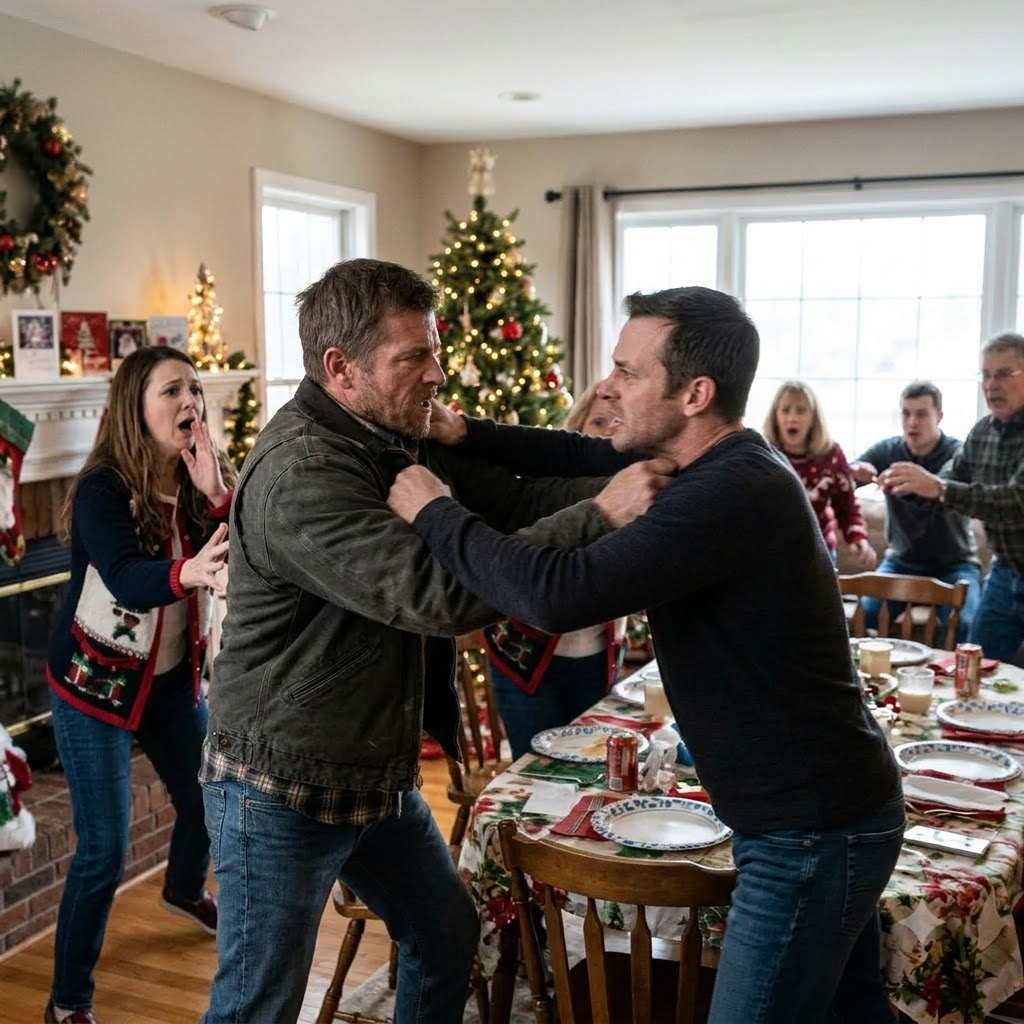
"Did you tell him about the signature?"
Those were the last words I heard before my sister's phone went dead.
I stood in my kitchen with the phone pressed against my ear.
For several seconds, I didn't move.
Then I called Emily back.
Straight to voicemail.
I tried again.
Nothing.
I stared at the screen.
My brother-in-law had just demanded to know whether my sister had told me about a signature.
My signature.
At least, that was what I feared.
And suddenly, the $160,000 loan my family had tried to force on me at Christmas dinner looked like something far more dangerous than a bad financial decision.
I opened our message thread.
Emily, are you safe?
The message showed as delivered.
No reply.
I typed another.
You don't have to explain anything right now. Just send me one word so I know you're okay.
I waited.
Thirty seconds.
A minute.
Two minutes.
Nothing.
I looked toward the framed photograph of my father standing beside my first Jeep.
He was smiling in that picture.
One hand rested on the rusted hood.
The other held a wrench.
I remembered something he'd told me years earlier, after a customer tried to blame me for damage I hadn't caused.
"Michael, when somebody gets angry because you ask for proof, pay attention. Sometimes the anger is meant to keep you from looking."
I'd never forgotten that.
And right now, I had a lot of things I needed to look at.
I didn't drive to Emily's house.
That was my first instinct, but I knew it could make things worse.
Travis had already taken her phone during our conversation.
If I showed up furious on Christmas afternoon, he could turn the situation into another argument about how unreasonable I was.
He'd done it before.
He was good at making other people defend themselves while he avoided answering questions.
Instead, I sat down at the kitchen table and wrote everything I knew on a yellow legal pad.
At the top, I wrote:
TRAVIS — $160,000 LOAN
Underneath, I listed the facts.
The bank wanted an additional guarantor.
Travis had no signed construction contracts.
He had overdue credit cards.
His savings were almost nonexistent.
My mother had provided him with my personal information.
Emily had signed documents she didn't understand.
And Travis had mentioned a signature he apparently didn't want me to know about.
I looked at the list.
It was ugly.
But ugly wasn't the same thing as proof.
I needed to know exactly what had happened.
My phone vibrated.
For a second, I thought it was Emily.
It was Mom.
Your sister is very upset. I hope you're proud of yourself.
I read the message without responding.
Then another arrived.
Travis says you've been calling and making accusations.
I leaned back in my chair.
I hadn't accused him of anything.
Not yet.
I'd asked questions.
Apparently, that was enough.
I typed:
Is Emily safe?
Mom responded almost immediately.
Of course she's safe. Stop being dramatic.
I stared at the words.
Then please ask her to call me privately.
Three dots appeared.
Disappeared.
Then came her answer.
She needs time away from your negativity.
I put the phone face down.
My mother had always been able to turn a reasonable concern into a character flaw.
If I asked about money, I was selfish.
If I questioned a decision, I was disrespectful.
If I refused to sign something, I was disloyal.
And now, if I worried about my sister, I was negative.
I picked up the legal pad again.
There was one question I couldn't stop thinking about.
Why would Travis need an old copy of my signature?
The first time I learned what a personal guarantee could do to somebody, I was thirty-four.
I'd been running my snow removal company for only a couple of years.
A man named Walter owned a landscaping business two towns over.
He had three trucks, a small crew, and a reputation for doing good work.
He was older than me and had been generous with advice when I was starting out.
One afternoon, we were standing in a parts store waiting for a hydraulic hose.
Walter looked exhausted.
I asked if he was sick.
He shook his head.
"Just dealing with a mess."
I didn't pry.
But a few weeks later, I learned what had happened.
Walter had guaranteed a business loan for a longtime friend.
The friend was opening an equipment rental company.
He had a convincing plan.
A nice office.
Professional brochures.
Projected revenue charts.
And absolutely no idea how quickly operating expenses could destroy cash reserves.
When the company failed, the lender pursued Walter under the guarantee.
The debt was larger than he could comfortably pay.
He spent months negotiating.
He sold equipment.
He borrowed against property.
Eventually, he closed the landscaping business he'd spent twenty years building.
I saw him one last time at an auction.
His trucks were lined up beside a row of used trailers.
He stood near the entrance, watching strangers inspect his equipment.
I remember asking him if he was okay.
He looked at me and said, "I signed one piece of paper because I didn't want to disappoint somebody."
That sentence stayed with me.
It was one of the reasons I became careful about debt.
Not afraid of it.
Careful.
There was a difference.
I'd borrowed money to purchase trucks.
I'd financed equipment when the numbers supported it.
I'd taken calculated risks.
But every major purchase came with a plan for what happened if things went wrong.
Because things always went wrong eventually.
A winter could be warmer than expected.
A truck could lose a transmission.
A customer could go bankrupt.
A contract could disappear.
Business ownership wasn't about pretending those possibilities didn't exist.
It was about surviving them.
And Travis wanted me to put my name behind $160,000 without even showing me a reliable list of customers.
I looked at the legal pad.
Then I wrote another sentence.
No signature. No authorization. No exceptions.
I underlined it twice.
At four that afternoon, I called Marcus.
He answered on the second ring.
"Please tell me you're not at the yard."
"I'm home."
"Good. Stay there."
"I need to ask you something."
He sighed.
"That doesn't sound like rest."
"It's about the loan."
His tone changed.
"What happened?"
I told him about Emily's phone call.
Not every personal detail.
Just enough.
The paperwork.
The old records.
The question about a signature.
Marcus was quiet for a long moment.
Then he said, "Mike, you need a lawyer."
"I know."
"Not next week. As soon as you can get one."
"I'll call Daniel tomorrow."
Daniel Mercer was a business attorney I'd used for years.
He'd helped me review commercial contracts, employment agreements, and equipment financing documents.
He wasn't cheap.
But he was thorough.
And he had one quality I valued more than anything.
He told me things I didn't want to hear.
Marcus cleared his throat.
"Do you think Travis forged something?"
"I don't know."
"That's not a no."
"No, it isn't."
I heard him exhale.
"Listen, don't let him bait you into a fight. If he did something stupid, let the paperwork prove it."
I looked down at my notes.
"That's the plan."
"And Mike?"
"Yeah?"
"Keep the company out of it until you know what you're dealing with."
I nodded, even though he couldn't see me.
"I will."
After we hung up, I walked into my home office.
I kept important documents in a locked filing cabinet.
Tax returns.
Insurance policies.
Vehicle titles.
Loan agreements.
Business registrations.
I pulled out the most recent folder and started checking.
Everything appeared normal.
No unfamiliar loans.
No new guarantees.
No notices from lenders.
I logged into my business banking account.
Nothing unusual.
Then I checked my personal credit information through the services I used to monitor it.
No obvious new account appeared.
I felt a small measure of relief.
But I knew that didn't settle anything.
A loan application might not appear as an open account.
A guarantee could involve documents I hadn't seen.
And if somebody had used my information without permission, I needed more than a quick glance at a screen.
I needed the actual paperwork.
The next morning, I called Daniel.
He answered from his office.
"Merry Christmas, Michael."
"Same to you. Sorry to bother you during the holiday."
"You're not bothering me. What's going on?"
I explained the situation.
He didn't interrupt.
When I finished, he asked one question.
"Have you signed anything?"
"No."
"Have you verbally agreed to guarantee the loan?"
"No."
"Have you authorized anyone to submit financial information on your behalf?"
"No."
"Good."
I waited.
"That doesn't mean there's nothing to investigate," he continued. "But those answers matter."
I told him about the folder at my mother's house.
The typed personal information.
The old records.
Emily's comments.
And Travis's final question.
Daniel became quiet.
"Michael, do not confront him about forgery until we know whether anything was actually submitted."
"I wasn't planning to."
"Good. Preserve every message. Write down what happened while it's fresh. And if you receive anything from a lender, send it to me immediately."
"What about the bank?"
"If you can identify the lender from the paperwork you saw, we can make an appropriate inquiry. I want to know whether your name appears on any pending application or executed agreement."
I looked at the legal pad.
"I remember the logo."
"Send me what you remember."
"Okay."
"And Michael?"
"Yeah?"
"Do not let your family convince you that protecting your financial identity is an attack on them."
I almost laughed.
"You've met my mother."
"I have."
"Then you know how that conversation will go."
Daniel sighed.
"Unfortunately, I do."
We arranged to speak again after he reviewed the information.
When I hung up, I felt better.
Not because the problem had disappeared.
But because I had taken the first step toward dealing with it properly.
There was a time in my life when I would have tried to handle everything myself.
I'd have called Travis.
Demanded answers.
Argued with Mom.
Maybe even apologized just to calm everyone down.
But running a business had taught me something important.
When a problem could cost more than you could afford to lose, pride was a terrible substitute for professional advice.
Around noon, Emily finally texted.
I'm okay.
I exhaled.
Then another message appeared.
Please don't call. Travis is home.
I stared at the screen.
Do you need help?
A minute passed.
I don't know.
I read those words several times.
They frightened me more than a direct request would have.
Emily had always been the person who knew exactly what she wanted.
Even when she was wrong.
Especially when she was wrong.
She'd argue over restaurant choices, vacation plans, and the correct way to load a dishwasher.
But now she didn't know whether she needed help.
I typed carefully.
You can come to my house anytime. No questions. No pressure.
She responded with a single word.
Thanks.
Then nothing.
I sat with the phone in my hand.
I wanted to ask about the documents.
About the signature.
About what Travis had said.
But I didn't.
Not yet.
If he was monitoring her phone, pressing for details could put her in a more difficult position.
So I waited.
It was one of the hardest things I'd done in a long time.
I'm a mechanic by nature.
When something breaks, I want to open it up and find the problem.
Waiting doesn't come naturally to me.
But my sister wasn't a truck.
She was a person.
And whatever was happening in her marriage, she needed room to make decisions without another man telling her what to do.
Three days later, Daniel called.
"I've made some preliminary inquiries," he said.
I sat down.
"And?"
"Nothing definitive yet. But I want you to come by my office."
"Why?"
"There's something I want to show you."
My stomach tightened.
"What is it?"
"I'd rather explain it in person."
I looked at the clock.
"I can be there in twenty minutes."
"Good."
I drove to his office without turning on the radio.
Daniel worked in a brick building near the courthouse.
His office smelled faintly of coffee and old paper.
He greeted me at the door and led me into a conference room.
A thin folder sat on the table.
I looked at it.
"Is that the loan?"
"Not exactly."
He sat across from me.
"First, I want to be clear. We don't have proof that anyone forged your signature or created a binding obligation in your name."
I nodded.
"But?"
"But there are enough irregularities that I don't want you communicating directly with Travis about the financing."
He opened the folder.
Inside was a copy of a preliminary financing document.
My name appeared under a section identifying a proposed guarantor.
My business address was listed.
So was an estimate of my company's annual revenue.
I leaned forward.
"Where did they get that number?"
Daniel watched me.
"Is it accurate?"
"Not exactly. It's close to an older figure."
"How old?"
"Maybe three years."
He nodded slowly.
"That may matter."
I studied the page.
The lender appeared to have received information about my business before I'd ever been asked to sign anything.
I felt anger rising.
Not the loud kind.
The cold kind.
The kind that made my thoughts become very clear.
"Can they do that?"
"Someone can propose a guarantor," Daniel said. "That doesn't mean the guarantor has agreed. But submitting inaccurate or unauthorized information can create serious problems depending on what was represented."
I pointed at the page.
"That revenue number came from an old tax return."
"Are you certain?"
"Not completely. But it's close enough that I want to check."
Daniel closed the folder.
"Do that. And I want you to review any old records your mother may still have."
I looked at him.
"She won't cooperate."
"Then don't force the issue. We'll pursue the information through proper channels."
I leaned back.
"Do you think Travis has already gotten money?"
Daniel considered his answer.
"I don't know. And I don't want to speculate."
I nodded.
He continued.
"What I do know is that you were right not to sign anything at Christmas dinner."
I looked down at my hands.
For years, those hands had been cut, bruised, burned, and frozen while I built my business.
I'd used them to repair engines.
To tighten hydraulic fittings.
To shake hands with customers.
To sign payroll checks.
And somebody in my family might have decided that those same hands weren't necessary when it came to putting my name on a financial document.
The thought made me sick.
When I left Daniel's office, I sat in my truck for several minutes.
I thought about calling Mom.
I even opened her contact information.
But I didn't press the button.
Instead, I drove to the company yard.
The trucks were lined up in their usual places.
Marcus was standing beside Unit Four, reviewing a maintenance checklist.
He looked up as I approached.
"Everything okay?"
"Not sure yet."
He studied my face.
"That bad?"
"Could be."
I told him what Daniel had shown me.
Marcus listened without interrupting.
When I finished, he shook his head.
"Your own family."
I looked toward the garage.
"Yeah."
He leaned against the truck.
"Remember the first year we worked together?"
I nodded.
"That storm in February?"
"The one where we were out for thirty hours?"
"That's the one."
He smiled faintly.
"You had two trucks. One broke down. We spent half the night fixing it in a parking lot."
"I remember."
"And you kept apologizing because you couldn't pay me overtime until the customer checks cleared."
I looked at him.
"I paid you."
"I know you did."
He pointed toward the row of vehicles.
"That's what I'm saying. You always paid what you owed. Even when it hurt."
I didn't answer.
"Don't let somebody who doesn't understand that put your name on something you didn't agree to."
I nodded.
Then my phone rang.
Mom.
I considered ignoring it.
But something told me to answer.
"Hello?"
Her voice was sharp.
"Michael, what have you done?"
I frowned.
"What are you talking about?"
"Travis says somebody contacted the lender."
I looked at Marcus.
"I asked my attorney to review the situation."
"You hired a lawyer?"
"Yes."
"For your own family?"
"For a financial agreement involving my name."
She made a sound of disbelief.
"Do you understand how humiliating this is?"
I closed my eyes.
There it was again.
Humiliation.
Not risk.
Not responsibility.
Not consent.
Humiliation.
"Mom, did you give Travis copies of my old business documents?"
Silence.
"Mom?"
"I was trying to help."
My stomach tightened.
"What did you give him?"
"Just some paperwork."
"What paperwork?"
"Michael, don't use that tone with me."
"What did you give him?"
She inhaled sharply.
"Your father kept records. Travis needed information for the application."
I stared at the ground.
"And you gave it to him without asking me?"
"I didn't think it would matter."
"Did you give him anything with my signature?"
Another silence.
Longer this time.
"Mom."
Her voice changed.
"Travis said it was only for reference."
I felt the blood drain from my face.
"What was only for reference?"
She didn't answer.
"Mom, what did you give him?"
"An old equipment agreement."
I gripped the phone.
"Signed by me?"
"Yes."
I closed my eyes.
Marcus watched me carefully.
I could hear my mother's breathing.
Then she said, almost defensively, "I didn't know he was going to make such a big deal out of it."
I opened my eyes.
"Mom, listen to me very carefully. Did Travis ask you for that document specifically?"
She hesitated.
"Yes."
"Why?"
"He said he needed to show the bank you had experience with equipment financing."
I stared at the trucks.
Nine vehicles.
Eleven winters.
Years of work.
All of it suddenly felt exposed.
"Mom, did he make a copy?"
"I assume so."
"Did he return the original?"
"I don't remember."
I pressed my free hand against my forehead.
"Where is the folder now?"
"At the house."
"Don't let anyone touch it."
"Michael—"
"I'm serious. Don't remove anything. Don't throw anything away. Don't give Travis another document."
Her voice hardened.
"You are treating your brother-in-law like a criminal."
"I'm trying to find out what happened."
"You're destroying this family over money."
I looked at Marcus.
He had turned away, giving me privacy.
"No, Mom," I said quietly. "I'm trying to protect myself from a debt I never agreed to."
She hung up.
I stood there for a long time.
Then I called Daniel.
He answered immediately.
"Michael?"
"My mother admitted she gave Travis an old agreement with my signature on it."
Daniel was silent for a moment.
"Do you know which agreement?"
"No. Something from an equipment purchase."
"All right. I want you to write down exactly what she said."
"I will."
"And don't contact Travis."
"I won't."
"We need to establish what documents were used and whether anything was submitted as though you had authorized it."
I looked toward the office.
"Daniel, could somebody use an old signature to make a new document look legitimate?"
He paused.
"It's possible to misuse a signature image. But we need evidence before drawing conclusions."
I nodded.
"Understood."
After we hung up, I walked into the office and wrote down the conversation with Mom.
Every word I could remember.
Then I put the notes in a folder.
I labeled it:
PERSONAL — LOAN DOCUMENTS
For the first time, I felt genuinely frightened.
Not because I thought I was about to lose everything.
But because I realized how little I knew about what my own family had been doing behind my back.
That evening, I went home early.
I cooked dinner.
Washed the dishes.
Checked the weather forecast.
Normal things.
Things that made life feel manageable.
Around eight, I sat in the living room with a cup of coffee.
The photograph of Dad and the old Jeep was on the shelf across from me.
I thought about the night he helped me replace the alternator.
How he'd stood in the freezing parking lot without complaining.
How he'd handed me the wrench instead of taking over.
He'd always wanted me to learn how to solve my own problems.
But he'd also taught me something else.
Never confuse love with permission.
Loving somebody didn't give them permission to take advantage of you.
And being family didn't make dishonesty harmless.
My phone vibrated.
A message from Emily.
Can you meet me tomorrow?
I sat forward.
Of course. Where?
She replied:
Not at my house.
I stared at the screen.
Where would you feel comfortable?
A minute passed.
Then:
Your office. Before anyone gets there.
I typed:
I'll be there.
Another message arrived.
Please don't tell Mom.
I frowned.
I won't.
Then Emily sent one final text.
I'm bringing something Travis doesn't know I found.
I read it twice.
Before I could respond, she sent a photograph.
It showed the corner of a manila envelope.
A bank logo was printed near the top.
Beneath it was a handwritten notation.
GUARANTOR — MICHAEL
I enlarged the image.
There was another line below my name.
Most of it was hidden by Emily's thumb.
But I could see the beginning.
Signature received:
My heart began pounding.
I typed:
Emily, where did you get this?
The message showed as delivered.
No response.
I waited.
Then my phone rang.
It was Emily.
I answered immediately.
"Em?"
She was whispering.
"Michael, I can't talk long."
"Are you safe?"
"Yes. But listen to me."
I stood.
"What is it?"
"I found the folder in Travis's desk."
"Okay."
"There are documents in it."
"What documents?"
"Loan papers. Bank statements. Copies of your business records."
I closed my eyes.
"Did you see anything signed?"
She took a shaky breath.
"Yes."
I gripped the phone.
"Emily, whose signature?"
There was a pause.
Then she whispered:
"Yours."
I felt the room tilt.
"Are you sure?"
"I've seen you sign birthday cards and checks my whole life, Michael. I know what your signature looks like."
I couldn't speak.
Then she said something that made the silence even worse.
"But there's something wrong with it."
I swallowed.
"What do you mean?"
"It looks like your signature, but the date is from before Christmas."
I stared at the wall.
"How long before?"
"Three weeks."
My hand tightened around the phone.
Three weeks before Christmas.
Before the family dinner.
Before Mom demanded that I co-sign.
Before Travis mocked my business.
Before I ever saw the loan application.
"Emily," I said slowly, "I need you to bring those documents tomorrow."
"I will."
"And don't let Travis know."
"I won't."
I heard a noise on her end.
She stopped breathing for a second.
"Emily?"
"Someone's coming."
"Put the papers somewhere safe."
"Okay."
"Call me if you need anything."
"I will."
Then she whispered:
"Michael, there's one more thing."
I waited.
"The signature isn't the only thing that's wrong."
My stomach tightened.
"What else?"
She lowered her voice.
"There's another name on the paperwork."
I stood completely still.
"Whose name?"
A door opened on her end.
Footsteps approached.
Emily inhaled sharply.
Then she whispered a name I hadn't expected to hear.
"Mom."
The line went dead.
I stared at my phone.
A moment later, a new message appeared from an unfamiliar number.
It contained only one sentence.
If you want to know what really happened to your signature, check the documents your father left behind.
Then another message arrived.
A photograph.
I opened it.
It showed an old equipment financing agreement.
My father's handwriting appeared in the margin.
And directly beneath it was a date.
The date was impossible.
Because the document had supposedly been signed three years after my father died.






Comments 0