My father had been dead for nine years.
Yet someone had just sent me a photograph of a financial document bearing his handwriting beside a date three years after his death.
I enlarged the image until the numbers filled my phone screen.
There was no mistake.
The date was clearly visible.
And the handwriting looked exactly like Dad's.
I knew those letters.
The way he crossed his sevens.
The way he wrote capital M's with an extra downward stroke.
The small, uneven loop at the end of his signature.
I'd seen that handwriting on birthday cards, repair estimates, grocery lists, and notes he'd left on my workbench.
For a moment, I felt as though somebody had reached into my chest and grabbed something I hadn't realized was still so fragile.
Then I looked at the date again.
Impossible.
I set the phone on the kitchen table.
My coffee had gone cold.
I hadn't touched it in nearly an hour.
The unknown number had sent two messages.
The first told me to check the documents my father left behind.
The second contained the photograph.
I typed a reply.
Who is this?
Nothing.
Where did you get that document?
Still nothing.
I waited.
Then I called the number.
A recorded message informed me that the call couldn't be completed.
I tried again.
Same result.
I stared at the photograph.
Something about the document bothered me beyond the impossible date.
It wasn't just the handwriting.
It was the layout.
The agreement looked old.
The paper had yellowed edges.
The financing company's logo belonged to a business I'd used years earlier when purchasing my first commercial plow truck.
But the date was recent.
Too recent.
And the section containing my father's handwriting appeared slightly different from the rest of the page.
I couldn't tell whether that meant anything.
A photograph wasn't proof.
Neither was a resemblance.
I knew enough about machinery to understand that a problem could look obvious until you opened the hood and discovered something entirely different.
So I did the only sensible thing.
I forwarded the image to Daniel Mercer.
Then I called him.
He answered after several rings.
"Michael?"
"I just received something strange."
"How strange?"
"A document with my father's handwriting on it."
"All right."
"The date says it was signed three years after he died."
Silence.
Then Daniel said, "Send me the original message thread if you can preserve it. Don't alter the image."
"I already forwarded the photograph."
"I see it coming through."
I waited while he opened it.
For nearly a minute, neither of us spoke.
Then he asked, "Are you certain about the date of your father's death?"
"Daniel, you attended his funeral."
"I know. I'm asking because I want us to establish facts carefully."
I exhaled.
"Yes. I'm certain."
"All right."
I heard papers moving on his desk.
"This could be an altered document, an incorrectly dated copy, or something else entirely. We shouldn't decide what it is from one photograph."
"I understand."
"Do you recognize the agreement?"
"Parts of it."
"Can you locate your original records?"
"Maybe. Dad kept copies at Mom's house."
"Do you have any copies yourself?"
I thought for a moment.
"Possibly in storage."
"Look for them. But don't contact the person who sent this again tonight."
"Why?"
"Because whoever sent it may know more than they're saying. I don't want you making assumptions or giving them information."
I looked at the photograph.
"Daniel, do you think this is connected to Travis?"
"I think the timing is concerning."
That was as far as he'd go.
Daniel never liked speculation.
It was one of the reasons I trusted him.
Before hanging up, he added, "Michael, one more thing."
"Yeah?"
"Don't tell your mother about this photograph yet."
I looked toward the window.
Snow was beginning to fall again.
"Wasn't planning to."
I barely slept that night.
Every time I closed my eyes, I saw the document.
My father's handwriting.
The impossible date.
The line identifying me as a guarantor.
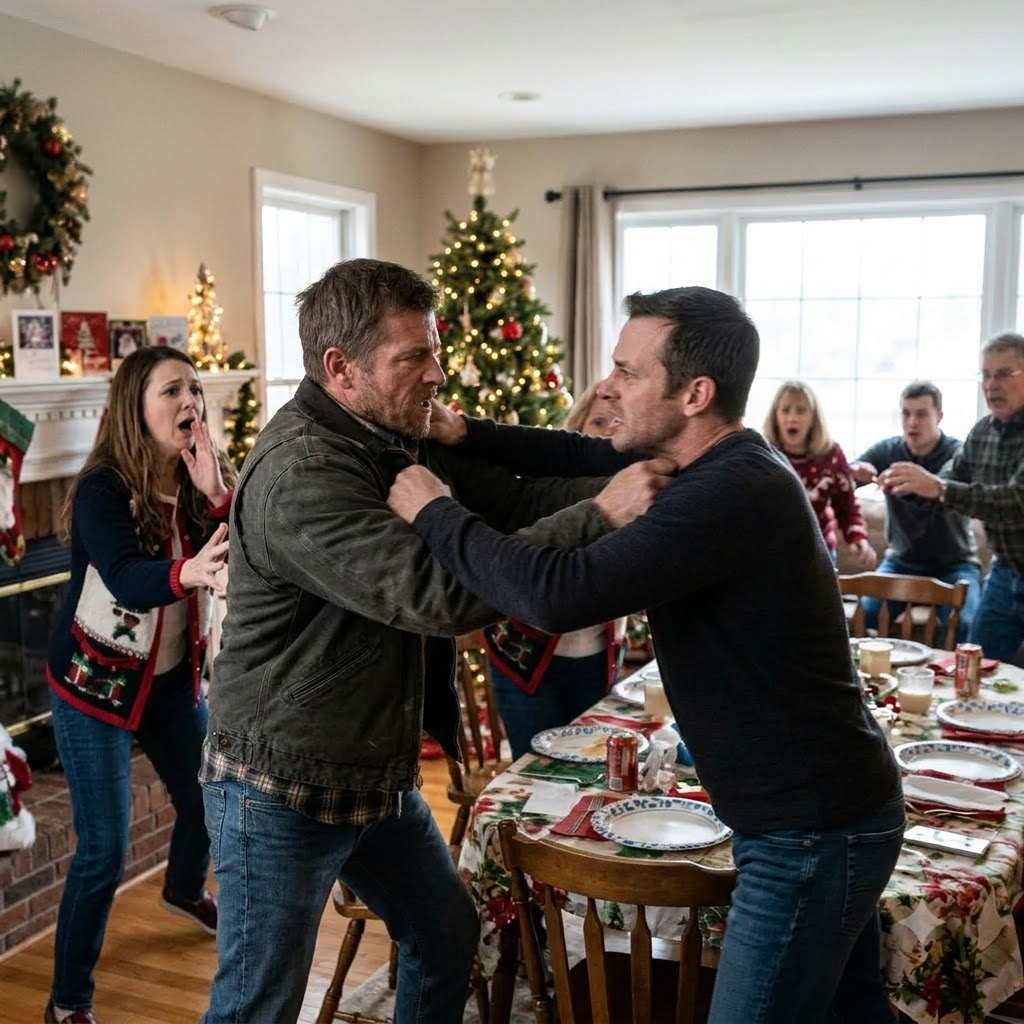
And Travis's face at Christmas dinner.
That smug little smile.
The eggnog raised in his hand.
The way he'd laughed when he called my work a child's job.
At the time, I'd thought he was simply arrogant.
Now I wondered whether the arrogance had been covering something else.
Desperation.
I'd known people like Travis before.
Men who talked about success constantly but rarely discussed actual numbers.
Men who loved expensive tools more than paying customers.
Men who believed buying equipment was the same thing as building a company.
Travis wasn't stupid.
That was what made him dangerous.
He was persuasive.
He could walk into a room full of strangers and make them believe he'd just closed the biggest deal of his career.
He spoke confidently.
He dressed well.
He remembered people's names.
He knew how to compliment the right person at the right moment.
And he had a talent for making ordinary plans sound like major opportunities.
I'd watched him do it for years.
At family cookouts, he'd talk about developers he supposedly knew.
At birthday parties, he'd mention commercial projects he was "in discussions" to secure.
At Thanksgiving, he'd describe equipment purchases as though they were already completed.
But whenever I asked specific questions, his answers became vague.
The contracts were being finalized.
The investors were waiting.
The timing wasn't right.
The market was about to turn.
There was always a reason the success he described hadn't arrived yet.
And there was always somebody else to blame.
I remembered one Thanksgiving three years earlier.
Travis had announced that he was starting a residential renovation company.
My mother had been thrilled.
"Finally," she'd said, looking directly at me, "somebody in this family is thinking big."
I'd been sitting at the table with a plate of turkey.
I didn't respond.
Travis had smiled.
"Construction's where the real money is."
I asked whether he'd secured any projects.
He told me he had several possibilities.
I wished him luck.
That should have been the end of it.
But Mom had leaned toward me.
"Maybe Travis can teach you something about expanding."
I looked at her.
At the time, my company had seven trucks and several long-term commercial contracts.
I'd just hired another full-time employee.
We'd finished the previous winter with our operating reserve intact.
I was proud of that.
Not because it sounded impressive at dinner.
Because it meant my employees could count on their paychecks.
But Mom didn't ask about any of it.
She wanted to know when I planned to stop driving trucks myself.
I told her I still enjoyed being out with the crew.
She shook her head.
"Successful businessmen don't do the dirty work."
Travis nodded.
"Exactly."
I remembered looking at him.
Then at Mom.
And realizing they had no idea what running a small business actually required.
Sometimes I drove because a truck needed an operator.
Sometimes I repaired equipment because it was faster than waiting for a mechanic.
Sometimes I answered customer calls at midnight because a problem couldn't wait until morning.
I didn't consider those things beneath me.
I considered them part of the responsibility.
But Travis believed success meant standing above the work.
I believed success meant being accountable for it.
That difference had always existed between us.
Christmas Eve had simply exposed it.
At six the next morning, I drove to my office.
The yard was quiet.
Only two trucks were out handling early commercial routes.
The rest sat in a row beneath a thin layer of snow.
I unlocked the office, turned on the lights, and opened the storage cabinet.
Years of paperwork filled the shelves.
Old insurance policies.
Maintenance records.
Equipment invoices.
Tax folders.
Contract renewals.
I found a cardboard box marked EARLY BUSINESS RECORDS.
Inside were documents from the first five years of the company.
I carried the box to my desk.
Then I started searching.
An hour passed.
Then another.
I found the purchase agreement for Unit One.
The financing paperwork for Unit Two.
Insurance records from the year Dad died.
Several handwritten notes he'd made while helping me compare equipment prices.
Seeing those notes hurt more than I expected.
One page contained a list of repair costs.
Beside the total, Dad had written:
Fix it right once. Cheaper than fixing it twice.
I smiled despite myself.
That was him.
Practical.
Stubborn.
Always thinking three steps ahead.
I turned another page.
There was a photograph of the two of us standing beside the old Jeep.
My face was younger.
Dad's hair was darker.
We were both smiling.
I sat there for a moment, holding the picture.
Then I returned to work.
Eventually, I found a copy of the financing agreement shown in the anonymous photograph.
The original agreement had been signed years before Dad died.
His handwritten note appeared in the margin.
But the date on my copy was different.
Correct.
Exactly where it should have been.
I placed both images side by side.
The handwriting matched.
The wording matched.
Even a small ink mark beside the margin matched.
But the newer photograph contained additional information beneath the original page.
A financing reference number.
A recent date.
And a section identifying a guarantor.
It looked as though an old document had been combined with newer paperwork.
I couldn't prove how.
But I knew one thing.
The document in the photograph wasn't an untouched copy of the agreement I'd signed years earlier.
I took pictures of the original.
Then I scanned every page.
I sent everything to Daniel.
His reply arrived twenty minutes later.
Keep the original secured. We need to compare the complete documents.
I put the agreement in a locked drawer.
Then I sat back.
For the first time, I felt something stronger than suspicion.
Somebody had been using my old business records.
The question was who.
And why.
Emily arrived at 7:42.
I knew because I was watching the security monitor when her car pulled into the lot.
She parked beside the office.
For a moment, she didn't get out.
I could see her sitting behind the wheel.
Her hands rested on the steering wheel.
Her head was lowered.
Then she opened the door.
She was wearing a cream-colored winter coat over a dark sweater.
Her copper-red hair was pulled back.
She looked exhausted.
I stepped outside.
"Hey, Em."
She looked up.
Her eyes were red.
"Hi."
I wanted to hug her.
But I waited.
She walked toward me.
Then she put her arms around my shoulders.
I held her.
For a few seconds, she didn't say anything.
Neither did I.
Finally, she stepped back.
"I'm sorry."
I shook my head.
"Come inside."
She followed me into the office.
I locked the door behind us.
Not because I expected trouble.
Because she seemed nervous.
I made coffee.
She didn't want any.
Instead, she sat across from my desk and placed a large brown envelope between us.
I looked at it.
"Is that everything?"
"Everything I could find."
"Does Travis know you have it?"
She shook her head.
"He thinks I went to the grocery store."
I sat down.
"Emily, before we look at anything, I need to ask you something."
She stared at her hands.
"Okay."
"Are you safe at home?"
She nodded.
"Yes."
"Has Travis ever physically hurt you?"
"No."
"Has he threatened you?"
She hesitated.
"Not like that."
I waited.
"He gets angry when I question him," she admitted. "He says I'm undermining his confidence."
"That doesn't mean you can't ask questions."
"I know."
"Do you?"
She looked up.
There were tears in her eyes.
"I used to."
I felt my chest tighten.
She looked away.
"At first, it was exciting. He had all these plans. He talked about building houses, hiring crews, making enough money that I wouldn't have to work anymore."
I listened.
"He made everything sound possible."
"What changed?"
She swallowed.
"The bills."
I didn't interrupt.
"First, there was a credit card. He said he needed it for business expenses. Then another. Then he started borrowing money from our savings."
"How much?"
She shook her head.
"I don't know exactly."
"Emily."
"I stopped asking because every conversation turned into a fight."
I leaned back.
She wiped her eyes.
"He kept saying we were one good contract away from everything changing."
I knew that sentence.
I'd heard versions of it from struggling business owners for years.
Sometimes it was true.
Sometimes a company really was waiting on a major contract.
But when every month depended on a future opportunity that never arrived, the problem wasn't timing anymore.
It was the business model.
"Did he ever show you the numbers?" I asked.
She shook her head.
"He said I wouldn't understand."
I felt anger rise.
I kept my voice calm.
"Emily, you manage accounts for a medical supply company."
She gave a weak smile.
"I know."
"You understand budgets."
"I know."
"Then don't let him tell you you're incapable of understanding a loan."
She looked down.
"I think I wanted to believe him."
That sentence hurt.
Because I understood it.
Not about Travis.
About family.
Sometimes believing somebody was easier than accepting what their behavior was telling you.
Emily pushed the envelope toward me.
"Just look."
I opened it.
Inside were copies of bank statements, financing applications, equipment estimates, and several pages of correspondence.
The first thing I noticed was the lender's name.
It matched the logo on the folder at Christmas dinner.
The second thing I noticed was the date.
The application had been prepared weeks before the family gathering.
The third thing was my name.
Again.
Printed beneath the heading:
PROPOSED PERSONAL GUARANTOR
I read the section carefully.
My address was listed.
My company name.
An estimated annual revenue figure.
And a description of my business assets.
Some details were outdated.
Others were close enough to suggest that somebody had reviewed old records.
I turned the page.
There was a signature field.
A mark appeared inside it.
I stared.
It resembled my signature.
But something was wrong.
The letters were too evenly spaced.
The final stroke was too clean.
My real signature changed slightly depending on whether I was signing a check, a contract, or a delivery receipt.
This one looked like a photograph of a signature.
A fixed image.
I didn't touch the page for several seconds.
Then I looked at Emily.
"Where did you find this?"
"In Travis's desk."
"Was it in a folder?"
"Yes."
"Did you take the originals?"
"No. I copied them."
I nodded.
"Good."
She looked frightened.
"Michael, did you sign that?"
"No."
Her eyes filled.
"Are you sure?"
I stared at her.
"Emily."
"I'm sorry. I just—"
"I have never signed a guarantee for Travis."
She covered her mouth.
I slid the document aside.
"We don't know yet whether this was submitted or whether anyone relied on it. Daniel will help us establish that."
She nodded.
Then I turned another page.
A list of proposed equipment purchases.
The excavator.
The skid steer.
The trailer.
Operating capital.
The numbers looked polished.
Almost too polished.
There were projected monthly revenues.
Estimated expenses.
Expected profit margins.
But no signed contracts attached.
No customer deposits.
No reliable work schedule.
And no meaningful contingency plan.
I looked at Emily.
"Did Travis prepare these projections?"
"He said a consultant helped."
"Who?"
"I don't know."
I turned another page.
There was a bank statement.
The account balance was far lower than I expected.
I checked the date.
Then another statement.
And another.
The pattern was obvious.
Money came in.
Money went out faster.
Several payments were marked overdue.
A few transfers appeared between accounts.
I wasn't an accountant, and I wasn't going to pretend I could diagnose an entire business from a handful of pages.
But I knew enough to recognize trouble.
"Emily," I said, "how much of your savings has he used?"
She stared at the envelope.
"Most of it."
I felt my stomach drop.
"How much is most?"
She whispered a number.
I looked at her.
"That's almost everything you saved from your job."
She nodded.
I leaned back.
"Does Mom know?"
Emily wiped her face.
"Some of it."
"How much?"
"I don't know what Travis told her."
I studied her.
"Why is Mom so determined to get this loan approved?"
Emily looked away.
"I think she believes it'll fix everything."
"Does she understand the debt?"
"I don't think so."
I looked at the papers.
Then I asked the question I'd been avoiding.
"Did Mom sign anything?"
Emily didn't answer.
I waited.
Finally, she reached into the envelope and removed another sheet.
She placed it on my desk.
It was a supporting financial statement.
Near the bottom was a handwritten notation.
My mother's name appeared beside it.
I stared at the page.
"What's this?"
Emily swallowed.
"Travis said Mom agreed to help with the application."
"How?"
"I don't know."
I looked at her.
"Emily, what exactly did he tell you?"
She took a shaky breath.
"He said Mom understood that family money should stay in the family."
I frowned.
"What family money?"
She shook her head.
"I don't know."
I looked down at the document.
Something about that phrase bothered me.
Family money.
My mother had always talked about money as though it belonged to the family collectively.
At least when the money was mine.
But she'd never shown much interest in sharing her own financial information.
After Dad died, she'd handled his estate.
I'd trusted her.
I hadn't questioned every document.
I hadn't demanded copies of every account statement.
I'd been busy running the business and grieving my father.
And I'd assumed that anything important would be discussed openly.
Now, for the first time, I wondered whether that assumption had been a mistake.
I called Daniel while Emily was still sitting across from me.
He answered immediately.
"Michael?"
"I have copies of the loan documents."
"Where did you get them?"
"Emily brought them."
"Are they originals?"
"No. Copies."
"All right. Don't write on them. Don't alter anything. Scan them exactly as they are."
"There's a signature that looks like mine."
He paused.
"Did you sign it?"
"No."
"Then we need to preserve that evidence."
I looked at Emily.
She was staring at the floor.
"Daniel, there's also something involving my mother."
"What kind of involvement?"
"Her name appears on a supporting financial statement."
"Send me everything."
"I will."
"And Michael?"
"Yeah?"
"Do not accuse anyone until we establish what was submitted, what was signed, and what legal effect any of these documents may have."
I nodded.
"Understood."
After the call, Emily looked at me.
"Are you going to call the police?"
"I don't know yet."
She lowered her head.
"Travis will hate me."
I leaned forward.
"Emily, listen to me."
She looked up.
"You didn't create this problem by asking questions."
Her eyes filled again.
"If somebody used my information without permission, that's on the person who did it."
She nodded slowly.
"And if Travis made financial promises he couldn't keep, those are his decisions."
She wiped her cheeks.
"I just wanted us to have a good life."
I felt something twist inside me.
"I know."
She looked toward the window.
"I thought if he got the equipment, things would finally get better."
"Maybe he believes that too."
She looked surprised.
I continued.
"People can believe in a plan and still make terrible decisions. But believing doesn't make the numbers work."
She nodded.
Then she whispered, "He says you're jealous of him."
I almost laughed.
"Of what?"
"His ambition."
I looked around my office.
The maintenance schedules.
The customer files.
The payroll records.
The photographs of our trucks working through storms.
"Emily, I hope he succeeds."
She stared at me.
"I mean that. I don't want him to fail. I don't want you to lose your home. I don't want anybody hurt."
"Then why won't you help?"
The question came out softly.
Not accusing.
Just desperate.
I took a breath.
"Because helping somebody isn't the same as accepting responsibility for every decision they make."
She looked down.
"If I guarantee a loan he can't repay, I could lose what I've built. My employees could suffer. Their families could suffer."
I paused.
"And if Travis doesn't have a workable business plan, giving him more debt won't fix that."
Emily nodded slowly.
For the first time that morning, I saw understanding in her expression.
Not complete agreement.
But understanding.
It was a start.
After Emily left, I spent another hour scanning the documents.
I saved copies in a secure folder.
Then I locked the originals she'd brought in my cabinet.
I was careful not to change anything.
The more I examined the paperwork, the more questions I had.
Some pages appeared to have been prepared at different times.
Several financial figures didn't match.
The equipment estimates came from different vendors.
And one document referred to a financing arrangement that wasn't included in the packet.
I made notes for Daniel.
Then I returned to the old agreement bearing Dad's handwriting.
The one with the impossible date.
I compared it to the original I'd found in storage.
The handwriting was identical.
Not merely similar.
The ink marks matched.
The spacing matched.
Even the small scratch across the scanned page matched.
Someone had reused an image of the old agreement.
But I still didn't know who.
Or why.
I checked the anonymous message again.
If you want to know what really happened to your signature, check the documents your father left behind.
I stared at the words.
Whoever sent that message knew about Dad's records.
They knew about the old agreement.
And they knew enough to direct me toward something specific.
I wondered whether Emily had sent it from another phone.
But the timing didn't fit.
She'd been frightened when we spoke.
And she seemed genuinely surprised when I showed her the photograph.
I considered asking her.
Then decided against it.
Not until I knew more.
I leaned back in my chair.
Outside, Marcus was walking across the yard with a clipboard.
One of the trucks started.
Its engine rumbled through the office walls.
Normal sounds.
Comforting sounds.
The sounds of a business I'd spent years building.
I thought about Christmas Eve.
Travis lifting his eggnog.
Mocking my work.
Demanding my financial support.
He'd wanted me to feel small.
But the more I learned about his situation, the more I wondered whether he had been trying to hide how small his own business really was.
That afternoon, Mom called again.
I answered.
"Hello?"
"Michael, your sister came home upset."
I looked at the clock.
"Did she?"
"She says you've been going through Travis's private financial documents."
"Emily brought me paperwork involving my name."
"That doesn't give you the right to interfere in their marriage."
"I'm not interfering in their marriage."
"Then stop acting like a detective."
I took a breath.
"Mom, did you know my signature appeared on loan documents before Christmas?"
Silence.
"Mom?"
"Travis said the paperwork was preliminary."
"That wasn't my question."
She sighed.
"Michael, you're making this sound sinister."
"Did you know?"
Another pause.
"I knew he was preparing an application."
"With my name?"
"He assumed you'd help."
I stared at the wall.
"Assuming isn't authorization."
"You're splitting hairs."
"No. I'm protecting myself."
Her voice sharpened.
"Your father never would have treated family this way."
I closed my eyes.
There it was again.
Dad.
Always Dad.
Whenever Mom wanted something, she reached for his memory.
I opened my eyes.
"Mom, please stop using Dad to pressure me."
She inhaled sharply.
"How dare you?"
"I loved him. You know that."
"Then act like his son."
I looked toward the locked drawer containing the original agreement.
"I am."
She went quiet.
For a moment, I thought she might actually listen.
Then she said, "Travis is trying to build a future for Emily."
"I understand that."
"He needs support."
"Then he needs honest financial advice, not a guarantee he can't justify."
"You think you're so much smarter than everyone."
"No, Mom. I think I have the right to decide what debts I accept."
She made an angry sound.
"You're going to regret treating your family like this."
I didn't answer.
Then she said something that caught my attention.
"Travis has people who believe in him."
I frowned.
"What people?"
"People who understand business."
"Who?"
"That's none of your concern."
"It becomes my concern when my name appears on their paperwork."
She hesitated.
Then said, "You'll see. Once everything is finalized, you'll understand."
I sat forward.
"What's being finalized?"
She didn't answer.
"Mom?"
"I have to go."
The call ended.
I stared at the screen.
Once everything is finalized.
I repeated the words silently.
Finalized.
Not approved.
Not discussed.
Finalized.
I picked up my pen and wrote the phrase on my legal pad.
Then I underlined it.
Twice.
At five that evening, Marcus knocked on my office door.
"You still here?"
"Unfortunately."
He stepped inside.
"Everything okay?"
"Working on it."
He looked at the papers spread across my desk.
"Loan stuff?"
I nodded.
He didn't ask for details.
Instead, he handed me a maintenance report.
"Unit Six needs new brake pads before the next storm."
I glanced at the numbers.
"Order them."
"Already did."
I smiled faintly.
"Then why are you telling me?"
"Because you pay me to tell you things."
I laughed.
He leaned against the doorframe.
"Seriously, Mike. You look exhausted."
"Didn't sleep much."
"Go home."
"I will."
He studied me.
Then he said, "You know what I remember about Travis?"
I looked up.
"What?"
"That barbecue at your mother's place two summers ago."
I frowned.
"Which one?"
"The one where he spent an hour telling everybody he was about to buy a construction company."
I remembered.
Travis had talked about acquiring a small contracting business from a retiring owner.
He'd described the deal as practically complete.
Nothing ever came of it.
Marcus continued.
"He asked me what I did."
"Yeah?"
"I told him I ran operations for your company."
I nodded.
"He asked if I ever wanted a real management job."
I stared at him.
Marcus shrugged.
"I told him managing nine trucks through a blizzard was real enough for me."
I shook my head.
"He said that?"
"Pretty much."
"Why didn't you tell me?"
Marcus smiled.
"Because I didn't think you needed another reason to dislike him."
I leaned back.
"He really believes he's better than us."
Marcus considered that.
"Maybe."
Then he added, "Or maybe he needs to believe it."
I looked at him.
"What do you mean?"
"Some people talk down to others because they're afraid somebody might notice they're standing on shaky ground."
I thought about Travis.
His expensive clothes.
His big promises.
His constant need to sound successful.
The loan.
The missing contracts.
The strange paperwork.
Marcus pushed away from the door.
"Anyway, Unit Six is handled. Go home before you turn into office furniture."
He left.
I sat alone for a while.
Then I began putting the documents away.
I was almost finished when my phone vibrated.
A message from Daniel.
Michael, I need to speak with you before you leave the office.
I called immediately.
He answered on the first ring.
"Daniel?"
His voice was unusually serious.
"I've reviewed the documents Emily brought."
"And?"
"There's a discrepancy I want to discuss."
My stomach tightened.
"What kind?"
"One of the supporting statements refers to an asset that doesn't appear to belong to Travis."
I frowned.
"What asset?"
He paused.
"Your mother's house."
I stared at the wall.
"What?"
"The paperwork references residential property as part of the proposed financial support."
I stood.
"Mom's house?"
"That's what it appears to indicate."
I thought about Emily.
Her savings.
Her fear.
The way Mom kept insisting that Travis needed the loan.
"Did she put her house up as collateral?"
"We don't know that. A reference in a supporting document isn't proof of a completed pledge. We need the actual agreement."
I exhaled.
"Okay."
"But Michael, there's something else."
I waited.
"The document identifies a source of funds connected to your father's estate."
My heart began pounding.
"Dad's estate?"
"Yes."
I stared at the photograph on my desk.
Dad standing beside the Jeep.
Smiling.
Alive.
"Daniel, Dad died nine years ago."
"I know."
"His estate was settled."
"That's what we need to verify."
I felt cold.
"What are you saying?"
"I'm saying we need to review the estate records before we draw conclusions."
I sat down slowly.
For years, I'd assumed everything had been handled properly after Dad died.
Mom had taken care of the paperwork.
I'd been grieving.
I'd been working.
I'd trusted her.
Now I wondered whether there were documents I'd never seen.
Accounts I'd never heard about.
Decisions made without my knowledge.
Daniel continued.
"Michael, do you have copies of the probate documents?"
"No."
"Can you get them?"
"I can try."
"Good. I also want you to bring any correspondence you received when the estate was settled."
I rubbed my forehead.
"All right."
"And don't discuss this with Travis."
"I won't."
We ended the call.
I sat in silence.
Then I opened the locked drawer and removed the original equipment agreement.
Dad's handwriting stared back at me.
I ran my thumb along the edge of the paper.
He'd been gone nine years.
And somehow, his name was appearing in financial documents connected to a loan my family wanted me to guarantee.
I didn't understand it.
But I intended to.
I put the agreement back.
Locked the drawer.
And reached for my coat.
Then the office phone rang.
Not my cell.
The landline.
Almost nobody called that number after business hours.
I answered.
"Michael's Snow Removal."
A woman spoke.
"May I speak with Michael?"
"Speaking."
"My name is Rebecca Hale. I'm calling regarding a financing inquiry."
I straightened.
"What financing inquiry?"
There was a pause.
"Before I continue, I need to confirm I'm speaking with the correct person."
She asked several basic identifying questions.
I answered only what was necessary and declined to provide sensitive information over an unsolicited call.
Then I asked her to identify her institution and provide a callback number I could independently verify.
She did.
I wrote it down.
"What's this about?" I asked.
Her voice became careful.
"Mr. Michael, your name appears in connection with a commercial financing application."
My grip tightened around the receiver.
"I haven't applied for any financing."
Another pause.
"That's why I'm calling."
I stared at the wall.
She continued.
"Our review department flagged a discrepancy involving the guarantor documentation."
I swallowed.
"What discrepancy?"
She hesitated.
Then said, "The signature verification record doesn't match the application timeline."
I closed my eyes.
"Was my signature submitted?"
"I can't discuss the full file until we complete verification through our official process."
I nodded, even though she couldn't see me.
"Understood."
She gave me the reference number.
I wrote it down.
Then she added, "Mr. Michael, there's one more reason I wanted to reach you."
I waited.
"Someone contacted our office earlier today claiming to represent you."
I went still.
"Who?"
She paused.
Then said, "The caller stated that you had changed your mind and were prepared to authorize the guarantee."
I stared at the phone.
"I never said that."
"I understand."
"Who made the call?"
"I'm not authorized to disclose that information at this stage."
I gripped the receiver.
"Then please make a note that I have not authorized anyone to speak for me."
"I will document your statement."
She gave me instructions for submitting a written notice through the institution's verified channels.
I wrote everything down.
Then she said, "There's something else you should know."
My stomach tightened.
"What?"
"The caller requested that any correspondence be sent to a different address."
I frowned.
"What address?"
She paused.
Then read it aloud.
I recognized it immediately.
It was my mother's house.
Before I could respond, I heard a knock at the office door.
Three slow knocks.
I looked up.
The yard was dark.
Marcus had already gone home.
The office lights reflected against the glass, making it difficult to see outside.
"Mr. Michael?" the woman asked.
I didn't answer.
Another knock.
Louder this time.
I stood slowly.
Through the frosted glass, I could make out the outline of a man.
Tall.
Broad shoulders.
Holding something under one arm.
Then a familiar voice came through the door.
"Mike. Open up."
Travis.
I stood perfectly still.
He knocked again.
"I know you're in there."
I looked down at the financing reference number on my desk.
Then toward the locked drawer containing Dad's original agreement.
Travis spoke again.
His voice was no longer mocking.
It was low.
Controlled.
And strangely urgent.
"We need to talk before you make a mistake."
I didn't move.
Then he added:
"Because if you tell that bank what you think you know, your mother is going to lose her house."
I reached for the door handle.
Before I could turn it, Travis slid a folded document through the gap beneath the door.
I looked down.
Across the top, in bold black letters, were three words.
NOTICE OF DEFAULT.
And beneath them was my mother's name.






Comments 0