“That's my house.”
I heard Bertel shift in his chair.
“Yes, Ford. I know.”
“That's where my wife and daughter live.”
“I understand.”
“How can somebody offer my house as collateral without asking me?”
“They can't legally pledge property they don't own. But someone has represented that you're willing to participate in the financing.”
“I'm not.”
“Then we'll make sure that's understood.”
I looked at Nora.
She was standing beside the kitchen table, holding a dishcloth. She had stopped wiping the table halfway through our conversation.
“Has anything been approved?” I asked.
“No. The application is still under review.”
I closed my eyes.
At least there was that.
“Bertel, I found something last night. An employment agreement with my signature on it. Except I never signed it.”
He became very quiet.
“Bring whatever you have tomorrow.”
“Should I call the police?”
“I'd suggest speaking with an attorney. And Ford?”
“Yeah?”
“Until we understand what's happened, don't assume this is the only document bearing your name.”
After we hung up, I told Nora everything.
She sat down.
For a while, she didn't say anything.
Then she looked toward the hallway leading to Lucy's bedroom.
“They were willing to risk our house?”
I wanted to defend my parents.
The impulse was almost automatic.
Maybe Garrett had misunderstood something. Maybe Dad hadn't read the application carefully. Maybe Mom had assumed listing our property was different from actually pledging it.
I had spent my entire life manufacturing explanations for people who rarely bothered explaining themselves.
This time, I couldn't find one that sounded reasonable.
“I don't know what they were thinking.”
Nora folded the dishcloth.
“I want them to stay away from Lucy until we understand what's happening.”
I nodded.
She looked surprised that I hadn't argued.
That bothered me more than her request.
Apparently, my wife had grown accustomed to coming second whenever my parents wanted something.
I opened the laptop and began checking our accounts.
Our mortgage was current. Our savings were intact. Nothing unusual appeared on our checking account.
We checked our credit reports and arranged credit freezes.
Then I changed passwords.
It felt ridiculous.
I was protecting my family's finances from the people who had taught me how to count change.
At two in the afternoon, Tara called.
I answered before Nora could advise me otherwise.
“Did you know about the loan?”
“What loan?”
“The two hundred and forty thousand dollars.”
“Oh, that.”
The casualness of her answer made my stomach turn.
“Garrett's arranging expansion financing.”
“With my house?”
She hesitated.
“That's just part of the application.”
“Did you know?”
“Ford, nobody's taking your house.”
“That's not what I asked.”
She sighed.
“Garrett said we needed to demonstrate that the family had sufficient assets.”
“Your family doesn't own my house.”
“You know what I mean.”
Unfortunately, I did.
Whenever my parents discussed family assets, they included everything I possessed.
Whenever they discussed inheritance, they remembered that Tara needed more.
“Did you sign my name on anything?”
“Absolutely not.”
“Did Garrett?”
“You'll have to ask him.”
“Put him on.”
“He's busy.”
“Doing what?”
“Trying to fix the disaster you created this morning.”
I looked at the clock.
It was two twenty-three.
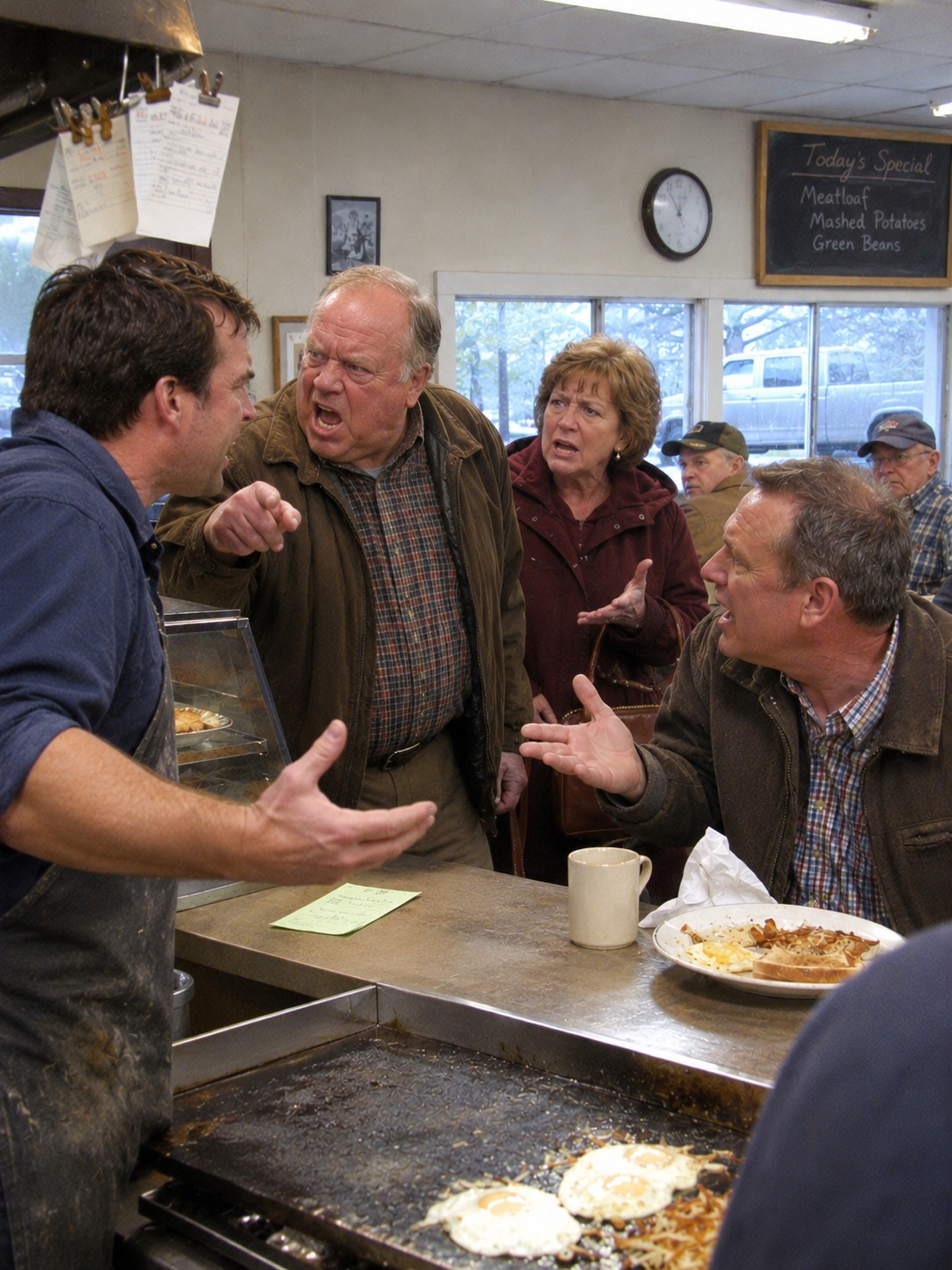
The diner had already closed.
“Tell him to call me.”
“Ford, you're making enemies out of your own family.”
I almost told her she'd managed that without my assistance.
Instead, I ended the call.
An hour later, someone knocked on our door.
It was Marcy.
She was holding a cardboard box and wearing the purple winter coat she'd owned since her oldest daughter graduated high school.
“Hope I'm not interrupting.”
“Come in.”
She stepped inside and set the box on our dining table.
“Your things.”
Inside were my spare work shirts, a sharpening stone, a kitchen thermometer, two coffee mugs, and a photograph of Grandpa standing beside the original diner sign.
I picked up the photograph.
“Who told you to bring these?”
“Nobody.”
She removed her coat.
“Garrett was clearing out the kitchen shelves. Said he wanted to eliminate clutter.”
I stared at her.
“He was throwing this away?”
“He put it beside the trash can.”
I ran my thumb across Grandpa's photograph.
There was a crease in one corner.
I'd kept it above the ticket rail for nearly twenty years.
Marcy accepted a cup of coffee from Nora.
“There's something else you ought to know.”
She reached into her coat pocket and removed a folded sheet of paper.
It was a proposed employee schedule.
My name occupied six days.
Monday through Saturday.
Opening through closing.
There was a notation beneath it.
Owner-family contribution. Nonpayroll.
Marcy pointed toward the other names.
“Look at mine.”
Her scheduled hours had been reduced from thirty-eight to twenty-four.
Two other waitresses had suffered similar reductions.
The dishwasher had disappeared from the schedule altogether.
“Garrett says we're overstaffed,” she explained.
“Based on what?”
“His spreadsheet.”
I looked at the schedule again.
Sunday breakfast had been a disaster with four people working.
Garrett apparently intended to operate the diner with three.
“He's going to burn everybody out.”
“That's what I told him.”
“What did he say?”
“That the old business model was emotionally inefficient.”
Nora nearly spilled her coffee.
Marcy shrugged.
“I don't know what it means either.”
She leaned closer.
“Ford, I've worked there long enough to know what goes through that register. Your dad's been saying the diner barely breaks even. But the place has been busy for years.”
I'd wondered about that myself.
Our Friday fish fries regularly sold out. Breakfast was steady. Food waste was low because I monitored purchasing carefully.
Our equipment was old, but most of it was paid for.
We should have been doing better.
“Did you ever see the books?” I asked.
“Your mother wouldn't let anybody near them.”
Marcy hesitated.
“Sometimes she'd take cash from the register before I counted it at closing.”
“How much?”
“Couple hundred here and there. Sometimes more.”
“Did she record it?”
“She always said she'd handle it.”
That sounded familiar.
Mom handled everything.
That was Dad's answer whenever money disappeared.
Marcy looked toward the box.
“There's something missing from your shelf, too.”
“What?”
“That little green notebook. The pancake one.”
I straightened.
“Where is it?”
“Your mother took it into the office yesterday.”
“Why?”
“I don't know. But she wasn't happy when she saw me looking.”
Grandpa's pancake tradition had never involved money.
The notebook contained dates, names, and occasional comments I'd written beside customers' entries.
I couldn't imagine why Mom would care about it.
Unless there was something in it I'd forgotten.
After Marcy left, Nora and I prepared dinner.
Lucy insisted that her stuffed rabbit needed a chair.
I found myself cutting chicken into little pieces while calculating how many months our savings could cover the mortgage.
Four, comfortably.
Six, if we were careful.
Less if something broke.
The thought of starting over at my age frightened me.
I'd never written a proper résumé.
My entire employment history could be summarized in one address.
But I knew how to run a kitchen.
I knew suppliers, inventory, food safety, scheduling, maintenance, and customer service.
Those skills belonged to me.
My parents couldn't give them to Tara.
At seven thirty, Dad sent a message asking me to come to their house.
Family meeting. We need to straighten this out.
Nora read it.
“I'm coming.”
I didn't argue.
We dropped Lucy off with Nora's sister and drove across town.
My parents' house looked exactly as it had when I was growing up. Same white porch railing. Same brass mailbox. Same ceramic flowerpots Mom brought inside every winter.
Garrett's SUV was parked in the driveway.
Tara opened the front door.
“Let's please keep this civilized.”
I hadn't said a word.
We followed her into the dining room.
Dad sat at the head of the table.
Mom had arranged six coffee cups and a plate of cookies.
Garrett had his laptop open.
It looked less like a family meeting than a presentation.
“Ford,” Garrett began, “there's been a fundamental misunderstanding.”
“Did you put my house on a loan application?”
He adjusted his glasses.
“We identified potential collateral.”
“Without my permission.”
“It wasn't finalized.”
“Did you sign my name?”
He looked toward Dad.
Dad picked up his coffee.
“Let's not get hung up on technicalities.”
Nora leaned forward.
“Someone forged my husband's signature. That's not a technicality.”
Mom frowned.
“There's no need to use ugly words.”
“What word would you prefer?” Nora asked.
Nobody answered.
Garrett turned his laptop toward us.
There were colorful charts showing projected revenue, renovation expenses, and a redesigned diner logo.
He explained that Ziegler's would become a modern dining destination.
Specialty coffee.
Premium breakfast offerings.
Branded merchandise.
A redesigned interior.
I recognized several items from the espresso cart Tara had attempted years earlier.
“Where's the money for all this coming from?” I asked.
“The financing package.”
“And if the business can't repay it?”
Garrett smiled.
“That's a pessimistic way to approach entrepreneurship.”
“It's a practical way to approach debt.”
Dad slapped his palm against the table.
“Enough!”
Lucy wasn't there, but I instinctively looked toward the empty chair beside Nora.
Dad lowered his voice.
“Your sister has a chance to build something substantial. All we're asking is that you help her get started.”
“With unpaid labor and my house?”
“You're twisting everything.”
“Then explain the $9,400.”
Mom immediately stood.
“I'm getting more coffee.”
“Sit down, Elaine,” Nora said.
Mom froze.
Nobody spoke to my mother that way.
Nora opened her purse and removed a printed photograph of the green guest check.
She placed it in the center of the table.
“Gerald acknowledged this debt four years ago. On the reverse side, there's a notation about a transfer to Tara.”
Tara leaned forward.
“What transfer?”
Mom stared at the photograph.
Dad's face lost its color.
I watched them carefully.
“What happened to the diner's money three days before you told me we couldn't afford the suppression system?”
Dad rubbed his forehead.
“Ford, that was a complicated time.”
“How much did you give her?”
Tara looked at Mom.
“Is he talking about Madison?”
Mom whispered her name.
“Tara.”
But my sister continued.
“You told me that money came from Grandpa's estate.”
I felt something shift inside me.
“Grandpa's estate?”
Tara looked confused.
“That's what they said.”
“How much?”
She glanced at Garrett.
Then at Dad.
“Fifteen thousand.”
The room became silent.
I remembered Dad sitting in the diner with his head in his hands.
I remembered the installation estimate.
I remembered transferring my savings.
Three days earlier, my parents had apparently found fifteen thousand dollars for Tara.
But they couldn't find ninety-four hundred to keep the kitchen open.
“Was that diner money?” I asked.
Dad looked away.
Mom began crying.
Not loudly.
Just enough to make Dad reach for her hand.
“You don't understand what it's like trying to make everything fair between your children,” she said.
I stared at her.
“Then explain it to me.”
She wiped her eyes.
“We were going to replace the money.”
“With what?”
Nobody answered.
Nora gathered the photograph and returned it to her purse.
“We're leaving.”
I stood.
Dad pushed back his chair.
“Ford, don't do anything stupid.”
I looked at him.
“I'm meeting Bertel tomorrow.”
His expression changed immediately.
“You've spoken to Bertel?”
“Yes.”
Garrett closed his laptop.
Mom stopped crying.
Tara looked from one face to another.
Dad stepped around the table.
“There's no reason to involve the bank in private family matters.”
“They're already involved.”
I reached for my coat.
Then Tara spoke.
“Wait.”
She disappeared upstairs.
Mom called after her, but Tara didn't answer.
A minute later, she returned carrying a large cream-colored envelope.
“Ford, I thought you knew about this.”
Dad moved toward her.
“Tara, give me that.”
She stepped away from him and handed me the envelope.
It bore the name of a local law firm.
Inside was a document dated eleven years earlier.
I recognized Grandpa's name on the first page.
Then I saw my own.
Dad reached for the papers.
Nora caught his wrist.
“Let him read it.”
I turned the page.
There, beneath a paragraph concerning ownership of Ziegler's Diner, was a handwritten amendment.
Grandpa had signed it.
So had my father.
And beside my father's signature was a sentence that made my mother suddenly scream for Tara to take the document away.






Comments 0