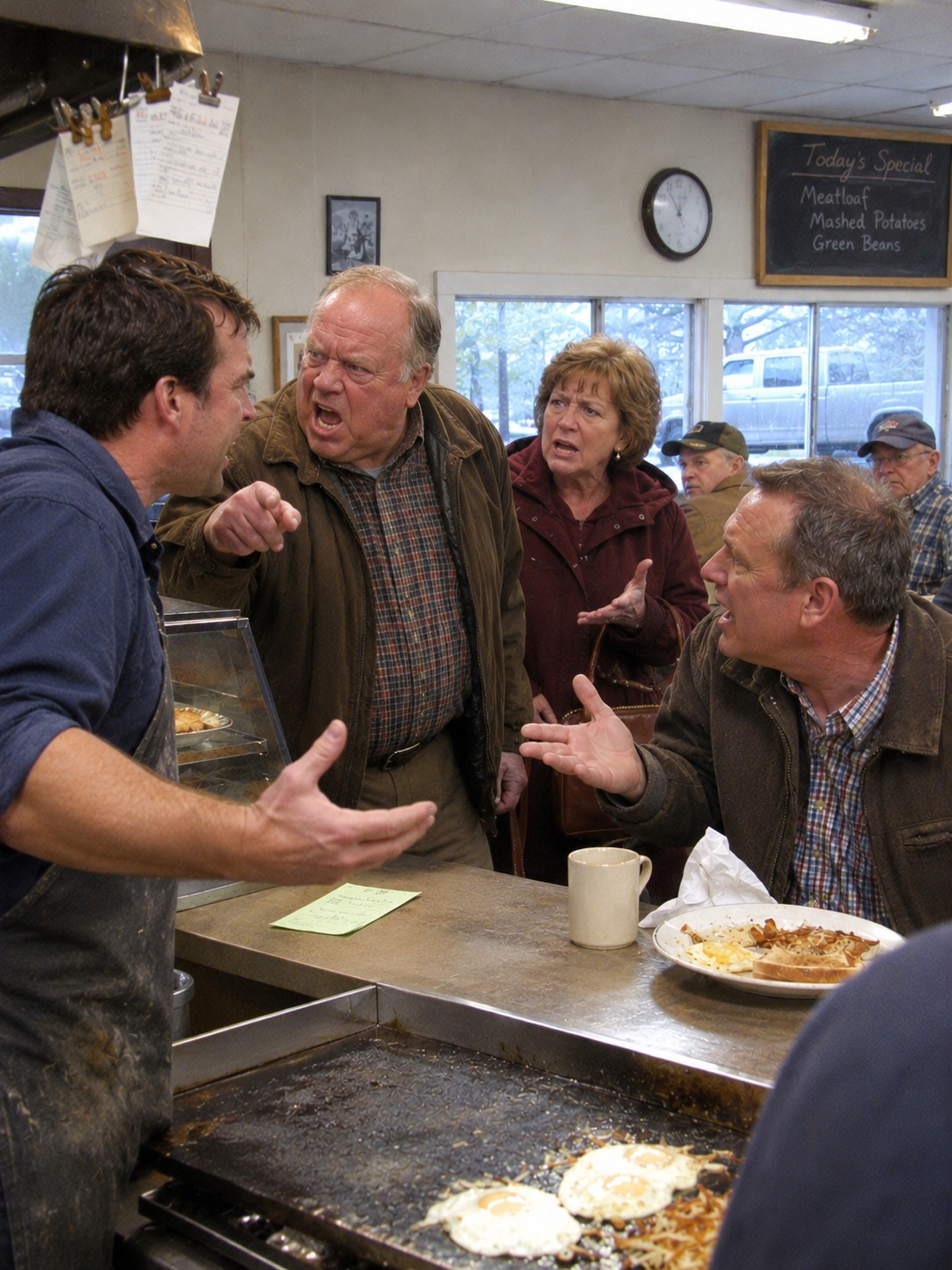
“Ford, your father may never have owned everything he just agreed to sell.”
I stared at Margaret.
“What does that mean?”
She turned the certified document toward me.
It was a recorded deed establishing an undivided ownership interest in the diner property.
Grandpa had transferred thirty percent of the property directly to me when I was eighteen, retaining the remaining interest that eventually passed to Dad.
I read the document three times.
“Thirty percent?”
Margaret nodded.
“The title company located the deed under an older property description. They're verifying the complete chain of ownership, but the preliminary findings are clear.”
“Why didn't anybody tell me?”
She opened another document.
“Your grandfather entrusted the original paperwork to your father. There was also correspondence instructing Gerald to explain the arrangement to you when you became financially independent.”
I leaned back.
Dad had never explained anything.
For nearly twenty years, I had worked inside a building I partially owned without receiving a single accounting of that ownership.
Bertel examined the documents.
“This also complicates the mortgage your father granted.”
Margaret nodded.
“Gerald could not independently pledge Ford's ownership interest without proper authorization. We'll need to resolve the lender's claims and confirm precisely what the mortgage encumbers.”
I thought about Garrett's purchase option.
The forged signatures.
The consent agreement.
Suddenly, I understood why my signature had been so important.
They hadn't simply needed me to cooperate.
They had needed me to surrender something I didn't know belonged to me.
“Did Garrett know?” I asked.
Margaret folded her hands.
“The documents Tara provided suggest he discovered your interest during his preliminary property research. That may explain his efforts to obtain a purported waiver.”
I looked down at Grandpa's signature.
Even after his death, he had been protecting me.
My father had spent years telling me that someday I might earn the right to own the diner.
Grandpa had already given me part of it.
The following morning, Dad came to Margaret's office with his attorney.
When Margaret placed the deed before him, he didn't pretend to be surprised.
He simply lowered his head.
“You knew,” I said.
He nodded.
“Why?”
“I thought if you knew, you'd start asking for things I couldn't afford to give you.”
“Things that belonged to me?”
His eyes filled with tears.
“Yes.”
I waited.
He looked at the document.
“Your grandfather wanted you to have security. I wanted to keep control.”
There it was.
No excuses about household expenses.
No explanation involving Tara's needs.
Just the truth.
“I'm sorry, Ford.”
I nodded slowly.
“Then help us make it right.”
And this time, he did.
Over the following weeks, Margaret worked with the title company, the lender, Hollis's attorney, and an independent accountant.
The recorded ownership interest was confirmed.
The lender acknowledged that I had never authorized a mortgage against my share.
A negotiated payoff allowed the outstanding mortgage to be discharged at closing.
Garrett's surrendered purchase option was formally resolved, and the property records were cleared of his claims.
Hollis revised his offer.
Instead of purchasing the entire property, his company acquired my parents' remaining seventy-percent interest.
I retained mine.
Our operating agreement established clear responsibilities, reasonable rent reflecting our respective ownership interests, and a structured opportunity for me to acquire Hollis's share over time.
For the first time in my life, I understood every document I signed.
Nobody rushed me.
Nobody called me selfish for asking questions.
Nobody told me that being family meant I didn't need something in writing.
When the closing was completed, Margaret handed me a set of keys.
I recognized the brass key immediately.
It was the same one Grandpa had given me when I was seventeen.
The one I'd left beside my resignation letter.
“Congratulations,” she said.
I stared at it.
Then I closed my hand around it.
“Thank you.”
Outside the office, Hollis waited beside his truck.
“Well?” he asked.
“We did it.”
He grinned.
“Good. I'm getting tired of eating breakfast at home.”
Vern emerged from the passenger side.
“That's because you can't cook.”
Hollis told him to mind his own business.
I laughed.
Then I called Nora.
This time, when she asked whether we owned the diner, I didn't say almost.
“Yes,” I told her.
“We do.”
The financial disputes took longer to resolve.
My parents agreed to repay the $37,860 withdrawn from my savings account, the $9,400 I'd contributed toward the fire suppression system, and the unpaid portion of Tara's espresso cart loan.
The settlement included an additional amount addressing documented compensation claims.
Part of the repayment came directly from their remaining property sale proceeds.
The balance was secured through an enforceable installment arrangement.
Tara returned the remaining reserve funds and cooperated fully with the investigation into Garrett's consulting payments.
Several contractors returned deposits for work that hadn't been performed.
The recovered business funds were applied according to the settlement, including payment of outstanding legitimate obligations.
Garrett wasn't nearly as fortunate.
The disputed signatures and financial records were referred to the appropriate authorities.
Months later, he pleaded guilty to forgery-related charges arising from the fabricated documents.
He received a criminal sentence that included restitution obligations.
Separate civil proceedings resulted in the recovery of a substantial portion of the improperly diverted development payments.
His consulting business closed.
The seventy-five-thousand-dollar payment he'd expected from the property sale never materialized.
Tara filed for divorce.
She moved into a modest apartment and accepted an administrative position with a local insurance agency.
For the first time, she was paying her own bills without calling our parents.
One afternoon, she stopped by the diner while we were preparing to reopen.
She handed me an envelope.
Inside was a check.
“What's this?”
“The last three hundred dollars from the espresso cart.”
I looked at her.
“That was included in the settlement.”
“I know.”
She swallowed.
“I just wanted to pay something myself.”
I studied her face.
Then I handed the check back.
“Put it toward your emergency savings. You've already met the agreed repayment terms.”
Her eyes filled with tears.
“Thank you.”
I nodded.
“Just don't mistake forgiveness for permission to do it again.”
“I won't.”
Our relationship didn't return to what it had been.
That was probably a good thing.
We were building something different.
Something that didn't require me to lose so she could win.
My parents sold their expensive Buick, reduced their household expenses, and eventually moved into a smaller house.
Dad found part-time work at a hardware store.
Mom began working several mornings a week at a local bakery.
They weren't destitute.
They simply had to live within their means.
For years, that had been their advice to me.
Now they were following it themselves.
Meanwhile, the diner slowly came back to life.
We restored the original red booths.
Repaired the counter.
Repainted the exterior without changing Grandpa's familiar sign.
I rehired Marcy and offered her the position of floor manager.
When I told her the salary, she stared at me.
“Are you serious?”
“Absolutely.”
She started crying.
Then she hugged me so hard I nearly dropped my clipboard.
We brought back the other employees who wanted to return and hired an additional experienced cook.
I established proper payroll procedures and hired an independent bookkeeper.
Every employee received written terms.
Every hour worked was recorded.
Nobody was expected to sacrifice their paycheck for somebody else's dream.
And for the first time, I paid myself a regular salary.
Nora helped design our operating budget.
She insisted that I schedule two days off every week.
I argued for approximately thirty seconds.
Then she reminded me that I had promised to build a business, not another prison.
I stopped arguing.
On reopening morning, I arrived before sunrise.
The parking lot was empty.
The streetlights cast pale reflections across the windows.
I unlocked the front door and stood inside.
Eleven stools.
Six booths.
One thirty-six-inch griddle.
Everything looked familiar.
And yet nothing felt the same.
I walked behind the counter and switched on the coffee machine.
Then I retrieved Grandpa's brass spatula from the drawer.
I ran my thumb along the wooden handle.
“Morning, Grandpa,” I whispered.
At five forty-five, Nora arrived with Lucy.
Lucy wore a tiny white apron with her name embroidered across the front.
“Daddy, I'm ready to work!”
I laughed.
“Your shift is going to be very short.”
She climbed onto a stool near the counter while Nora stood beside her.
I poured the first pancake onto the griddle.
Grandpa had always called the first pancake the scout.
It told you whether the temperature was right.
Whether the batter was ready.
Whether the morning was going to cooperate.
When the bubbles appeared, I slipped the brass spatula underneath and flipped it.
Perfect.
I placed it on a small plate.
Lucy clapped.
“Is that mine?”
I smiled.
“Of course.”
I carried it over to her.
She poured far too much syrup onto it.
Nora laughed.
I watched my daughter take her first bite.
And something inside me finally settled.
At six, Marcy unlocked the front door.
Vern and Hollis were waiting outside.
Behind them stood dozens of familiar faces.
Ruth Jensen.
Dennis, the old meat supplier.
Retired teachers.
Farmers.
Former employees.
People who remembered Grandpa.
People who had watched me grow up.
Within twenty minutes, every seat was occupied.
The coffee machine barely kept up.
Orders covered the ticket rail.
Marcy moved between the booths with the confidence of someone who knew exactly where she belonged.
Hollis ordered oatmeal.
Vern ordered pancakes.
Then Hollis complained that Vern's pancakes looked better than his oatmeal.
Some things, thankfully, never changed.
At eight thirty, my parents arrived.
Dad stood near the entrance holding his cap.
Mom looked nervous.
I walked over.
“Table for two?”
Dad nodded.
“If you've got room.”
I showed them to a booth.
Marcy brought coffee.
They ordered breakfast.
When the check arrived, Dad paid the full amount and left a generous tip.
Before leaving, he approached the counter.
“You're doing a good job, son.”
“Thanks, Dad.”
He looked around.
“Better than I did.”
I didn't contradict him.
He rested his hand briefly on my shoulder.
Then he left with Mom.
There would always be things between us that couldn't be undone.
But I no longer needed their approval to know what I was worth.
One year later, Ziegler's Diner was profitable.
Our debts were manageable.
The employees were happy.
I had begun purchasing additional ownership interests from Hollis under our agreement.
Nora and I rebuilt our savings.
We replaced the old truck without borrowing money from anyone.
And every Wednesday afternoon, I picked Lucy up from preschool.
We went to the park, bought ice cream, or simply drove home together.
I never missed those afternoons.
Above the register, I hung Grandpa's photograph beside the original 1961 newspaper clipping.
Beneath them sat his green notebook.
I'd restored its damaged cover and begun adding new names.
Whenever someone needed breakfast but couldn't afford it, we quietly took care of the bill.
No photographs.
No announcements.
Just food.
One Sunday morning, Lucy asked why Grandpa's picture was hanging above the counter.
I lifted her into my arms.
“Because he taught me how to make pancakes.”
She thought about that.
“Did he teach you everything?”
I looked around the diner.
At Nora laughing with Marcy.
At Vern and Hollis arguing over breakfast.
At the sunlight pouring through the windows.
“Not everything,” I said. “Some things I had to learn myself.”
“Like what?”
I kissed her forehead.
“Like how important it is to take care of the people you love.”
She smiled.
Then she asked for another pancake.
I carried her into the kitchen, where Nora was waiting.
We made breakfast together.
For most of my life, I had believed that inheriting the diner would be the greatest reward I could ever receive.
I had been wrong.
The greatest reward was owning my future, protecting my family, and finally having the freedom to decide what kind of man I wanted to be.
Grandpa had given me more than a restaurant.
He had given me an example worth following.
And now, standing beside my wife and daughter in the kitchen where my story had begun, I knew exactly what I wanted to leave behind.
Not broken promises.
Not hidden debts.
Not obligations disguised as love.
Something honest.
Something lasting.
A place where everyone belonged, where hard work was respected, and where family meant lifting one another up instead of holding someone down.
I flipped another pancake.
Lucy cheered.
Nora kissed my cheek.
Outside, the familiar Ziegler's Diner sign glowed in the morning sunlight.
And inside, surrounded by the people who had never stopped believing in me, I was finally home.






Comments 0