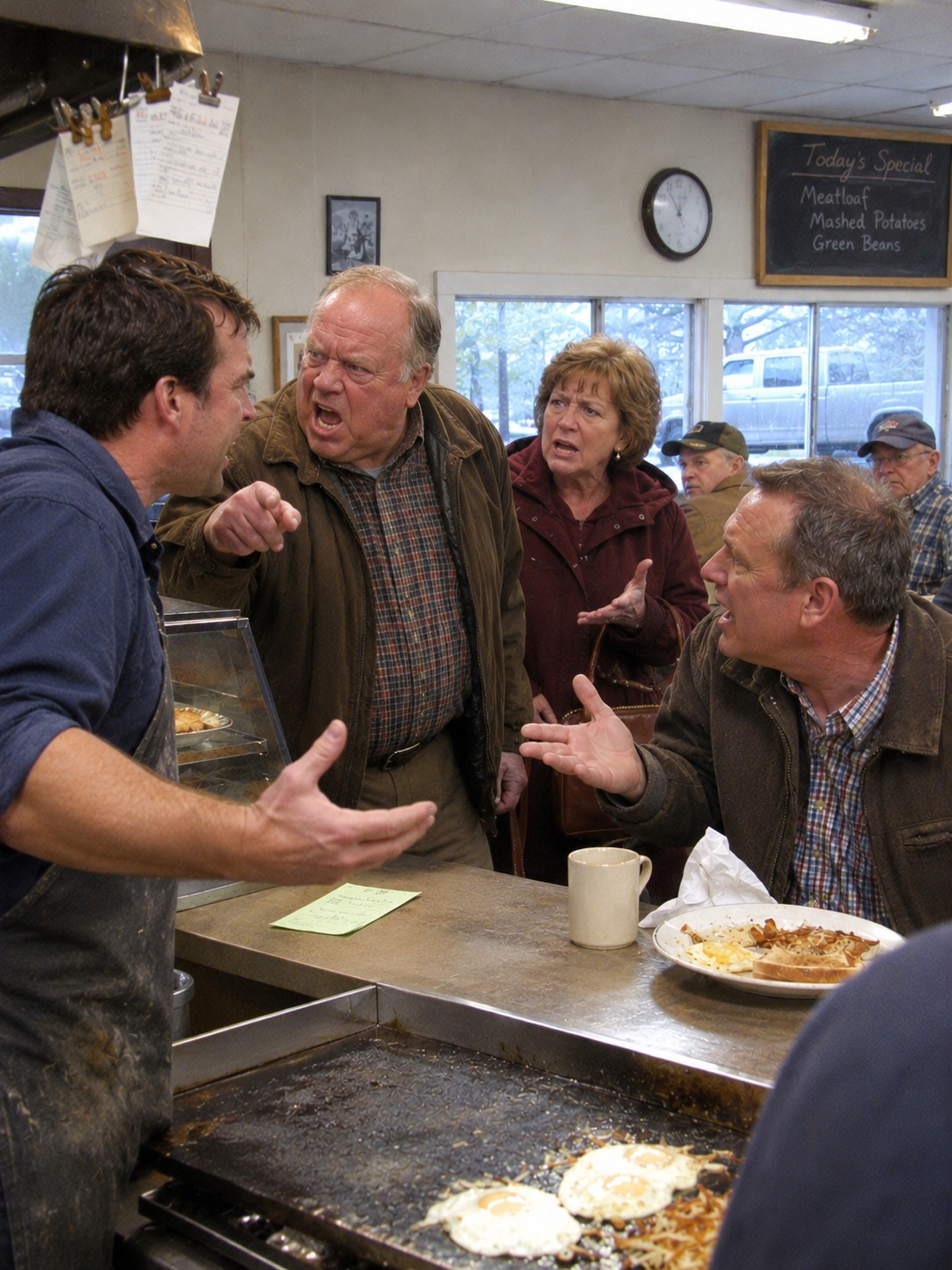
“Give it back to your sister!”
Mom's voice was so sharp that Garrett stood up.
I moved away from the table and held the document beneath the dining room light.
The handwritten amendment was only two sentences long.
Upon Gerald's retirement, Ford Ziegler shall be offered the first opportunity to acquire the family diner under the terms of the original succession agreement. No transfer to another family member shall take place until Ford has received that offer in writing.
Beneath it were two signatures.
Grandpa Leo's and Dad's.
I looked at the date again.
The amendment itself had been signed nearly twenty years earlier. The cover document, dated eleven years ago, appeared to be a later review of the family's ownership arrangements.
“What's the original succession agreement?” I asked.
Dad sat down.
He suddenly looked older than he had at his retirement party.
“It's complicated.”
“Everybody keeps telling me that.”
Mom reached toward the document.
“Those papers aren't yours.”
“My name is on them.”
“They concern your grandfather's estate.”
“Then why haven't I seen them?”
She looked at Dad.
He looked at Tara.
Tara looked genuinely confused.
For the first time since the retirement announcement, I wondered how much my sister actually knew.
“Mom gave me that envelope when Garrett started putting together the business plan,” she explained. “She said it contained some old ownership paperwork.”
“And you read it?”
“Garrett did.”
I turned toward him.
He was studying his laptop.
“You knew about this?”
He closed the computer.
“It's an outdated arrangement.”
“According to whom?”
“Your parents own the business. They're entitled to make decisions.”
“Then why does this exist?”
Garrett shrugged.
“Families make informal agreements all the time.”
I looked at Grandpa's signature.
There was nothing informal about it.
Grandpa had been a man who kept receipts for replacement light bulbs. When he loaned somebody his lawn mower, he wrote their name on a calendar.
He believed agreements mattered.
Apparently, his children believed otherwise.
Nora took out her phone.
“I'm photographing every page.”
Mom protested.
Dad told her to stop.
Neither of us listened.
When Nora finished, I returned the papers to Tara.
“Keep those somewhere safe.”
She nodded.
Mom immediately held out her hand.
Tara hesitated before giving her the envelope.
I didn't argue.
We had copies now.
As Nora and I walked toward the front door, Dad followed us.
“Ford, you're going to destroy this family over money.”
I stopped.
For years, those words would have worked.
I would have apologized.
I would have returned to the table and accepted whatever arrangement kept everybody comfortable.
But that evening, I looked at my father and asked him a question I'd never had the courage to ask before.
“Why was it always my money?”
He didn't answer.
“Why was it always my time? My paycheck? My savings? My weekends?”
He rubbed his chin.
“You were always the dependable one.”
I waited for something else.
An apology.
An explanation.
Anything.
Instead, he added, “Your sister needed more help.”
I nodded slowly.
“And you never thought I might need some?”
His mouth opened.
Then closed.
I walked out.
On the drive home, Nora held my hand across the center console.
Neither of us spoke until we reached the courthouse.
“Did you know your grandfather made an agreement?” she asked.
“No.”
“Did he ever mention one?”
I thought about it.
Grandpa had occasionally said things about the future.
He'd told me to learn the register, even though Dad handled it. He'd insisted I understand how food costs affected prices. He'd taught me how to calculate payroll expenses on the back of a paper napkin.
Once, when I was eighteen, he asked whether I'd rather attend culinary school or eventually operate the diner.
I told him I wanted the diner.
He smiled.
“Then you'd better learn more than cooking.”
At the time, I'd thought he was giving me advice.
Now I wondered whether he had been preparing me for something specific.
We collected Lucy from Nora's sister and went home.
After putting her to bed, I sat at the dining table with the photographs of the succession amendment.
Nora searched the name of the law firm printed on the envelope.
The firm still existed.
One of its founding attorneys had retired, but his daughter now managed the practice.
“We should call them tomorrow,” she said.
I agreed.
Then I opened a fresh notebook.
At the top of the first page, I wrote three words.
What they owe.
I started with the suppression system.
Then the espresso machine.
Then the Christmas bonus Dad had promised when I worked nineteen consecutive days.
I didn't include every unpaid hour. There were too many, and I didn't have records for most of them.
But the amounts I could document were substantial.
Nora watched me write.
“There's another list you should make.”
“What?”
“What you want.”
I stared at the empty space beneath the figures.
For most of my life, what I wanted had depended on what my parents were willing to give me.
I wanted the diner because Dad had promised it.
I wanted a raise because Dad had mentioned one.
I wanted Sundays off because Mom occasionally said I deserved a break.
I'd rarely considered making a decision without waiting for their permission.
Finally, I wrote:
Protect our house.
Recover our money.
Find out what Grandpa intended.
Nora read the list.
Then she added a fourth item.
Be home for Lucy.
I smiled.
“That one's expensive.”
She shook her head.
“No. Missing it was expensive.”
I slept better that night than I expected.
At seven the following morning, I woke to the sound of Lucy singing in the hallway.
She was wearing one sock and carrying a plastic spatula.
“Daddy, breakfast!”
I made scrambled eggs.
We ate together.
At eight thirty, I drove to Pine River Savings.
Bertel's office hadn't changed much since the day I'd opened my independent checking account. There was a photograph of his fishing boat on the wall, a brass desk lamp, and a jar of peppermints beside the telephone.
His mustache had gone entirely gray.
“Sit down, Ford.”
He closed the office door.
I placed my folder on his desk.
The photographs.
The signed guest check.
The unauthorized employment agreement.
The messages from Tara and Garrett.
And the succession amendment.
Bertel examined each document carefully.
He spent the longest time looking at Grandpa's signature.
“You know anything about this?” I asked.
He leaned back.
“Your grandfather was a careful man.”
“That's not an answer.”
“No,” he admitted. “It isn't.”
He removed his glasses.
“Leo did business with this bank for decades. He was concerned about what would happen to the diner after he died.”
“Concerned about Dad?”
Bertel considered his answer.
“Concerned about whether the person operating the business would eventually be the person who owned it.”
I looked down at the amendment.
“Did Grandpa mean me?”
“You'll need to discuss that with the attorney who handled his arrangements.”
He opened another folder.
“First, we need to address the immediate problem.”
He explained that the proposed $240,000 loan would cover renovations, operating expenses, and refinancing of existing business obligations.
The application identified Tara and Garrett as future operators.
It identified me as the kitchen manager.
My anticipated unpaid labor had been incorporated into the financial projections.
My house had been listed as potential additional collateral.
Bertel assured me that no mortgage or lien had been created through the application. The bank would not proceed on the assumption that I had consented.
I signed a statement confirming that I had authorized neither the guarantee nor the use of my property.
Then he showed me a document bearing another imitation of my signature.
I recognized the same perfectly formed Z.
“Who submitted this?”
“Garrett delivered the application package on Friday.”
“Did you ask him about my signature?”
“He represented that the family had reached an agreement. I wanted to confirm your participation independently.”
I sat back.
Friday.
The retirement party had been Saturday.
They had submitted paperwork committing my labor and suggesting the use of my home before telling me Tara was taking over.
The announcement hadn't been a family decision made public.
It had been the final stage of an arrangement they expected me to accept.
“Would this business even qualify without me?” I asked.
Bertel folded his hands.
“I can't discuss every aspect of another applicant's financial position. But I can tell you that the assumptions concerning your participation were material.”
I understood.
Without my labor and supposed financial backing, their plans might not survive.
That explained Dad's desperation on Sunday.
It explained Garrett's threatening messages.
It explained why Mom had been frightened when I photographed the employment agreement.
They hadn't simply expected me to cook.
They had built their future around my inability to say no.
When I left the bank, I called the law firm.
A receptionist transferred me to Margaret Keller, the daughter of Grandpa's former attorney.
She listened while I explained what we'd found.
“Mr. Ziegler, do you have the complete succession agreement?”
“Only an amendment.”
“Who has the original?”
“My parents, presumably.”
She paused.
“Let me review our archived files. I may need to retrieve some documents from storage.”
“Did my grandfather leave me anything?”
“I'd rather answer that after examining the records.”
She promised to call when she had more information.
I thanked her and returned to my truck.
There were six missed calls from Dad.
Three from Mom.
Two from Tara.
And a message from Garrett.
Your actions have jeopardized a legitimate financing arrangement. We expect you to cooperate immediately.
I forwarded it to Nora.
Then I drove to the diner.
Not to work.
Not to apologize.
I wanted to see what was happening to the place.
The parking lot was nearly empty.
A handwritten sign announced limited service due to staffing difficulties.
Through the window, I saw Dad standing behind the register. Tara was carrying coffee cups. Garrett was talking to somebody on his phone.
Marcy noticed my truck and came outside.
“You all right?”
“Getting there.”
She looked back toward the diner.
“They're blaming you for everything.”
“I figured.”
“Your mother told customers you're demanding half the business.”
“I'm demanding repayment of a loan.”
Marcy shook her head.
“That's not the story they're telling.”
She reached into her apron pocket.
“Listen, I found something.”
She handed me a small green spiral notebook.
Grandpa's pancake notebook.
The cover was bent, and several pages had been torn out near the back.
“Where was it?”
“In the office trash.”
I felt a sudden anger that surprised me.
“They threw it away?”
“Your mother did. I saw her.”
I opened the notebook.
Years of names stared back at me.
Vern.
Hollis.
Schoolteachers.
Farmers.
Truck drivers.
People who had moved away.
People who had died.
Little pieces of our town, written in my handwriting.
Then I noticed something unusual.
The cardboard backing had been partially separated from the spiral binding.
Marcy pointed toward it.
“There's something tucked inside.”
I carefully pulled the backing apart.
A narrow envelope slipped into my hand.
It was yellow with age.
Across the front, in handwriting I recognized immediately, were four words.
For Ford. From Grandpa.
My throat tightened.
Grandpa had been dead for nearly twenty years.
I turned the envelope over.
The seal was broken.
Someone had already opened it.
Inside was a folded letter and a small brass key.
I unfolded the letter.
The first sentence stopped me cold.
Ford, if your father has kept his promise, you should never need to use this key.
Before I could read the next line, Marcy grabbed my arm.
“Ford.”
I looked up.
Dad was standing outside the diner.
His eyes were fixed on the envelope.
He started toward us.
And for the first time in my life, I heard my father beg.
“Son, please don't read what's on the other side.”






Comments 0