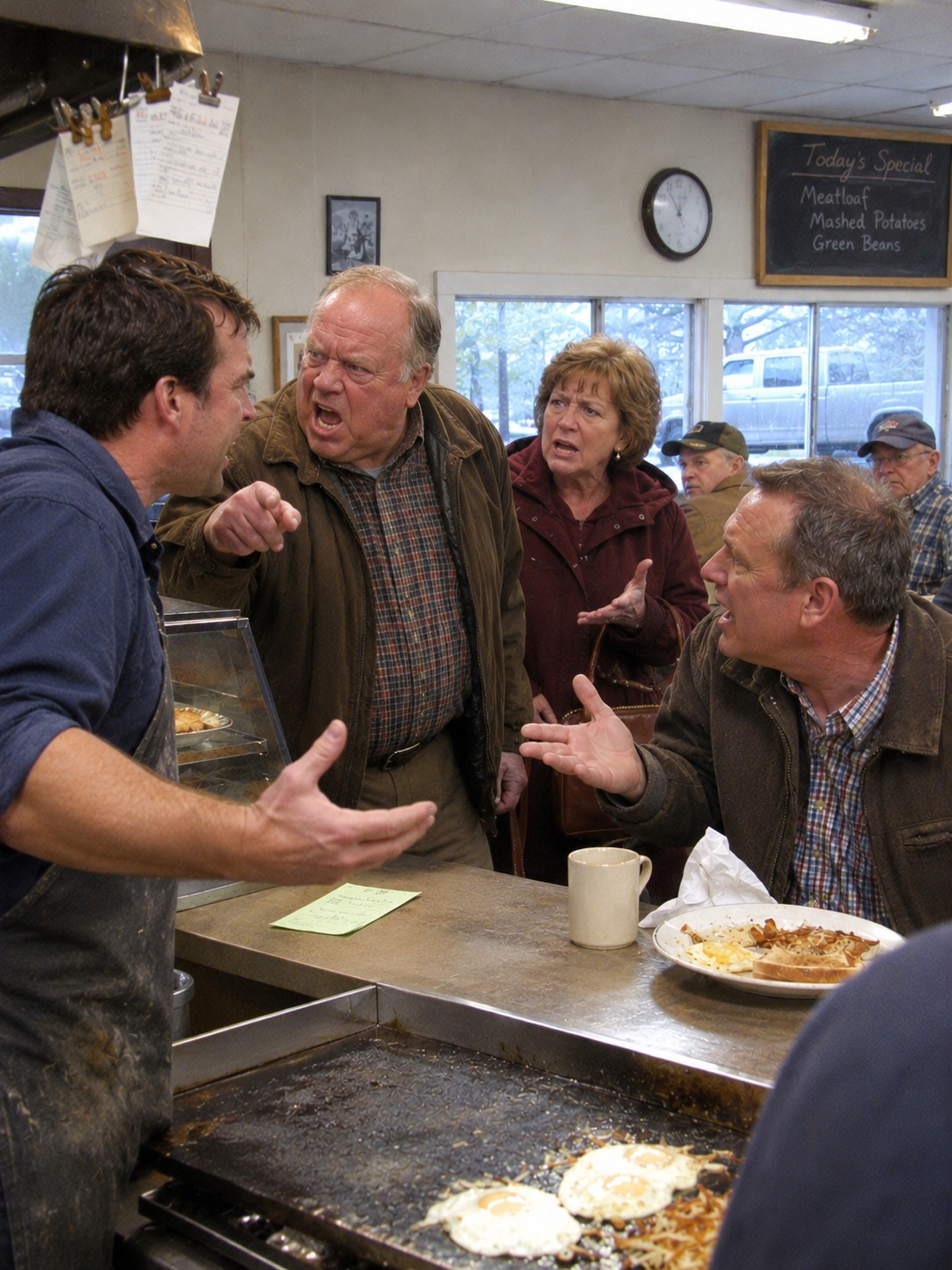
“I'm exercising my option, Ford. Your father has already agreed to sell me the diner.”
Garrett stood across from me with the confidence of a man who believed he'd already won.
Margaret picked up the notice.
“Who represents you in this matter?”
“That isn't important.”
“Actually, it is.”
Garrett ignored her and looked at me.
“You could've avoided all of this by accepting the arrangement your parents offered.”
I stared at him.
“You mean working for nothing while you sold the building?”
“You would've been compensated eventually.”
“Like everybody else you've promised to pay?”
His expression hardened.
Margaret examined the purchase option.
The agreement allowed Garrett's company to acquire the diner property for a predetermined price if certain conditions were satisfied.
That price was considerably below Hollis's proposed offer.
I couldn't understand why Dad would have agreed to it.
Then again, I'd spent the past several days discovering things my father had done that made absolutely no sense.
“Exercising an option doesn't automatically establish that it's enforceable,” Margaret said.
Garrett smiled.
“Gerald signed it.”
“And we're examining the circumstances surrounding that signature.”
“Good luck.”
He turned toward the door.
Before leaving, he looked back at me.
“When this is over, chief, you're going to wish you'd stayed in the kitchen.”
I watched him disappear down the hallway.
Margaret immediately called Dad's attorney.
I sat beside her desk, staring at the notice.
My hands felt cold.
After everything we'd uncovered, Garrett still believed he could walk away with the building.
And perhaps he could.
That possibility frightened me more than I wanted to admit.
Margaret finished her telephone conversation.
“Your father's attorney is reviewing the agreement. We're also moving forward with our request for emergency judicial relief.”
“Can Garrett take possession tomorrow?”
“Not simply by delivering this notice. There are legal and contractual steps involved. But we cannot ignore his claim.”
I nodded.
“There's something else,” she continued.
She pointed toward a paragraph near the bottom of the agreement.
“The option was granted in connection with Garrett's development services. If those services were materially misrepresented, or if the agreement was obtained through improper conduct, there may be grounds to challenge it.”
“What do we need?”
“Evidence.”
I looked toward the hallway.
“We've got plenty of that.”
“Then let's make sure it's properly documented.”
I spent the remainder of the afternoon organizing everything.
The forged employment agreement.
The proposed loan guarantee.
The unauthorized use of my personal information.
The consent agreement witnessed by a dead man.
The payments to Garrett's consulting company.
The undisclosed seventy-five-thousand-dollar compensation arrangement.
Each document told part of the story.
Together, they described something far more troubling than a family disagreement.
At six thirty, Dad called.
“Ford, I didn't understand what I signed.”
I closed my eyes.
“Dad, you keep saying that.”
“I thought it was a backup arrangement.”
“For what?”
“In case the financing didn't work.”
“So Garrett could buy the diner cheaply?”
“He said it would protect us.”
“From whom?”
Dad didn't answer.
I looked at the papers spread across our kitchen table.
“Tomorrow morning, you need to tell your attorney everything.”
“I have.”
“Everything?”
He hesitated.
“Yes.”
I wanted to believe him.
But believing my father had become an expensive habit.
That evening, Tara arrived unexpectedly.
She wasn't wearing her wedding ring.
Nora noticed immediately but said nothing.
Tara sat down and placed a flash drive on the table.
“I found something.”
“What?”
“Emails Garrett sent to his business partner.”
She explained that the messages had been stored in the shared business account she was authorized to access.
She had preserved copies before contacting her attorney.
“There's one you need to see.”
She opened her laptop.
The email was dated eight months earlier.
Before Garrett and Tara had even returned from their honeymoon.
I read the first paragraph.
Garrett described the diner as an undervalued property controlled by an aging owner with significant financial vulnerabilities.
Then he mentioned me.
The son is the operational backbone but has no meaningful management authority. Family pressure should ensure his continued cooperation during the transition.
I stopped reading.
Nora leaned closer.
The next paragraph discussed using the proposed renovations to justify additional financing and increase the property's appeal to prospective buyers.
Garrett had never intended to build a better diner.
He had intended to extract as much money as possible from it.
Tara began crying.
“There's another message.”
She opened it.
This one discussed the purchase option.
If the external transaction fails, the fallback acquisition provision allows us to secure the property directly.
I looked at her.
“He planned both outcomes.”
She nodded.
“He was going to make money whether the restaurant succeeded or failed.”
“Did he ever mention your role?”
She scrolled downward.
There was a sentence near the end.
The wife's involvement provides the necessary family credibility.
Tara covered her mouth.
I didn't feel triumphant.
I felt sick.
My sister had believed she was building a future with her husband.
Garrett had apparently regarded her as a useful connection.
“Does your attorney have these?” I asked.
“Yes.”
“Good.”
She looked at me.
“Ford, I'll testify if I have to.”
I studied her face.
“You understand that might mean admitting things you did wrong, too?”
She nodded.
“I know.”
For once, she wasn't asking somebody else to protect her.
The following morning, we gathered at Margaret's office.
Hollis arrived with Vern.
Bertel joined us shortly afterward.
Dad and Mom came with their own attorney.
Tara arrived separately.
Garrett appeared with legal counsel just before ten.
Nobody greeted him.
Margaret distributed copies of the relevant correspondence.
Garrett's attorney read the emails carefully.
Then he asked to speak privately with his client.
They disappeared into another room.
Dad stared at the documents.
“That's what he thought of me?”
Nobody answered.
Mom began crying.
Tara looked straight ahead.
I watched my father read the description of himself as financially vulnerable.
For years, he'd dismissed my concerns while praising Garrett's business intelligence.
Now he was discovering exactly what that intelligence had been used for.
When Garrett returned, he no longer looked confident.
His attorney explained that his client disputed several interpretations of the documents but was willing to discuss a negotiated resolution.
Margaret remained composed.
“We're prepared to proceed with litigation if necessary.”
Garrett looked at Tara.
“You gave them those emails?”
She nodded.
“You had no right.”
“My attorney disagrees.”
His face reddened.
“You're destroying everything we built.”
Tara shook her head.
“You never built anything.”
The room fell silent.
Garrett turned away.
Negotiations continued for nearly three hours.
Nobody got everything they wanted.
Hollis refused to increase his offer to cover Garrett's demands.
Dad agreed to provide a complete accounting of the funds transferred under the development agreements.
Tara agreed to return the remaining reserve money, subject to the necessary accounting and legal arrangements.
Garrett's attorney eventually proposed that his client relinquish the purchase option and withdraw his claims against the property.
In exchange, he wanted a comprehensive release from liability.
Margaret refused.
“We're discussing the property dispute. We're not granting immunity for unrelated conduct or releasing claims that haven't been fully investigated.”
Garrett whispered angrily to his attorney.
Another private conversation followed.
When they returned, the terms had changed.
Garrett would relinquish the purchase option without receiving additional payment from the family.
Disputed financial claims would remain subject to separate proceedings.
He would preserve the relevant records.
And he would surrender any authority he claimed over the diner's operations.
His attorney placed the revised agreement before him.
Garrett stared at it.
Then he looked at Dad.
“You'll regret this.”
Dad didn't respond.
Garrett picked up the pen.
For several seconds, he held it above the signature line.
Finally, he signed.
I watched Margaret examine the document.
She nodded.
The purchase option was being surrendered under a written agreement.
Garrett stood, collected his belongings, and walked out.
Tara didn't follow him.
For the first time since the retirement party, nobody seemed interested in what Garrett thought.
But our work wasn't finished.
Margaret turned toward Dad.
“Now we need to address the original succession agreement.”
Dad's attorney placed a separate settlement document on the table.
The proposed arrangement recognized that my father had failed to honor Grandpa's written instructions.
It established a process for transferring the property to Hollis's company, satisfying the outstanding mortgage and other legitimate property obligations at closing.
The diner equipment and operating assets would be transferred under separately negotiated terms.
I would establish my own business entity and enter into the lease arrangement with Hollis.
My parents would no longer control the restaurant.
My personal financial claims, including the unauthorized withdrawal from my savings and the ninety-four-hundred-dollar loan, were addressed through a combination of proposed repayment obligations and settlement provisions.
Everything was subject to final verification and closing requirements.
Dad read the document slowly.
Mom sat beside him.
“Gerald,” she whispered, “what are we going to live on?”
He looked at her.
“Whatever we have left.”
She began crying again.
I felt the old instinct to reassure her.
To offer help.
To promise everything would be fine.
Instead, I remained seated.
Their retirement couldn't depend on another sacrifice from my family.
Dad looked at me.
“Will you keep the name?”
“Ziegler's Diner?”
He nodded.
“Yes.”
His eyes filled with tears.
“Your grandfather would've liked that.”
I swallowed.
“I hope so.”
He picked up the pen.
Then he stopped.
“Ford, I'm sorry.”
I looked at him.
“For the money?”
“For everything.”
He lowered his eyes.
“I should've been the one protecting you.”
I didn't answer immediately.
An apology couldn't restore twenty years.
But it was the first one he'd offered without asking me to do something in return.
“Thank you,” I said.
He signed.
Mom signed after him.
Tara added her signature to the provisions requiring her cooperation.
Hollis signed the purchase agreement.
I signed the settlement and the conditional operating arrangement after reviewing them with Margaret.
When I put down the pen, my hands were trembling.
There were still closing requirements to satisfy.
But the future I'd spent years imagining was finally within reach.
Vern slapped Hollis on the shoulder.
“Looks like we're getting decent pancakes again.”
Hollis smiled.
“About damn time.”
I called Nora from the parking lot.
“We signed.”
She screamed.
Then she started laughing.
I laughed, too.
For several minutes, neither of us could say anything sensible.
When I arrived home, Lucy ran toward me.
“Daddy, did you get your restaurant?”
I picked her up.
“Almost, sweetheart.”
She wrapped her arms around my neck.
“Can I help?”
“Absolutely.”
That evening, I received a call from Margaret.
Her voice was different.
“Ford, the title company just completed an additional review of the property records.”
I stopped smiling.
“What's wrong?”
“There's a recorded document involving your grandfather that wasn't included in the initial materials.”
“What kind of document?”
“An ownership instrument. It references a separate interest in the property.”
I lowered Lucy gently onto the couch.
“Does it affect the sale?”
“It might change the entire transaction.”
I grabbed my keys.
Margaret told me to come to her office immediately.
When I arrived, Bertel was already there.
Margaret placed a certified document beneath the desk lamp.
I recognized Grandpa's signature.
Beneath it was another name.
Mine.
Margaret turned the page.
“Ford, your father may never have owned everything he just agreed to sell.”






Comments 0