"Hide that letter, Miss Bennett. Please!"
Samuel Voss's voice shook as he stood in the doorway of the old stone cellar.
Clara Bennett didn't move.
The folded letter from her father remained in her hand. Beside her, Reuben stared at the two men blocking the entrance, while Doraththa Marsh pressed herself against the wooden workbench.
Samuel looked nothing like the nervous clerk who had returned the farm ledger that morning.
His face was pale.
His collar was crooked.
And his hands trembled around the leather satchel he carried.
"Who is coming?" Clara asked.
Samuel glanced over his shoulder.
"Mr. Pierce."
Clara slowly folded her father's letter.
"Then he can wait."
"You don't understand."
"I understand that you've come onto my property without permission."
Samuel swallowed.
The second man stepped forward.
He was younger than Samuel, perhaps twenty-eight, with a narrow face and a dusty brown coat. Clara recognized him as a driver employed by Pierce Provisions.
His name was Henry Bell.
"Miss Bennett," Henry said, "we didn't come to cause trouble."
"Then tell me why you're here."
Samuel looked at the wooden box on the workbench.
His expression changed when he saw the old photograph and the handwritten papers.
"You found it," he whispered.
Clara felt a chill.
"Found what?"
Samuel didn't answer.
Instead, he reached into his satchel and removed a folded document.
"I was told to bring this."
"By Walter Pierce?"
"Yes."
Clara held out her hand.
Samuel hesitated before giving it to her.
The document was a formal notice.
Pierce Provisions claimed that Bennett Dairy Farm had failed to meet certain quality standards during previous milk deliveries.
Unless the alleged violations were corrected immediately, the company reserved the right to enforce the penalty provisions of the supply contract.
Clara read the notice carefully.
Then she checked the date.
It had been prepared the previous afternoon.
Before Pierce had even returned her father's ledger.
Before she had reviewed the disputed entries.
Before he could possibly know whether the next delivery would meet the contract requirements.
Clara looked up.
"These allegations are unsupported."
Samuel shifted uncomfortably.
"I'm only delivering the notice."
"Then you can deliver my response."
She placed the paper on the workbench.
"Tell Mr. Pierce that every gallon required by the contract will be delivered on schedule. Tell him I expect written documentation of any quality complaint. And tell him I won't accept deductions that aren't supported by the agreement."
Samuel nodded quickly.
But he didn't leave.
Clara noticed.
"There's something else."
He glanced toward Henry.
The driver looked away.
"Miss Bennett," Samuel said quietly, "your father wasn't as careless with money as people think."
Clara felt her heartbeat quicken.
"Then you know something about these accounts."
Samuel's eyes moved toward the letter in her hand.
"I know enough to be afraid."
"Of Walter Pierce?"
He didn't answer.
That was answer enough.
Clara stepped closer.
"Samuel, if my father was cheated, I need to know."
The clerk's mouth tightened.
For one moment, she thought he might tell her everything.
Then the distant sound of carriage wheels reached the cellar.
Samuel went rigid.
Henry turned toward the entrance.
"He's coming," Henry whispered.
Clara looked down at her father's letter.
She had barely read the first lines.
Whatever Thomas Bennett had discovered before his death was still waiting inside those pages.
She slipped the letter into the pocket of her skirt.
Then she closed the wooden box.
"Reuben, take this to the farmhouse."
Samuel caught his breath.
"Miss Bennett—"
Clara looked directly at him.
"If Mr. Pierce wants to speak with me, he can do it in daylight. He doesn't get to decide what I read in my own cellar."
Reuben lifted the box.
Doraththa followed him toward the door.
Samuel stepped aside.
And Clara walked out to meet Walter Pierce.
Walter's carriage stood beside the farmhouse.
He was speaking to Pete Granger when Clara emerged from the cellar.
Pete looked relieved to see her.
Walter did not.
"Clara," he said sharply. "I understand you've been examining old farm equipment."
She stopped several feet away.
"Good afternoon, Mr. Pierce."
He ignored the greeting.
"What are you doing in that cellar?"
"Looking at property I inherited."
His eyes narrowed.
"That equipment hasn't been used in years."
"Then I suppose it's fortunate that I enjoy repairing old things."
Walter glanced toward the farmhouse, where Reuben had disappeared carrying the wooden box.
"What was that?"
"Something that belonged to my grandmother."
"May I see it?"
"No."
The refusal was quiet.
Immediate.
Walter stared at her.
Pete lowered his head to hide his expression.
Walter took a step closer.
"Clara, I am trying to help you avoid a disaster."
"Then stop sending unsupported notices about my milk."
His jaw tightened.
"I see Samuel has delivered the document."
"He has."
"Good. Then you understand the seriousness of your situation."
"I understand that you're preparing complaints before you've inspected the deliveries."
Walter's face reddened.
"Are you accusing me of dishonesty?"
"I'm asking for evidence."
"Your father never questioned my integrity."
Clara thought of the hidden letter.
The discrepancies.
The cattle sold at suspicious prices.
The note on the back of Pierce's warning.
Ask Clara about figures.
"My father questioned more than you realize," she said.
For the first time, Walter looked genuinely unsettled.
Only for a second.
Then his expression hardened.
"You're playing a dangerous game."
Clara looked toward the barn.
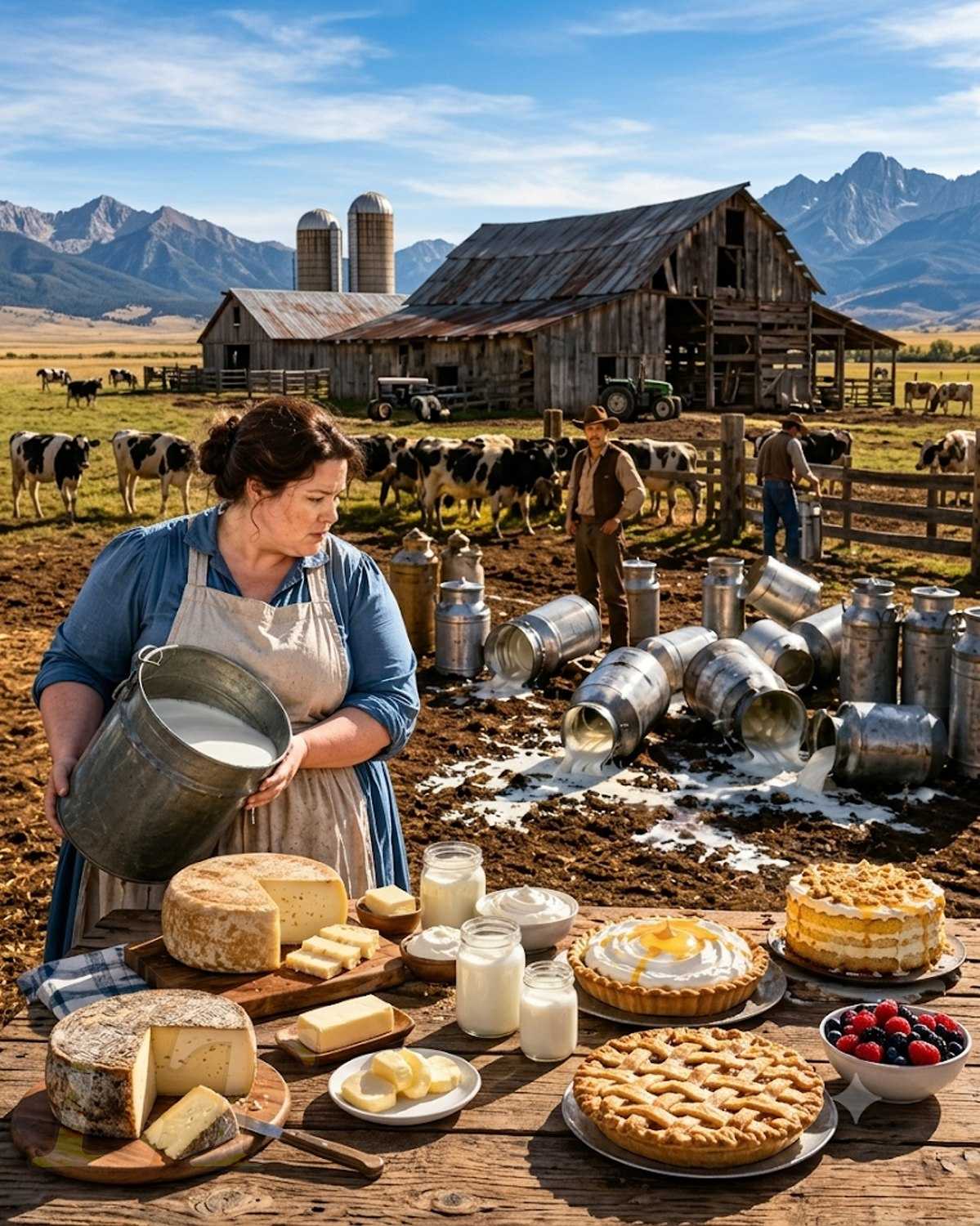
Fourteen cows moved slowly behind the wooden fence.
Milk cans stood beside the collection area.
The farm looked tired.
But it was still working.
"No, Mr. Pierce. I'm running a dairy farm."
Walter gave a humorless laugh.
"With what money?"
She didn't answer.
"With which employees?"
Still nothing.
"And how exactly do you intend to survive when your largest customer stops buying?"
Clara met his eyes.
"By honoring the contract."
He stared at her.
Then he smiled.
A cold, unpleasant smile.
"See that you do."
He turned toward his carriage.
Before climbing inside, he looked back.
"One hundred and forty gallons, Clara. Every week. Not one gallon less."
"I can read a contract."
"Then perhaps you'll understand what happens when you fail."
The carriage pulled away.
Clara watched until it disappeared beyond the fence.
Pete approached.
"Miss Bennett, that man is going to make trouble."
"He already has."
"What are we going to do?"
Clara looked toward the cellar.
Then toward the milk cans.
"We're going to stop giving him reasons to think we're helpless."
Inside the farmhouse, Reuben had placed the wooden box on the kitchen table.
Doraththa stood beside it, waiting.
Clara closed the door.
Then she took out her father's letter.
Her hands were steady now.
She unfolded the pages.
The handwriting was familiar.
Uneven in places.
Her father had been ill when he wrote it.
My dear Clara,
If you're reading this, then Walter has probably told you that I ruined everything.
Perhaps I did make mistakes. I trusted people I should have questioned, and I waited too long to ask for help.
But I need you to know that the farm did not fail because the cows stopped producing.
Clara stopped reading.
She looked at Reuben.
He remained silent.
She continued.
We produced good milk. We worked hard. But somehow, every month, the money grew smaller while the debt grew larger.
I began checking the payments against the prices paid by the buyers who purchased milk through Pierce Provisions.
The figures did not agree.
I have hidden copies of the amounts I could verify. They may not prove everything, but they should be enough to show you where to look.
Clara picked up the folded sheet from the box.
Now she understood what it represented.
Not a complete accounting.
Not a confession.
But a record of transactions her father had begun investigating.
She examined the columns.
The amounts suggested that Pierce had resold some milk at prices substantially higher than those paid to Bennett Dairy Farm.
Reselling at a profit wasn't illegal.
Clara knew that.
But certain deductions appeared to have been charged twice.
Other entries referred to payments her father had never received.
She turned back to the letter.
I don't know how much longer I can keep fighting this. I am tired, Clara. More tired than I ever admitted to you.
Her vision blurred.
She pressed her lips together.
I wish I had asked you to come home sooner.
Doraththa quietly began to cry.
Clara kept reading.
There is something else I want you to remember.
Your grandmother saved this farm once.
Not by selling more milk.
By making something better from what we already had.
Clara slowly lifted her eyes.
The cellar.
The molds.
The cheese press.
Her grandmother's recipes.
Her father had remembered.
He had been thinking about the same possibility.
If the old creamery can be made useful again, perhaps you will find a way I couldn't.
Whatever happens, don't let anyone convince you that you are less capable because you are different from the people who came before you.
You were always better with figures than I was.
And you were always braver than you knew.
Love, Daddy.
Clara lowered the letter.
For a long time, nobody spoke.
Then Reuben quietly asked, "Miss Clara?"
She wiped one tear from her cheek.
"Yes?"
"Are we going to make cheese?"
Clara looked at her father's handwriting.
Then she looked at the recipes.
"First," she said, "we're going to find out whether we still know how."
The next morning, Clara was in the barn before sunrise.
Pete nearly dropped his lantern when he saw her.
"Miss Bennett? What are you doing up?"
"Working."
He glanced at the notebook in her hand.
"On what?"
"Milk production."
Pete sighed.
"We've been over the numbers."
"Not these numbers."
She placed the notebook on a wooden barrel.
"I want every gallon accounted for."
Pete frowned.
"Every gallon?"
"Every single one."
Reuben joined them carrying a pail.
Clara explained her plan.
The farm would record daily production separately from sales, household use, animal feeding, and losses.
They would identify exactly how much surplus milk remained usable.
They would also inspect every storage container.
No more guessing.
No more accepting waste as unavoidable.
Pete listened with growing interest.
"That's a lot of recordkeeping."
Clara nodded.
"That's why I came home with pencils."
Reuben laughed.
Pete almost smiled.
By eight o'clock, they had completed the first inventory.
Fourteen cows.
Approximately two hundred and sixty gallons produced during a normal day.
One hundred and forty gallons reserved for Pierce's weekly contractual delivery.
Local customers purchasing varying amounts.
The rest moving through a system that had become unreliable.
Some milk was sold.
Some used.
Some stored.
Some spoiled.
And far too much was lost.
Clara examined the figures.
"We've been thinking about this backward."
Pete scratched his beard.
"What do you mean?"
"We've been treating milk as valuable only when someone arrives to buy it."
"Well, that's usually how selling works."
"Not if we can make something that lasts longer."
Reuben looked up.
"Cheese?"
"Cheese. Butter. Cream."
Pete frowned.
"Your grandmother used to do that."
"Exactly."
"That was years ago."
"The milk hasn't changed."
"The equipment has."
"Then we'll repair what we can and replace what we must."
Pete studied her.
"Miss Bennett, cheese takes time."
"I know."
"And you can't just put milk in a pot and expect it to turn into something worth selling."
"I know that, too."
He looked embarrassed.
Clara softened her voice.
"Pete, I'm not pretending this will be easy. I'm asking whether we can make a small, safe, properly prepared batch and see what happens."
He considered the question.
Then nodded.
"I suppose we can try."
Clara smiled faintly.
"Good. Because I already have a list."
By noon, the old cellar had become the busiest place on the property.
Reuben carried out broken crates.
Pete inspected the cheese press.
Doraththa washed jars and sorted old equipment.
Clara examined the wooden molds, discarding anything that could not be cleaned or repaired safely.
She refused to use questionable equipment merely because it had belonged to her grandmother.
Sentiment couldn't replace sanitation.
She wrote to a supplier in Denver requesting new cheesecloth, salt, and a proper press.
She also prepared a letter to Marta Schreiber.
Marta had been a Bavarian immigrant who taught Clara the fundamentals of cheesemaking when Clara was younger.
She had been exacting.
Patient.
And utterly unforgiving of careless work.
Clara remembered Marta standing over a pot of milk, saying, "A recipe tells you what to do. Your eyes and hands tell you whether you've done it properly."
If Marta could help, Clara wanted her advice.
But she couldn't afford to wait for a reply before preparing the cellar.
They scrubbed the stone floor.
Cleaned the shelves.
Checked the spring-fed cooling area.
Opened the ventilation shafts.
Reuben repaired a damaged door hinge.
Pete worked on the old press.
By late afternoon, the cellar looked different.
Still old.
Still simple.
But no longer abandoned.
Clara stood in the doorway, studying the room.
She could almost picture her grandmother moving between the shelves.
For the first time since the funeral, the memory didn't hurt quite as much.
It gave her something to do.
That evening, Clara sat with Doraththa at the kitchen table.
The old recipes lay between them.
"Do you remember how Grandmother made the fresh cheese?" Clara asked.
Doraththa nodded.
"Some of it."
"Tell me everything."
The older woman smiled.
"Your grandmother always said the milk had to be treated gently."
Clara took notes.
They discussed the traditional methods, the importance of clean equipment, the careful handling of curds, and the difference between fresh cheese and varieties that required aging.
Clara remembered watching the process as a girl.
But memories were not enough.
She needed reliable methods.
She needed consistency.
And she needed products that would be safe to sell.
They began with a small test batch using fresh milk that had been properly handled and heated.
Clara followed the written instructions carefully, comparing them with what she remembered.
The first attempt did not go well.
The curds were too soft.
The texture was uneven.
The finished cheese lacked the firmness she wanted.
Reuben tasted a small piece.
He chewed thoughtfully.
"Well?"
He hesitated.
Clara raised an eyebrow.
"Tell the truth."
"It's... different."
Doraththa laughed.
Clara looked at the cheese.
"Different isn't good enough."
Pete examined the result.
"Can we use it?"
"Only if we're satisfied it's safe. But we certainly aren't selling it."
She wrote down the mistakes.
The temperature had been difficult to control.
The old press was unreliable.
The timing needed adjustment.
She wasn't discouraged.
She was collecting information.
That was something she knew how to do.
The following day, she tried again.
This time, she worked more slowly.
She paid closer attention to the process.
Doraththa helped.
Pete repaired a fitting on the press.
Reuben kept the work area supplied with clean water and fresh fuel.
By evening, they had produced a small wheel that looked considerably better.
Clara examined it.
The surface was smooth.
The texture was more consistent.
The aroma reminded her of her grandmother's kitchen.
Doraththa tasted a properly prepared sample.
Her eyes widened.
Clara held her breath.
"Well?"
Doraththa swallowed.
Then she looked at Clara with an expression Clara hadn't seen in years.
"Your grandmother made cheese that tasted exactly like this."
Clara stared at her.
"Really?"
Doraththa nodded.
"She would have been proud."
For a moment, Clara couldn't speak.
Then she looked at the small wheel resting on the wooden board.
It wasn't a fortune.
It wasn't even a sale.
But it was proof that something forgotten could be brought back to life.
And that was enough to make her try again.
The next three days passed in a blur of work.
Clara rose before dawn.
She checked the cows.
Reviewed the milk records.
Supervised the cleaning of the cellar.
Worked on recipes.
Compared costs.
And spent her evenings reconstructing her father's accounts.
She also wrote to Marcus Holt with copies of the suspicious transactions.
He replied that the figures warranted further investigation, but warned her not to make accusations without stronger evidence.
Clara understood.
She wanted justice.
But first, she needed to keep the farm alive long enough to pursue it.
By the third day, three small cheese wheels were resting on clean shelves in the cellar.
Fresh butter cooled in the spring box.
The cream separator had been repaired sufficiently for limited use.
Pete watched Clara examine the finished products.
"You're serious about this."
She looked at him.
"Did you think I wasn't?"
"I thought maybe you were trying to keep busy so you wouldn't think about your father."
Clara considered his words.
"Maybe that was part of it."
Pete lowered his eyes.
"I'm sorry."
"Don't be."
She touched the edge of a wooden shelf.
"My father spent his life trying to keep this place going. I don't want his last memory to be a pile of unpaid bills."
Pete was silent.
Then he said, "He worried about you."
Clara turned.
"What?"
"Your father. Before he got sick."
She felt a familiar ache.
"What did he say?"
Pete hesitated.
"He said he didn't want you coming home because you felt obligated. He wanted you to have a life of your own."
Clara looked toward the doorway.
Pete continued.
"But he also said that if anybody could make sense of the mess, it would be you."
She swallowed.
"Why didn't he tell me?"
Pete shrugged sadly.
"Maybe he thought he had more time."
Clara looked down at her hands.
They were rougher than they had been a week earlier.
There was a small cut near her thumb.
Her back ached.
Her feet hurt.
But she had never felt more certain that she belonged somewhere.
That afternoon, a neighboring rancher arrived.
Elias Morgan.
Clara remembered him as a quiet young man who had once helped her father repair a fence after a winter storm.
He was forty now.
Broad-shouldered.
Sun-browned.
With dark hair beginning to gray at the temples.
He removed his hat when Clara approached.
"Miss Bennett."
"Mr. Morgan."
"I'm sorry about Thomas."
"Thank you."
Elias looked toward the barn.
"I heard things were difficult."
Clara gave a small smile.
"That's a polite way of putting it."
He didn't laugh.
Instead, he studied the repaired fence and the cleaned milk containers.
"Looks like you've been busy."
"We have."
"I came to ask whether you needed help with anything."
Clara hesitated.
She had grown accustomed to people offering sympathy.
Not practical assistance.
"Do you know anyone who repairs dairy equipment?"
Elias nodded.
"A man in the next county. Honest work. Fair prices."
"I'd appreciate his name."
He took out a small notebook.
Then he noticed the cheese wheel on the table beside the barn.
"What's that?"
"An experiment."
He looked closer.
"Cheese?"
"Hopefully."
Elias smiled.
"My mother used to make cheese."
"Did she?"
"She sold it at market when times were hard."
Clara felt a spark of interest.
"Was there much demand?"
"More than she could supply some weeks."
Clara looked at the cheese.
Elias followed her gaze.
"Are you thinking of selling it?"
"Eventually."
He nodded slowly.
"There's a kitchen manager at the Crestwood Hotel. George Tilman. Very particular about his food."
Clara raised an eyebrow.
"That sounds encouraging."
Elias smiled.
"It should. If he likes something, he buys it. And he pays on time."
Clara considered the possibility.
A hotel.
A regular customer.
A standing order.
It was exactly the kind of buyer she needed.
But she wasn't ready.
Not yet.
"I'd like to meet him once our product is consistent."
Elias nodded.
"I can arrange an introduction."
Clara looked at him.
"Why would you do that?"
He seemed surprised.
"Because your father helped me when I was starting out."
"That was years ago."
"Some debts are worth remembering."
Clara felt her expression soften.
"Thank you, Elias."
He put his hat back on.
"Don't thank me yet. Tilman is hard to impress."
She looked at the cheese wheel.
"Then I'll have to make something worth impressing him with."
That night, Clara counted her remaining money.
The figures were grim.
The farm needed feed.
Repairs.
Supplies.
Wages.
And the bank deadline was approaching.
Her personal savings were not unlimited.
She could use them to keep the workers employed, but doing so would leave her with little protection if the cheese business failed.
She sat at the kitchen table for nearly an hour.
Then she made another decision.
She would pay Pete the six weeks of wages he was owed.
She would also advance four weeks of wages to secure his continued help.
The money would come from her savings.
It was a risk.
But without experienced workers, the farm couldn't function.
The next morning, she called Pete into the kitchen.
He entered looking worried.
"Is something wrong?"
Clara placed an envelope on the table.
"That's what I owe you."
Pete stared.
"What?"
"Six weeks of unpaid wages."
He didn't touch the envelope.
"Miss Bennett, you don't have to—"
"Yes, I do."
She placed a second envelope beside it.
"And that's four weeks in advance."
Pete looked up sharply.
"Where did you get this money?"
"My savings."
He shook his head.
"You shouldn't spend your own money on me."
"You're not a charity case, Pete. You're an employee who deserves to be paid."
His eyes grew wet.
He looked away.
Clara continued.
"I need you to stay. But I won't ask you to work without wages."
Pete slowly picked up the envelopes.
For several seconds, he couldn't speak.
Then he nodded.
"My wife, Agnes, knows a thing or two about butter and cream."
Clara looked up.
"Does she?"
"She helped her mother with dairy processing when she was young."
"Would she be interested in working here?"
Pete smiled.
"I think she'd be at the door before breakfast if I asked."
Clara laughed softly.
It was the first genuine laugh she'd had since returning home.
And it surprised her.
By the end of the week, the farm had changed.
Not dramatically.
The barn still needed repairs.
The debts still existed.
Walter Pierce still controlled the raw milk contract.
And the bank still expected payment.
But the workers were no longer preparing to leave.
The cellar was clean.
The cheese press was being repaired.
The first products were taking shape.
And every gallon of milk was being counted.
Clara stood beside the wooden worktable late one afternoon, examining a fresh wheel of cheese.
Agnes Granger had joined the work.
She was practical, energetic, and quick to point out mistakes.
Together, the women had improved the process.
The latest batch was firmer.
The flavor was balanced.
The texture was consistent.
Clara cut a small piece.
She tasted it.
Then she closed her eyes.
For a moment, she was a little girl again, standing beside her grandmother in the cellar.
She could hear the old woman's voice.
Don't hurry, Clara. Good things take time.
Clara opened her eyes.
Agnes watched her.
"Well?"
Clara looked at the cheese.
Then she smiled.
"This one is good."
Agnes grinned.
"Good enough to sell?"
Clara considered the question carefully.
"Good enough to begin proper testing and preparing for customers."
Pete appeared in the doorway.
"Miss Clara?"
She turned.
"What is it?"
"There's a letter for you."
He held out an envelope.
Clara recognized the handwriting on the front.
Marta Schreiber.
Her old teacher.
She opened it immediately.
Inside was a short letter offering advice, corrections to the traditional recipes, and a promise to visit when travel allowed.
Clara read the final paragraph twice.
Marta had written that a small creamery could succeed if it maintained consistent quality, proper sanitation, and reliable customers.
She also warned that the first serious mistake could destroy a reputation before it was established.
Clara folded the letter.
She knew Marta was right.
Success would require more than one good batch.
It would require discipline.
Records.
Patience.
And trust.
She looked toward the cheese wheels.
Then toward the milk cans.
Thirty or forty gallons wasted every week.
Sometimes more.
For years, that milk had been treated as a burden.
Now it represented an opportunity.
Clara picked up her notebook.
She began calculating production costs.
Milk.
Salt.
Fuel.
Labor.
Packaging.
Transportation.
Then she estimated how much cheese the surplus could produce.
The numbers were promising.
Not miraculous.
Not enough to pay every debt overnight.
But promising.
She calculated again.
And again.
Then she wrote a figure at the bottom of the page.
A potential selling price.
She stared at it.
For the first time, the farm's surplus milk appeared more valuable as cheese than as raw milk sold through Pierce.
She leaned back.
The room was quiet.
Outside, the cows moved slowly through the pasture.
Reuben called to Pete near the barn.
A wagon rattled along the distant road.
Clara looked at her father's photograph on the shelf.
"Daddy," she whispered, "I think we found it."
Then someone knocked on the farmhouse door.
Three hard knocks.
Clara frowned.
Doraththa went to answer.
A young messenger stood outside holding a sealed envelope.
"Miss Bennett?"
Clara approached.
"Yes?"
"This came from town. I was told to deliver it immediately."
She took the envelope.
The seal belonged to the county bank.
Her stomach tightened.
She opened it.
Inside was a formal notice.
The bank had received new information concerning the financial status of Bennett Dairy Farm.
An urgent review had been scheduled.
And the deadline for addressing the outstanding loan had been moved forward.
Clara read the date.
Tomorrow.
She stared at the page.
Then she saw a handwritten note at the bottom.
Mr. Walter Pierce has requested to attend the review as an interested creditor.
Clara folded the notice slowly.
Pete stepped into the doorway.
"Miss Clara? What's wrong?"
She looked up.
Before she could answer, the messenger spoke again.
"There's one more thing, ma'am."
Clara turned toward him.
He reached into his coat and removed a second envelope.
This one had no bank seal.
No return address.
Only her name.
Written in hurried, uneven handwriting.
"Who gave you that?" Clara asked.
The messenger swallowed.
"A man outside Pierce Provisions."
"Did he give his name?"
The boy shook his head.
"He said you'd understand when you opened it."
Clara broke the seal.
Inside was a single sheet of paper.
On it were five words.
Ask Samuel about the cellar.
Clara looked up sharply.
The messenger was already stepping backward.
"Wait," she said. "What did the man look like?"
But before he could answer, the sound of a carriage came from the road.
Fast.
Too fast for the narrow farm lane.
Pete turned toward the window.
Clara followed his gaze.
A dark carriage stopped outside the gate.
Two men climbed down.
One wore a familiar navy coat.
The other carried a black leather case.
Walter Pierce had arrived.
And this time, he had brought someone Clara had never seen before.
The stranger opened his case.
Inside lay a stack of official-looking documents.
He removed the top sheet.
Then he looked directly toward the farmhouse.
"Clara Bennett!" he called.
Clara stepped onto the porch.
The man raised the document.
And the first words out of his mouth made Pete drop the bucket he was carrying.
"By order of the county authorities, no dairy products are to leave this property until further notice."
Clara went still.
Walter Pierce stood beside the stranger.
Smiling.
Then the man opened a second document.
And Clara saw that it carried a date from three days before she had even returned to the farm...






Comments 0