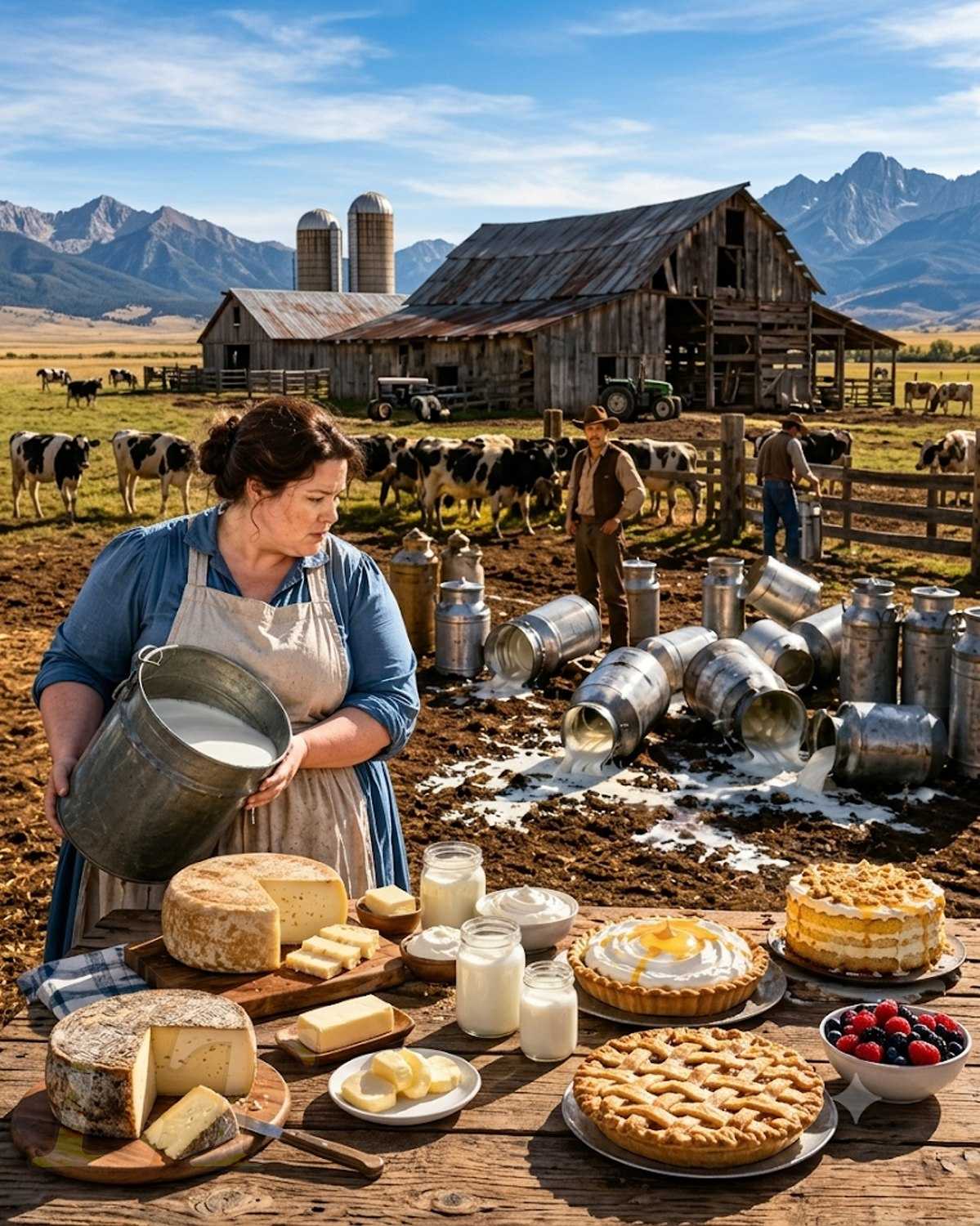
"Tell her, Walter. Tell Clara what you did to her father the night he died."
The voice came from the darkness beyond the creamery door.
Clara Bennett turned slowly.
A man stood beside the deputy, holding a folded document in one hand. His coat was torn, his face bruised, and a white bandage showed beneath his collar.
For a moment, she didn't recognize him.
Then he stepped into the lantern light.
"Henry?"
Henry Bell nodded.
Walter Pierce went completely still.
Clara stared at the young driver.
"Where have you been?"
"Trying to stay alive."
Sheriff Mercer appeared behind him.
The sheriff's expression was grim.
"Miss Bennett, Mr. Bell came to my office tonight with information concerning Thomas Bennett's death."
Clara felt the floor shift beneath her feet.
Her father.
Again.
Every answer seemed to lead back to the man she had buried.
She looked at Henry.
"What do you know?"
Henry glanced toward Walter Pierce.
"Enough to know he shouldn't be standing here demanding anything."
Walter recovered his composure.
"This is absurd. Bell is a disgruntled employee."
Henry gave a bitter laugh.
"That's what you called Samuel, too."
Marcus Holt stepped between Walter and the deputy.
"Sheriff, before anyone removes property from this building, I want this court order examined."
Mercer took the paper.
He studied the signature.
Then the date.
His expression hardened.
"Who delivered this to you, Deputy?"
The young deputy looked uncomfortable.
"A messenger from Commissioner Briggs's office."
"Did you verify it with the court clerk?"
"No, sir. It bore the court seal."
Marcus pointed to the date.
"The order was prepared before the petition was filed."
Mercer looked toward Walter.
"Mr. Pierce, did you arrange this?"
Walter straightened his coat.
"I instructed my attorney to protect my lawful interests."
"That wasn't my question."
Walter said nothing.
Mercer folded the document.
"Until the court verifies this order, nothing leaves the creamery."
The deputy stepped away from the metal box.
Walter's face darkened.
"You have no authority to interfere with a judicial order."
"I have every authority to investigate a document that may be fraudulent."
For the first time, Walter Pierce looked afraid.
Clara barely noticed.
Her eyes remained on Henry.
"What happened to my father?"
Henry lowered his head.
"I should have told you sooner."
"Then tell me now."
He took a trembling breath.
"The night before your father became ill, Mr. Pierce went to Bennett Farm."
Clara felt cold.
"Here?"
Henry nodded.
"I drove him."
Doraththa Marsh pressed a hand to her mouth.
Clara looked toward the farmhouse beyond the dark yard.
She remembered that night.
Her father had been alive.
She had been in Denver.
And Walter Pierce had come to see him.
Henry continued.
"Mr. Pierce wanted the original deed and the papers concerning Crestline Agricultural Holdings. Your father had discovered that the transportation charges were being collected against rights already belonging to the Bennett family and neighboring farms."
Walter stepped forward.
"That's a lie."
Henry turned toward him.
"I heard you threaten him."
The creamery fell silent.
Clara felt her heartbeat pounding in her ears.
"What did he say?"
Henry swallowed.
"He told your father that if he didn't surrender the deeds, he'd lose the farm. Your father refused."
Clara closed her eyes.
She could hear Thomas Bennett answering in his quiet, stubborn voice.
This land belonged to my father before me. It isn't yours to take.
Henry continued.
"They argued. Mr. Pierce struck the table. Your father stood up too quickly, and he stumbled."
Clara opened her eyes.
"Did Walter hurt him?"
Henry looked at her.
"He shoved him."
Walter's face turned red.
"I did no such thing."
Henry's voice rose.
"I saw it."
Mercer stepped closer.
"Go on."
"Thomas fell against the edge of the desk. He hit his shoulder and his head. He was conscious, but he was struggling to breathe."
Clara felt tears rising.
"What happened then?"
Henry looked down.
"I wanted to fetch Dr. Lane."
"And?"
"Mr. Pierce ordered me back to the carriage."
Clara stared.
"He left Daddy there?"
Henry nodded.
"He said Thomas was only trying to frighten him. He said we'd have trouble if anyone learned about the visit."
Walter shook his head.
"This is a monstrous invention."
Henry reached inside his coat.
He removed a small folded paper.
"Then explain why you paid me to keep quiet."
He handed the paper to Mercer.
The sheriff opened it.
It was a receipt bearing the mark of Pierce Provisions.
Beneath the amount were the words:
Special carriage service. Confidential.
And Walter Pierce's signature.
Clara looked at Walter.
"You knew he was hurt."
Walter's mouth opened.
No words came.
"You knew my father needed help."
"Your father was ill already," Walter said sharply. "Everyone knew that."
Clara stepped toward him.
"And you used that as an excuse to leave him alone."
Walter looked away.
Henry's voice broke.
"I came back after taking Mr. Pierce home. But your father had already been helped to bed by Mrs. Marsh. I was afraid to tell her what I'd seen."
Doraththa covered her face.
Clara looked at the older woman.
"You found him?"
Doraththa nodded through tears.
"He told me he'd fallen. He wouldn't say more."
Clara remembered her father's final days.
His exhaustion.
His headaches.
The way he had tried to dismiss every question.
She turned toward the sheriff.
"Did Walter kill him?"
Mercer's expression was grave.
"Miss Bennett, I won't make a finding before the evidence is examined. Dr. Lane's records show your father had a serious illness, and we cannot assume what caused his death."
Clara swallowed.
"But Walter left him injured."
"That is the allegation Mr. Bell has made, and it requires investigation."
Walter took a step backward.
Mercer looked directly at him.
"Mr. Pierce, you're coming with me."
Walter stared.
"On whose authority?"
"Mine. You're being arrested on suspicion of assault and intimidation of witnesses. The financial and court-order matters will also be investigated."
The deputy moved beside him.
Walter looked toward Clara.
His face twisted with anger.
"You think this changes anything? You still have a debt."
Clara held his gaze.
"Then we'll find out what I truly owe."
Mercer took Walter by the arm.
The man who had controlled so many farmers' lives turned toward the door.
For once, he had no carriage waiting to carry him away from the consequences.
After the sheriff left, the creamery seemed strangely quiet.
Henry sat on a wooden bench, his shoulders bowed.
Marcus examined the documents he had brought.
Clara stood beside the metal box.
She felt as though she had been holding her breath for weeks.
Doraththa approached.
"Child."
Clara turned.
The older woman embraced her.
For a moment, Clara held herself rigidly.
Then she began to cry.
Not because Walter Pierce had finally been arrested.
Not because the farm might be safe.
But because her father had been frightened and injured, and she had not been there to help him.
Doraththa held her tightly.
"He loved you," she whispered.
Clara nodded against her shoulder.
"I know."
"He never wanted you to carry his troubles."
"I wish he'd let me."
"I know, child."
When Clara finally stepped back, Marcus approached.
"There's something we should settle before morning."
She wiped her eyes.
"The deeds?"
He nodded.
"Henry brought the original recorded survey and a certified copy from the county land archive. The document Walter tried to seize is not the only evidence of ownership."
Clara looked at him.
"Does that mean his claim is false?"
"It means the claim has serious defects. The Bennett family title and the recorded access rights appear valid. Walter's petition relies on a later transfer that does not match the original land records."
Clara stared.
"A forged transfer?"
"That is what the investigators will need to determine. But the original documents are strong evidence in your favor."
She looked toward the sealed envelope.
FOR CLARA — THE FORTUNE.
Her father's handwriting.
His final gift.
Marcus followed her gaze.
"Clara, I think you should open it."
She picked up the envelope.
The wax seal was still intact.
Her hands trembled as she broke it.
Inside was a small brass key, wrapped in a piece of cloth, and a letter.
She unfolded the paper.
My dearest Clara,
If you have reached this envelope, then you have found the deeds your grandfather protected and the records I spent so long trying to understand.
There is one more thing I want you to know.
Clara took a breath.
Your grandmother never believed the value of a farm could be measured only by its acres or the price of its cows. She believed its true fortune was what a family could make from the land, and what honest neighbors could accomplish together.
When she made cheese from the milk no buyer would take, she saved us through a winter that should have ruined us.
I have tried to save enough to give you the chance to do the same.
Clara looked up.
"Save enough?"
Doraththa smiled through her tears.
"Keep reading."
Clara turned the page.
The key belongs to the small strongbox beneath the false bottom of the metal chest. Inside are the savings I put aside from the creamery's earlier years, together with the receipts for the equipment your grandmother purchased outright.
It isn't a king's fortune, but it is honestly earned. I hope it will give you a beginning.
Clara stared at the box.
Then she reached inside.
Beneath the cloth lining, her fingers found a narrow wooden panel.
She lifted it.
There was a second compartment.
Inside stood a small iron strongbox.
Clara inserted the brass key.
The lock opened.
She lifted the lid.
Inside were carefully wrapped banknotes, a packet of silver coins, and a savings certificate issued years earlier by a neighboring county bank.
Marcus leaned forward.
Clara counted the money slowly.
Then she counted it again.
Her eyes widened.
It was enough to cover several months of wages, purchase needed equipment, and provide working capital for the creamery.
Not enough to make her wealthy overnight.
But enough to give the farm something it had lacked for years.
Breathing room.
Clara looked at Doraththa.
"Daddy saved all this?"
The older woman nodded.
"Little by little."
Clara looked down at the money.
She had spent weeks searching for a fortune in the milk everyone had thrown away.
And her father had been saving the beginnings of that fortune for her all along.
But the most valuable thing in the box was not the money.
It was the chance to use the farm differently.
She unfolded the last page of the letter.
I do not know whether I will live to see you make this place your own.
But I know you can.
You were always the child who could look at a column of numbers and see what others missed. I hope one day you will look at this farm and see what I could not finish.
Whatever happens, Clara, never believe that you must become smaller to deserve a place in this world.
You have always been enough.
Love, Daddy.
Clara pressed the letter against her chest.
For a long time, she couldn't speak.
Then she looked toward the old cheese press.
Her grandmother had saved the farm once.
Her father had protected its future as best he could.
Now it was her turn.
The following weeks changed the county.
Walter Pierce's arrest brought more witnesses forward.
Farmers who had once been afraid to speak began bringing their account books to Marcus Holt.
Daniel Foster arrived with twelve years of receipts.
Jacob Miller brought records of disputed transportation charges.
Two former employees of Pierce Provisions confirmed Samuel Voss's description of the company's accounting practices.
Henry Bell gave a sworn statement concerning Thomas Bennett's final confrontation with Walter.
Samuel provided the correspondence numbers and the locations of additional company records.
And Andrew Foster helped investigators trace transfers through Crestline Agricultural Holdings.
The inquiry was painstaking.
Every document had to be checked.
Every signature compared.
Every payment traced.
Clara learned that justice moved more slowly than anger.
But this time, it moved.
The county court invalidated the emergency order against the creamery after finding that it had not been properly authorized.
The disputed transfer of Bennett land was set aside after the original deed and survey established that the farm's title had never passed to Crestline.
Alderman Briggs was removed from his role in the agricultural complaint proceedings and later resigned his county office.
Edwin Hargrove lost his position at the bank. He cooperated with investigators and admitted that he had concealed disputed records while serving as Crestline's financial representative.
Walter Pierce was eventually convicted of fraud involving the agricultural accounts, unlawful intimidation, and offenses arising from his assault on Thomas Bennett. His sentence included imprisonment and financial restitution.
The medical evidence did not establish that the assault had caused Thomas's death. Clara accepted that the court could not give her an answer the evidence did not support.
But the truth of that final confrontation was no longer hidden.
Walter had threatened her father.
He had hurt him.
He had left without summoning help.
And he had tried to bury the evidence.
That truth mattered.
So did what followed.
A court-supervised accounting found that Bennett Dairy Farm had been charged for milk deliveries that had been accepted and sold, along with transportation fees unsupported by the actual agreements.
The eight cows taken as debt settlement had been valued improperly.
After the false charges were removed and the proceeds credited, the farm's legitimate outstanding balance was far smaller than Walter had claimed.
Restitution and the return of improperly collected funds covered the remaining amount.
The foreclosure was dismissed.
The lien was released.
And one clear morning, Marcus Holt arrived at Bennett Dairy Farm carrying a document Clara had dreamed of seeing.
He found her in the creamery.
"Clara."
She looked up from a tray of fresh cheese.
"Marcus?"
He smiled.
"I have something for you."
She wiped her hands and approached.
He handed her the paper.
She read it.
Then read it again.
Debt Satisfied. Lien Released.
Her hands began to shake.
"Is this final?"
Marcus nodded.
"The farm is yours. Free of Pierce's claim."
Clara stared at him.
Then she laughed.
A startled, disbelieving laugh.
"Mine?"
"Yours."
She covered her mouth.
Tears filled her eyes.
For weeks, she had imagined the bank taking the house.
The barns.
The cows.
The fields where her father had walked.
Now the farm belonged to her without the threat that had nearly destroyed it.
She stepped forward and embraced Marcus.
The lawyer laughed softly.
"I'll take that as approval."
Clara wiped her eyes.
"Thank you."
Marcus shook his head.
"You did the hard part."
She looked down at the document.
"No. We all did."
The creamery grew.
At first, the changes were modest.
George Tilman's standing order increased from ten pounds a week to twenty.
Then thirty.
Ruth Caldwell introduced Bennett cheese to friends who owned shops and boardinghouses.
Marta Schreiber returned to help Clara develop a firmer aged cheese that could travel farther without losing its quality.
Agnes became responsible for daily production.
Pete supervised the equipment and deliveries.
Reuben learned to manage the milk records.
Doraththa insisted on overseeing the farmhouse kitchen, though Clara suspected she also considered herself the unofficial manager of everyone's happiness.
And Clara kept the books.
Every penny.
Every pound.
Every gallon.
She calculated the cost of milk, labor, salt, cloth, fuel, and transportation.
She tracked losses.
She recorded profits.
She refused to confuse a busy business with a profitable one.
The lesson had been painful.
But it had made her careful.
The first month, the creamery earned only a modest surplus.
The second month, it earned more.
By the end of the season, Bennett Farm Creamery had become a reliable supplier to the Crestwood Hotel, three merchants, and several families in the surrounding towns.
The old stone building could no longer hold all the work.
Clara used part of her father's savings to improve the storage room and purchase additional equipment.
She kept enough in reserve to pay wages through a difficult season.
And she made one decision that surprised everyone.
She invited neighboring farmers to supply milk.
The meeting took place in the Bennett barn.
Daniel Foster arrived first.
Jacob Miller came with his brother.
Several other farmers followed.
Some looked hopeful.
Others suspicious.
They had spent years selling milk under arrangements they could not control.
Now Clara stood before them with a ledger and a simple proposal.
"I won't promise that cheese will make us rich by next Thursday," she began.
A few men laughed.
"But I can promise that you'll know what your milk is worth."
She opened the ledger.
"Every delivery will be weighed and recorded. Every price will be written down. Every deduction will be explained."
Daniel Foster raised a hand.
"And who decides what we get paid?"
Clara smiled.
"We agree on a formula before the milk is delivered."
Jacob Miller frowned.
"And if the creamery has a bad month?"
"Then you'll see the accounts."
The men exchanged glances.
Clara continued.
"I want to build a business where farmers aren't forced to choose between accepting unfair prices and throwing good milk away."
She looked toward the creamery.
"My grandmother made cheese because she couldn't bear to waste what the cows produced. My father wanted to give farmers another choice."
Her voice softened.
"I'd like to finish what they started."
For a moment, nobody spoke.
Then Daniel Foster stood.
"I'll bring twenty gallons next week."
Jacob Miller nodded.
"I'll bring fifteen."
Another farmer raised his hand.
Then another.
Clara looked around the barn.
The business she had imagined was becoming something larger than her own survival.
It was becoming a place where people could work together without surrendering their independence.
One afternoon, Elias Morgan found Clara sitting beneath the old apple tree.
She had a ledger on her lap.
Her hair had escaped its pins.
There was a streak of flour on her sleeve.
And she was frowning at a column of figures.
Elias leaned against the tree.
"You're doing it again."
Clara looked up.
"Doing what?"
"Trying to solve every problem in the county before supper."
She laughed.
"Only the ones involving milk."
He sat beside her.
"That still leaves quite a few."
Clara closed the ledger.
"How are your fields?"
"Good."
"And your horses?"
"Good."
"And your patience?"
Elias smiled.
"Being tested."
She raised an eyebrow.
"By whom?"
He looked at her.
"By a certain woman who never stops working long enough for me to ask her an important question."
Clara felt her heartbeat quicken.
"What question?"
Elias reached for her hand.
"Clara, I've loved you since before either of us knew what to call it."
She stared at him.
He smiled nervously.
"I loved the girl who used to climb the fence to watch the horses. I admired the woman who went to Denver and made a life for herself. And I've fallen in love with the woman who came home and refused to let anyone take what mattered to her."
Clara felt tears rise.
"Elias..."
He squeezed her hand.
"I don't want to rescue you. You've already proved you don't need rescuing."
She laughed through her tears.
"That's good, because I have a great deal of work."
"I know."
He smiled.
"I want to work beside you. If you'll have me."
Clara looked at him.
The man who had driven her to the Crestwood Hotel.
Who had stood beside her at the courthouse.
Who had never asked her to be quieter, smaller, or less determined.
She smiled.
"Are you asking me to marry you?"
Elias took a breath.
"Yes."
Clara laughed.
Then she leaned forward and kissed him.
When she drew back, his eyes were shining.
"Was that a yes?"
She smiled.
"That was a yes."
They married the following spring.
The ceremony took place beneath the apple trees at Bennett Dairy Farm.
Doraththa cried before the vows even began.
Agnes helped Clara dress.
Pete and Reuben decorated the yard with ribbons.
Marta Schreiber brought a wheel of cheese so beautiful that George Tilman declared it ought to be displayed rather than eaten.
Ruth Caldwell disagreed.
"Good cheese is meant to be enjoyed," she announced.
Everyone laughed.
Clara wore a simple cream-colored dress made to fit her comfortably and beautifully.
She did not try to hide her broad shoulders or soften the generous curves of her body.
For years, people had treated her size as though it told them something about her worth.
Walter Pierce had used it to mock her.
Others had underestimated her because she did not resemble the delicate women in fashionable magazines.
But Clara had learned that dignity did not depend on taking up less space.
She walked toward Elias with her head high.
He looked at her as though she were the loveliest woman he had ever seen.
When they exchanged vows, Clara's voice trembled only once.
It happened when she looked toward the empty chair beside Doraththa.
The chair they had placed there for Thomas Bennett.
She wished her father could have seen this day.
Then Elias took her hand.
And she knew he would have been happy.
By the following autumn, Bennett Farm Creamery had become one of the county's most respected small businesses.
Its products were known for their quality.
Its records were open to the farmers who supplied it.
Its workers were paid fairly.
And its success had encouraged others to reconsider how they sold their milk.
The fortune Clara discovered was no longer hidden in a box.
It was in the steady wages Pete carried home to Agnes and their children.
It was in the new roof Daniel Foster could afford.
It was in the dairy farmers who no longer had to pour good milk into the dirt because one buyer refused to pay a fair price.
It was in the cheese delivered to the Crestwood Hotel.
In the butter sold at the Saturday market.
In the clean, busy creamery where milk that had once been wasted became something valuable.
And it was in the farm itself.
Fourteen cows had become eighteen.
The barns were repaired.
The pastures were healthy.
The farmhouse roof no longer leaked.
Clara still kept her father's blue ledger.
But now it rested on a shelf beside a new set of books.
Books filled with honest figures.
Real earnings.
Fair payments.
And plans for the future.
One evening, after the last delivery wagon had departed, Clara walked to the old stone creamery.
Elias followed.
The sun was setting over the fields.
Inside, the shelves held rows of carefully labeled cheese.
The air smelled faintly of warm milk and clean stone.
Clara stood beside the old press.
She touched the wooden handle.
Elias watched her.
"Thinking about your grandmother?"
Clara nodded.
"And Daddy."
He stepped beside her.
She looked around.
"Do you remember the day I found this place?"
Elias smiled.
"You looked as though you'd discovered a buried kingdom."
Clara laughed.
"I thought it was a room full of broken equipment."
"And now?"
She looked at the shelves.
The records.
The tools.
The worktables.
The place where Agnes had taught Reuben to handle curds.
The place where Pete had repaired the old press.
The place where Marta had shown her how to turn uncertain milk into good cheese.
Clara smiled.
"Now I think it was a room full of possibilities."
Elias slipped an arm around her waist.
She leaned against him.
For a while, they stood in silence.
Then Clara reached into her apron pocket.
She removed her father's final letter.
The paper had been folded and unfolded so many times that the creases had softened.
She read the last lines again.
Whatever happens, Clara, never believe that you must become smaller to deserve a place in this world.
You have always been enough.
Clara smiled through her tears.
Then she folded the letter carefully.
Elias kissed her forehead.
"What are you thinking?"
She looked toward the farmhouse.
The barn.
The pastures.
The road that now carried wagons belonging to farmers who could choose their own buyers.
"I'm thinking Daddy would have liked this."
Elias nodded.
"I think he would have loved it."
Clara looked at the creamery once more.
For years, Walter Pierce had treated Bennett Dairy Farm as something he would eventually own.
He had counted its debts.
Measured its fields.
Calculated the value of its cows.
And waited for the day he could take it.
But he had never understood the thing that made the farm valuable.
Not the land alone.
Not the buildings.
Not even the money.
It was the people who refused to abandon it.
The knowledge passed from one generation to another.
The courage to begin again.
And the simple belief that honest work deserved an honest reward.
Clara took Elias's hand.
Together, they walked toward the farmhouse.
Doraththa was calling everyone to supper.
Laughter floated from the kitchen.
Pete's children were playing beneath the apple trees.
Agnes stood on the porch, waving them inside.
The last sunlight rested on the roof of the old creamery.
Clara paused at the gate.
She looked back across the farm her father had loved.
The farm her grandmother had saved.
The farm she had nearly lost.
And the farm that would now belong to her family for generations to come.
She smiled.
"Come on," she said softly. "We've got a good life waiting for us."
Elias squeezed her hand.
And together, they went home.






Comments 0