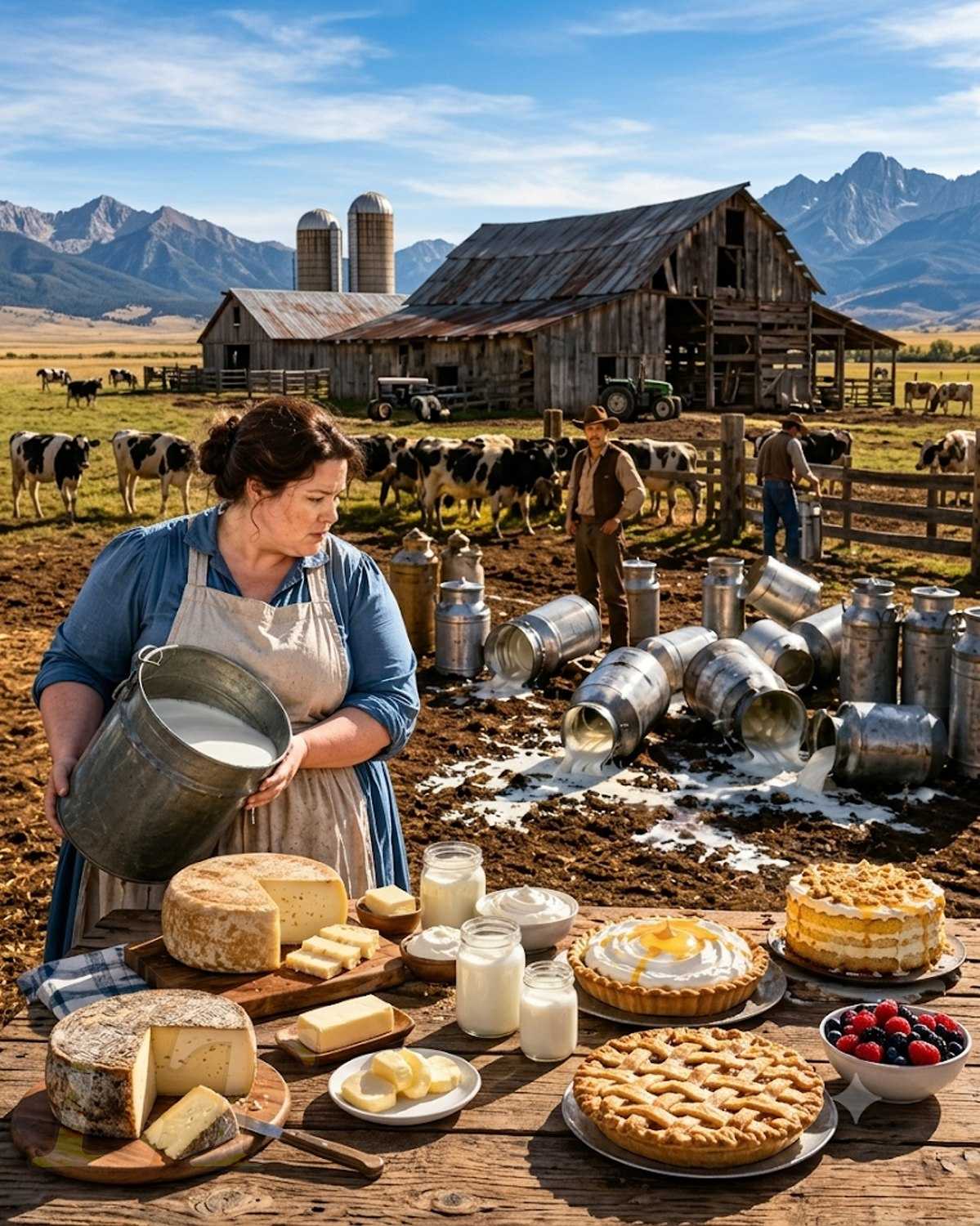
"Nobody touches my milk until I see that order!"
Clara Bennett's voice cut across the farmyard.
The stranger holding the black leather case stopped halfway toward the barn.
Walter Pierce stood beside him, wearing the satisfied expression of a man who had already decided how the morning would end.
Pete Granger remained near the farmhouse steps, staring at the official-looking document.
Reuben had come running from the milking shed.
And Clara stood between the two visitors and the fourteen cows that represented nearly everything her father had left her.
"Miss Bennett," the stranger said, "I suggest you cooperate."
"Then I suggest you tell me who you are."
He straightened his coat.
"Arthur Whitcomb. Assistant agricultural inspector for the county."
Clara extended her hand.
"Your identification, please."
Whitcomb hesitated.
Walter gave an impatient sigh.
"Clara, must you argue about everything?"
"Only the things that concern my property."
Whitcomb removed a small identification card from his pocket.
Clara examined it.
Then she looked at the paper in his other hand.
"You said this order came from the county authorities."
"It did."
"And you said no dairy products could leave my farm."
"Until further notice."
"On what grounds?"
Whitcomb glanced toward Walter.
Clara noticed.
"Mr. Whitcomb," she said, "I'm asking you."
The inspector cleared his throat.
"A complaint was received concerning improper handling and storage of dairy products."
"Who filed the complaint?"
"That information is not necessarily relevant."
"It is to me."
Walter stepped forward.
"Your father had difficulties maintaining standards toward the end."
Clara turned toward him.
"My father is not here to answer accusations. I am."
Whitcomb unfolded the document.
"Miss Bennett, this is a precautionary measure."
Clara examined the paper.
At the top was a county office heading.
Beneath it was a request for inspection.
But the document was not what Whitcomb had claimed.
It did not authorize an immediate seizure.
It did not establish that contamination had occurred.
And it did not prohibit all dairy products from leaving the farm.
It was a notice requesting an investigation.
Nothing more.
Clara looked at the date.
Three days before her return.
Her father had already been buried.
She looked up slowly.
"Who submitted this complaint?"
Whitcomb shifted his weight.
"Mr. Pierce brought the matter to our attention."
Walter's expression hardened.
Clara nodded.
"I see."
She held the paper toward the inspector.
"Then perhaps you can explain why you announced a prohibition that isn't written anywhere in this document."
Whitcomb took the paper back.
For several seconds, he said nothing.
Walter broke the silence.
"The county has every right to investigate."
"Of course it does," Clara replied. "And I'll cooperate with a lawful inspection."
She stepped aside.
"But you will not shut down my farm because Mr. Pierce says you should."
Pete looked at Reuben.
Reuben looked at the inspector.
Whitcomb's ears reddened.
"I'll need to examine the storage facilities."
"Then follow me."
Clara turned toward the barn.
Walter started after them.
She stopped.
"Mr. Pierce."
He raised an eyebrow.
"What?"
"This is an inspection of my farm. You're not the inspector."
His mouth tightened.
"I have a financial interest in the property."
"Then you can wait outside."
For a moment, Clara thought he might refuse.
But Whitcomb was already walking toward the barn.
Walter remained near the carriage.
And Clara led the inspection herself.
Arthur Whitcomb spent nearly two hours examining the dairy operation.
He checked the milk containers.
The cleaning procedures.
The storage area.
The condition of the barn.
He asked questions about the herd, the milking schedule, and the handling of surplus milk.
Clara answered every question.
When she didn't know something, she asked Pete or Reuben.
She did not pretend the farm was in perfect condition.
The barn needed repairs.
Some old containers had been removed from use.
The creamery equipment was being restored.
But the working milk containers were clean, the animals were being monitored, and the farm was taking steps to improve its operations.
Whitcomb made notes.
At one point, he stopped beside the old cream separator.
"Is this being used commercially?"
"Not yet," Clara said.
"Why not?"
"Because we're still testing our processing methods and replacing equipment that doesn't meet our standards."
He looked surprised.
"You understand that processed dairy products require proper handling."
"Yes."
"And that improper cheese production can cause serious illness."
"Yes."
Whitcomb studied her.
"Most farmers become defensive when I ask questions like these."
Clara folded her hands.
"I'd rather you find a problem before a customer does."
The inspector looked at her for a moment.
Then he returned to his notes.
By the time they reached the farmhouse, Walter was pacing beside his carriage.
"Well?" he demanded.
Whitcomb closed his notebook.
"I found conditions requiring improvement, but nothing supporting an immediate blanket prohibition on the farm's milk shipments."
Walter stared at him.
"What?"
"The complaint warrants documentation and follow-up. It does not justify the action you suggested."
Clara remained silent.
Walter stepped closer.
"Are you saying the farm is operating properly?"
"I'm saying I haven't found grounds to stop its existing lawful deliveries."
Walter's face darkened.
Whitcomb continued.
"I will provide Miss Bennett with written recommendations. Any new commercial processing will need to meet the applicable requirements."
Clara nodded.
"Thank you."
Walter looked at her.
Then at the inspector.
"This isn't finished."
Clara met his eyes.
"No, Mr. Pierce. I don't believe it is."
The next morning, Clara went to town with Marcus Holt.
She carried the inspection notice, her father's ledger, and the bank's revised deadline.
Marcus read the documents carefully.
Then he looked up.
"Pierce is becoming impatient."
Clara sat across from him.
"He tried to stop the farm from shipping milk."
"And failed."
"This time."
Marcus nodded.
"That's what concerns me."
Clara looked toward the window.
Outside, townspeople moved between shops and wagons.
Life continued as though nothing unusual were happening.
But Clara knew Walter Pierce had influence.
He bought milk from farmers throughout the county.
He supplied businesses.
He knew bank officials.
He had relationships with men who could make life difficult for anyone who challenged him.
And now he knew Clara wasn't going to surrender quietly.
"What can we do?" she asked.
Marcus folded his hands.
"First, we make sure the farm complies with every requirement. Second, we challenge any unsupported financial claims. Third, we document everything Pierce does."
Clara nodded.
"And the bank?"
"I spoke with Mr. Hargrove."
She leaned forward.
"What did he say?"
"The bank is willing to review your reconstructed accounts before taking further action."
"Does that mean the deadline is restored?"
"For now, yes. You still have seven days from the original notice to present a credible repayment plan."
Clara exhaled.
It wasn't victory.
But it was time.
And time was the one thing she needed most.
Marcus looked at her.
"Tell me about the creamery."
Clara hesitated.
Then she explained the old cellar, her grandmother's recipes, the repaired equipment, and the first successful cheese batches.
Marcus listened closely.
When she finished, he leaned back.
"You're trying to create a second business."
"I'm trying to make the farm profitable."
"By selling processed products instead of raw milk?"
"By selling the surplus. Pierce will receive every gallon the contract requires."
Marcus nodded.
"I reviewed the agreement again. Nothing in it prohibits that."
Clara felt relief.
"But," Marcus added, "you'll need proper documentation for commercial sales."
"I know."
"And you must keep the creamery's finances separate enough to show exactly what you're producing and selling."
Clara almost smiled.
"That part I can do."
Marcus studied her.
"Your father would have been proud."
Clara looked down at her hands.
"I hope so."
When Clara returned to the farm, Agnes Granger was waiting in the kitchen.
She had brought a basket of clean cloths and a notebook filled with recipes.
Pete's wife was a sturdy woman in her late thirties, with practical hands and a manner that left little room for nonsense.
"I hear you're serious about making cheese," Agnes said.
Clara placed her bag on the table.
"Very serious."
"Then we need to talk."
Clara pulled out a chair.
Agnes opened her notebook.
"My mother made butter and fresh cheese for half the county when I was a girl. She wasn't rich, but she knew how to keep customers."
Clara leaned forward.
"I'm listening."
Agnes pointed to a page.
"People don't buy the same thing every week. Some want fresh cheese. Some want aged. Some want butter. Some want cream for baking."
Clara nodded.
"Different products. Different customers."
"Exactly."
Agnes turned another page.
"And if you promise something, you deliver it."
Clara smiled.
"That sounds familiar."
Agnes looked at her.
"Your grandmother?"
"Yes."
"Smart woman."
Clara opened her own notebook.
Together, they began planning.
They would start small.
They would focus on products they could make consistently and safely.
They would use only properly handled milk.
They would keep detailed records of each batch.
And they would not sell anything until Clara was satisfied with the quality.
Pete entered carrying a repaired metal fitting.
"Press is ready."
Clara looked up.
"Really?"
"Replaced the damaged bolt and reinforced the frame. It should hold."
Agnes examined it.
"Then let's see what it can do."
The first full day of organized creamery work began before sunrise.
Clara had barely slept.
She had spent the previous evening reviewing recipes and calculating production costs.
Now she stood in the cellar with Agnes, Doraththa, and Reuben.
The stone walls held the cool morning air.
Clean wooden shelves lined the room.
Fresh cloths hung ready for use.
A large pot stood near the heating area.
Clara checked her notebook.
"We start with a small batch."
Agnes nodded.
"Better to make ten pounds properly than fifty pounds badly."
Reuben grinned.
"That sounds like something Miss Clara would say."
Clara looked at him.
"Then perhaps you're finally listening."
He laughed.
The work began.
They measured the milk.
Checked its condition.
Prepared the equipment.
And followed the process with deliberate care.
Clara recorded temperatures and times.
Agnes watched the curds.
Doraththa prepared the cloths.
Reuben carried supplies and cleaned equipment between tasks.
There was no rushing.
No guessing.
No shortcuts.
When something looked wrong, they stopped and checked it.
When a measurement differed from the recipe, Clara wrote it down.
By midday, the cellar smelled of warm milk and fresh curds.
Agnes lifted a small portion.
"Look at that."
Clara leaned closer.
The texture was firmer than their earlier attempts.
More even.
More promising.
They transferred the curds carefully.
Then came pressing.
The old wooden frame creaked.
Pete watched from the doorway.
"She's holding."
Clara looked at the press.
"Let's hope she keeps holding."
Hours passed.
Outside, the cows moved through the pasture.
The afternoon sun warmed the barn roof.
Inside the cellar, the first properly organized batch slowly took shape.
By evening, they had produced several small cheese wheels.
Clara examined them carefully.
They were not perfect.
But they were consistent.
And consistency was something she could build a business around.
Agnes wiped her hands.
"Well?"
Clara looked at the wheels.
Then at the notebook.
"We're getting closer."
Three days later, Clara received a reply from Marta Schreiber.
The letter arrived in a plain envelope with careful handwriting.
Clara opened it at the kitchen table.
Marta remembered her.
She remembered Thomas Bennett.
And she remembered the old creamery.
The letter was direct.
Marta praised Clara's decision to keep detailed records but warned that traditional recipes had to be adapted carefully to modern sanitation practices.
She included corrections to the process, advice about temperature control, and suggestions for improving the texture of the cheese.
She also offered to visit the farm if Clara could arrange transportation.
Clara read the letter twice.
Then she handed it to Agnes.
Agnes smiled.
"She sounds like a woman who knows what she's doing."
"She does."
"Can we get her here?"
Clara looked at the cost of travel.
It would take money she could barely spare.
But a serious mistake could cost far more.
"Yes," she said. "We'll find a way."
She wrote back immediately.
Then she returned to the cellar.
The latest batch was ready for inspection.
Agnes had been watching it closely.
Clara cut a small section.
The texture was smooth.
The aroma was clean.
The flavor was rich without being overpowering.
She tasted it.
Then she looked at Agnes.
"This is better."
Agnes nodded.
"Much better."
Doraththa took a small piece.
She closed her eyes.
For a moment, she looked almost young again.
"Your grandmother would have recognized this."
Clara felt a tightness in her throat.
She looked toward the old photograph on the shelf.
Her grandmother stood beside the original creamery, surrounded by cheese wheels.
Clara had spent years believing that part of her family's history was gone.
Now it was beginning again.
The next challenge was money.
Clara spread her calculations across the kitchen table.
The numbers were encouraging, but they were not enough.
Not yet.
The farm needed regular customers.
Without sales, the cheese would simply become another product sitting on shelves.
She needed buyers who valued quality.
Buyers who paid fairly.
Buyers who weren't controlled by Walter Pierce.
That evening, Elias Morgan arrived.
He brought a small sack of feed as a gift and asked how the creamery was progressing.
Clara showed him the latest cheese.
Elias examined it.
"Looks good."
"Looks aren't enough."
He smiled.
"May I taste it?"
Clara cut a small piece from a batch she had set aside for household sampling.
Elias tasted it.
He chewed slowly.
Then he looked at her.
"Clara."
She waited.
"This is very good."
She tried not to look too pleased.
"You're being kind."
"No. I'm being serious."
He took another small piece.
"My mother used to make cheese like this. People traveled from three counties to buy it."
Clara looked down at the wheel.
"Do you think a hotel would be interested?"
Elias nodded.
"I told you about George Tilman."
"The kitchen manager at the Crestwood."
"That's right."
Clara hesitated.
"I don't want to approach him until we can guarantee consistent quality."
Elias studied her.
"That's sensible."
She looked surprised.
"Most people tell me I'm being too cautious."
"Most people aren't responsible for feeding paying customers."
Clara smiled.
Elias continued.
"Tilman doesn't care about fancy packaging. He cares about taste, reliability, and whether you can deliver what you promise."
Clara nodded slowly.
"Then perhaps I should meet him."
Elias smiled.
"I can arrange it."
The following morning, Clara called a meeting in the barn.
Pete.
Agnes.
Reuben.
Doraththa.
Everyone who had helped keep the farm alive.
She stood beside the wooden worktable.
Several cheese wheels rested on clean boards.
Small portions of butter sat in covered containers.
A few jars of cream stood nearby.
Clara opened her notebook.
"I want to show you something."
Pete leaned against a post.
Reuben folded his arms.
Agnes stood beside the table.
Doraththa watched quietly.
Clara pointed to the first column.
"This is what we receive when we sell raw milk."
Then she pointed to the second.
"This is what we may receive when we turn the surplus into products people are willing to pay more for."
Pete frowned.
"That's a big difference."
"It is."
Reuben leaned closer.
"Are those real prices?"
"Prices we need to test with buyers. Not guaranteed sales."
Agnes nodded approvingly.
Clara continued.
"We still have expenses. Labor. Fuel. Salt. Supplies. Transportation. Equipment. Spoilage. And we need to account for all of them."
She turned the page.
"But if we can produce consistently and find reliable customers, the surplus milk may become profitable."
Pete stared at the figures.
"You're saying the milk we've been throwing away could pay our wages?"
Clara looked at him.
"Eventually, yes. If we do this properly."
Reuben shook his head.
"All those years..."
Clara understood.
All those years of wasted milk.
All those years of struggling to find buyers.
All those years of accepting low prices because they believed there was no alternative.
She looked toward the barn.
Her father had worked himself to exhaustion trying to keep the farm alive.
And the answer might have been sitting in the cellar all along.
Agnes placed a hand on the table.
"Then we make the best cheese in the county."
Pete smiled.
Reuben grinned.
Doraththa wiped her eyes.
Clara looked at them.
"We start by making cheese good enough that people come back for more."
By the end of the week, the creamery had a routine.
Morning milking.
Careful separation of milk intended for Pierce's contract.
Fresh processing of the surplus.
Cleaning.
Recordkeeping.
Inspection of finished products.
Storage.
And constant attention to quality.
Clara worked harder than she had ever worked in Denver.
Her feet ached.
Her back hurt.
Her hands were rough.
But she had a purpose.
The farm was no longer simply trying to survive another day.
It was preparing to sell something new.
Marta Schreiber arrived on a Saturday morning.
She was a strong woman in her sixties with silver hair and sharp blue eyes.
Clara hurried down the farmhouse steps.
"Marta!"
The older woman opened her arms.
"Clara Bennett. Let me look at you."
Clara laughed as Marta embraced her.
"You haven't changed."
Marta stepped back.
"Nonsense. I've gotten older, and you've gotten wiser. I hope."
Clara smiled.
"I need your help."
"Then show me what you've been doing."
They went directly to the cellar.
Marta inspected everything.
The shelves.
The press.
The cleaning procedures.
The milk records.
The cheese wheels.
She asked questions.
Many questions.
Clara answered them all.
Then Marta tasted the latest batch.
She said nothing.
Clara waited.
Agnes stood beside her.
Pete watched from the doorway.
Marta took another small piece.
Then she looked at Clara.
"This is promising."
Clara exhaled.
"But?"
Marta raised one finger.
"The texture needs improvement. The aging conditions must be more consistent. And your records need to identify every batch clearly."
Clara nodded.
"I can do that."
Marta smiled.
"I know you can."
For the next two days, Marta worked beside them.
She corrected techniques.
Improved their handling procedures.
Helped establish more reliable aging conditions.
And taught Agnes and Reuben how to recognize problems before they became serious.
Clara recorded everything.
By the time Marta prepared to leave, the creamery had improved dramatically.
The latest fresh cheese was firm, clean, and flavorful.
The butter had a rich golden color.
The cream was carefully handled and stored.
Marta examined the finished products.
Then she looked at Clara.
"Now you have something worth showing a buyer."
Clara felt her heart lift.
"Really?"
Marta nodded.
"Yes. But remember, Clara. A customer may forgive a small mistake once. They rarely forgive carelessness twice."
Clara smiled.
"I won't forget."
Two days later, Elias Morgan returned with news.
George Tilman had agreed to meet Clara.
The kitchen manager at the Crestwood Hotel was willing to taste her cheese.
But there was a condition.
He wanted a sample of the fresh variety and the aged variety.
And he wanted to know whether she could supply ten pounds every week.
Clara listened carefully.
"Ten pounds?"
Elias nodded.
"To start."
She looked toward the cellar.
They had enough finished fresh cheese for a sample.
The aged variety was still developing.
She didn't want to rush it.
"When does he want to meet?"
"Next Thursday."
Clara calculated quickly.
That gave her time to prepare.
Time to inspect the products.
Time to make sure the samples represented what she could consistently produce.
She nodded.
"I'll be there."
Elias smiled.
"Good."
Then his expression became serious.
"There's something else."
Clara looked at him.
"What?"
"I heard Pierce has been asking questions about you."
She sighed.
"That's hardly surprising."
"Not just about the farm."
Clara frowned.
"What do you mean?"
"He's been asking whether you've applied for credit. Whether you're buying equipment. Whether anyone has offered to help you expand."
Clara felt a cold sensation in her stomach.
"Who told you?"
"A man I trust."
"Did Pierce say why?"
Elias shook his head.
"No. But I thought you should know."
Clara looked toward the barn.
Walter Pierce had already tried to frighten her into selling.
He had attempted to use the county inspection process against her.
He had pressured the bank.
And now he was investigating her plans.
She understood what that meant.
He was beginning to see the creamery as a threat.
"Thank you for telling me," she said.
Elias nodded.
"Be careful, Clara."
She looked at him.
"I will."
That evening, Clara sat alone in the kitchen.
The farm was quiet.
Doraththa had gone to bed.
Pete and Agnes had returned home.
Reuben was finishing the last chores.
Clara opened her notebook.
She reviewed the production figures.
The costs.
The possible selling prices.
The hotel meeting.
Then she took out her father's letter.
She read the final lines again.
Your grandmother saved this farm once.
Not by selling more milk.
By making something better from what we already had.
Clara looked toward the window.
Beyond the glass, the barn stood beneath the fading light.
She thought of the milk that had once been poured into the dirt.
Thirty or forty gallons a week.
Sometimes more.
Milk that had seemed worthless because nobody wanted to buy it quickly enough.
Now it was becoming cheese.
Butter.
Cream.
Products that could be stored, transported, and sold to customers willing to pay for quality.
She opened a fresh page.
At the top, she wrote:
BENNETT FARM CREAMERY
Then she began listing potential customers.
Crestwood Hotel.
Local grocers.
Market customers.
Ranching families.
Households in neighboring towns.
She paused.
For the first time, she wasn't writing down what the farm owed.
She was writing down what it might earn.
A soft knock came at the kitchen door.
Clara looked up.
"Come in."
Reuben entered.
His face was pale.
"Miss Clara?"
She put down her pencil.
"What is it?"
"There's a man outside."
"Who?"
"I don't know."
Clara stood.
"What does he want?"
Reuben swallowed.
"He said he used to work for Pierce Provisions."
Clara felt her heartbeat quicken.
"Did he give his name?"
"Yes."
She waited.
"Henry Bell."
Clara remembered the young driver who had accompanied Samuel Voss to the cellar.
"Why is he here?"
Reuben looked toward the door.
"He said he has something you need to see."
Clara moved past him.
Outside, the farmyard was dark.
A single lantern burned near the gate.
Henry Bell stood beside a wagon.
He looked nervous.
When Clara approached, he removed his hat.
"Miss Bennett."
"Mr. Bell."
He glanced toward the road.
"I shouldn't be here."
"Then why are you?"
Henry swallowed.
"Because I heard what Mr. Pierce is planning."
Clara remained still.
"What is he planning?"
Henry looked at the farmhouse.
Then at the barn.
Then he reached into his coat.
"I took something from the office."
He pulled out a folded paper.
Clara recognized the letterhead.
Pierce Provisions.
Henry held it toward her.
"Mr. Pierce sent this to the Crestwood Hotel."
Clara felt her stomach tighten.
"To George Tilman?"
Henry nodded.
"What does it say?"
He didn't answer.
Instead, he handed her the letter.
Clara unfolded it beneath the lantern.
The first paragraph contained a warning about Bennett Dairy Farm.
The second questioned the safety of its products.
The third urged the hotel to avoid purchasing anything from Clara until an investigation could be completed.
Clara stared at the page.
Walter Pierce was trying to destroy her first potential customer before she had even made a sale.
She looked up.
"How did you get this?"
Henry's hands trembled.
"I was supposed to deliver it tomorrow."
"Why didn't you?"
He looked toward the road again.
"Because there's something else."
Clara waited.
Henry reached into his coat a second time.
This time, he removed a small envelope.
It was sealed.
And on the front, written in Walter Pierce's handwriting, were three words.
FOR ALDERMAN BRIGGS
Clara felt a sudden chill.
She had heard the name before.
Alderman Briggs was a county commissioner.
A man with influence over local business matters.
And, according to rumors, a frequent dinner guest of Walter Pierce.
Henry looked directly at her.
"Miss Bennett, I wasn't supposed to see what's inside."
Clara held out her hand.
Henry hesitated.
Then he gave her the envelope.
She examined the seal.
It had already been broken.
Someone had opened it before.
"Henry," she said quietly, "what did you see?"
His face turned white.
Before he could answer, a carriage lantern appeared on the road.
Henry grabbed Clara's arm.
"He's here."
Clara turned.
A dark carriage was approaching the gate.
Fast.
Henry stepped backward.
"Miss Bennett, you need to hide that envelope."
The carriage stopped.
A door opened.
A man climbed down.
He wore a long black coat and carried a leather briefcase.
Clara recognized him from town.
Alderman Briggs.
The commissioner looked toward Henry.
Then toward the envelope in Clara's hand.
His expression changed.
He stepped forward.
"Miss Bennett," he said, "I believe you have something that belongs to me."
Clara didn't move.
Briggs reached into his briefcase.
He removed a folded document.
Then he looked directly at her.
"And before you decide whether to return it, there's something you should know about your appointment at the Crestwood Hotel..."






Comments 0